What Affects Your Pet Insurance Premium?
Your pet insurance premium is set by two groups of factors: things you can't change — your dog's breed, age, and your ZIP code — and things you can — the deductible, reimbursement percentage, annual limit, and any add-ons you choose. The unchangeable factors decide the neighborhood your quote lives in (anywhere from roughly $25 to $100+ per month for a dog); the plan levers decide the exact house. Renewal increases from aging and vet-cost inflation then push that number up a little every year for life. This guide walks through each factor and how hard it moves the needle. To see how a premium fits into your dog's total yearly budget, run the free dog cost calculator first — it takes about a minute.

What Actually Sets a Pet Insurance Premium?
Insurers price one thing: the expected cost of your dog's future vet bills, plus margin. Every factor below is a proxy for that expectation. A quote is the insurer's answer to "how much will this specific dog, in this specific place, on this specific plan, probably cost us per year?"
Here's the full factor list at a glance, ranked roughly by how hard each one moves the price:
| Factor | Can you control it? | Typical impact on premium |
|---|---|---|
| Breed | No (after you have the dog) | Large — high-risk breeds can quote 2–3× a low-risk mix |
| Age at enrollment (and every year after) | Only by enrolling early | Large — premiums often double or triple from puppy to senior |
| ZIP code | Not realistically | Moderate–large — 30–50% gaps between cheap and expensive metros |
| Deductible | Yes | Large — the biggest lever you control |
| Reimbursement percentage | Yes | Moderate — each tier (70/80/90%) shifts the price |
| Annual limit | Yes | Moderate — unlimited plans cost meaningfully more than $5,000 caps |
| Add-ons (wellness, exam fees, etc.) | Yes | Small–moderate — usually $10–$25/month each |
| Vet-cost inflation | No | Steady — pushes renewals up a few percent yearly, everywhere |
| Spay/neuter status, multi-pet discounts | Somewhat | Small — usually single-digit percentage tweaks |
The rest of this guide takes these one at a time, starting with the ones baked into your dog.
How Much Does Breed Matter?
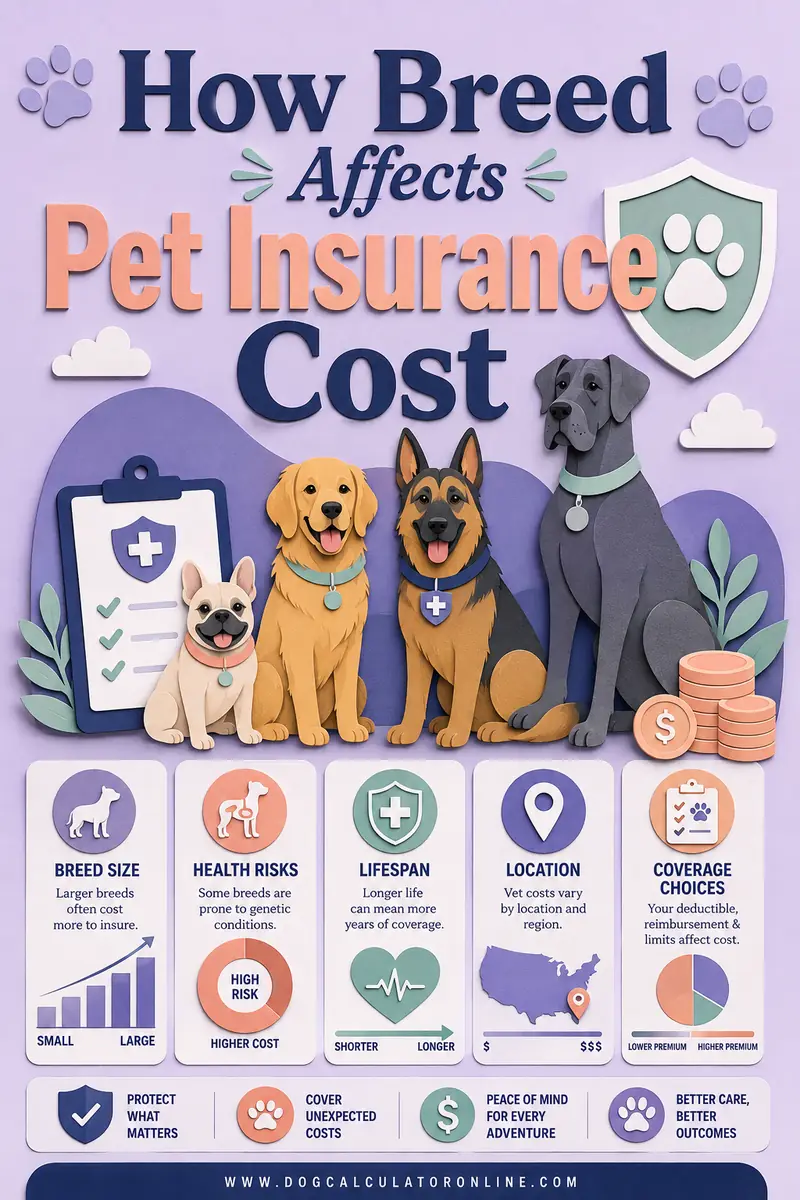
A lot — breed is often the single biggest fixed factor. Insurers have decades of claims data by breed, and they price what the data shows: some breeds simply generate more, and more expensive, claims.
The expensive-to-insure profile usually involves one or more of these:
- Flat-faced (brachycephalic) breeds — French Bulldogs, English Bulldogs, Pugs — carry airway, skin, spine, and eye risks, and often need cesarean deliveries. They routinely sit at the top of premium charts.
- Giant breeds — Great Danes, Mastiffs, Bernese Mountain Dogs — cost more per procedure (bigger doses, bigger everything), face bloat risk, and have shorter lifespans with earlier orthopedic and cardiac issues.
- Popular purebreds with known hereditary conditions — German Shepherds (hips), Golden Retrievers and Labs (joints, and well-documented cancer rates in Goldens), Cavaliers (heart), Dobermans (heart).
- Mixed breeds generally quote cheaper — hybrid genetics dilute single-breed hereditary risks, and the claims data reflects it.
The gap is not subtle: a French Bulldog can quote two to three times what a similar-sized mixed breed does in the same ZIP code, on the same plan. If you're comparing quotes and wondering why your neighbor pays half what you do, breed is the usual answer. Our cost by breed guide goes deeper on which breeds sit where and why.
One nuance worth knowing: you can't shop your way out of breed pricing. Every insurer uses breed data, and a breed that's expensive at one company is expensive at all of them. What varies is how much each insurer weights it — which is a reason to compare quotes, not a reason to expect a bargain.
Why Does Age Raise the Price Every Year?
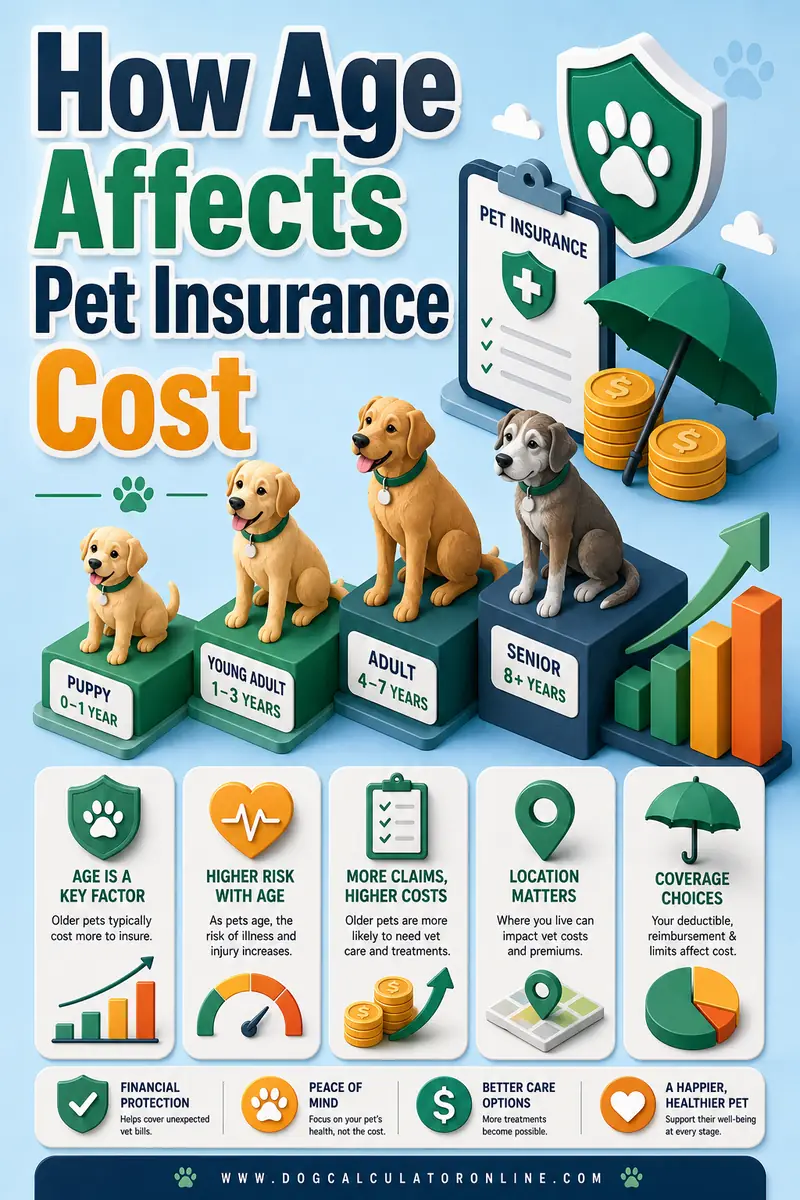
Because risk rises every year, and insurers reprice annually to match. Age works on your premium twice:
At enrollment. A quote for an eight-week-old puppy is the cheapest that dog will ever see — often $30–$50/month for accident-and-illness coverage. The same dog quoted fresh at age six starts meaningfully higher, and quoted at age ten may start at double or more, with some insurers declining new enrollments for senior dogs entirely.
At every renewal. This is the part that surprises people. Your premium doesn't lock in at the enrollment rate; it's recalculated each year using your dog's new age. The increases are usually gentle through young adulthood — a few dollars a month — then steepen from around age seven as claims data turns against older dogs. A dog enrolled at $35/month as a puppy commonly renews at $80–$100+/month by age eight or nine. That's not a penalty or a response to your claims; it's the age curve doing what it always does.
The practical takeaway cuts one way: age is the strongest argument for enrolling early. You can't stop the curve, but enrolling young means starting at its bottom, with no pre-existing conditions excluded. The full breakdown by life stage is in our cost by age guide — worth a read if you're deciding when to start, and budget for the senior-years number, not the puppy number, when you decide whether a policy is sustainable long-term.
Why Does Your ZIP Code Change the Quote?
Because the insurer isn't insuring your dog against illness — it's insuring itself against your local vets' invoices. Veterinary prices vary enormously by region: an emergency-clinic visit that bills $800 in a small Midwestern town can bill $2,000 in Manhattan or San Francisco. Rent, staff wages, and the density of specialty and 24-hour hospitals all feed local pricing, and premiums track it directly.
The result: the same dog, same breed, same plan can cost 30–50% more to insure in a major coastal metro than in a lower-cost region. High-cost states and cities — much of California, the New York metro area, and other dense urban markets — consistently quote above the national ranges you see in articles like this one.
Two honest notes here. First, you obviously shouldn't move for a pet insurance quote — but if you are relocating to a pricier city, expect the renewal to reflect it, because premiums update with your address. Second, high-vet-cost areas are also where insurance arguably earns its keep fastest: the same forces inflating your premium inflate the $6,000 surgery you're insuring against. Expensive-city owners weighing a policy against a dedicated savings account should run that comparison with local prices, not national averages.
How Do Deductible, Reimbursement, and Annual Limit Change the Price?
These three are the levers you actually control, and together they can swing the same dog's premium by 40% or more. Each one is a trade between what you pay monthly and what you pay on claim day.
The deductible
The deductible is what you pay out of pocket before reimbursement starts — typically offered at $100 to $1,000, usually per year. It's your biggest lever: moving from a $250 to a $750 deductible commonly cuts the premium by 20–30%. Higher deductibles suit owners with cash on hand who want catastrophe protection at the lowest monthly cost; lower deductibles suit those who want the policy to kick in on mid-sized bills too. The mechanics — including annual versus per-incident structures, which matter more than most people realize — are in our deductible guide.
The reimbursement percentage
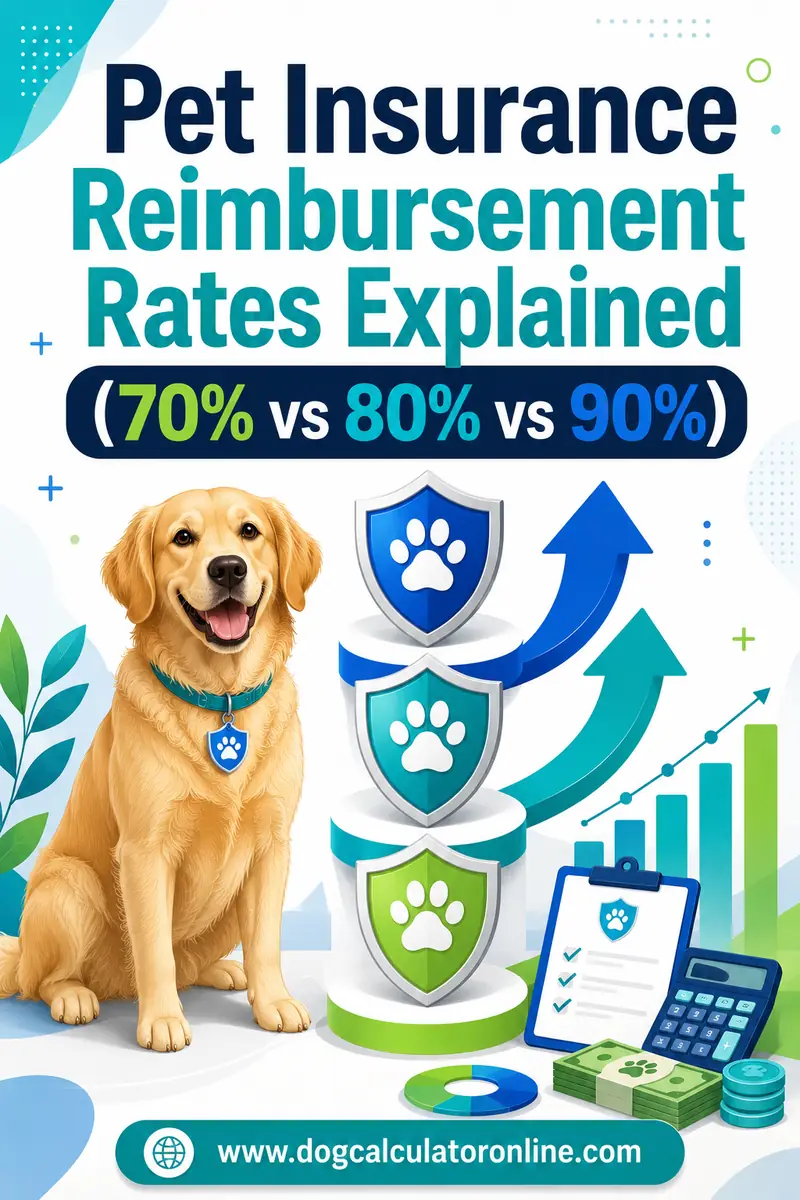
After the deductible, the insurer pays a set percentage of covered costs — usually 70%, 80%, or 90%. Each step up raises the premium, because the insurer is committing to a bigger share of every future claim. On a $5,000 bill after deductible, the gap between 70% and 90% is $1,000 back in your pocket, so this lever changes real claim-day outcomes, not just the monthly price. The 80% tier is the common middle ground. Full worked examples live in the reimbursement guide.
The annual limit
The annual limit caps what the insurer will pay out in total each policy year — common options run from $5,000 to unlimited. Lower caps trim the premium; unlimited coverage costs meaningfully more. The catch is that a cap only matters in the exact scenario insurance exists for: the catastrophic year. A $5,000 limit disappears fast against an emergency surgery plus complications, which is why cap-shopping purely for premium savings can quietly defeat the point of the policy. How limits interact with the other two levers is covered in our annual limit guide.
The general strategy most budget-conscious owners land on: high deductible, high reimbursement, high (or no) limit. That combination keeps the monthly cost down while preserving the policy's real job — capping your worst-case year.
What Do Add-Ons Do to the Price?
Add-ons bolt extra coverage onto the base accident-and-illness plan, each for an extra monthly charge:
- Wellness/routine care riders ($10–$25/month) reimburse predictable costs — vaccines, annual exams, sometimes dental cleanings. Because these costs are predictable, the rider is essentially prepayment with a fee attached; the math only works if you'd use nearly every covered item every year.
- Exam fee coverage adds the vet's consultation charge (often $50–$150 per sick visit) to what's reimbursable. Cheap, and one of the more defensible add-ons for dogs who visit often.
- Rehab, acupuncture, and alternative therapy riders matter mainly for orthopedic-prone breeds where post-surgery physio is likely.
None of these transform the premium the way the big three levers do, but $20 of riders on a $50 base plan is a 40% increase — worth a deliberate yes or no, not a default checkbox.
A handful of smaller factors round out the quote, each usually worth single-digit percentages rather than dramatic swings. Spayed and neutered dogs sometimes quote slightly lower, since altering removes certain reproductive-health claims and is loosely associated with fewer roaming injuries. Multi-pet discounts commonly knock 5–10% off each additional pet's policy. Paying annually instead of monthly often trims a small processing margin, and some insurers offer discounts through employers or for military families. Sex generally matters little for dogs, and microchipping occasionally earns a token discount. Stack every small factor perfectly and you might save the cost of one add-on rider — worth collecting, not worth choosing a plan over.
Why Does the Premium Go Up Even If You Never Claim?
Because the two background factors never stop moving. Your dog gets a year older at every renewal — that's the age curve from earlier — and veterinary costs themselves rise steadily. New diagnostics, new treatments, corporate consolidation of clinics, and higher staffing costs have pushed vet prices up faster than general inflation in many recent years, and premiums are repriced against those local costs.
Stack the two and a typical policy rises at most renewals even with zero claims filed. A useful mental model: expect single-digit percentage increases in the young years, larger jumps in the senior years, and treat any flat renewal as a pleasant surprise.
What you can do about it, without losing coverage: raise the deductible at renewal, drop unused add-ons, or step the reimbursement down a tier. What you generally shouldn't do is cancel and re-shop every couple of years — every condition in your dog's chart becomes pre-existing to the new insurer, so serial switching trades small premium savings for permanently shrinking coverage.
How Can You Lower Your Premium Without Gutting the Coverage?
A short, honest checklist:
- Enroll young. The single most effective move, and it only works once.
- Raise the deductible to the highest number you could genuinely pay tomorrow.
- Keep reimbursement and limits strong. Cut monthly cost with the deductible, not the ceiling — the ceiling is the product.
- Audit add-ons yearly. Wellness riders especially: total what you'd actually claim and compare it to the rider's annual cost.
- Ask about discounts. Multi-pet, annual-pay, and employer or military discounts are common and worth a few percent each.
- Compare quotes before enrolling, not after. Insurers weight factors differently, so the cheapest company for a Lab in Texas isn't the cheapest for a Frenchie in Boston. Shop hard once, then stay put.
Frequently Asked Questions
What factors affect pet insurance premiums the most?
Breed, age, and location set the baseline — a high-risk breed or an older dog in an expensive city can quote two to three times the national ranges. Among factors you control, the deductible moves the price most, followed by reimbursement percentage and annual limit.
Why is my pet insurance quote so much higher than average?
Usually one of three reasons: a breed with documented hereditary risks (flat-faced and giant breeds especially), an older dog, or a high-vet-cost ZIP code. Averages you see online — roughly $40–$70/month for adult dogs — blend all breeds, ages, and regions, so individual quotes land well above or below them.
Does pet insurance go up every year?
Usually, yes. Premiums are recalculated at renewal using your dog's new age and current local vet costs, so most policies rise even with no claims filed. Increases tend to be small in young adulthood and steeper after roughly age seven.
Do claims raise my pet insurance premium?
Most US pet insurers price renewals on age, breed, location, and overall vet-cost trends rather than your individual claims, so a single claim doesn't typically trigger a personal surcharge. Check your policy documents, though — practices vary, and state rules differ.
How can I lower my pet insurance premium?
Raise the deductible to what you could comfortably pay in cash, drop add-ons you don't use, and ask about multi-pet or annual-pay discounts. Avoid cutting the annual limit or reimbursement too far — that saves monthly dollars by weakening exactly the catastrophic protection you're buying.
Is a cheaper premium with a low annual limit worth it?
Rarely, if the limit is very low. A $2,500–$5,000 cap can be exhausted by a single emergency surgery, leaving you uncovered for the rest of the year. Most owners get better value trimming the premium with a higher deductible while keeping a high or unlimited annual cap.
The Bottom Line
Your premium is your dog's risk profile with a price tag: breed, age, and ZIP code set the range, your deductible, reimbursement, and limit choices set the final number, and age plus vet inflation nudge it upward every year after. Control what you can — enroll early, lever the deductible, keep the ceiling high — and budget for the senior-year premium, not just today's. To see the whole picture, premium included, alongside food, routine care, and everything else, run your numbers through the free dog cost calculator.