How Age Affects Pet Insurance Cost
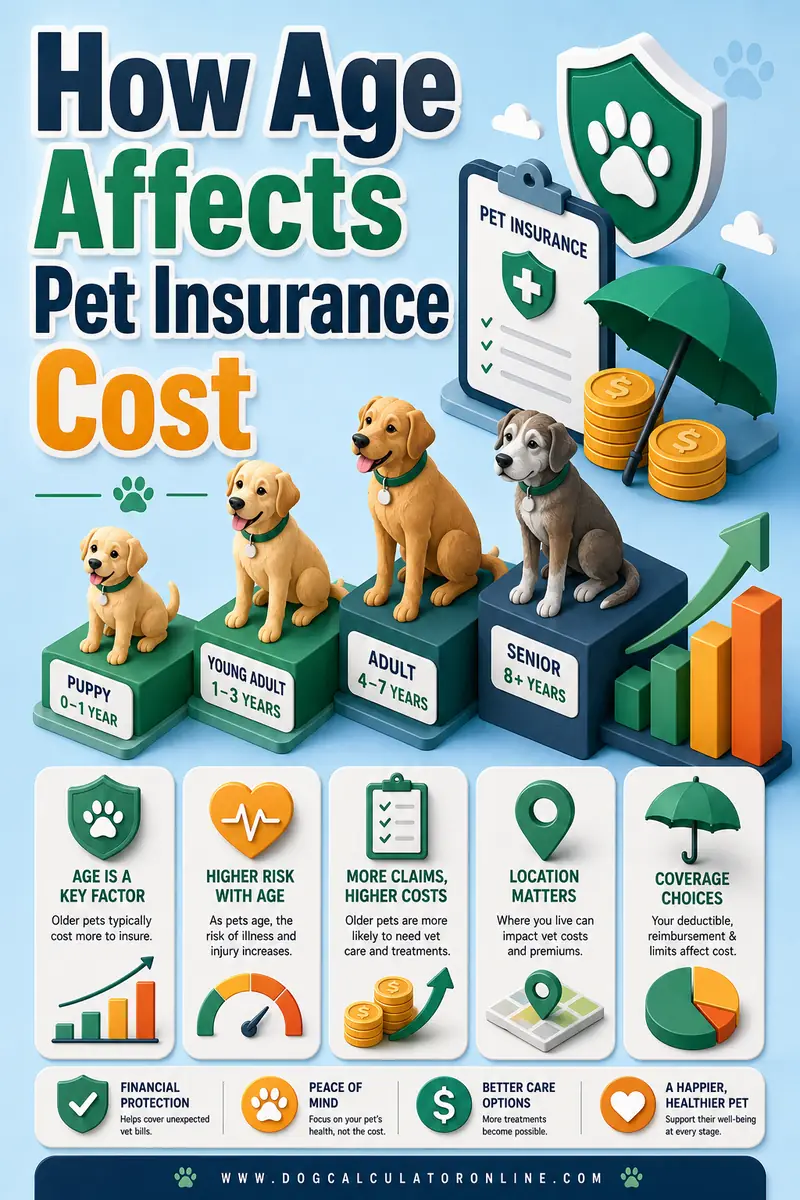
Age is the single strongest driver of pet insurance cost: the same accident-and-illness plan that quotes $30–$50 a month for a puppy typically runs $45–$75 for a middle-aged dog and $80–$150+ for a senior — and the premium keeps rising at every renewal, no matter when you enrolled. Insurers price age this directly because claims climb with it: older dogs see the vet more, for more expensive things. The good news is that the curve is predictable, which means you can plan for it — and the free dog cost calculator helps you see how a rising premium fits into your dog's whole yearly budget at any life stage.
How Much Does Pet Insurance Cost at Each Age?
For a medium-sized, mixed-breed dog on a typical US accident-and-illness plan ($500 deductible, 80% reimbursement), the age curve looks roughly like this:
| Dog's age | Typical monthly premium | What's happening |
|---|---|---|
| Under 1 (puppy) | $30–$50 | Lifetime low; empty medical chart |
| 1–4 (young adult) | $35–$60 | Gentle annual increases |
| 5–7 (middle age) | $45–$75 | Curve steepens; first chronic conditions appear breed-wide |
| 8–10 (senior) | $70–$110 | Steep climb; claims frequency rises sharply |
| 11+ (geriatric) | $90–$150+ | Highest premiums; some insurers no longer accept new enrollments |
Read the table with the usual honesty caveats. Breed shifts every row — a French Bulldog or Great Dane sits above these bands at every age, a small mix below them, and breed pricing has its own guide. Location shifts every row too, because premiums track local vet prices. And plan settings can move any number by a third in either direction. What holds everywhere is the shape: a slow rise through young adulthood, then a knee in the curve somewhere in middle age, then steep climbs through the senior years.
One more wrinkle: the curve runs on your dog's biological age more than the calendar. Large breeds age faster and hit the steep section around age 6–7, while small dogs may cruise to 9 or 10 first — that's the same size-adjusted aging the AVMA describes, and it's exactly what the dog age calculator estimates for your dog's size.
Why Do Premiums Rise With Age?
Because claims do, and premiums are claims with overhead. An insurer's actuarial tables tell a simple story: as dogs age, they visit the vet more often, the visits cost more, and the problems become chronic rather than one-off.
A puppy's claims are mostly accidents — swallowed objects, fractures, the occasional infection. Dramatic, but usually single events with single bills. A senior dog's claims look different: arthritis that needs management every month for years, dental disease under anesthesia, kidney and liver values that need recurring bloodwork, heart conditions, lumps that need investigating, and cancer — the largest claim category of all, commonly $5,000–$15,000 to diagnose and treat. None of this is pessimism; it's the ordinary arc of a dog's life showing up in billing codes.
Two forces stack on top of each other in your renewal letter:
- Age repricing. Each year your dog moves up the actuarial table, and the premium moves with it. This happens even if you've never filed a claim — you're being priced with every dog your dog's age, not on your personal history. Most pet insurers don't raise your individual rate for filing claims; the age-and-inflation escalator does the work.
- Veterinary inflation. Vet costs have risen faster than general inflation for years — new diagnostics, new treatments, higher staffing costs — and insurers pass that through to everyone, puppies included.
Put together, a 10–20% annual renewal increase in the senior years is common, and it's why the table above isn't a flat line with a bump — it's a curve that compounds.
One instructive contrast: accident-only policies age far more gently. A ten-year-old dog isn't much more likely to swallow a sock than a three-year-old, so accident-only premiums stay comparatively flat across life — often $15–$35 a month at any age. The steep age curve belongs almost entirely to illness coverage, because illness is what accumulates with years. That's worth knowing, but read it carefully: the flat price reflects the narrow protection, and illness is precisely what senior dogs claim for most.
Does Enrolling Young Lock In a Low Price?
No — and this is the most misunderstood thing in age-based pricing. Enrolling your puppy at $35 a month does not freeze $35. The premium reprices upward at every renewal as your dog ages, and by the senior years it will be senior-priced regardless of when you started.
So what does enrolling young get you? Something more valuable than a price lock: coverage lock. A dog enrolled at 10 weeks with a clean chart has every future condition coverable for life, as long as the policy stays continuous. The allergy at three, the cruciate tear at six, the cancer at ten — all covered, because none of them existed at enrollment. A dog first insured at eight brings eight years of medical history to the table, and everything in that history is excluded.
That's the real economics of the age curve. You can't avoid paying senior premiums for a senior dog; you can only decide whether those premiums buy full coverage (enrolled young, chart was clean) or partial coverage (enrolled late, chart already full). The mechanics of what counts as pre-existing — including cure clauses and bilateral conditions — are in our pre-existing conditions guide.
This is also why serial switching between insurers to chase lower quotes is a trap for older dogs: every switch resets waiting periods and re-runs the pre-existing screen against an ever-longer chart. The quote may be lower; the coverage almost certainly is too.
What Does the Lifetime Premium Actually Add Up To?
Seeing the whole curve at once puts the monthly numbers in perspective. Take a medium-sized dog enrolled as a puppy and insured continuously through a 13-year life, using the midpoints of the ranges above: roughly $40 a month through the puppy and young-adult years, $60 through middle age, $90 through the senior years, and $110+ in the geriatric stretch. Summed honestly, that's somewhere in the neighborhood of $9,000–$14,000 in lifetime premiums — more for large or high-risk breeds, less for a small mix in a cheap state.
Is that a lot? It depends entirely on what the policy ends up absorbing. One cruciate surgery at age six ($4,000) plus a cancer diagnosis at eleven ($8,000) and the policy has roughly paid for itself, with every smaller claim along the way as margin. A dog that lives a charmed life and never files a major claim leaves you $10,000 lighter — which is the deal with all insurance, and why a well-funded savings account is the legitimate alternative for owners who can truly build one.
Two things the lifetime view makes obvious. First, the senior years contain most of the cost and most of the value — canceling at age nine, after a decade of cheap premiums, exits right before the years the policy was priced to cover. Second, trying to save money by delaying enrollment a few years saves less than it appears: you skip the cheapest premiums of the curve and pay for the skipped years with permanent exclusions instead.
Is There a Maximum Age to Enroll a Dog?
Often, yes — and it's the sharpest edge on the whole age question. Many insurers cap new accident-and-illness enrollments somewhere between age 10 and 14, and a few cap earlier for giant breeds that age fastest. Past the cap, those companies will typically still sell you accident-only coverage — swallowed objects, injuries, toxin ingestion — but not illness coverage, which is what a senior dog is most likely to need.
The details vary by company, and some insurers advertise no upper age limit at all. But the practical takeaway is universal: the option to buy full coverage expires before your dog does. If you're on the fence with a 9-year-old, the fence has a gate that's closing.
Equally important is the other side of the rule: once enrolled, virtually all policies renew for life. Insurers don't cancel you for getting old or for filing claims; the deal is that you keep paying age-adjusted premiums and they keep covering new conditions. That guarantee-to-renew is a real asset for an aging dog, and it's another reason continuous coverage from a young age beats any strategy involving gaps.
What Should You Do at Each Life Stage?
The right move depends on where your dog is on the curve today.
- Puppy (8 weeks–1 year): The golden window. Premiums at their lifetime low, chart empty, waiting periods cleared before adolescence. If you're going to insure this dog at any point in its life, enrolling now gets the most coverage per dollar — the complete argument is in is pet insurance worth it for a puppy.
- Young adult (1–4): Still an excellent time. Quotes remain modest and most dogs' charts are still short. Check the chart honestly, though: any condition already noted will be excluded, so enroll before the list grows rather than after.
- Middle age (5–7): The last comfortable window, and the moment of truth for large breeds, which are entering their senior phase already — see large-breed insurance costs for why their clock runs faster. Premiums are noticeably higher but illness coverage is still fully available, and enrolling now still beats enrolling at nine.
- Senior (8+): Genuinely a judgment call. Premiums are high, existing conditions are excluded, and enrollment caps loom — but a healthy senior with a short chart can still get real value, since the biggest claims (cancer, organ disease) often haven't appeared yet. We weigh both sides honestly in is pet insurance worth it for an older dog — and remember that "senior" itself varies a lot by size, arriving around seven for big dogs and closer to ten for small ones.
Alternatives shift with age too. For a puppy, a savings account's weakness is the early gap before it's funded. For a senior with excluded conditions, the calculus can flip: money that would buy a policy full of exclusions may protect you better as a dedicated emergency fund. There's no one right answer — only an honest match between the chart, the quotes, and your finances.
How Do You Budget for the Rising Curve?
Since the increases are predictable, plan for them instead of being ambushed at renewal:
- Budget the curve, not the quote. If your three-year-old costs $50 a month today, pencil in $70–$90 by age eight and north of $100 in the geriatric years. A policy you can only afford at today's price is a policy you'll cancel exactly when it's about to pay off.
- Absorb increases with the deductible, not by canceling. At renewal, raising the deductible from $250 to $500, or trimming reimbursement from 90% to 80%, can offset much of an age increase while keeping coverage continuous — and continuity is what protects the pre-existing lock-in you've paid years to build.
- Never let a policy lapse in the senior years. A missed payment that cancels an old dog's policy can be catastrophic: re-enrollment means new waiting periods, a fresh pre-existing review of a long chart, and possibly an enrollment age cap. Autopay is cheap insurance for your insurance.
- Re-shop carefully, if at all. Switching insurers to save $15 a month makes sense for a two-year-old with a clean chart and little to lose. For a nine-year-old, the new insurer's pre-existing screen will almost always cost more in lost coverage than the discount returns.
Frequently Asked Questions
How much does pet insurance cost for a senior dog?
Typically $80–$150+ per month for accident-and-illness coverage on a dog aged eight or older, depending on breed, location, and plan settings — large and flat-faced breeds sit at the high end. Accident-only policies for seniors run much less, often $15–$35, but skip the illness coverage older dogs most often need.
Does pet insurance go up every year even if I never claim?
Usually, yes. Premiums reprice at renewal for two reasons that have nothing to do with your claims: your dog is a year older on the actuarial tables, and veterinary costs inflate. Most pet insurers don't penalize individual claim history — the age-and-inflation escalator drives the increases.
At what age can you no longer get pet insurance?
Many insurers cap new accident-and-illness enrollments between ages 10 and 14, sometimes earlier for giant breeds, though some companies have no upper limit. Accident-only coverage usually remains available at any age. Once a dog is enrolled, policies renew for life regardless of age.
Is pet insurance cheaper if you start when your dog is a puppy?
The starting premium is the lowest your dog will ever be quoted — commonly $30–$50 a month — but it doesn't freeze there; it rises at every renewal like everyone else's. The lasting advantage of starting young is coverage: nothing is pre-existing yet, so every condition that develops later remains claimable for life.
Should I bother insuring a 10-year-old dog?
It can still make sense if the dog is healthy, the chart is short, and a $5,000+ bill would genuinely hurt — cancer and organ-disease claims typically arrive in exactly these years. It makes less sense if major conditions are already diagnosed and excluded, in which case a dedicated savings fund may serve you better. Compare real quotes against the chart before deciding.
What age counts as senior for insurance pricing?
There's no single industry line — premiums climb continuously rather than jumping at a birthday. Practically, the steep part of the curve starts around age 7–8 for most dogs, earlier for large and giant breeds that age faster, and enrollment caps begin appearing around age 10. Veterinarians draw similar size-based lines for senior care.
Wherever your dog sits on the curve today, the numbers are knowable. Check your dog's biological age with the free dog age calculator, then run premiums, food, and vet care through the dog cost calculator — a rising premium is much easier to plan for when you can see the whole budget it lives in.