Pet Insurance Cost Factors for Large-Breed Dogs
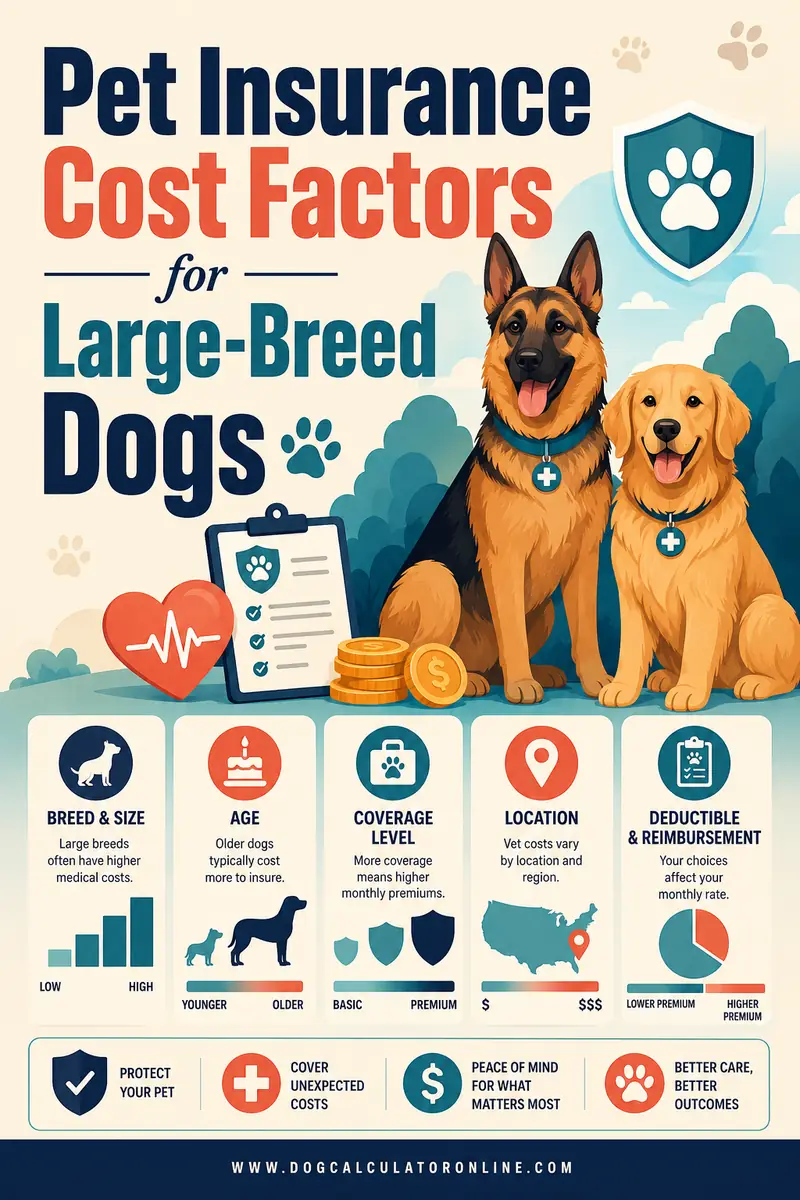
Insurance for large breed dogs typically runs $50–$90 per month for accident-and-illness coverage in the US — noticeably above the $40–$70 band most medium-sized dogs quote — and the gap comes from three things insurers can see in their claims data: concentrated orthopedic risk, expensive size-scaled emergencies like bloat, and faster aging that moves big dogs into senior pricing years earlier than small ones. None of that makes coverage a bad deal for a big dog; in many ways it makes the case stronger, because the bills insurance exists to absorb are exactly the bills large breeds tend to generate. Before you weigh any policy, it helps to see the whole picture — the free dog cost calculator shows how insurance fits into a budget that runs bigger across the board when the dog does.
How Much Does Insurance for a Large-Breed Dog Cost?
For a young, healthy large-breed dog in a mid-cost US area, accident-and-illness coverage typically quotes between $50 and $90 per month. For context, NAPHIA — the industry association that tracks pet insurance in North America — has published average accident-and-illness premiums for dogs in the mid-$50s per month range in recent years, and large breeds reliably sit above that average.
Here's roughly how the popular large breeds tend to land. Treat these as illustrative bands, not quotes — your zip code, your dog's exact age, and your deductible and reimbursement choices all move the number:
| Breed (young adult, accident + illness) | Typical monthly range |
|---|---|
| Large mixed breed (50–90 lbs) | $45–$70 |
| Labrador Retriever / Golden Retriever | $50–$80 |
| German Shepherd | $55–$85 |
| Rottweiler / Doberman | $60–$95 |
| Great Dane, Mastiff, other giants | $65–$100+ |
Two patterns are worth noticing. First, mixed-breed large dogs usually quote a bit lower than purebreds of the same size, because insurers can't pin a specific hereditary condition list on them. Second, the giants form their own tier — a Great Dane isn't just "large" to an actuary, it's a different risk category with its own shortened lifespan and its own emergency profile. If you want the broader context of what any dog costs to insure per month, our monthly pet insurance cost guide covers the full range from Chihuahua to Newfoundland.
Location stacks on top of all of this. The same Labrador can quote $55 in a low-cost state and $85 in an expensive metro, because premiums track local veterinary prices, and vet prices track local everything-else prices.
Why Do Insurers Charge More for Big Dogs?
The short answer: because big dogs cost vets more to treat, and they need treatment more often for a specific set of expensive conditions. It isn't a judgment about your dog — it's claims math, applied to hundreds of thousands of policies.
Everything is dosed and priced by weight
A surprising amount of veterinary medicine scales with the animal. Anesthesia is dosed by weight. Many medications are dosed by weight, so a course of antibiotics or a month of arthritis medication for a 120-pound Mastiff can cost several times what the same prescription costs for a 12-pound terrier. Hospitalization often costs more for large dogs because they need bigger kennels, more staff to move safely, and more of everything consumable — fluids, bandaging, food. Even routine dental cleanings can run higher because anesthesia time and drug volume rise with mass. When an insurer looks at the average claim for a 90-pound dog versus a 20-pound dog, the same diagnosis simply produces a bigger check.
Orthopedic risk is concentrated in large breeds
Hip dysplasia, elbow dysplasia, and cranial cruciate ligament (CCL) tears — the dog version of a torn ACL — all show up disproportionately in large and giant breeds. That's partly genetics and partly physics: more weight moving at speed puts more load on developing joints. These aren't cheap problems. Cruciate surgery commonly runs $3,000–$6,000 per knee, and dogs that tear one cruciate ligament frequently tear the other within a couple of years. Total hip replacement can exceed $6,000 per hip. Orthopedic claims are a big enough category that many policies treat them specially, with longer waiting periods — more on that below.
The emergency profile is scarier
Gastric dilatation-volvulus (GDV), commonly called bloat, is the classic example: the stomach fills with gas and twists, cutting off blood flow. It overwhelmingly affects large, deep-chested breeds — Great Danes, Standard Poodles, German Shepherds, Weimaraners — and it's fatal within hours without emergency surgery that typically costs $3,000–$8,000. Large breeds are also overrepresented in some cancers, notably osteosarcoma (bone cancer), where treatment involving amputation and chemotherapy can pass $10,000. An actuary pricing a Great Dane policy knows these possibilities exist in a way they simply don't for a Maltese.
How Does Faster Aging Change the Premium Curve?
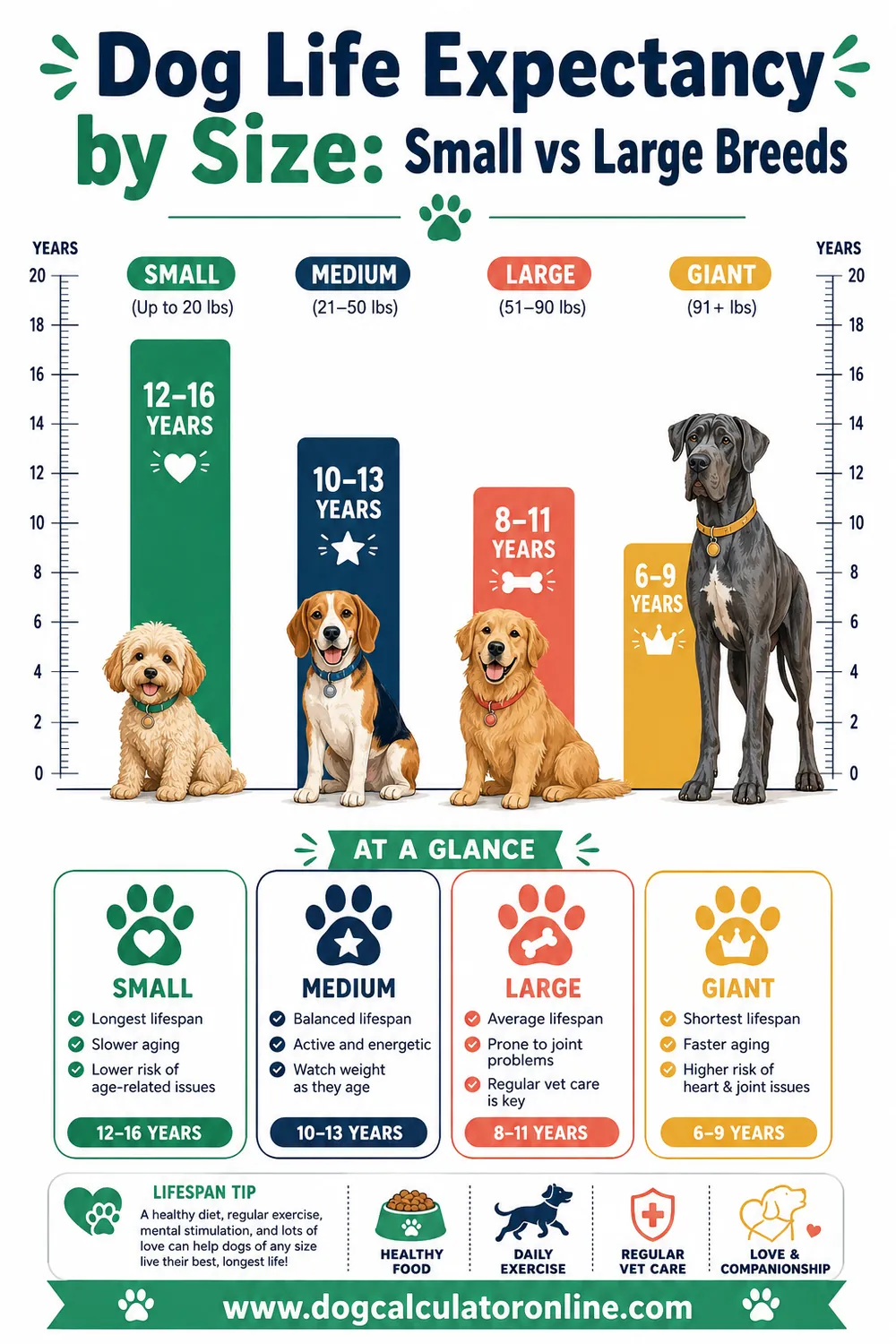
Size and lifespan run in opposite directions in dogs: the bigger the breed, the shorter the expected life. Giant breeds often live 7–10 years, large breeds 10–12, while small dogs regularly reach 14–16. The AVMA's size-adjusted view of aging reflects the same reality — a large dog is functionally "senior" around age 6–7, while a small dog may not hit that stage until 10 or 11. Our guide to dog life expectancy by size covers why this pattern exists.
For insurance, this changes the shape of the cost curve in three ways:
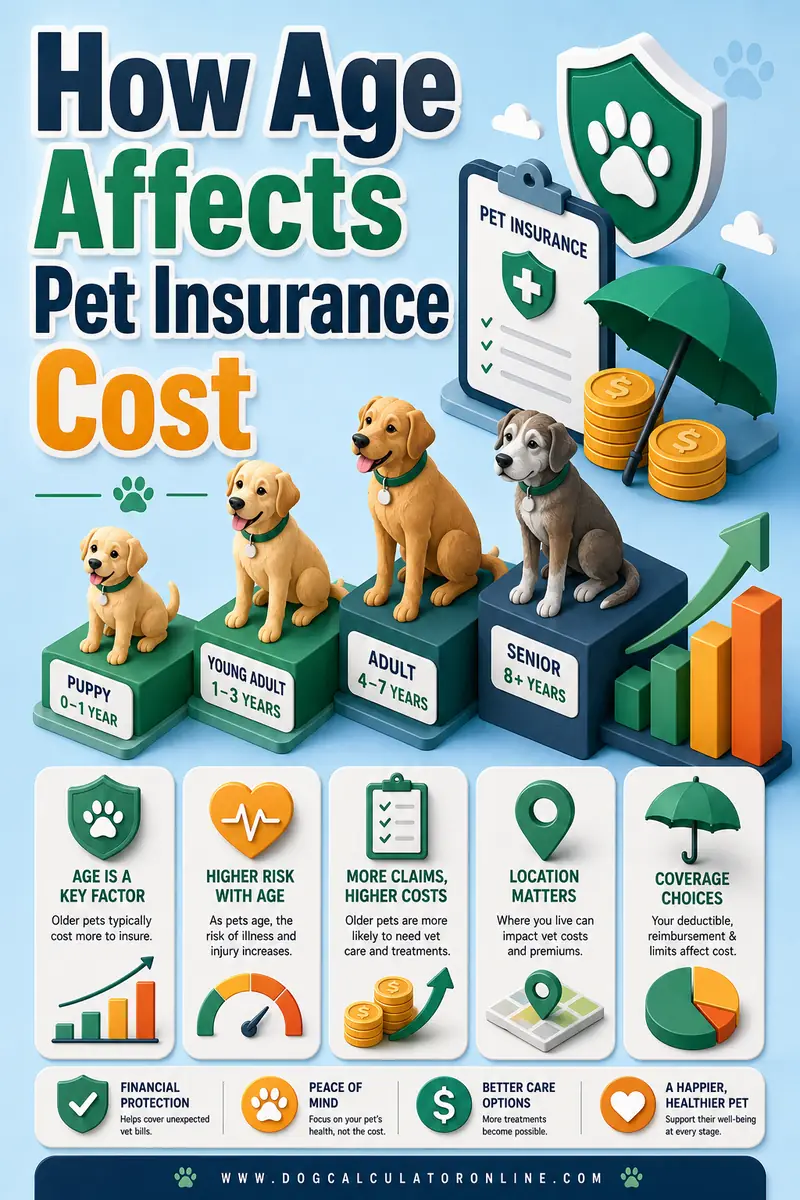
- The steep years arrive sooner. Premiums climb with age for every dog, but a Bernese Mountain Dog hits the sharp part of the curve at an age when a Yorkie's premium is still ambling upward. If you insure a large breed at age five, you're much closer to the expensive years than the calendar suggests.
- The enrollment window is effectively shorter. The value of enrolling before anything is diagnosed applies to all dogs, but large breeds develop their signature conditions — joint disease especially — earlier in life. Waiting until age four to insure a German Shepherd means gambling that the hips stay quiet until then.
- Lifetime premium totals can be lower than you'd fear. Here's the honest flip side: because large dogs live fewer years, the total amount you pay over a lifetime of coverage may end up comparable to a small dog's — fewer years of premiums, at higher monthly rates. The math isn't automatically worse; it's compressed.
How age itself moves the number — for dogs of every size — is a big enough topic that we cover it separately in how age affects pet insurance cost.
Which Conditions Drive Large-Breed Claims?
If you want to understand a large-breed premium, look at what the policies end up paying for. These are the classic large-dog claims and their honest US cost ranges:
| Condition | Why large breeds | Typical US cost |
|---|---|---|
| CCL (cruciate) tear | Weight and force on the knee; strong breed predisposition | $3,000–$6,000 per knee |
| Hip dysplasia | Hereditary in many large lines; worsened by rapid growth | $1,500–$7,000 (management to full replacement) |
| Bloat (GDV) | Deep-chested conformation | $3,000–$8,000 emergency surgery |
| Elbow dysplasia | Developmental joint disease of fast-growing breeds | $2,000–$4,500 |
| Osteosarcoma | Documented predisposition in large/giant breeds | $5,000–$10,000+ with treatment |
| Chronic arthritis | Follows joint disease and sheer loading over years | $500–$2,000 per year ongoing |
Two policy details matter enormously for this list. First, orthopedic waiting periods: many insurers impose a six-month wait before covering cruciate and hip conditions, though some will shorten or waive it if a vet examines the joints early in the policy — worth doing for any large breed, as our waiting period explainer lays out. Second, bilateral condition clauses: if your dog tore the left cruciate before enrollment, many policies will treat a later right-knee tear as related to a pre-existing condition and exclude it. For a breed where both knees are at risk, enrolling before the first tear is the whole game.
What Plan Settings Matter Most for a Big Dog?
Plan configuration matters more for large breeds than for almost any other kind of dog, because single claims can be enormous:
- Annual limit: go high or unlimited. A $5,000 annual cap sounds generous until one TPLO surgery consumes it in an afternoon. For a large breed, a $10,000+ limit — or an unlimited option if the premium difference is tolerable — is the setting that actually protects you in the scenarios you're buying insurance for.
- Reimbursement: 80% is the workhorse. At large-breed bill sizes, the gap between 70% and 90% reimbursement is real money. On an $8,000 bloat surgery, 70% leaves you paying $2,400 plus deductible; 90% leaves $800. Pick the highest tier that keeps the monthly premium inside your budget.
- Deductible: annual beats per-condition for this size class. Large breeds are prone to chronic, recurring problems — arthritis, skin issues in some lines — and an annual deductible means you clear it once per year no matter how many conditions pile up. Per-condition deductibles can multiply your out-of-pocket in exactly the years you need help.
- Skip the wellness add-on unless the math clearly works. Routine care is predictable; you can budget vaccines and checkups directly. The unpredictable five-figure surgery is what you can't budget, and that's the part worth paying premiums for.
How Can You Keep the Premium Manageable?
You can't make a Rottweiler price like a rat terrier, but you have more leverage than the quote screen suggests:
- Enroll young, before anything is on the chart. This is the single biggest lever. Every vet note — a limp at age two, an ear infection at three — is a potential exclusion later. Enrolling before symptoms appear means hereditary conditions like dysplasia are coverable when they show up. The full mechanics are in our pre-existing conditions guide.
- Raise the deductible rather than gutting coverage. Moving from a $250 to a $500 or $750 deductible cuts the premium meaningfully while preserving catastrophe protection. Dropping illness coverage or capping the limit low saves money by removing the protection you actually need.
- Keep your dog lean. Excess weight measurably accelerates joint disease in large breeds, and a long-running lifetime study in Labrador Retrievers found lean-fed dogs lived roughly two years longer and developed arthritis later. A lean dog files fewer orthopedic claims — and feels better, which is the point.
- Ask about multi-pet and annual-pay discounts. Many insurers trim a few percent for each; small, but it compounds over a decade.
- Compare the fine print, not just the price. For a large breed, the cheap policy with a strict bilateral clause and a six-month orthopedic wait may be far worse value than a slightly pricier one with a waiver exam option.
Is Insurance Worth It for a Large-Breed Dog?
Here's the honest framing. Insurance is a bet you make against expensive surprises, and large breeds generate more expensive surprises than almost any other category of dog: bigger bills per incident, well-documented orthopedic and emergency risks, and cancer predispositions in several popular breeds. That means the expected payout on a large-breed policy is genuinely higher — which is exactly why the premium is too.
The alternative — a dedicated savings account — has to work harder for a big dog. A fund that would comfortably absorb a small dog's worst-case bill might cover half of a Dane's bloat surgery. If you self-insure a large breed, the target needs to be $5,000–$10,000, seeded early, because the orthopedic years can start at age two, not age ten.
The strongest case for insuring a large breed: you'd struggle to produce $6,000 on a random Tuesday, your breed appears in the table above, and your dog is young enough that the chart is still clean. The weakest case: an older dog with joint disease already diagnosed — at that point the biggest risks are already excluded, and the money may serve you better in savings. Most large-dog owners live somewhere between those poles, which is why breed-by-breed context helps; our companion guide on how breed affects pet insurance cost shows where your dog sits in the wider pricing landscape.
Frequently Asked Questions
How much is pet insurance for a large-breed dog per month?
Typically $50–$90 per month for accident-and-illness coverage on a young, healthy large breed in the US, with giants like Great Danes and Mastiffs often quoting $65–$100 or more. Location, age, and plan settings can push any breed above or below these bands.
Why is insurance more expensive for large dogs?
Three reasons: treatment costs scale with body weight (anesthesia, medication, hospitalization), large breeds carry concentrated risk for expensive conditions like cruciate tears, hip dysplasia, and bloat, and they age faster, reaching the costly senior years at 6–7 rather than 10+. Insurers price all three from claims data.
Does pet insurance cover hip dysplasia in large breeds?
Most modern accident-and-illness policies cover hip dysplasia as a hereditary condition — but only if your dog was enrolled before any signs appeared. Many insurers also apply a special orthopedic waiting period of up to six months, sometimes waivable with an early vet exam. A dog already showing symptoms will have the condition excluded as pre-existing.
What annual limit should I choose for a big dog?
Aim for $10,000 or more, or unlimited if the premium difference is small. Single large-breed claims — a TPLO knee surgery, emergency bloat surgery, cancer treatment — routinely run $4,000–$8,000, so a low cap can be exhausted by one incident with months left in the policy year.
Is bloat covered by pet insurance?
Yes — emergency GDV surgery is covered by standard accident-and-illness policies, provided the condition isn't pre-existing and waiting periods have passed. Preventive gastropexy (tacking the stomach) is usually not covered on its own, though some policies pay for it when performed during covered bloat surgery.
Do large dogs cost more to insure as seniors?
Yes, and the senior pricing arrives sooner. Because large breeds age faster, premiums begin their steep climb around age 6–7, and a giant breed at age 8 can quote well over $100 per month. This is the strongest argument for enrolling a large breed young and keeping the policy continuous.
Big dog, big numbers — but they don't have to be mystery numbers. Run your dog's full yearly budget, insurance included, through the free dog cost calculator and you'll know exactly what you're planning for before the quotes start arriving.