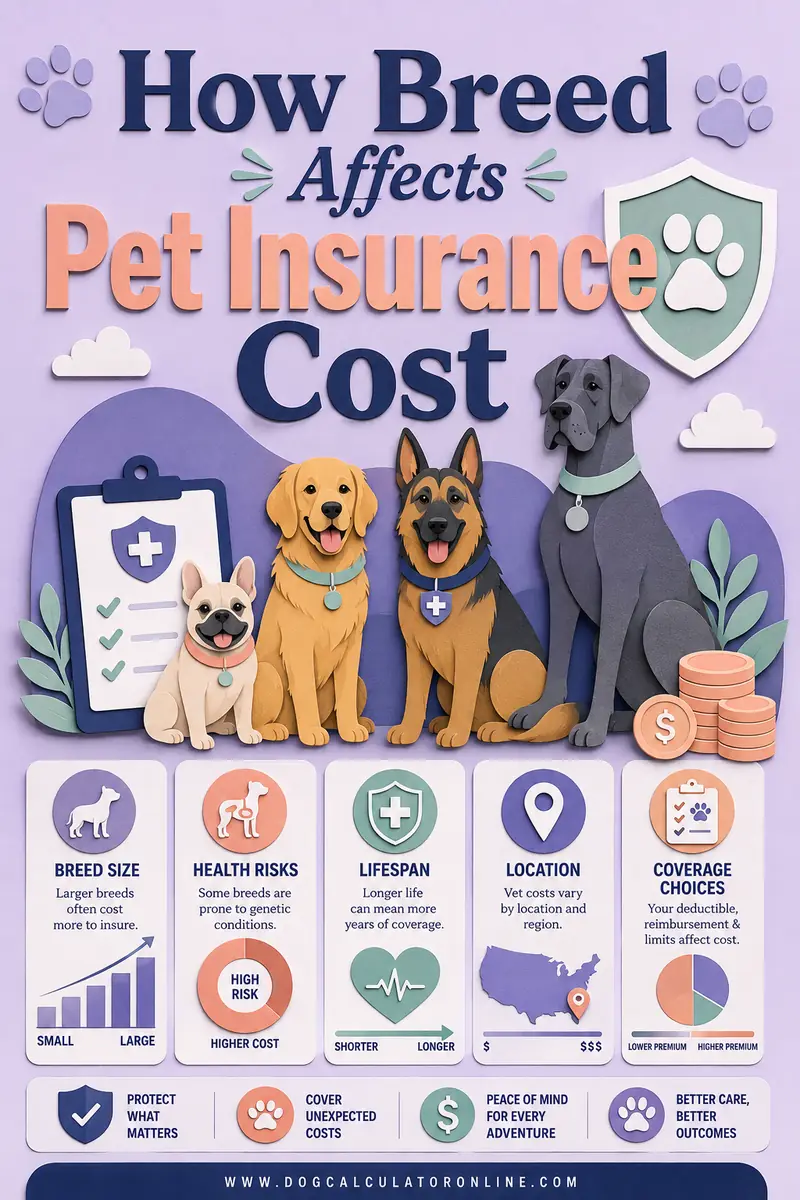
How Breed Affects Pet Insurance Cost
Breed is one of the three biggest inputs in any pet insurance quote — alongside age and location — and it can easily double the price. The same accident-and-illness plan that quotes $30 a month for a small mixed-breed dog can quote $70 for a French Bulldog and $90+ for a Great Dane in the same zip code, because insurers price each breed on what dogs like it have historically cost to treat. This guide walks through the honest US ranges by breed type and, more usefully, the why behind them — size, skull shape, and hereditary condition lists. Insurance is only one slice of what a breed costs to own, though; the free dog cost calculator shows the whole yearly picture for your dog's size in about a minute.
Why Do Insurers Price by Breed at All?
Because breed predicts claims, and claims are the whole business. Pet insurers sit on years of paid-claim data across hundreds of thousands of dogs, and when they sort it by breed, clear patterns fall out: certain breeds file more claims, file bigger claims, and file them earlier in life. Pricing by breed is just that history projected forward.
This is worth internalizing because it reframes the quote you get. A high premium isn't a prediction about your dog — it's a statement about the average vet bill of thousands of dogs that share your dog's genetics and build. Your individual Bulldog may sail through life with nothing worse than an upset stomach. But the insurer can't know that in advance, so it prices the breed, not the dog.
It also means breed pricing is strangely honest. If a breed quotes expensive, that's the market telling you what owners of that breed have historically spent at the vet — useful information even if you never buy a policy. A $75-a-month quote is a signal that your emergency fund, if you self-insure, needs to be sized for that breed's real risks, not for the average dog's. Our overview of how much pet insurance costs for a dog covers the baseline; this guide is about why your dog's line on that chart sits where it does.
Which Breed Traits Raise Premiums the Most?
Insurers don't publish their pricing formulas, but the patterns in quotes are consistent enough that the drivers are no secret. Four traits do most of the work.
Size — the biggest single factor
Almost everything at the vet scales with weight: anesthesia, medications, fluids, hospitalization, surgical time. A cruciate ligament repair on a 100-pound dog is a bigger operation than the same repair on a 15-pound dog, and the pharmacy bill afterward is bigger too. Large and giant breeds also carry concentrated orthopedic risk — hip and elbow dysplasia, cruciate tears — plus emergencies like bloat that barely exist in small dogs. And because big dogs live shorter lives and age faster, they reach the expensive senior years sooner. The result is a premium ladder that climbs steadily with the scale reading; we break the whole size story down in pet insurance cost for large-breed dogs.
Skull shape — the brachycephalic premium
Flat-faced (brachycephalic) breeds — French Bulldogs, English Bulldogs, Pugs, Boston Terriers — are a special pricing category all their own. The shortened skull bundles several risks together: obstructed airways that can require BOAS surgery ($1,500–$4,500), poor heat tolerance that turns warm days into emergency-room risks, prominent eyes prone to ulcers and injuries, skin-fold infections, and a spine and hip structure that carries its own problems in some lines. A Frenchie can quote as much as a dog three times its size for exactly this reason — the full breakdown is in our French Bulldog insurance cost guide.
Hereditary condition lists
Every established breed comes with a documented list of conditions that show up in its lines more often than chance: intervertebral disc disease in Dachshunds and Corgis, mitral valve disease in Cavalier King Charles Spaniels, dilated cardiomyopathy in Dobermans, hip dysplasia in German Shepherds, skin and ear trouble in several spaniel and retriever lines. Breed clubs and veterinary bodies openly document these tendencies, and insurers price them in. The longer and costlier the breed's list, the higher the base premium.
Cancer-prone lines
A handful of beloved breeds — Golden Retrievers, Boxers, Bernese Mountain Dogs, Rottweilers among them — are widely documented as having elevated cancer rates. Cancer claims are among the largest in pet insurance, with diagnosis and treatment commonly running $5,000–$15,000, so a breed's cancer reputation shows up in its quotes even while the dog is a perfectly healthy two-year-old.
What Do Different Breed Types Typically Pay?
Exact prices vary by insurer, location, age, and plan settings, but for a young adult dog on a mid-range accident-and-illness plan in the US, quotes tend to cluster like this:
| Breed type | Typical monthly range | What drives the price |
|---|---|---|
| Small mixed breed (under 25 lbs) | $25–$45 | Small doses, no documented hereditary list, long lifespan |
| Small purebred (Chihuahua, Shih Tzu, Dachshund) | $30–$55 | Breed-specific lists (knees, backs, teeth) on a small frame |
| Medium breed (Beagle, Border Collie, spaniels) | $35–$60 | Moderate size, moderate hereditary risk |
| Large breed (Lab, Golden, German Shepherd) | $50–$85 | Orthopedic risk, size-scaled bills, cancer risk in some lines |
| Giant breed (Great Dane, Mastiff, Newfoundland) | $65–$100+ | Everything above, plus short lifespans and bloat risk |
| Brachycephalic (Frenchie, Bulldog, Pug) | $55–$105 | Airway, eye, skin, spine, and heat risks bundled together |
A few honest notes on reading this table. The ranges overlap because breed is only one input — an eight-year-old small dog can easily out-quote a two-year-old Labrador, which is why age deserves its own guide. The top of each range usually reflects expensive metro areas; the bottom reflects lower-cost states. And within any category, individual breeds can surprise you: some insurers price a Rottweiler above a Great Pyrenees, others the reverse, depending on whose claims data you're looking at. Getting quotes for your actual dog is the only way to know where you land.
Do Mixed-Breed Dogs Really Cost Less to Insure?
Generally, yes — at any given size, a mixed-breed dog usually quotes below purebreds of the same weight, and a small mixed breed is often the cheapest dog in the entire quote engine.
The reason is uncertainty working in your favor. A purebred comes with a known, documented risk list; a mix of unknown parentage doesn't, and broader genetic diversity tends to dilute the concentrated hereditary conditions that purebred lines carry. Insurers reflect that in the price.
Two honest caveats, though. First, size still rules: a 90-pound mixed breed carries most of the large-dog risk profile — the joints don't care about pedigree, and neither does bloat if the chest is deep. A big mix will quote like a big dog, just usually at the gentler end of the band. Second, mixed doesn't mean immune. Mixes inherit real genes from real parents, and a Lab-Shepherd cross can absolutely develop hip dysplasia. The discount reflects lower average risk across thousands of dogs, not a guarantee for yours — so the case for enrolling before symptoms appear applies to mixes exactly as it does to purebreds.
If you've adopted a mystery mix, insurers will typically quote based on your best guess of breed and adult weight. Answer honestly; misstating breed on the application is one of the few things that can genuinely jeopardize claims later.
Are Hereditary Conditions Actually Covered?
This is the question that matters more than the premium, and the answer has a hard edge: most modern accident-and-illness policies do cover hereditary and congenital conditions — but only if your dog enrolled before the condition ever showed signs.
The mechanism is the pre-existing condition exclusion, and it's unforgiving. If your Cavalier develops a heart murmur at age four and you shop for insurance at five, mitral valve disease is off the table on every policy you'll find. If your Frenchie has a BOAS surgery consult on the chart, airway coverage is gone. Insurance can only ever cover the unknown future, never the documented past — the full mechanics live in our pre-existing conditions guide.
For high-risk breeds this creates a specific strategy: the higher your breed sits on the pricing table, the earlier enrollment matters. A Golden Retriever puppy with an empty chart can lock in lifetime coverability for the cancers and hips its breed is known for. The same dog at age six, with a fatty lump aspirated at four and a stiff hip noted at five, has already lost coverage for the two things most likely to generate its biggest bills. High-risk breeds have the most to gain from early enrollment and the most to lose from waiting — the premium is higher precisely because the covered risks are real.
Watch for two fine-print items on hereditary coverage: a few budget policies still exclude hereditary conditions entirely (worth ruling out before you compare prices), and bilateral clauses can extend one pre-enrollment knee or hip problem into an exclusion for the other side.
Can You Lower the Cost If Your Breed Quotes High?
You can't change the breed, but you're not powerless against the premium. The levers, roughly in order of impact:
- Enroll young — timing beats shopping. The difference between insuring a high-risk breed at 10 weeks versus at 4 years is bigger than the difference between any two insurers' prices, because early enrollment preserves coverage for the hereditary conditions the breed is priced on.
- Raise the deductible. Moving from $250 to $500 or $750 meaningfully trims the monthly premium while keeping full protection against the five-figure disaster. For expensive breeds, this is usually smarter than cutting the reimbursement rate or the annual limit.
- Keep the annual limit honest. Cutting a Dane's policy to a $5,000 cap to save premium defeats the purpose — that's one bloat surgery. Trim elsewhere first.
- Consider accident-only as a floor, not a first choice. Accident-only coverage prices much lower and mostly ignores breed, because a swallowed sock costs the same in any dog. It abandons exactly the hereditary illness coverage a high-risk breed most needs, but for owners who'd otherwise go uninsured, it's a legitimate floor — the trade-offs are laid out in accident vs comprehensive coverage.
- Keep the dog lean and conditioned. No insurer discounts a fit dog, but a lean dog genuinely files fewer orthopedic and metabolic claims — which saves you the deductibles and co-pays no policy reimburses.
- Ask about discounts. Multi-pet, annual-pay, and employer-benefit discounts each shave a little; together they can offset a chunk of the breed premium.
How Should You Use Breed Pricing When Deciding?
Think of your breed's quote as free actuarial research, and put it to work in three ways.
First, size your backup plan with it. If you decide against insurance, the premium still told you something: a breed quoting $85 a month is a breed whose owners have historically faced serious bills. Self-insuring that dog means building an emergency fund of $8,000–$10,000, not the $2,000 that might reasonably back up a small mix. The quote is the market's estimate of your risk — ignore the product if you like, but not the information.
Second, let it point you at the fine print. Breed pricing tells you exactly which policy clauses matter for your dog. Large-breed owners should scrutinize orthopedic waiting periods and bilateral clauses. Flat-faced breed owners should confirm airway and skin-fold conditions aren't excluded. Dachshund owners should search the sample policy for how spinal disc disease is handled. The conditions your breed is priced on are the conditions worth reading about before you sign.
Third, weigh the premium against the breed's signature bill, not against zero. The question isn't "is $70 a month a lot?" — it's "is $840 a year reasonable protection against the $6,000 surgery my breed is known for?" Framed that way, expensive breeds often have the strongest case for coverage, provided the chart is still clean. The premium is high because the risk is real; the risk being real is the reason insurance exists.
Frequently Asked Questions
Which dog breeds are the most expensive to insure?
Giant breeds (Great Danes, Mastiffs, Newfoundlands) and flat-faced breeds (French Bulldogs, English Bulldogs, Pugs) consistently sit at the top, commonly quoting $65–$105+ per month for accident-and-illness coverage. Giants combine size-scaled bills with short lifespans; brachycephalic breeds bundle airway, eye, skin, and heat risks.
Which dog breeds are the cheapest to insure?
Small mixed-breed dogs are usually the cheapest, often $25–$45 per month, because they combine small-dog treatment costs, long lifespans, and no documented hereditary condition list. Small, generally healthy purebreds without major breed-specific issues land close behind.
Do purebred dogs cost more to insure than mixed breeds?
Usually, yes, at the same size — purebreds carry documented hereditary condition lists that insurers price in, while mixed ancestry dilutes those concentrated risks. The gap is modest for low-risk purebreds and widest for breeds with long condition lists. Size still matters more: a large mix typically quotes above a small purebred.
Does breed matter more than age for pet insurance cost?
Breed sets your starting band; age moves you through it. A high-risk breed starts expensive and gets more so, but every breed's premium climbs substantially with age — a senior small mix can out-quote a young Great Dane. Over a dog's lifetime, age is usually the stronger force, which is why enrollment timing matters for every breed.
Will an insurer refuse to cover my dog because of its breed?
Outright breed refusals are rare in pet insurance — high-risk breeds are typically priced rather than declined, unlike in some home-insurance contexts. What you will see instead is higher premiums and, on some policies, condition-specific exclusions or longer waiting periods. Read the sample policy for your breed's known conditions before buying.
Is it worth insuring a low-risk breed?
A healthy small mix is the cheapest dog to insure and also the least likely to generate a catastrophic bill — so the math is genuinely closer. The case rests on the low premium making catastrophe protection cheap, and on the fact that even low-risk dogs eat socks and get cancer. It's a judgment call about your finances more than about the breed.
Your dog's breed sets the insurance bill, the food bill, and half the rest of the budget besides. See what your breed's size class really costs per year — insurance line included — with the free dog cost calculator, and you'll be negotiating with real numbers instead of guesses.