Accident-Only vs Comprehensive Pet Insurance: Which Fits Your Dog?
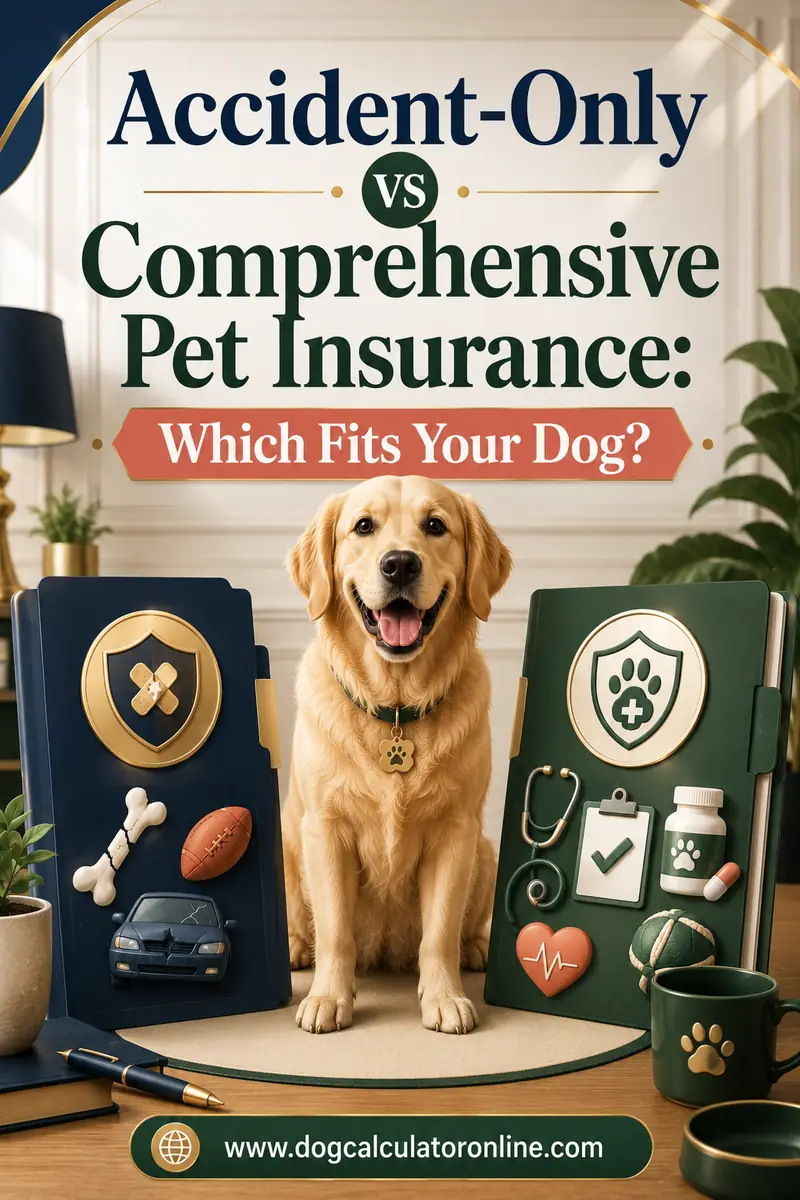
Accident-only pet insurance covers injuries — broken bones, swallowed objects, wounds — for roughly $15–$25 per month, while comprehensive (accident-and-illness) coverage adds every new illness from ear infections to cancer for a typical $40–$70 per month. The catch: illness, not injury, is the more common reason dogs rack up big vet bills over a lifetime. This guide compares the two honestly so you can match the plan to your dog and your budget — no carrier pitches. And to see either premium inside your full dog budget, try the free dog cost calculator.
The Two Plan Types at a Glance
| Accident-only | Comprehensive (accident + illness) | |
|---|---|---|
| Typical monthly cost | $15–$25 | $40–$70 |
| Injuries (fractures, wounds, swallowed objects, toxins) | ✅ | ✅ |
| Illnesses (infections, allergies, digestive issues) | ❌ | ✅ |
| Major disease (cancer, diabetes, heart, kidney) | ❌ | ✅ |
| Hereditary conditions (if not pre-existing) | ❌ | ✅ Usually |
| Diagnostics, surgery, hospitalization | ✅ For accidents only | ✅ For accidents and illness |
| Pre-existing conditions | ❌ | ❌ |
| Routine/preventive care | ❌ | ❌ (wellness add-on only) |
| Senior dogs accepted for new enrollment | ✅ Often, even past illness age limits | ⚠️ Some insurers cap new enrollment age |
Both plan types use the same machinery — deductible, reimbursement rate, annual limit — and both exclude pre-existing conditions and routine care. The entire difference is that one word: illness.
What Accident-Only Plans Actually Cover
Accident-only coverage handles sudden external events:
- Broken bones, sprains, and soft-tissue injuries from falls or rough play
- Swallowed foreign objects and the surgery to remove them
- Lacerations, bite wounds, and abscesses from dog-park scraps
- Poisoning and toxin ingestion (chocolate, xylitol, rodenticide)
- Vehicle accidents, burns, insect and snake bites
These are genuinely the scariest single bills in dog ownership — emergency surgery routinely lands between $2,000 and $6,000 — and accident-only plans cover them at a bargain premium. For a young, healthy dog whose owner mainly fears the catastrophic ER visit, that's real protection for the price of a few coffees a month.
One boundary to understand: cruciate ligament tears, among the most common and expensive orthopedic problems in dogs, are often classified as conditions rather than accidents, with their own waiting periods and rules. If a torn knee is your nightmare scenario (large-breed owners, take note), read the policy language before assuming an accident-only plan has you covered.
What You Give Up: The Illness Half
Here's the uncomfortable truth about the cheaper option: over a dog's lifetime, illness claims outnumber accident claims by a wide margin. Skin and ear infections, allergies, digestive trouble, urinary issues — these are the everyday reasons dogs visit vets. And the truly enormous bills of a dog's later years are almost all illness: cancer treatment can run $4,000–$10,000+, diabetes means years of ongoing costs, and heart or kidney disease requires repeated diagnostics and medication.
An accident-only plan pays $0 toward all of it. That's not a flaw — it's the deal. But it means accident-only insurance protects you from the dramatic risk while leaving the statistically bigger risk uncovered. Our full breakdown of what pet insurance covers shows just how much of the coverage list lives on the illness side.
The Price Gap, Framed Honestly
The comprehensive premium is roughly two to three times the accident-only premium — call it a difference of $25–$45 a month, or $300–$540 a year, for a typical adult dog. What does that buy?
- Coverage for the most common claims your dog will actually have (illness).
- Coverage for the biggest lifetime bills (cancer, chronic disease).
- Protection that matures with your dog: a comprehensive policy started young covers conditions that appear later for life, as long as it stays active.
What does keeping that money buy? About $3,600–$6,500 over ten years — a meaningful self-insurance fund, if you genuinely save it. This is the same fork at the heart of the whole is pet insurance worth it question: certainty versus flexibility. Accident-only is a middle path — catastrophe blunting at minimum cost — but only if you're honest that illness bills will be yours alone.
Who Should Pick Which
Accident-only makes sense if:
- The comprehensive premium genuinely doesn't fit your budget — some coverage beats none.
- Your dog is a senior who no longer qualifies for new illness coverage; accident-only plans often accept older dogs when comprehensive plans won't. (More on that trade-off in insurance for older dogs.)
- You hold a solid emergency fund for illness but want cheap protection against the freak $5,000 injury.
- Your dog already has extensive pre-existing conditions, so illness coverage would exclude most of what's likely to happen anyway.
Comprehensive makes sense if:
- You want insurance to do its full job — covering the claims most likely to occur and the worst-case bills.
- Your dog is young and healthy: enrolling now locks in illness coverage before anything becomes pre-existing.
- Your breed carries documented predispositions (allergies, hips, hearts, skin) that are illnesses, not accidents.
- A surprise $4,000 cancer diagnosis would strain you as much as a $4,000 surgery — because to your bank account, they're identical.
If you're on the fence, price both for your actual dog. The typical ranges in our monthly cost guide are a starting point, but real quotes for your breed, age, and ZIP settle it in minutes.
A Worked Comparison Over Five Years
Take a 2-year-old mixed-breed dog. Accident-only at $18/month vs comprehensive at $52/month — a $2,040 premium gap over five years. Now three futures:
| Five-year outcome | Accident-only owner pays | Comprehensive owner pays |
|---|---|---|
| Lucky: no claims at all | $1,080 premiums | $3,120 premiums |
| One accident ($3,500 surgery) | $1,080 + ~$1,000 share | $3,120 + ~$1,000 share |
| Illness path ($6,000 in allergy + cancer care) | $1,080 + $6,000 (uncovered) | $3,120 + ~$1,600 share |
(Assumes a $500 annual deductible and 80% reimbursement for covered claims.) The lucky future favors accident-only; the illness future flips the result decisively. Nobody knows which row they'll live — that's why this is a risk decision, not a math trick.
Notice also what the table doesn't show: the accident-only owner in the illness row doesn't just pay more — they pay it at the worst possible moment, unbudgeted, and every one of those illness diagnoses becomes permanently pre-existing for any future upgrade. The comprehensive owner's extra $2,040 in premiums bought coverage that now follows the dog for life. When you extend the horizon from five years to a full 10-to-13-year lifespan — where senior illness costs dominate — the comparison tilts further: lifetime accident-only premiums (~$2,500–$3,500) plus a realistic illness history routinely exceed lifetime comprehensive premiums plus co-insurance shares. Accident-only wins the sprint when luck holds; comprehensive is built for the marathon.
The Upgrade Trap: Why "Start Cheap, Upgrade Later" Backfires
A tempting plan: buy accident-only now while money is tight, upgrade to comprehensive when the budget improves. It sounds prudent. In practice, it's the single most expensive sequencing mistake in pet insurance, for one reason: the upgrade date becomes a brand-new pre-existing line.
Illness coverage added later only covers illnesses that first appear after the upgrade (plus its fresh waiting periods). Every condition that surfaced during your accident-only years — the allergy flare at age two, the ear infections, the murmur noted at a checkup — is permanently excluded from the illness coverage you eventually buy. You end up paying comprehensive prices for Swiss-cheese protection, with holes exactly where your dog's history predicts claims.
The arithmetic makes it concrete. Suppose the comprehensive premium is $35/month more than accident-only. Delaying the upgrade two years "saves" $840. If during those two years your dog develops any chronic condition — skin allergies alone can run $500–$1,500 a year for life — the exclusion costs multiples of the savings, every year, forever.
If comprehensive coverage is where you want to end up, the cheaper honest path is usually: comprehensive now, with a high deductible and 70–80% reimbursement to compress the premium, upgraded dial-by-dial at renewals as your budget grows. Dial changes on an active policy don't reset the pre-existing line; plan-type upgrades effectively do. Start with the coverage shape you want and tune the numbers — not the reverse.
Questions to Ask Before Buying Accident-Only
If you land on the cheaper plan, buy it with full information. Five questions for any insurer:
- "How do you classify cruciate ligament injuries?" If torn knees fall under condition rules rather than accident rules, the plan's biggest apparent benefit may not exist for your large breed.
- "Does an injury during play or exercise always count as an accident?" Some policies distinguish sudden trauma from injuries deemed degenerative — get the boundary in writing.
- "What diagnostics ride along with a covered accident?" Confirm imaging, bloodwork, hospitalization, and follow-up visits are included when the triggering event is an injury.
- "Can I upgrade to comprehensive later without penalties?" Understand the upgrade path now: new waiting periods will apply, and any illness that appeared in the meantime becomes pre-existing on the upgraded coverage.
- "Are there per-incident caps?" Accident-only plans sometimes carry lower per-incident or annual limits than their comprehensive siblings — a $2,500 cap defeats the purpose when surgeries run $4,000.
And one question for yourself: what's the actual plan for illness bills? "I'll figure it out" is not a plan. A named savings account with an automatic monthly transfer is. If the answer is honest and funded, accident-only plus self-funded illness care is a coherent strategy; if it isn't, the premium gap between the two plan types is the cost of closing that hole properly.
FAQ
What is accident-only pet insurance?
A budget policy that reimburses vet costs from physical injuries — fractures, swallowed objects, wounds, poisoning — but pays nothing toward illnesses. It typically costs $15–$25 per month for dogs, versus $40–$70 for full accident-and-illness coverage.
Is accident-only pet insurance worth it?
It's worth it when the alternative is no coverage at all, or for seniors who can't enroll in illness plans. It's a poor substitute for comprehensive coverage if you can afford the difference, because illness generates most lifetime vet costs.
Does accident-only insurance cover a torn ACL or cruciate ligament?
Often not as a simple accident — many insurers classify cruciate injuries as orthopedic conditions with separate waiting periods or exclusions. Read the specific policy language; this single detail matters enormously for large-breed dogs.
Can I switch from accident-only to comprehensive later?
Usually yes, but the illness coverage starts fresh: new waiting periods apply, and any condition that appeared while you held the accident-only plan becomes pre-existing. Waiting to upgrade is how owners accidentally lock out coverage for exactly the conditions they later need.
Do accident-only plans have age limits?
Generally no, or much higher ones — which is why they're a common fallback for seniors. Comprehensive plans sometimes cap new enrollments at a certain age, while accident-only coverage frequently remains available for life.
Which plan type do most dog owners choose?
Comprehensive accident-and-illness plans dominate the US market by a wide margin. Accident-only fills two niches: strict budgets and older dogs outside illness-enrollment windows.
The Bottom Line
Accident-only insurance is cheap catastrophe cover for injuries; comprehensive coverage costs two to three times more and covers the illness claims that actually dominate a dog's lifetime vet spending. Pick accident-only as a deliberate budget or senior-dog strategy — never as a discount version of full coverage. Then put your chosen premium where it belongs: one line in the complete picture the free dog cost calculator builds for your dog in about a minute.