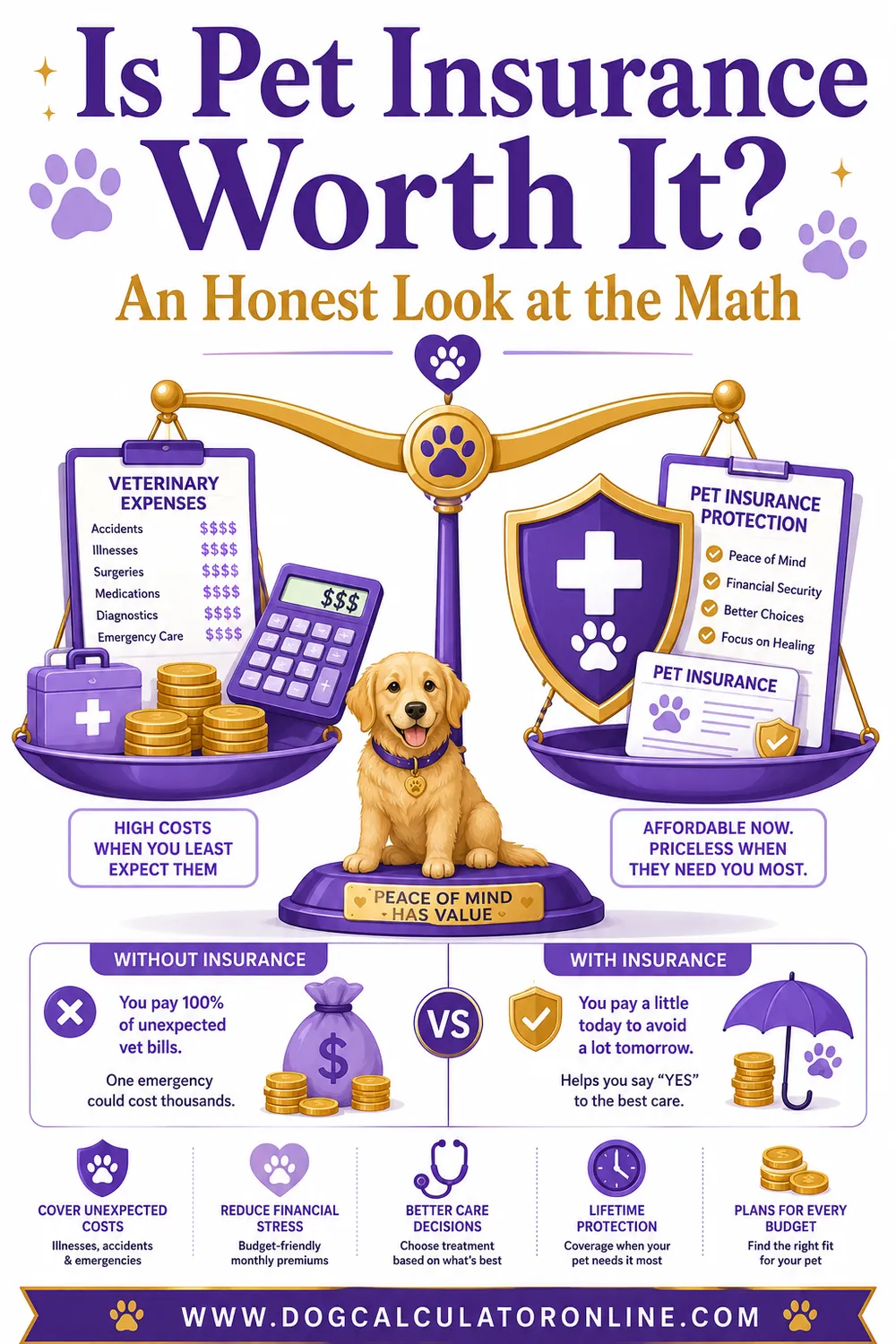
Is Pet Insurance Worth It for a Puppy? The Case for Starting Early
If pet insurance is ever going to be worth it for your dog, puppyhood is the moment: premiums are at their lifetime low (often $30–$50 per month), nothing is pre-existing yet, and puppies are world-class at swallowing things that require $3,000 surgeries. That doesn't make insurance automatic — a well-funded emergency account is a legitimate alternative — but the timing argument is real and one-directional: you can always cancel later, while coverage you didn't start can't be backdated past a diagnosis. Here's the honest math, no carrier pitches. And for the full picture of first-year costs, the free dog cost calculator adds it all up in a minute.

The Short Answer
Pet insurance is worth it for a puppy if a surprise $3,000–$5,000 vet bill would strain your finances — and puppyhood is when such bills are disproportionately likely to be accidents: swallowed objects, fractures, toxin ingestion. It's less compelling if you already hold a healthy emergency fund and the discipline to keep it earmarked. What makes the puppy question different from the general is pet insurance worth it question is timing leverage: enrolling now locks in the lowest premiums, an empty pre-existing list, and lifetime coverage for whatever develops later.
Why Puppyhood Is the Cheapest Entry Point
Premiums start at their lifetime low
Insurers price age directly: a puppy might be quoted $35/month for coverage that would cost the same dog $80+ at age eight. You'll pay more each year as your dog ages regardless of when you enroll — but starting young means starting at the bottom of the curve. Typical adult accident-and-illness plans run $40–$70/month; puppies commonly quote below that band. Our monthly cost guide breaks down the ranges.
Nothing is pre-existing — yet
This is the big one. Insurance never covers conditions that were diagnosed or symptomatic before enrollment. A 10-week-old puppy has essentially no medical history, so everything is coverable: the allergies that emerge at two, the hip dysplasia flagged at four, the cancer at ten. Wait even six months and the first vet-chart notes start accumulating — an ear infection here, a skin irritation there — each one a potential exclusion on a later policy. The full mechanics are in our pre-existing conditions guide, but the summary is simple: the empty medical file is a one-time asset, and enrollment is how you spend it.
Waiting periods clear before the risky months
Policies impose waits before coverage starts — days for accidents, ~14 days for illness, up to 6 months for orthopedic conditions (often waivable with a vet exam). Enroll at 8–10 weeks and those clocks run out while your puppy is still mostly napping. By the time adolescent chaos peaks — the counter-surfing, sock-eating, fence-testing phase — coverage is fully live. Details and waiver tactics are in the waiting period explainer.
What Puppies Actually Cost Vets to Fix
Puppy claims skew toward accidents and acute illness, and the bills are not small:
| Common puppy incident | Typical US cost range |
|---|---|
| Swallowed object (endoscopy or surgery) | $2,000–$5,000 |
| Broken leg (jumped off the couch wrong) | $1,500–$4,000 |
| Toxin ingestion (chocolate, grapes, medications) | $500–$3,000 |
| Parvovirus treatment (hospitalization) | $1,500–$5,000 |
| Severe digestive episode with imaging | $800–$2,500 |
None of these are rare, exotic events — they're the standard casualty list of a curious animal with no judgment and brand-new teeth. An insured owner with a typical plan ($500 deductible, 80% reimbursement) turns a $4,000 foreign-body surgery into roughly a $1,200 problem. An uninsured owner eats the whole bill, often in the same year they paid adoption fees, vaccine series, spay/neuter, and a crate.
That first-year pile-up matters: insurance is most valuable when your cash buffer is thinnest, and for most new owners that's exactly the first year or two.
The Honest Case Against Insuring a Puppy
Balance requires the other side, and it's a fair one:
- Most puppies don't have a catastrophe. In any given year, most policyholders pay more in premiums than they get back — that's how insurance works. If you insure at 10 weeks and your dog lives a lucky 14 years, you may pay $8,000–$15,000 in lifetime premiums for modest reimbursements.
- A savings account keeps the surplus. Auto-transferring $50/month into a dedicated pet fund builds $600/year that stays yours in the lucky scenario. By year three you'd hold ~$1,800 — enough to blunt most single emergencies.
- The savings route's weakness is the early gap. The strategy fails precisely when a $4,000 bill arrives in month four, when the fund holds $200. If you choose self-insurance for a puppy, seed the account with a lump sum on day one — otherwise you're simply uninsured for the riskiest, poorest stretch.
- Premiums rise every year regardless. Starting cheap doesn't mean staying cheap. Budget for the premium to climb with age and vet inflation, and re-evaluate the deductible at each renewal rather than rage-canceling — canceling forfeits the pre-existing lock-in you've been paying to build.
If you're financially able to absorb a mid-four-figure bill today without hardship, either path is defensible. If you're not, the puppy year is the worst possible time to be uncovered.
If You Do Insure: Puppy-Specific Setup Tips
- Enroll right after the first vet visit. The visit documents a healthy baseline; enrolling immediately afterward starts the clocks with a clean chart.
- Pick accident-and-illness, not accident-only. The price gap is smallest at puppy age, and illness coverage is what becomes irreplaceable later.
- Consider 90% reimbursement with a higher deductible. Young-dog premiums make the strong reimbursement tier affordable; the higher deductible keeps the monthly cost sane while preserving catastrophe protection.
- Get the orthopedic waiver exam if offered — especially for large breeds whose cruciate and hip risks arrive in adulthood.
- Skip the wellness add-on unless the math clearly works. Vaccines and routine visits are predictable; pre-paying them through an insurer usually adds a fee for the convenience. Budget them directly instead — the dog cost calculator shows what routine care actually costs per year for your dog's size.
- Set premiums to autopay. A lapsed puppy policy quietly converts every note in the growing medical chart into a pre-existing condition on the next one.
Where Insurance Sits in the First-Year Budget
Context matters: the premium is one line in the most expensive year of dog ownership. A realistic first-year picture for a medium-sized puppy:
| First-year expense | Typical range |
|---|---|
| Adoption or purchase | $50–$2,000+ |
| Vaccine series + vet visits | $200–$500 |
| Spay/neuter | $150–$600 |
| Food (puppy formula, growing appetite) | $300–$700 |
| Crate, bed, leash, bowls, toys | $200–$500 |
| Training classes | $100–$400 |
| Pet insurance (12 months at $30–$50) | $360–$600 |
| Typical first-year total | $1,400–$4,500+ |
Seen in that table, insurance is roughly 10–20% of the first-year spend — the only line that caps your downside rather than adding to it. It's also the line people cut first when the budget pinches, which is exactly backwards: the gear can be secondhand and the training can be YouTube, but nothing else on the list protects you from the $4,000 day. If the full budget surprises you, run your own version with the free dog cost calculator before the puppy comes home — deciding on insurance is easier when every line is visible.
Claims by puppy phase (what actually gets filed)
- 8–16 weeks: digestive upsets from dietary indiscretion, parasite issues, the occasional parvo scare in under-vaccinated pups.
- 4–8 months: teething-driven chewing means swallowed objects; growing bodies mean playground fractures and sprains.
- 8–18 months: peak athletic recklessness — soft-tissue injuries, lacerations from fence and trail misadventures, and the first allergy flags in predisposed breeds.
The pattern is why puppy policies earn their keep on the accident side early, then quietly become illness lock-in as the dog matures.
The Decision in Four Questions
- Could you cover a $4,000 emergency tomorrow without debt? No → insure. Yes → continue.
- Will you genuinely fund a pet savings account from day one, seeded with $1,000+? No → insure. Yes → continue.
- Is your breed high-risk (flat-faced, giant, or known hereditary issues)? Yes → insurance likely earns its keep; at minimum, enroll before symptoms appear.
- Would you sleep better converting unknown disasters into a known monthly cost? Insurance is partly a peace-of-mind product; valuing that is legitimate.
There's no universally right answer — only an honest match between your finances, your breed, and your temperament.
FAQ
Is pet insurance worth it for an 8-week-old puppy?
Eight to ten weeks is the ideal enrollment window: quotes are at their lifetime minimum, the medical file is empty, and waiting periods expire before the accident-prone adolescent months. Whether it's worth it still depends on your finances — but no later moment offers better terms.
How much is pet insurance for a puppy?
Typical accident-and-illness coverage for a puppy runs about $30–$50 per month in the US, varying by breed, location, and plan settings. High-risk breeds and expensive cities quote higher; small mixed breeds in low-cost states can come in under $30.
What does puppy insurance not cover?
The same exclusions as any policy: pre-existing conditions, routine care (vaccines, deworming, spay/neuter) unless you add a wellness plan, and anything arising during waiting periods. Puppy vaccine series and neutering are predictable costs to budget directly.
Should I get insurance before or after the first vet visit?
Right after. The visit creates a documented healthy baseline, and enrolling immediately starts waiting periods with a clean record. Delaying invites the first chart notes that can become exclusions.
Can I just save money instead of insuring my puppy?
Yes — if you seed the fund immediately (ideally $1,000+) and automate monthly deposits. The savings strategy's fatal flaw is the early gap between adopting and accumulating; a big bill in month four defeats it. Insurance exists precisely for that gap.
Does puppy insurance get more expensive as the dog grows up?
Yes. Premiums rise at renewal with age and veterinary inflation — typically gently through the young-adult years and more steeply from around age seven. Starting young doesn't freeze the price; it starts you at the bottom of the curve with maximum coverage locked in.
The Bottom Line
For puppies, the insurance question tilts further toward "yes" than at any other age: lowest premiums, zero pre-existing conditions, waiting periods cleared before peak chaos, and maximum exposure to exactly the accidents insurance handles best. If your emergency fund is thin, insure now and re-evaluate at each renewal. If you self-insure instead, seed the fund today, not gradually. Either way, know your full numbers — premiums, food, vet care, gear — with the free dog cost calculator, and check where your pup sits on the aging curve with the dog age calculator.