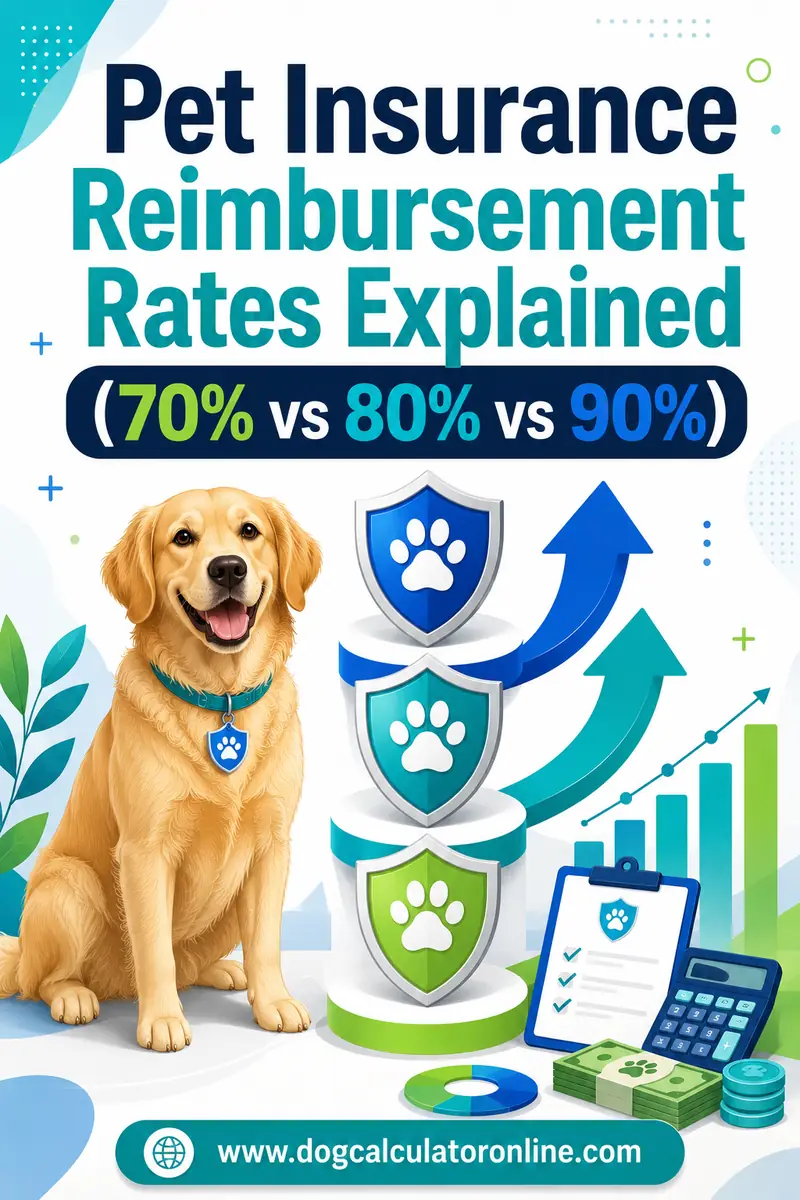
Pet Insurance Reimbursement Rates Explained (70% vs 80% vs 90%)
Your pet insurance reimbursement rate is the percentage of covered vet costs the insurer pays back after your deductible — most US plans let you pick 70%, 80%, or 90%. A higher rate means bigger payouts and a higher monthly premium; a lower rate means you shoulder more of each bill in exchange for cheaper months. This guide runs the real math on all three rates so you can pick with your eyes open — no carrier pitches. And since the premium is just one line in your dog budget, the free dog cost calculator shows you the whole annual picture.
What "Reimbursement Rate" Actually Means
Pet insurance in the US runs on a reimbursement model: you pay the vet, file a claim, and get money back. The reimbursement rate is the percentage applied to covered costs after your deductible comes off:
(Covered costs − remaining deductible) × reimbursement rate = payout
The remaining share — 30%, 20%, or 10% — is your co-insurance: your permanent slice of every covered bill. Unlike the deductible, it never gets "met." On a $10,000 cancer treatment year, a 90% plan leaves you with $1,000 of co-insurance (plus deductible); a 70% plan leaves you with $3,000. That's the real stakes of this dial.
If any part of the pay-then-claim pipeline is fuzzy, our walkthrough of how pet insurance works traces a bill from the clinic counter to the payout.
The Three Standard Rates, Compared
| 70% | 80% | 90% | |
|---|---|---|---|
| Your share of covered bills (after deductible) | 30% | 20% | 10% |
| Monthly premium | Lowest | Middle | Highest |
| Your cost on a $1,000 covered claim | $300 | $200 | $100 |
| Your cost on a $5,000 covered claim | $1,500 | $1,000 | $500 |
| Your cost on a $10,000 covered claim | $3,000 | $2,000 | $1,000 |
(Table assumes the deductible is already met, to isolate the rate's effect.)
Notice the pattern: on small claims, the rates barely differ — $100 or $200 either way. On catastrophic claims, the gap becomes serious money. Since catastrophic protection is the whole reason most people buy insurance, this pushes many owners toward 80% or 90%. But the premium side of the ledger pushes back, so let's look at that.
The Premium Trade: What Does 90% Cost You?
Typical accident-and-illness premiums for an adult dog run about $40–$70 per month, and the reimbursement rate is one of the three dials that position you inside (or outside) that range. Moving from 70% to 90% commonly raises a premium by a noticeable chunk — often in the range of 10–25%, varying by insurer and dog.
Here's the honest framing. Suppose 90% costs you $8/month more than 70% — about $96 a year:
- In a claim-free year, the 70% plan wins by $96.
- In a year with $2,000 of covered claims, the 90% plan pays out $400 more, netting you roughly $300 ahead.
- In a catastrophic $10,000 year, the 90% plan nets you about $1,900 ahead.
The higher rate is essentially more insurance — it performs exactly when insurance is supposed to perform. The lower rate is a bet on good luck, which is a bet you're already making by owning a dog. That's why the common-sense pairing is a higher deductible with a higher reimbursement rate: you absorb the small predictable stuff yourself, and the policy shows up strongly for disasters. The other half of that pairing is explained in our deductible guide.
Reimbursement Rate vs "Actual Cash Paid": Two Gotchas
Two policy details can make your real payout smaller than the headline percentage suggests:
1. Reimbursement based on your actual bill vs a benefit schedule
Most modern US plans reimburse a percentage of your actual vet invoice — that's what you want. A few older-style policies instead pay according to a benefit schedule: a fixed maximum per condition, regardless of what your vet charged. Under a schedule, "90%" of a $4,000 surgery might be capped at a $2,500 line item for that condition. Always confirm a plan reimburses on the actual invoice.
2. What counts as "covered costs"
The percentage only applies to covered items. If your plan excludes exam fees, that $95 consultation line comes off before the math starts. Same for taxes in some cases, boarding, or anything tied to a pre-existing condition. Two plans with identical 90% rates can return different amounts on the same invoice because their "covered" lists differ — which is why comparing plans on rate alone misleads.
A concrete illustration: two 90% plans process the same $1,200 sick visit ($120 exam fee, $1,080 diagnostics and treatment, deductible met). Plan A covers exam fees and returns $1,080. Plan B excludes them and returns $972. Same advertised rate, $108 apart on one routine claim — and a chronic condition means many such visits per year. Multiply the difference across a policy's life and the exam-fee row quietly outweighs a 5% rate difference. Our overview of what dog insurance costs covers how to line up quotes fairly.
Worked Example: A Full Year at 80%
A 5-year-old Beagle mix on an 80% plan with a $500 annual deductible and $10,000 annual limit has this year:
| Claim | Covered amount | Math | Payout |
|---|---|---|---|
| February: ear infection | $420 | ($420−$420 of deductible) × 80% | $0 — $420 goes to deductible |
| May: swallowed toy, surgery | $3,600 | ($3,600−$80 remaining deductible) × 80% | $2,816 |
| October: skin allergy workup | $650 | $650 × 80% | $520 |
| Year totals | $4,670 in bills | $3,336 reimbursed |
The owner paid $1,334 of vet bills plus roughly $600–$800 in premiums — versus $4,670 uninsured. In a quieter year, the premiums would have bought nothing but peace of mind. That's the deal, stated plainly; whether it's a good deal for your finances is the question our worth-it framework helps you answer.
Don't Forget the Third Dial: Annual Limits
The reimbursement rate operates inside a ceiling — your annual limit ($5,000, $10,000, or unlimited on most plans). The two interact in ways worth seeing before you optimize one and neglect the other:
- A 90% rate with a $5,000 limit pays beautifully on mid-size claims, then stops cold partway through a $9,000 cancer year. Total reimbursement: $5,000, not $7,650.
- An 80% rate with an unlimited limit pays less on every bill but never abandons you in the catastrophic scenario.
If your budget forces a choice between a richer rate and a higher limit, most owners are better served protecting the limit — the whole point of insurance is the worst case, and the worst cases are exactly where limits bind. The rate decides how much you co-pay; the limit decides whether coverage survives the year that matters.
Four Owner Profiles, Four Sensible Setups
| Owner situation | Sensible pairing | Logic |
|---|---|---|
| Thin emergency fund, high-risk breed | 90% rate, $500 deductible, high/unlimited limit | Maximum protection where finances are most fragile |
| Solid savings, healthy mixed breed | 80% rate, $1,000 deductible, high limit | Catastrophe-only coverage at minimum premium |
| Tight monthly budget, wants some cover | 70% rate, $750 deductible, $10,000 limit | Affordable premium that still blunts disasters |
| Chronic-condition dog on a long-held policy | 80–90% rate, deductible raised at renewals | Keep the policy alive; manage premium via deductible, not cancellation |
These aren't the only defensible combinations, but they illustrate the principle: the three dials are one system. Set them together, against your actual bank account, rather than maxing whichever one a quote page happens to highlight.
Which Rate Should You Pick?
- Pick 90% if a large surprise bill would genuinely strain you, or your dog's breed carries known risks of expensive conditions. You're buying maximum performance in the scenario that matters.
- Pick 80% if you want the mainstream balance — meaningful payouts with a premium that stays mid-range. It's the most commonly chosen rate for a reason.
- Pick 70% if the premium difference is the deciding factor between having coverage and having none, or you hold healthy savings and mainly want catastrophe blunting. A 70% plan that stays affordable beats a 90% plan you cancel at the first renewal increase.
Whatever you pick, keep the rate consistent when comparing insurers — same rate, same deductible, same limit — or the quotes tell you nothing.
And remember the rate can move later. Most insurers let you lower the reimbursement rate at renewal without fuss — a standard way to tame premium increases as your dog ages — while raising it may require review or be restricted once conditions exist. Practically, that asymmetry argues for starting a young dog at 90% and stepping down if money ever tightens, rather than starting at 70% and hoping to upgrade after the first scare.
FAQ
What does 90% reimbursement mean in pet insurance?
After your deductible is met, the insurer pays 90% of every covered vet cost and you pay the remaining 10%, up to your annual limit. On a $2,000 covered bill with the deductible already met, you'd receive $1,800.
Is 70% or 90% reimbursement better?
90% pays substantially more exactly when bills are largest, at a higher monthly premium; 70% is the budget option that still blunts catastrophes. If the premium gap is affordable, most owners get better protection-per-dollar pairing 90% with a higher deductible.
Does the reimbursement percentage apply before or after the deductible?
After. The insurer subtracts your remaining deductible from covered costs first, then applies the percentage to what's left. This order slightly reduces payouts compared to the reverse, so it's worth knowing when you estimate a claim.
Why was my reimbursement less than my rate suggested?
Common reasons: part of the invoice wasn't covered (exam fees, non-covered items, anything pre-existing), your deductible wasn't fully met, or you hit your annual limit. The claim statement (explanation of benefits) itemizes exactly what was excluded and why.
Can I change my reimbursement rate later?
Usually at renewal, yes. Raising the rate may be restricted or re-underwritten by some insurers; lowering it to manage premium increases as your dog ages is generally straightforward.
Do all pet insurers offer 70/80/90 options?
Most major US insurers offer some or all of these tiers; a few offer 100% options or fixed rates. Always check whether the plan reimburses a percentage of your actual invoice rather than a benefit schedule — that structural difference matters more than the exact percentage.
The Bottom Line
The reimbursement rate decides your permanent share of every covered bill: 30%, 20%, or 10%. Small bills barely notice it; catastrophic bills turn it into thousands of dollars. Choose the highest rate whose premium you'll happily keep paying, pair it with a deductible your savings can absorb, and compare insurers only on identical settings. Then put the whole thing in context — run your dog's complete annual costs, premium included, through the free dog cost calculator.