How Does Pet Insurance Work? A Plain-English Guide
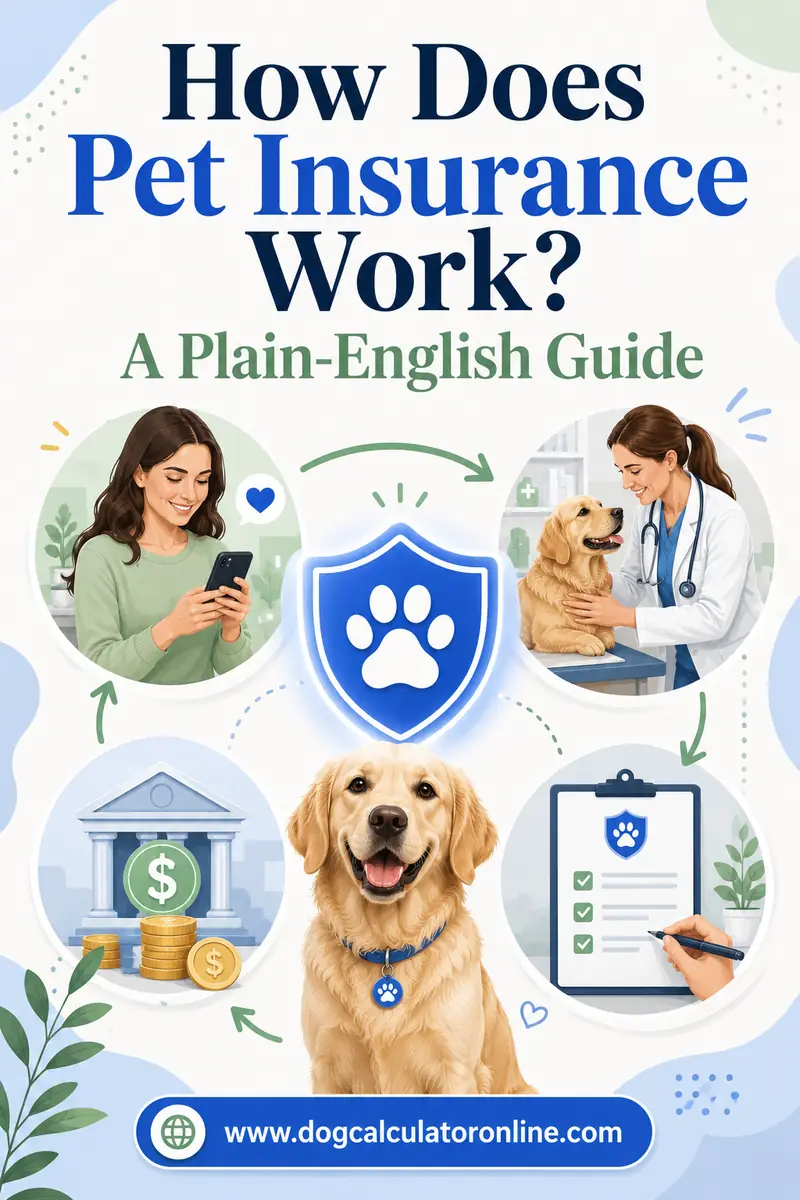
Pet insurance works on a reimbursement model: you pay the vet bill up front, submit the itemized invoice to your insurer, and get a percentage of covered costs paid back to you after your deductible is met. That's the whole engine — everything else (waiting periods, exclusions, annual limits) is detail bolted onto that core loop. This guide walks through the entire process step by step, from enrollment to payout, with no carrier pitches. And because insurance is just one line in your dog budget, the free dog cost calculator can show you where a premium fits alongside food, gear, and routine care.
The Core Idea in 60 Seconds
Unlike human health insurance, pet insurance in the US is mostly property-style insurance with a reimbursement model. That means three practical things:
- You can use any licensed vet. There are no networks. Your regular clinic, the emergency hospital across town, a specialist — all fine.
- You usually pay first, then get paid back. The vet doesn't bill the insurer; you do.
- The policy pays a percentage, not everything. After your deductible, the insurer reimburses a set rate — commonly 70%, 80%, or 90% — of covered costs, up to your annual limit.
If you remember only one sentence: pet insurance turns a rare, giant, unpredictable bill into a predictable monthly cost plus a manageable share of each incident.
Step 1: You Enroll and Pick Three Dials
When you sign up, you provide your dog's breed, age, and ZIP code, and choose three settings that shape both your premium and your protection:
| Dial | Common options | What it means |
|---|---|---|
| Annual deductible | $250 / $500 / $1,000 | What you pay each policy year before reimbursement starts |
| Reimbursement rate | 70% / 80% / 90% | The share of covered costs the insurer pays after the deductible |
| Annual limit | $5,000 / $10,000 / unlimited | The most the insurer will pay out per policy year |
Lower deductible, higher rate, and higher limit all raise your monthly premium — typically landing an adult dog's accident-and-illness plan around $40–$70 per month in the US. Our guide to monthly pet insurance costs breaks down the ranges by age and breed type.
Most insurers also ask for your dog's veterinary records, or request them at first claim. Anything already diagnosed or showing symptoms becomes a pre-existing condition — permanently excluded on most policies. This single rule is why enrolling while your dog is young and healthy matters so much.
Step 2: Waiting Periods Tick Down
Coverage doesn't start the moment you pay. Nearly every policy has waiting periods — buffer windows after enrollment during which claims aren't covered:
- Accidents: commonly 2–14 days
- Illnesses: commonly around 14 days
- Orthopedic conditions (like cruciate ligament tears): often 6 months, sometimes reducible with a vet exam
Anything that shows symptoms during a waiting period is treated as pre-existing — even if the formal diagnosis comes later. This prevents people from buying insurance in the emergency-room parking lot. We cover the details, including how to shrink the orthopedic wait, in our waiting period explainer.
Step 3: Your Dog Needs Care — You Go to Any Vet
When something happens — a limp, a swallowed sock, a weird lump — you go to whatever vet you choose and authorize whatever care you and the vet decide on. The insurer isn't involved in treatment decisions at all. No pre-approvals are required for most plans (a few offer optional pre-approval for big procedures, which can be reassuring before a $5,000 surgery).
You pay the clinic in full. This is the part that surprises new policyholders: insurance does not remove the need for accessible cash or credit. If the emergency bill is $4,000, you need to be able to float $4,000 for days to weeks until reimbursement arrives. A small number of insurers can pay the vet directly at participating clinics, but treat that as a bonus, not the default.
Step 4: You File a Claim
Filing is usually simple and app-based:
- Get the itemized invoice from the clinic (not just the credit-card receipt).
- Photograph or upload it through the insurer's app or website.
- Add brief details: what happened, when symptoms started.
- First claim only: the insurer may request your dog's full medical records to check for pre-existing conditions.
That records review is why first claims often take the longest — sometimes a few weeks — while later claims on an established policy can be processed in days. Keeping your own copy of your dog's records speeds everything up.
Step 5: The Reimbursement Math Runs
Here's the calculation the insurer applies to every covered claim:
(Covered costs − remaining deductible) × reimbursement rate = your payout, capped by your annual limit.
Worked example — $3,000 surgery, $500 annual deductible (none used yet), 90% reimbursement, $10,000 annual limit:
| Step | Amount |
|---|---|
| Covered invoice total | $3,000 |
| Minus annual deductible | −$500 |
| Subtotal | $2,500 |
| × 90% reimbursement | $2,250 |
| Your payout | $2,250 |
| Your total out of pocket | $750 |
Note the order: deductible first, then the percentage. And because most deductibles are annual, a second claim in the same policy year skips straight to the percentage step — a $1,000 follow-up bill in this example would return $900. The mechanics of deductible types (annual vs per-condition) change this math meaningfully; our deductible guide walks through both.
Payout arrives by direct deposit or check — typically within a few days to a couple of weeks on straightforward claims.
A second example: a chronic condition across two policy years
Reimbursement math gets more interesting when a condition doesn't end. Say your dog is diagnosed with diabetes in October (policy year runs January–December, $500 annual deductible, 80% reimbursement):
- October–December bills ($1,800 in diagnostics, insulin, rechecks): deductible already met earlier in the year, so reimbursement = $1,800 × 80% = $1,440.
- January renewal: the deductible resets. The first $500 of the new year's diabetes costs come out of your pocket again before the 80% resumes.
- Every subsequent year: same pattern — deductible first, then 80% of ongoing insulin, monitoring, and related care, for life, as long as the policy stays active.
This is why chronic-condition owners guard their policies so carefully: the coverage renews, but only on an unbroken policy. Cancel or lapse, and the diabetes becomes pre-existing on any replacement.
Common First-Claim Mistakes (And How to Avoid Them)
Most claim frustration traces to a handful of avoidable errors:
- Submitting the payment receipt instead of the itemized invoice. The insurer needs line items — exam, diagnostics, medications — to apply coverage rules. Ask the front desk for the "itemized invoice" specifically.
- Not listing every clinic at enrollment. The records review will find the dermatology referral you forgot; the delay (or worse, a misrepresentation flag) is avoidable by being thorough up front.
- Waiting months to file. Most policies have claim-filing deadlines — commonly 90 days to a year after treatment. File within days while details are fresh.
- Assuming the exam fee counts. If your plan excludes exam fees, budget for that $50–$150 per sick visit yourself; it also doesn't count toward the deductible.
- Expecting the ER to handle paperwork. Unlike human insurance, the clinic usually has no relationship with your insurer. You are the claims department. Keep a folder (paper or phone) with your policy number, the app login, and your dog's records.
None of these change what you're owed — they change how fast and smoothly you get it.
Direct Vet Pay: The Exception Worth Knowing
A minority of insurers can pay the veterinary clinic directly at checkout, so you only cover your deductible and co-insurance share on the spot. Where it's offered, it typically requires the clinic's cooperation and sometimes pre-approval for the procedure, so it works best for planned surgeries rather than 2 a.m. emergencies. If fronting a large bill would genuinely be impossible for you, direct-pay availability is a legitimate top-tier factor when choosing an insurer — more important than a few dollars of premium difference. Just confirm the mechanics with both the insurer and your own vet before you need them, and keep a backup plan (credit line, care financing) for clinics that won't participate.
What's Covered — and What Never Is
A standard accident and illness policy covers the expensive, unpredictable stuff:
- Accidents: broken bones, swallowed objects, lacerations, toxin ingestion
- Illnesses: infections, cancer, diabetes, allergies, digestive issues
- Diagnostics: bloodwork, X-rays, ultrasound, MRI
- Treatment: surgery, hospitalization, prescription medications
- Hereditary and congenital conditions — if they weren't symptomatic before enrollment
And the standard exclusions, which are remarkably consistent across the industry:
- Pre-existing conditions (anything diagnosed or symptomatic before coverage or during waiting periods)
- Routine and preventive care — exams, vaccines, flea and heartworm prevention — unless you add a wellness plan
- Elective and cosmetic procedures, breeding costs, and usually food and supplements
- Exam fees on some policies — a detail worth checking before you buy
If you're deciding between plan types, the trade-offs between injury-only and full coverage are covered in our accident-only vs comprehensive guide.
Renewal: How the Policy Ages With Your Dog
Pet insurance renews annually, and three things happen at renewal:
- Your premium usually rises — your dog is a year older, and vet prices have gone up. Increases from age seven onward tend to be steeper.
- Your deductible resets for the new policy year.
- Coverage continues for chronic conditions that developed while insured — this is the quiet superpower of keeping a policy active. A dog who develops diabetes in year three keeps coverage for it in year four, five, and beyond, as long as you don't let the policy lapse.
That last point is also the argument against casually switching insurers to chase a cheaper premium: a new policy treats everything your dog has developed so far as pre-existing. Switching makes the most sense when your dog is still young and condition-free.
Six Terms Your Policy Page Assumes You Know
The paperwork gets much easier once these are second nature:
- Effective date. The day your policy legally starts — waiting periods count from here, and the pre-existing line is drawn here, not the day you clicked "buy."
- Co-insurance. Your permanent percentage share of covered bills after the deductible — 10%, 20%, or 30% depending on your reimbursement rate. Unlike the deductible, it never gets "met."
- Explanation of benefits (EOB). The statement you receive after each claim showing what was covered, what was excluded and why, and how the math produced your payout. Read every line — this is where you catch errors worth appealing.
- Per-incident limit. A cap on payouts for a single condition or event, used by some policies instead of (or alongside) annual limits. A $3,000 per-incident cap changes the value of coverage against a $6,000 surgery, so check which structure you're buying.
- Curable vs incurable pre-existing conditions. Many insurers restore coverage for curable past conditions (an ear infection that fully resolved) after a symptom-free window, while chronic conditions stay excluded. The distinction is defined by the insurer — find their list.
- Chronic condition coverage. Confirmation that conditions developing during coverage remain covered at renewal, for life, while the policy is active. Standard among major US insurers now, but worth verifying in writing — it's the single most valuable sentence in the contract.
Ten minutes with these six terms and a sample policy document will tell you more than an hour of marketing pages.
Where Pet Insurance Fits in Your Dog Budget
Insurance is one strategy for handling the "big bill" risk — the other is self-funding an emergency account. Both are legitimate; the honest comparison depends on your savings, your dog's risk profile, and your discipline, which we walk through in is pet insurance worth it.
Either way, the premium belongs in your annual dog budget next to food, routine vet care, grooming, and gear. Most owners are surprised by the total when they finally add it up. The free dog cost calculator does that math for your dog's size and lifestyle in about a minute — and the dog age calculator can tell you where your dog sits on the age curve that drives premiums in the first place.
FAQ
Do I pay the vet first with pet insurance?
Almost always, yes. Pet insurance is a reimbursement product: you pay the clinic, file a claim with the itemized invoice, and receive your covered share back afterward. A few insurers can pay participating vets directly, but plan your finances assuming you'll front the bill.
How long does pet insurance reimbursement take?
Straightforward claims on an established policy are often processed within a few days to two weeks. First claims take longer because the insurer reviews your dog's medical history for pre-existing conditions.
Can I use any vet with pet insurance?
Yes. US pet insurance has no networks — any licensed vet, emergency hospital, or specialist counts. The insurer reimburses based on your invoice, not on who provided the care.
Does pet insurance cover routine checkups and vaccines?
Not under a standard accident-and-illness policy. Routine and preventive care is only reimbursed if you buy an optional wellness add-on, which is essentially a budgeting tool rather than risk protection.
What happens if I switch pet insurance companies?
Your new policy starts fresh: new waiting periods, and every condition your dog has developed so far becomes pre-existing. That's why switching is cheap for young healthy dogs and expensive for dogs with any medical history.
Does filing a claim raise my premium?
Most US pet insurers don't raise your individual premium for filing claims. Premiums rise at renewal mainly because of your dog's age and veterinary cost inflation in your area — though breed-wide and region-wide claim trends do feed into pricing for everyone.
The Bottom Line
Pet insurance works as a simple loop: enroll early, wait out the waiting periods, pay the vet, file the claim, get your percentage back after the deductible. The product rewards people who read the three dials, enroll before problems appear, and keep the policy active once a condition shows up. Before you decide whether that loop belongs in your budget, put real numbers on the whole picture — premium included — with the free dog cost calculator.