What Is 6 Months in Dog Years? Puppy Development Explained
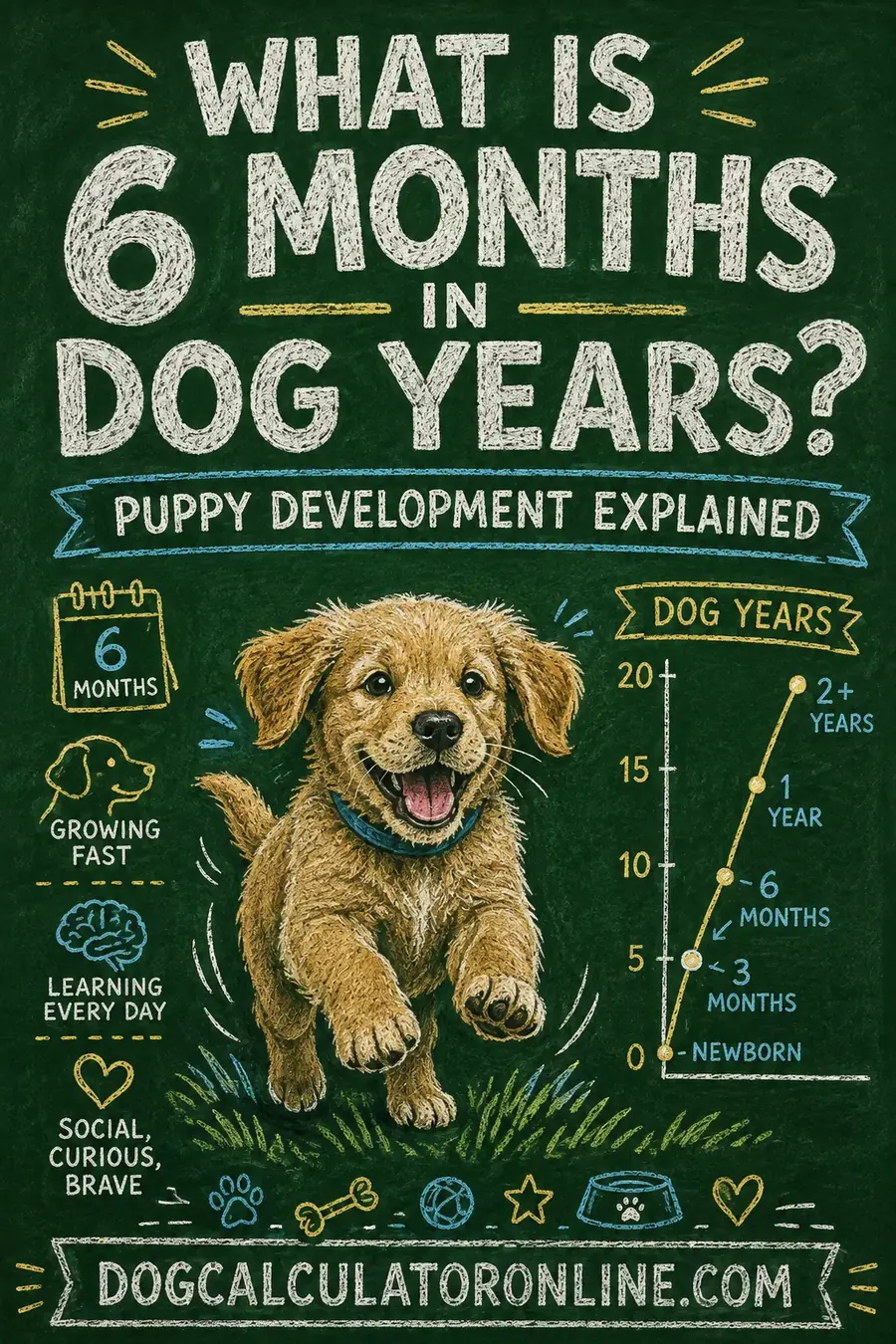
A 6-month-old puppy is roughly equivalent to a 10-year-old human in developmental terms — already well past infancy, but nowhere near fully grown or mentally mature. This is one of the most misleading points to apply the old "multiply by 7" rule, since it would suggest a 6-month-old puppy is only 3.5 in human terms — wildly understating how much development has actually happened by this age.
Why 6 Months Represents So Much Development
Puppies pack an enormous amount of physical and behavioral development into their first year, far faster than humans do. By 6 months old, most puppies have:
- Lost their baby teeth and grown a full set of adult teeth (this process typically finishes between 4-7 months)
- Reached 60-75% of their adult height, though total adult weight varies more by breed size and can take much longer to complete, especially for large breeds
- Entered or be approaching sexual maturity — many dogs can reproduce starting around 6 months, though full physical and mental maturity comes later
- Developed most core behavioral patterns, though adolescence (roughly 6 months to 18-24 months, depending on breed size) is often when the most challenging behavior shows up, as independence increases faster than judgment
Why "10 Human Years" Is a Reasonable Comparison
At 6 months, a puppy has the physical size and baseline capability that would take a human child roughly a decade to reach, but still has the impulse control, judgment, and behavioral consistency of someone much younger — which is a genuinely useful way to think about why 6-month-old puppies are simultaneously large, capable, and still frequently badly behaved. They look mature; they aren't yet.
What This Means for Training
Understanding that a 6-month-old puppy is developmentally more like a preteen than a toddler helps set realistic training expectations:
They can learn complex commands, since cognitive development is well underway by this point — most puppies can reliably learn sit, stay, come, and leash manners by 6 months with consistent training.
They still have limited impulse control, similar to how a real 10-year-old human can understand rules perfectly well but still struggle to consistently follow them under exciting or stressful circumstances. This is the single most common reason puppy training seems to "regress" around 5-8 months — the dog isn't forgetting what it learned, it's struggling to apply it under distraction.
Adolescence is beginning, not ending. Many owners expect a 6-month-old (already looking mostly grown, especially in smaller breeds) to behave like an adult dog. In reality, the most behaviorally challenging stretch — roughly 6 to 18 months for most breeds — is often just starting.
Physical Milestones Around 6 Months
Teething is finishing up. Most puppies have all 42 adult teeth in by around 6-7 months, which often coincides with a drop-off in destructive chewing behavior as the discomfort driving it resolves.
Growth plates are still open, especially in larger breeds. This matters for exercise — many vets recommend limiting high-impact activities (long runs on hard surfaces, jumping from height) until growth plates close, which can be well past a year old for larger breeds, to avoid joint damage during this vulnerable growth window.
Spay/neuter timing is a common topic around this age, since 6 months has traditionally been cited as a typical age for the procedure — though current veterinary guidance increasingly recommends timing based on breed size and individual growth rather than a fixed age for every dog, so this is worth discussing directly with your vet.
Comparing Across Breed Sizes
The general "10 human years at 6 months" estimate holds reasonably well across most breed sizes, since early development happens at a broadly similar pace regardless of eventual adult size — the size-based aging differences (large breeds aging faster in adulthood) become much more significant later, generally from around age 2 onward. For a precise, size-adjusted estimate at any specific age, a dog age calculator accounts for breed size in the calculation rather than using a single flat estimate.
What to Expect Behaviorally Right Around 6 Months
If your puppy suddenly seems like a different dog around this age, that's not your imagination — it's a genuinely distinct developmental window, and it helps to know what's normal:
Increased independence and testing boundaries. A puppy who reliably came when called at 4 months may suddenly seem to "forget" that skill at 6 months. This is adolescence starting, not regression — the same pattern shows up in human preteens who know the rules perfectly well but suddenly seem to forget them under excitement or distraction.
A second fear period. Many puppies go through a second, milder fear period somewhere around 6-14 months (the first is usually around 8-11 weeks), where something previously unremarkable — a vacuum, a stranger, a new object — suddenly gets a startled reaction. This is a normal part of neurological development, not a sign anything is wrong, and calm, unpressured exposure tends to work through it fastest.
More confident, sometimes pushier body language. As physical size and confidence increase, some puppies start testing social boundaries with people and other dogs in ways they didn't as very young puppies — consistent, patient boundary-setting now pays off enormously in adulthood.
Why Some Breeds Hit This Stage Differently
While the general "6 months, roughly 10 human years" comparison holds reasonably well across most breeds, a few things shift the picture:
Smaller breeds tend to mature faster in early puppyhood and may seem more "grown up" behaviorally by 6 months than a same-age large breed puppy, who is often still very much a gangly, physically uncoordinated adolescent despite an already-substantial size.
Working and herding breeds often show adolescent testing behavior earlier and more intensely than more laid-back breeds, simply due to higher baseline energy and drive — this isn't a training failure, it's breed temperament meeting a developmental stage that amplifies it.
Giant breeds are, in a real sense, "behind" a same-age small breed despite often already being quite large physically — their brains and impulse control are on a slower maturation timeline that doesn't catch up to their body size until well past a year old, which is part of why giant breed adolescence can feel disproportionately long to owners expecting size to correlate with maturity.
Setting Realistic Expectations for the Months Ahead
Knowing that 6 months is roughly the human-equivalent of a 10-year-old — not yet a teenager, but well past toddlerhood — helps calibrate what's reasonable to expect. You can expect real learning capacity and genuine understanding of trained commands. You should not expect the consistent impulse control of a mature adult dog, which typically doesn't fully arrive until somewhere between 18 months and 3 years depending on breed size. Patience through this specific stretch, rather than assuming something has gone wrong with training, is usually the single biggest factor in how smoothly the rest of adolescence goes.
Nutrition Considerations Right Around This Age
Six months is also a genuinely important nutritional checkpoint, worth mentioning alongside the developmental milestones above. Many puppy food formulas are specifically designed around the rapid growth phase of the first several months, and depending on your dog's projected adult size, this is often close to the window where a vet might discuss transitioning feeding amounts or timing toward a more adult-appropriate schedule, especially for smaller breeds that mature faster. Large and giant breeds generally stay on puppy-formulated food considerably longer, sometimes well past a year, specifically because their growth plates remain open longer and rapid nutritional shifts during that extended growth window carry real orthopedic risk. This is a conversation worth having directly with your vet around this age rather than assuming a fixed timeline applies to every dog regardless of size.
Setting Training Expectations for the Months Ahead
Understanding that a 6-month-old puppy is roughly equivalent to a 10-year-old — capable of real learning, but still years away from full impulse control — helps set training expectations for what's coming next, not just what's happening now. The next 12-18 months will likely include continued testing of boundaries, possibly a second fear period, and a gradual, non-linear improvement in reliability rather than the steady, predictable progress many new owners expect. Trainers who work regularly with adolescent dogs consistently emphasize that consistency and patience through this stretch — rather than assuming a training plateau means something has gone wrong — is what predicts a well-adjusted adult dog more reliably than almost any other single factor.
Four Months in Dog Years: The Stage Just Before This One
If your puppy is not there yet, the comparison two months earlier is useful, because the change between the two is dramatic.
Four months in dog years works out at roughly six to seven human years — a young grade-schooler rather than the teenager a six-month-old resembles. That maps onto what is actually happening. At four months the adult teeth are pushing through, chewing is at its most destructive, and the primary socialization window is closing, which makes the weeks either side of this age the highest-value time you will ever have for calm exposure to new people, surfaces, and sounds.
What separates four months from six:
- Teething is active at four months, mostly finished by six.
- Bladder control is still limited at four months — expect one accident-free hour per month of age, so roughly four.
- The second fear period has not started yet. It usually appears somewhere between six and fourteen months.
- Growth plates are wide open, so forced exercise and repetitive jumping matter even more than they will at six months.
In short, four months is childhood and six months is adolescence, and the training that works changes accordingly.
Frequently Asked Questions
Is a 6-month-old puppy considered an adult dog? No — most dogs aren't considered physically and behaviorally fully mature until somewhere between 1 and 2 years old, with larger breeds generally taking longer to fully mature than smaller breeds.
Why does my 6-month-old puppy seem to have forgotten its training? This is extremely common and usually isn't actually forgetting — it's adolescence. Around this age, impulse control often temporarily lags behind physical size and prior learning, similar to how a preteen can know rules perfectly well but still struggle to consistently follow them, especially when excited or distracted.
Should a 6-month-old puppy still be teething? Teething is generally wrapping up around this age for most dogs, with the full set of 42 adult teeth typically in place by 6-7 months, though some individual variation exists.
Does breed size affect how developed a puppy is at 6 months? Early development (teething, initial height growth, reaching sexual maturity) happens at a broadly similar pace across most breed sizes, but larger breeds generally take longer to reach full adult weight and complete physical maturity, sometimes not finishing until 18-24 months or later.
Is 6 months a good age to start formal obedience classes? Yes — many trainers consider 6 months an ideal window to begin or continue more structured obedience training, since the puppy has enough cognitive development to genuinely learn while still early enough in adolescence to build good habits before independence peaks.
Should a 6-month-old puppy be fully vaccinated by this point? Most core puppy vaccination series are completed by around 16-20 weeks, so a 6-month-old puppy should generally be fully covered on the initial core series, though it's always worth confirming the exact schedule with your own vet.
Why does my 6-month-old puppy seem bigger than expected for their breed? Growth rates vary meaningfully even within a breed, and some individual dogs simply grow faster or end up larger than typical breed averages — if you have specific concerns, your vet can help assess whether your puppy's growth trajectory looks appropriate.
Do all puppies go through adolescence at exactly 6 months? No — the timing varies by individual and breed, with adolescence generally starting somewhere between 5 and 8 months and extending well beyond a year, so 6 months is a reasonable midpoint reference rather than a precise universal marker.
Should I expect my puppy's personality to change permanently during this stage? Not permanently — the testing, independence, and occasional regression seen during adolescence are a developmental phase, not a fixed personality shift, and most dogs settle into a calmer, more consistent temperament once they reach full maturity.
Do male and female puppies reach the 6-month milestone differently? Development is broadly similar between sexes at this age, though females sometimes reach physical maturity slightly earlier than males of the same breed, a pattern that becomes more noticeable later in adolescence than right at 6 months.
Is it normal for a 6-month-old puppy's appetite to change noticeably? Yes — as growth rate begins gradually slowing after the fastest early growth phase, some puppies show a modest natural dip in appetite around this age, though a dramatic change is still worth mentioning to your vet.