10 Dog Years in Human Years: How Old Is a 10-Year-Old Dog?
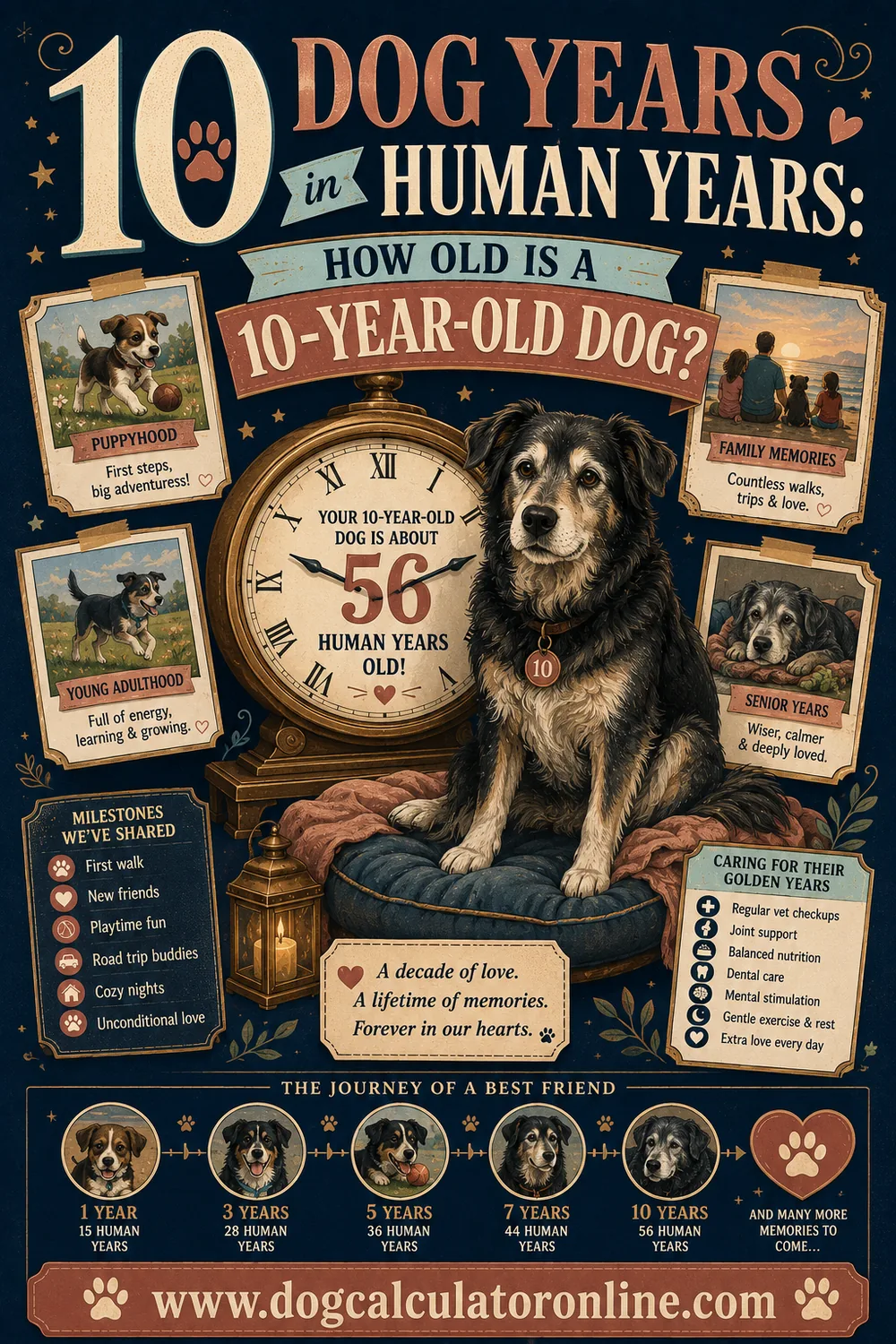
A 10-year-old dog is about 56 to 80 in human years, depending on size: roughly 56 for a small dog, 64 for a medium, 72 for a large, and 80 for a giant breed. Double digits is a real milestone — late middle age for the littlest dogs, deep retirement for the biggest.
For your dog's exact number, the free dog age calculator runs the vet-backed size-adjusted math plus the 2019 DNA-study formula instantly. Here's what turning 10 means, size by size.
🐾 Quick check: how old is a 10-year-old dog?
Tap your dog’s size class to see the human-year equivalent at age 10:
Tap a size above to see the answer.
The Short Answer: 10 Dog Years ≈ 56–80 Human Years
The size-adjusted guideline used by veterinary organizations assigns about 15 human years to a dog's first year, 9 to the second, then 4–7 per year based on adult weight. At age 10, that's 24 plus eight size-adjusted years:
| Size class | Adult weight | Math | 10 dog years in human years |
|---|---|---|---|
| Small | Under 20 lb | 24 + (8 × 4) | ≈ 56 |
| Medium | 21–50 lb | 24 + (8 × 5) | ≈ 64 |
| Large | 51–90 lb | 24 + (8 × 6) | ≈ 72 |
| Giant | Over 90 lb | 24 + (8 × 7) | ≈ 80 |
The old 7:1 rule flattens all of this to 70 — too old for a small dog by 14 years, too young for a giant by 10. At age 10 the spread between a Chihuahua and a Great Dane is a full 24 human years. No single multiplier can describe both dogs.
Double Digits: What Age 10 Means by Size
- Small breeds (≈56): Genuinely senior now, but often gloriously so. Many small dogs at 10 still walk briskly, play daily, and have 4–6 years ahead. Think active-56-year-old energy.
- Medium breeds (≈64): Fully retired. A 10-year-old Beagle or Border Collie mix has earned slower mornings, though many stay spry with good weight and joint care.
- Large breeds (≈72): Elderly. Labs and Shepherds who reach 10 are doing well — this is the stage of shorter walks, softer beds, and twice-yearly vet visits.
- Giant breeds (≈80): Remarkable. A 10-year-old Great Dane has outlived the typical 8–10 year lifespan for the giants. Every month is a gift; comfort is the whole care plan.
Reaching 10 is common for small dogs, typical for mediums, an achievement for large breeds, and exceptional for giants. Wherever your dog lands, double digits is a birthday worth celebrating properly — extra-long sniff walk included.
The DNA Study's Answer: About 68
The 2019 UC San Diego epigenetic study compared DNA methylation patterns — chemical marks that accumulate with age — between about a hundred Labrador Retrievers and humans, yielding:
Human age = 16 × ln(dog age) + 31
For age 10: 16 × ln(10) + 31 ≈ 68 human years.
That lands neatly between the guideline's medium (64) and large (72) answers — fitting, since Labradors sit at the medium-large boundary. Two things worth knowing about the formula at this age:
- The curve has gone nearly flat. By the DNA clock, a 10-year-old measures 68 and a 14-year-old only 73. Most molecular aging, by this measure, happened years ago.
- It remains a Labrador formula. The researchers cautioned that other breeds may follow different curves, so the size-adjusted guideline — which explicitly accounts for your dog's weight class — remains the practical tool.
The free dog age calculator shows both numbers side by side, which makes for a fun comparison at exactly this age, where the two methods roughly agree for mid-sized dogs.
Life With a 10-Year-Old Dog
Most double-digit dogs share a recognizable rhythm, whatever their breed:
- Sleep expands. Senior dogs commonly sleep 14–18 hours a day. Longer naps are normal; difficulty getting comfortable, restless nights, or nighttime pacing are worth a vet conversation.
- Enthusiasm outlives stamina. The ball is still exciting; the twentieth throw is not. Let your dog set the pace, and end games while they're still fun.
- Senses soften. Some hearing and vision loss is typical. Dogs adapt astonishingly well — many owners don't notice until the doorbell stops working. Keep furniture layouts stable for a dog with fading sight, and switch to hand signals early if hearing dims.
- Weather matters more. Cold stiffens old joints; heat taxes old hearts. Ten-year-olds appreciate climate-considerate scheduling.
- The mind may wander. Some senior dogs develop cognitive changes — standing in corners, forgetting routines, confusion at night. Mention anything like this to your vet; early support helps.
None of these are emergencies. All of them are information. The unglamorous superpower of a good senior-dog owner is noticing things and reporting them at the next checkup, which — for most dogs this age — should now come twice a year.
Helping a 10-Year-Old Thrive
The care plan for a double-digit dog, in rough priority order (details are your vet's department):
- Twice-yearly exams with senior bloodwork. At this compressed life stage, six months is the equivalent of 2–4 human years. Labs catch kidney, liver, and thyroid trends while they're still just trends.
- Ruthless weight management. Every extra pound burdens 10-year-old joints and organs. Lean seniors move better, breathe easier, and — per the well-known Labrador lifespan research — live longer.
- Daily gentle exercise. Muscle is a senior dog's mobility insurance. Two or three easy walks beat one ambitious one; swimming is superb where available.
- Comfort engineering. Orthopedic bed, rugs on slick floors, ramps for the car or couch, raised bowls for tall dogs. Cheap fixes, daily payoff.
- Dental attention. Painful mouths make picky eaters. If breath is foul or chewing looks careful, the teeth need a professional look.
- Keep the brain busy. Sniffing is effortless enrichment for old dogs — slow "sniffari" walks, scatter feeding, snuffle mats.
Celebrating a Double-Digit Dog (Yes, Really)
Ten deserves a party — and senior-friendly celebration ideas double as enrichment, which older dogs need as much as younger ones:
- The long sniff walk. Pick a new route and let your dog set the pace and read every fire hydrant. Sniffing is low-impact, mentally rich, and the activity most old dogs visibly love best.
- A food puzzle "cake." A snuffle mat or slow-feeder loaded with their regular kibble plus a few vet-approved extras beats a sugary human cake (which should stay off the menu entirely).
- The greatest-hits tour. Revisit a favorite park, creek, or friend. Familiar joys land deeper at this age than novel chaos.
- A comfort upgrade as the gift. Orthopedic bed, car ramp, or a set of traction rugs — presents your dog will use daily for years.
It sounds sentimental, but there's a practical core: dogs who keep receiving exercise, novelty, and social time in their senior years stay behaviorally younger. Enrichment isn't a luxury at 10 — it's maintenance.
Partial Ages and the Fine Print of the Math
For the precisionists: age 10 is 24 human years for the first two dog years, plus eight size-adjusted years. In-between ages pro-rate cleanly — a 10-and-a-half-year-old medium dog is 64 + (0.5 × 5) ≈ 66.5, and a large dog at 10 years 4 months is 72 + (0.33 × 6) ≈ 74.
Two classification notes that matter more at this age than any other:
- Use healthy adult weight, not senior weight. Dogs often lose muscle late in life; a German Shepherd who has slimmed to 48 lb at 10 is still a large-class ager.
- Mixed sizes take the nearest class. A 55-lb mix ages like a large dog; a 19-lb terrier mix like a small one. When in doubt between two classes, the true answer sits between their numbers — at age 10, one class is 8 human years, so it's worth being thoughtful.
Or skip the fine print: the free dog age calculator takes years, months, and weight, and returns the properly adjusted answer instantly.
How 10 Compares to the Ages Around It
Zooming out one step in each direction puts the milestone in context. At 8 dog years, a medium dog was about 54 — pre-retirement, still cruising. By 12, that same dog will be about 74. So the two years on either side of 10 each carry roughly a decade of human-equivalent aging for mid-sized dogs, and more for large ones.
That's the practical argument for treating 10 as a checkpoint rather than just a birthday. Habits you lock in now — lean weight, daily walks, six-month vet visits — pay off across what amounts to 10–16 human-equivalent years between now and age 12. Few investments in a dog's life compound faster than the ones made at double digits.
Related Guides
If this helped, these go deeper on the same question:
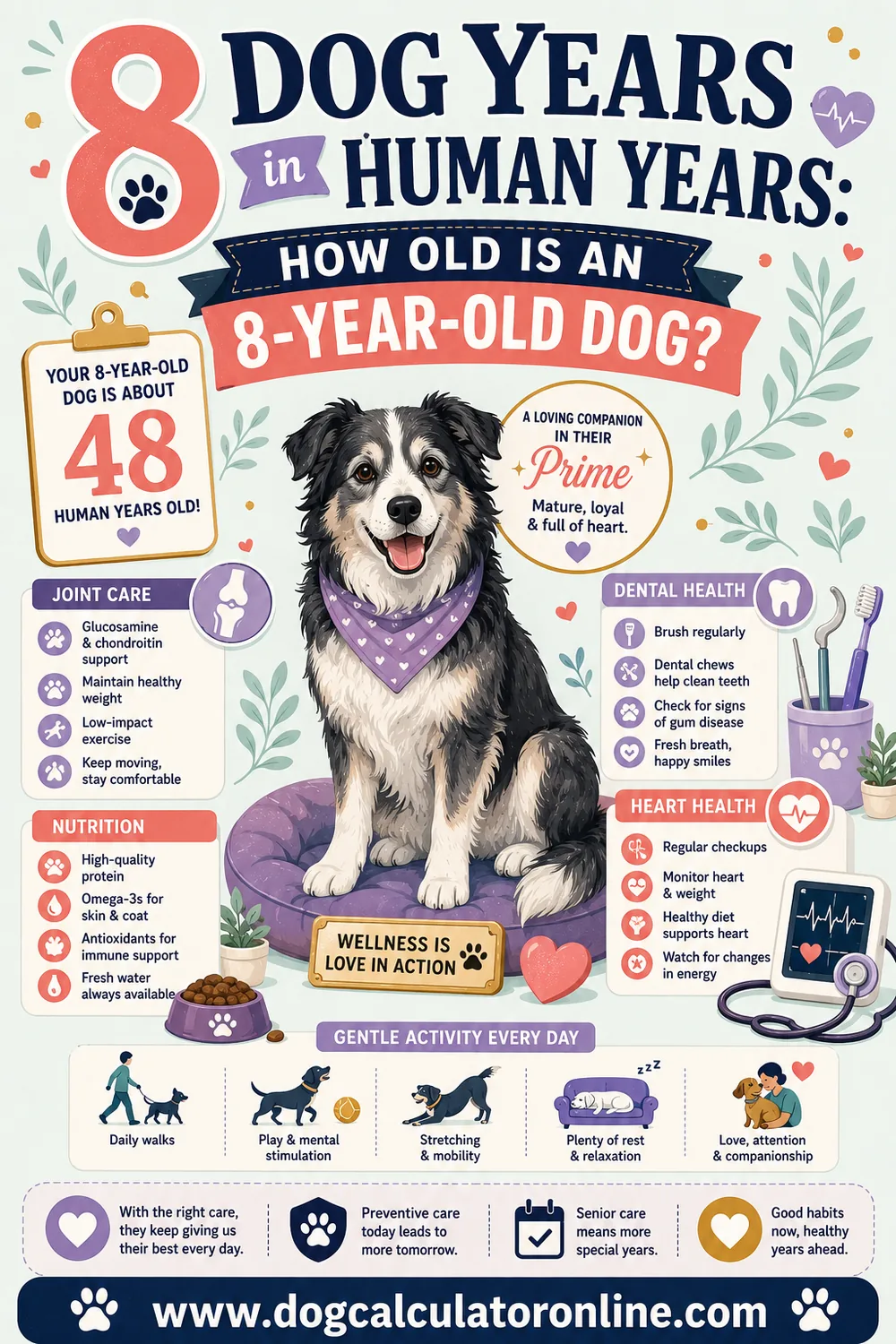
- 8 Dog Years in Human Years: How Old Is an 8-Year-Old Dog?
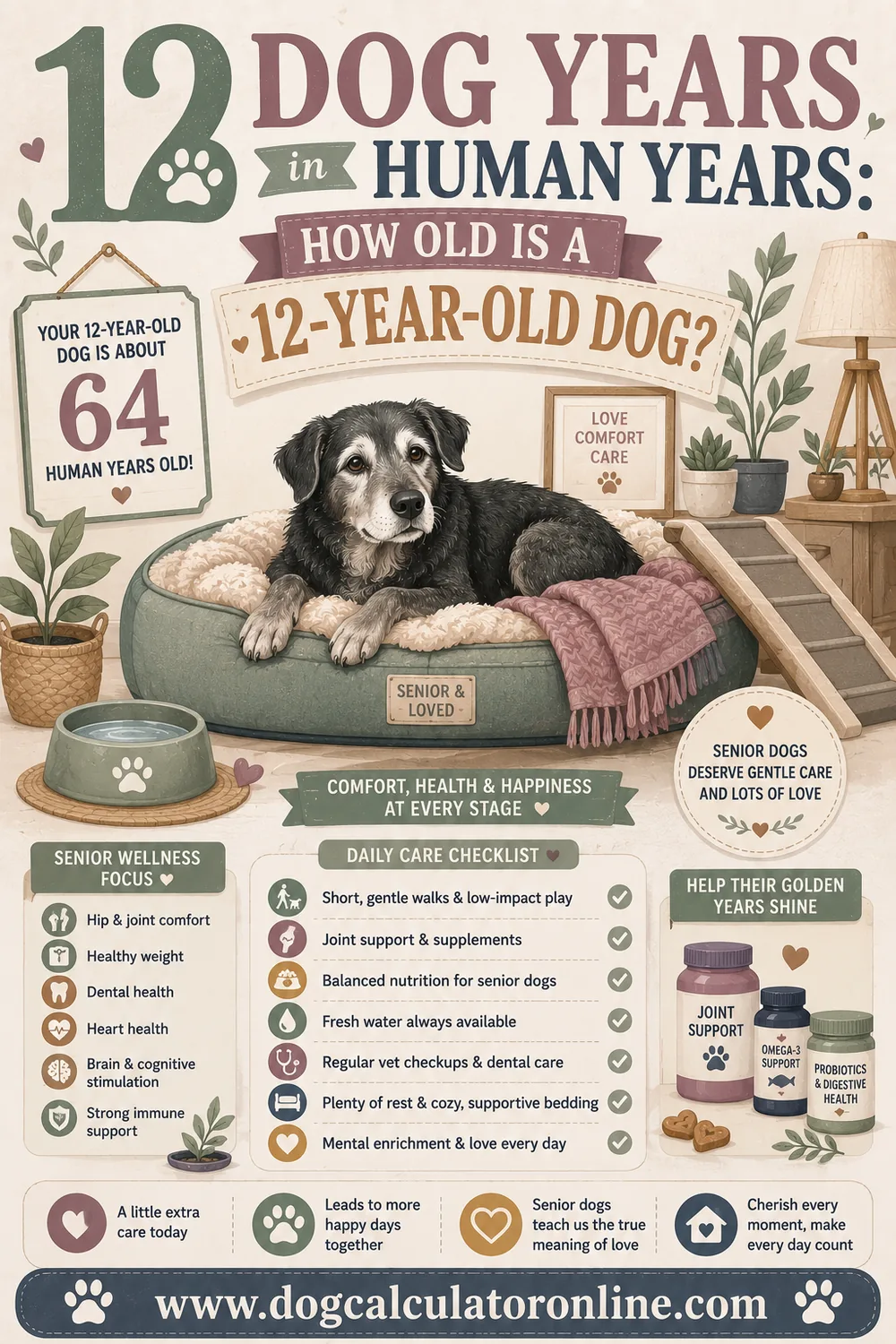
- 12 Dog Years in Human Years: How Old Is a 12-Year-Old Dog?
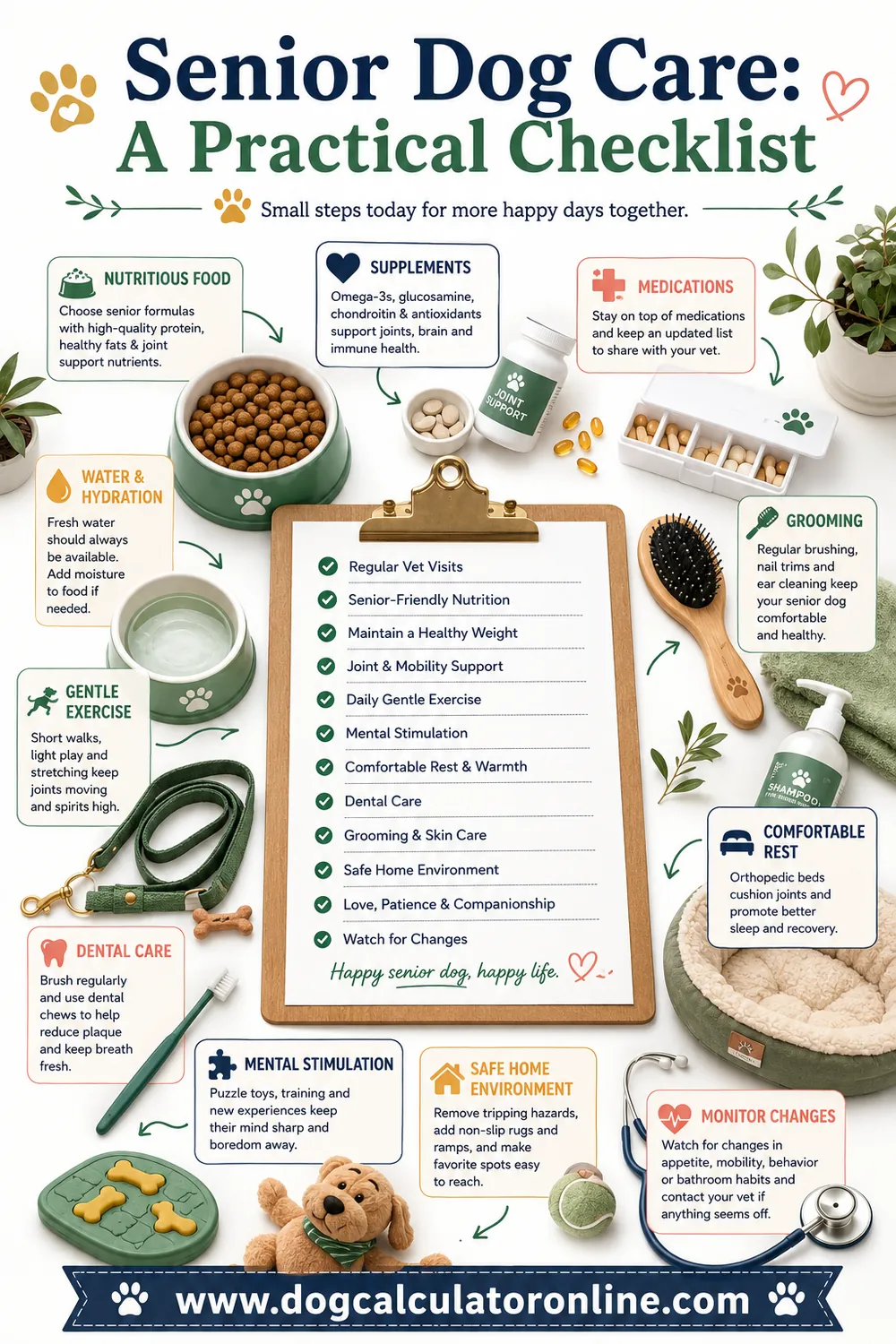
- Senior Dog Care: A Practical Checklist
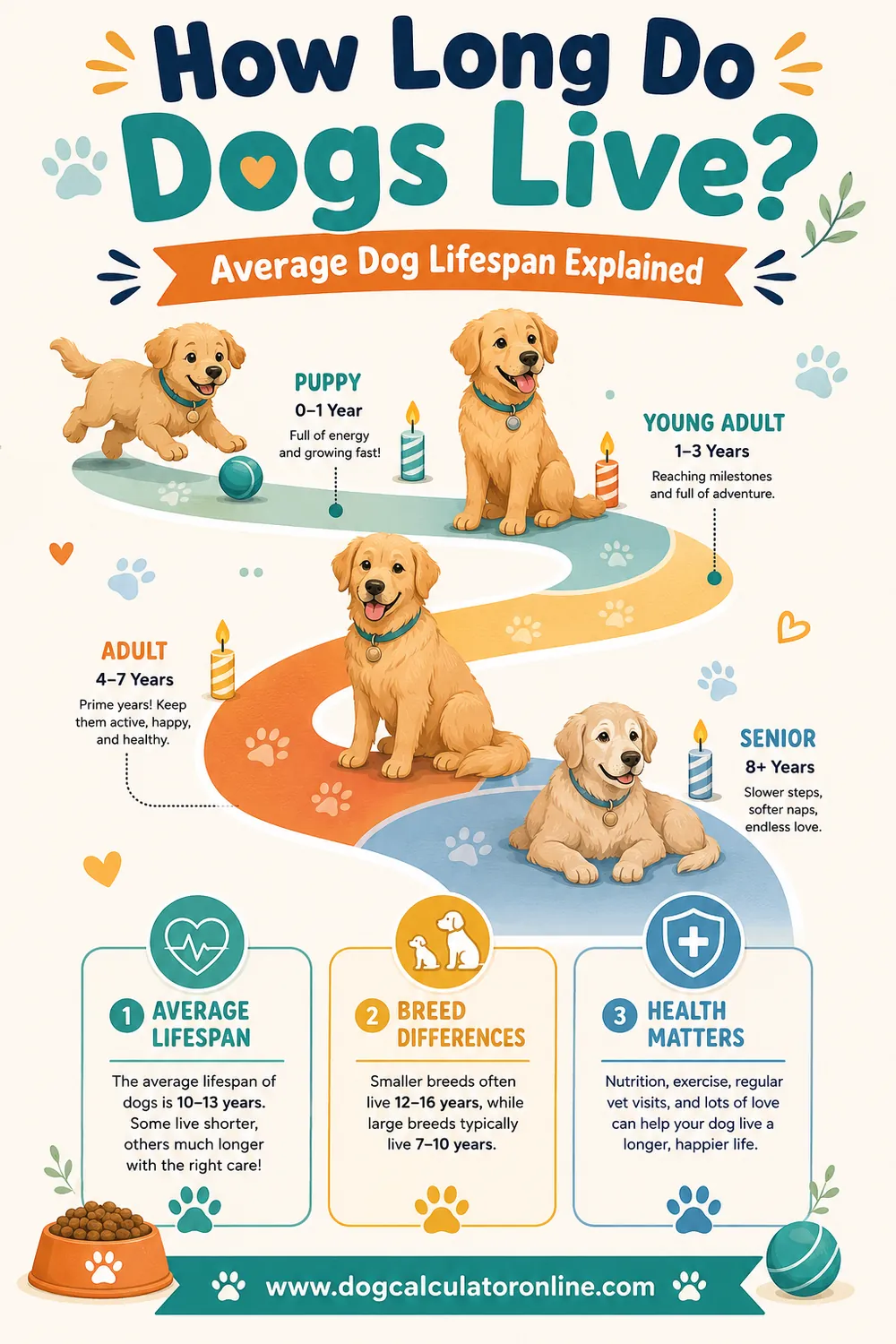
- How Long Do Dogs Live? Average Dog Lifespan Explained
And if you just want your own dog's number, the free dog age calculator does it in one tap.
FAQ
How old is a 10-year-old dog in human years?
About 56–80 depending on size: 56 for small dogs, 64 for medium, 72 for large, and 80 for giant breeds, per the vet-backed size-adjusted method.
Is a 10-year-old dog 70 in human years?
Only by the outdated 7:1 myth. The real range runs from 56 (small) to 80 (giant) — at this age the myth can be off by 10–14 years in either direction.
Is 10 old for a dog?
It depends on size. For small breeds, 10 is senior but often very healthy. For giant breeds, 10 exceeds the typical lifespan. Mediums and larges at 10 are solidly in their senior years.
What does the DNA study say a 10-year-old dog is?
About 68 human years, from the 2019 UCSD formula. At this age it roughly agrees with the size-adjusted guideline for medium-large dogs — the breeds closest to the Labradors it was built on.
How much longer might a 10-year-old dog live?
Against typical lifespans: small breeds often 4–6 more years, mediums 2–4, large 0–2, giants are already past average. Individual health and weight move these numbers a lot — ask your vet about your dog.
Should a 10-year-old dog see the vet more often?
Most vets recommend twice-yearly exams for dogs this age, usually with senior bloodwork. Age-related changes develop fast in dog-time; six-month intervals catch them earlier.
The Bottom Line
Ten dog years equal about 56–80 human years — late-fifties vitality for the smallest dogs, a distinguished 80 for the giants. Double digits calls for the full senior toolkit: twice-yearly vet care, lean portions, gentle daily movement, and generous comfort upgrades.
See exactly where your dog lands — size-adjusted, with the DNA-study figure alongside — free at the dog age calculator.