How Old Is My Dog in Dog Years?
"Dog years" usually means one of two things, and the confusion is exactly why people ask. Most often, people mean human years — as in "how old is my dog in human-equivalent years?" The accurate answer uses the size-adjusted method: a dog's first year equals about 15 human years, the second adds 9 more, and each year after that adds 4 to 7 depending on size. A 5-year-old medium dog is about 39 in human years.
The fastest way to settle it for your own dog is our free dog age calculator — enter age and weight, and it shows both the human-equivalent age and the DNA-study version in seconds.
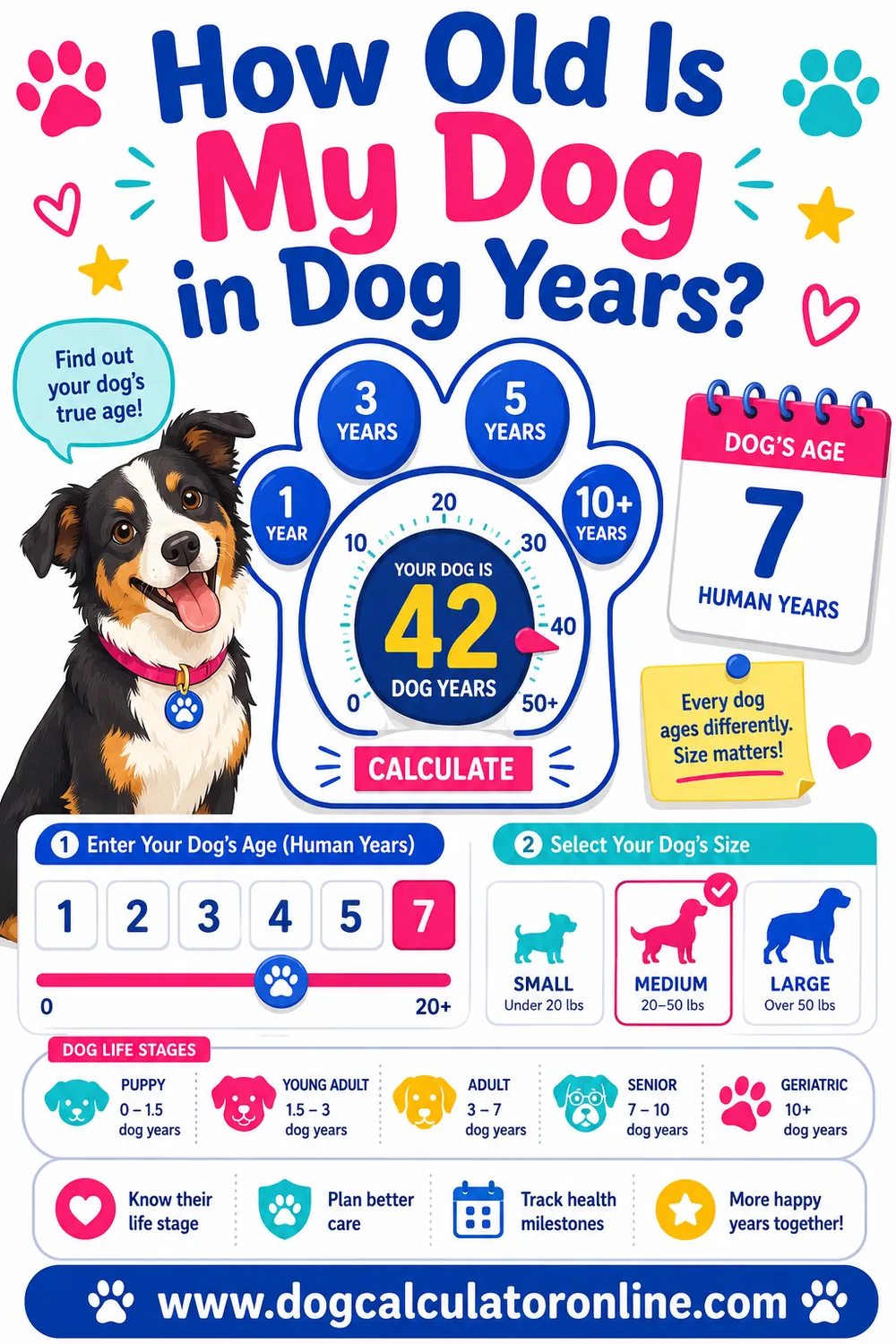
🐾 Your dog’s age in human years
Tap your dog’s real age to see the human-year equivalent (medium breed):
Tap an age above.
What "Dog Years" Really Means
The phrase "dog years" is genuinely ambiguous, and both meanings float around:
- Meaning 1 (most common): human-equivalent years. When someone says "she's 70 in dog years," they mean their dog is like a 70-year-old human. This is really "human years," but everyone calls it dog years. It's what the vast majority of people are asking.
- Meaning 2 (literal): calendar years the dog has lived. A dog's actual age — the number of birthdays. A "3-year-old dog" has lived three years, full stop.
If you're wondering "how old is my dog in dog years," you almost certainly want Meaning 1: how old your dog is in human-equivalent terms. So let's answer that properly.
The Accurate Answer: The Size-Adjusted Method
Forget "multiply by 7" — that rule is a myth (a 1-year-old dog can reproduce; a 7-year-old child can't). Veterinary organizations use a size-adjusted guideline instead:
- Year 1 ≈ 15 human years. Puppies race to young adulthood in twelve months.
- Year 2 ≈ +9 human years. So a 2-year-old dog is about 24, regardless of size.
- Each year after adds 4–7 human years, by size class:
| Size class | Adult weight | Added per year (after age 2) |
|---|---|---|
| Small | Under 20 lb | +4 |
| Medium | 21–50 lb | +5 |
| Large | 51–90 lb | +6 |
| Giant | Over 90 lb | +7 |
That's the whole system. It reflects two truths a flat multiplier ignores: dogs mature fast early, and bigger dogs age faster than smaller ones.
Your Dog's Age at a Glance
Here's how real ages translate to human-equivalent years across the size classes:
| Dog's real age | Small | Medium | Large | Giant |
|---|---|---|---|---|
| 1 | 15 | 15 | 15 | 15 |
| 2 | 24 | 24 | 24 | 24 |
| 3 | 28 | 29 | 30 | 31 |
| 5 | 36 | 39 | 42 | 45 |
| 7 | 44 | 49 | 54 | 59 |
| 10 | 56 | 64 | 72 | 80 |
| 13 | 68 | 79 | 90 | 101 |
Notice how the columns fan apart with age. At year one they're identical; by year ten a small dog is 56 while a giant is 80. That's why "how old is my dog in dog years" has no single answer without knowing your dog's size — and why our dog age calculator asks for weight.
Why the Size Difference Is So Big
It's one of biology's oddities: within dogs, bigger means faster-aging and shorter-lived, the reverse of the between-species rule. The leading reasons:
- Rapid growth. A giant-breed puppy multiplies its birth weight over a hundredfold in under two years; that explosive cell division appears to speed aging and raise cancer risk.
- Higher IGF-1. Larger dogs carry more of this growth hormone, which is linked to faster aging across species.
- Earlier disease onset. Big dogs develop arthritis, heart disease, and cancers at younger calendar ages.
So a 7-year-old Great Dane (about 59 in human years) is genuinely a senior, while a 7-year-old Chihuahua (about 44) is barely middle-aged. Same birthday, very different lives.
Where the 7:1 Rule Came From (And Why It Stuck)
The "multiply by 7" rule wasn't ever based on biology — it seems to have grown out of simple lifespan division. Humans lived roughly 70 years, dogs roughly 10, so someone drew a straight line: one dog year, seven human years. Tidy, memorable, and printed on enough posters and pet-food ads over the decades to feel official.
The problem is that aging isn't a straight line for either species. Dogs compress childhood, adolescence, and young adulthood into their first two years, then coast; humans spread it over twenty-five. A flat multiplier can't bend that way — it makes a 1-year-old dog a "7-year-old child" (despite being able to reproduce) and an ancient 18-year-old dog a "126-year-old" (older than any human ever recorded). The rule survived on catchiness, not accuracy — the size-adjusted method replaced it precisely because it follows the real curve.
The DNA-Study Angle
In 2019, researchers at UC San Diego measured aging directly using DNA methylation — chemical marks that change with age — and derived a formula from Labrador Retrievers:
Human age = 16 × ln(dog age) + 31
It produces "older" numbers for young dogs (a 1-year-old Lab looks like a 31-year-old human at the DNA level) and then flattens sharply. It's a fascinating molecular second opinion, but it was built on one breed and measures cellular aging rather than life stage. For everyday questions — when to switch to senior food, when to add twice-yearly checkups — the size-adjusted method maps better onto how dogs actually live. Our calculator shows both so you can compare.
Wait — What If I Mean My Dog's Actual Age?
If you genuinely mean the literal count of years your dog has lived and you don't know it (common with rescues), you estimate it from physical clues:
- Teeth are the best guide: needle-sharp baby teeth mean under ~4 months; a full set of clean white adult teeth means roughly 7 months to 2 years; tartar and wear build up with age.
- Eyes develop a bluish haze (normal lens aging) around 6–8 years.
- Muzzle gray typically starts around 5–7 years.
- Muscle and energy shift from lanky-and-bouncy to filled-out-and-calm with maturity.
Your vet can give a solid estimate at a checkup. Once you have a calendar age, feed it and your dog's weight into the dog age calculator to get the human-equivalent number too.
Putting It Together
Say you have a 6-year-old, 60-pound (large) rescue mix. Real age: 6. Human-equivalent: 15 + 9 + (4 years × 6) = 48 in human years — squarely middle-aged. That single number tells you a lot: it's time for baseline bloodwork, a hard look at body weight, and a plan to start twice-yearly vet visits in a year or two as she crosses into her senior years.
That's the real value of the question. "How old is my dog in dog years" isn't trivia — the answer sets your whole care calendar.
Milestone Birthdays: When Does Your Dog Turn 21, 40, or 65?
A fun way to flip the question: instead of converting your dog's age, ask when your dog hits the human milestones. Running the size-adjusted math backwards gives you this:
| Human milestone | Small dog | Medium dog | Large dog | Giant dog |
|---|---|---|---|---|
| 21 (legally an adult) | ~1 yr 8 mo | ~1 yr 8 mo | ~1 yr 8 mo | ~1 yr 8 mo |
| 30 (proper grown-up) | ~3.5 yrs | ~3 yrs | ~3 yrs | ~3 yrs |
| 40 (middle age knocks) | ~6 yrs | ~5 yrs | ~4.5–5 yrs | ~4.5 yrs |
| 65 (retirement age) | ~12 yrs | ~10 yrs | ~9 yrs | ~8 yrs |
Every dog "turns 21" before their second birthday — the early curve is that steep for all sizes. The milestones only drift apart afterward: a small dog doesn't reach "retirement age" until around 12, while a giant breed gets there by 8. If you like an excuse for a dog party, the day your pup hits human-21 is a solid one.
Why People Keep Asking This Question
The phrase sticks around because it does something useful: it translates a dog's age into terms we feel in our bones. "My dog is 9" doesn't land emotionally the way "my dog is like a 59-year-old" does. Suddenly you picture someone easing into their later years — and you understand why the vet wants twice-yearly checkups now, why the long hikes should get a little shorter, why joint comfort matters.
That's the real payoff of converting to human-equivalent years. It's not trivia; it's a translation that makes good care decisions feel obvious. A number like "48 in human years" tells you your dog is middle-aged and it's time for baseline bloodwork. A number like "80 in human years" tells you to prioritize comfort, warmth, and gentle routines.
So when you ask "how old is my dog in dog years," you're really asking "what does my dog need from me right now?" — and the human-equivalent age answers that better than the calendar age alone ever could. Just remember to feed in your dog's size, since the same birthday means very different things for a Chihuahua and a Mastiff.
Related Guides
If this helped, these go deeper on the same question:
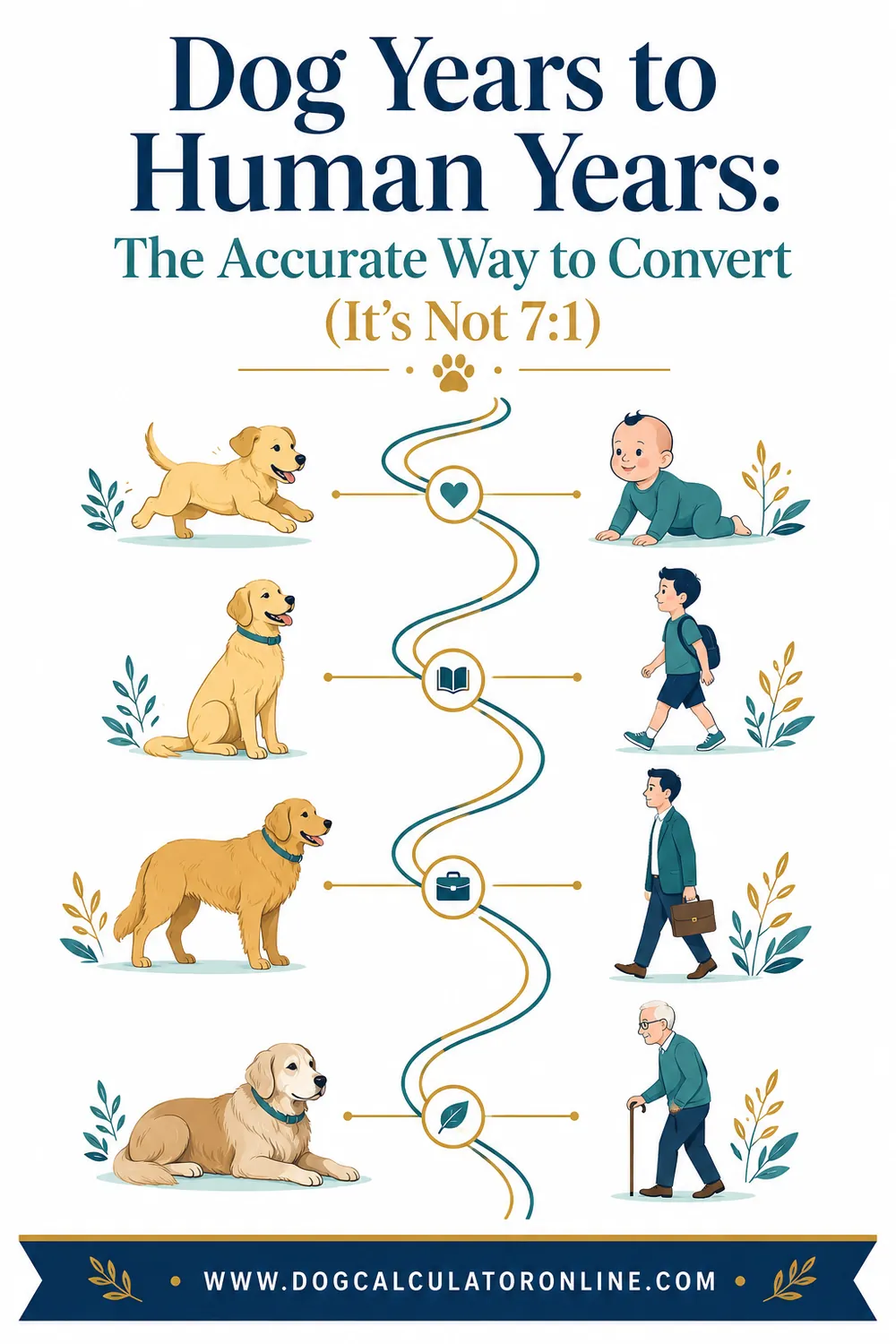
- Dog Years to Human Years: The Accurate Way to Convert (It's Not 7:1)
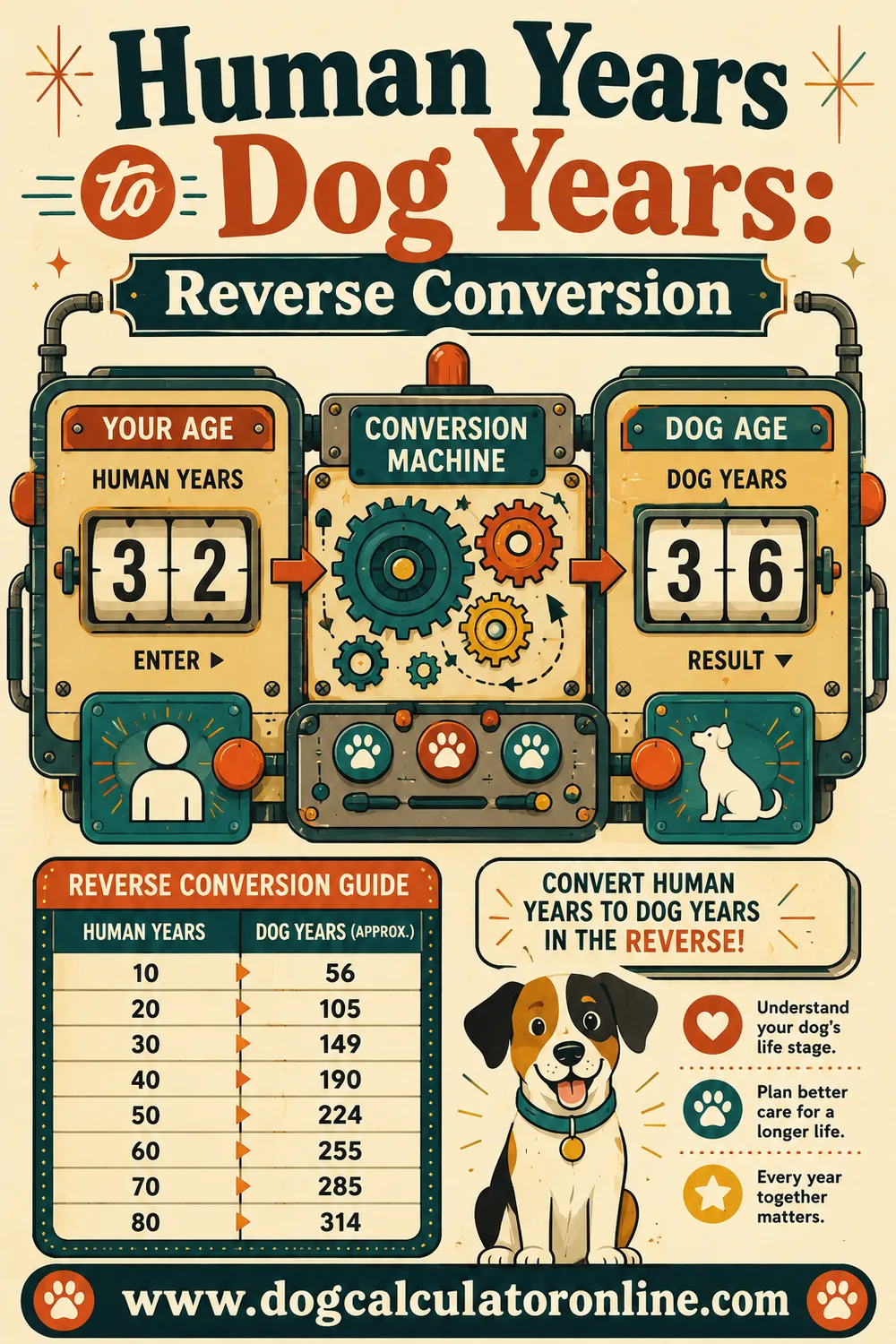
- Human Years to Dog Years: Reverse Conversion
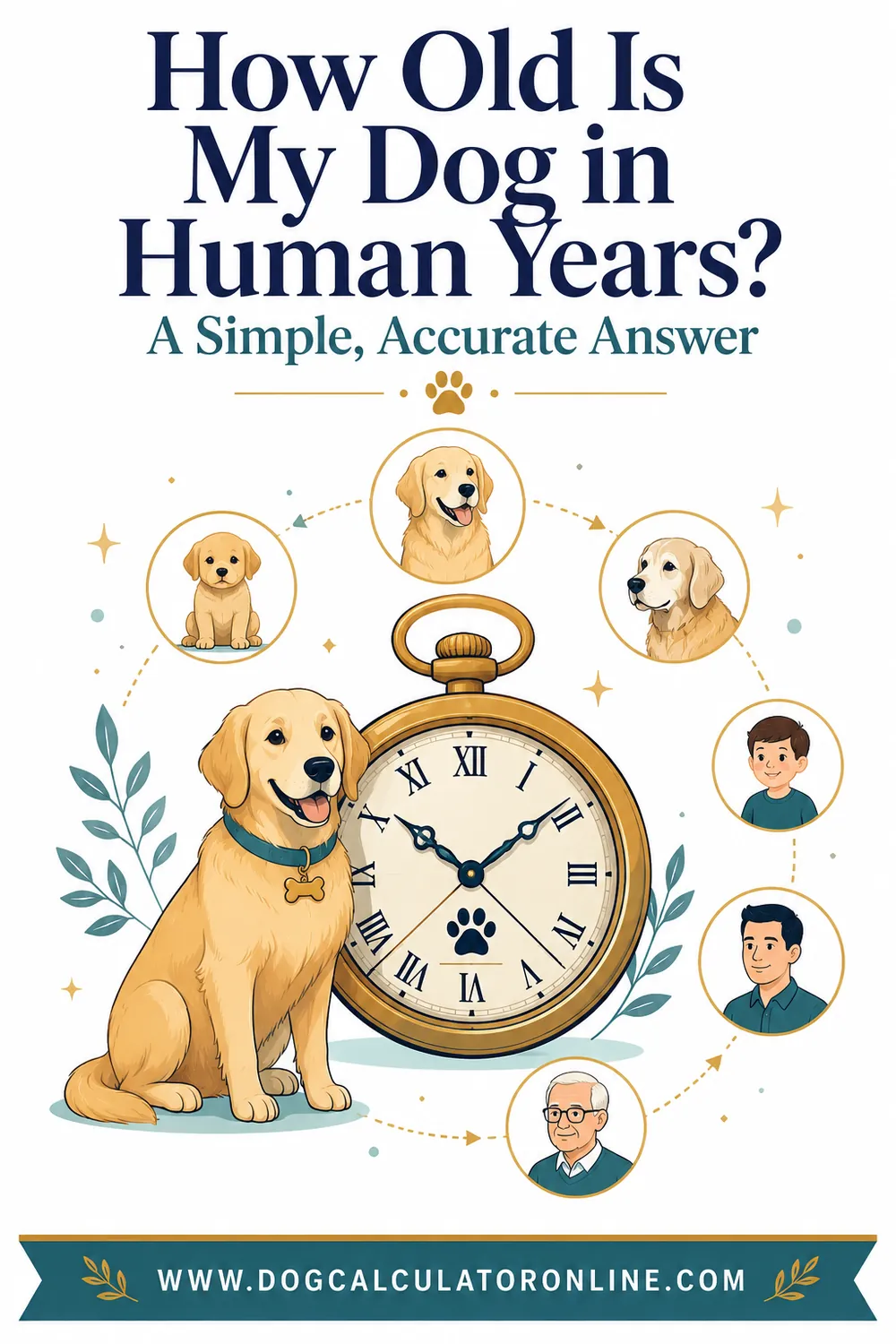
- How Old Is My Dog in Human Years? A Simple, Accurate Answer
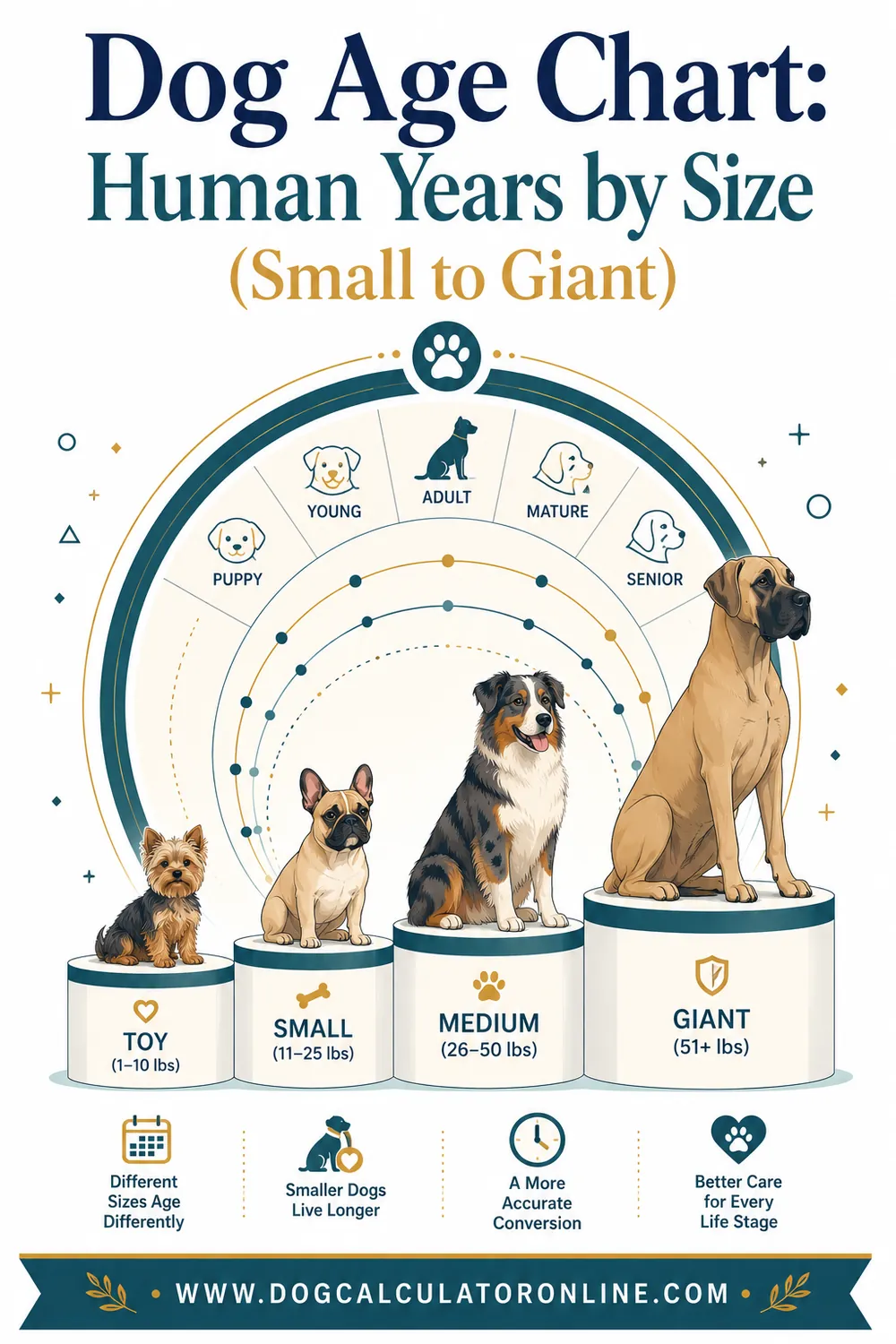
- Dog Age Chart: Human Years by Size (Small to Giant)
And if you just want your own dog's number, the free dog age calculator does it in one tap.
FAQ
How old is my dog in dog years?
Most people mean human-equivalent years. Using the size-adjusted method: year one ≈ 15 human years, year two adds 9, then each year adds 4–7 by size. A 5-year-old medium dog is about 39.
Is 1 dog year 7 human years?
No — that's a myth. A dog's first year is worth about 15 human years, not 7, and the rate changes with age and size. A flat multiplier can't describe the real curve.
Do "dog years" mean human years or actual years?
Usually human-equivalent years — "she's 70 in dog years" means she's like a 70-year-old human. Sometimes people mean the literal number of years lived. The size-adjusted method answers the first.
Does my dog's size change the answer?
A lot. At age 10 a small dog is about 56 in human years while a giant breed is about 80. Bigger dogs age faster, so size is essential to an accurate conversion.
How do I find my rescue dog's age?
Estimate from teeth (the best clue), eyes, muzzle color, and body condition — or have your vet estimate it. Then convert to human-equivalent years with the age and weight.
Where can I convert my dog's age instantly?
Our free dog age calculator gives both the size-adjusted human-equivalent age and the 2019 DNA-study version from your dog's age and weight.
Why do two calculators give me different dog-year numbers?
Usually because they use different methods. The size-adjusted (AVMA) method tracks real-life stages; the 2019 DNA-methylation formula tracks molecular aging and was built on Labradors. They answer different questions, so their numbers diverge — especially for young dogs. Neither is "wrong."
Does breed matter, or just size?
Size is the main driver of aging rate, so a good conversion needs your dog's weight above all. Breed adds nuance — some breeds are longer-lived than others within a size class — but for the age-in-human-years question, weight does most of the work.
Can my dog be "younger" than their dog-year age?
In a practical sense, yes. The conversion describes an average dog of that size — a lean, well-exercised 10-year-old with good teeth often looks and moves "younger" than the number suggests, while an overweight couch potato can run older. The number sets the screening schedule; the dog in front of you sets the pace.
The Bottom Line
"How old is my dog in dog years" almost always means "how old in human-equivalent years" — and the accurate answer is the size-adjusted method, not the discredited 7:1 rule. Fifteen for the first year, nine more for the second, then four to seven per year by size, with bigger dogs aging faster.
Skip the mental math: enter your dog's age and weight into the free dog age calculator and get the exact human-equivalent age — plus the DNA-study number — in one tap.