Human Years to Dog Years: Reverse Conversion
Converting human years to dog years reverses the usual math: instead of asking "how old is my dog in human terms," you're asking "what dog age matches this human age?" Because a dog's first year alone equals about 15 human years, the answer isn't a clean division. A human age of 24, for example, matches a 2-year-old dog — not a 3-year-old.
Our free dog age calculator handles both directions of the math using the size-adjusted method vets use, so you never have to work the reverse formula by hand.
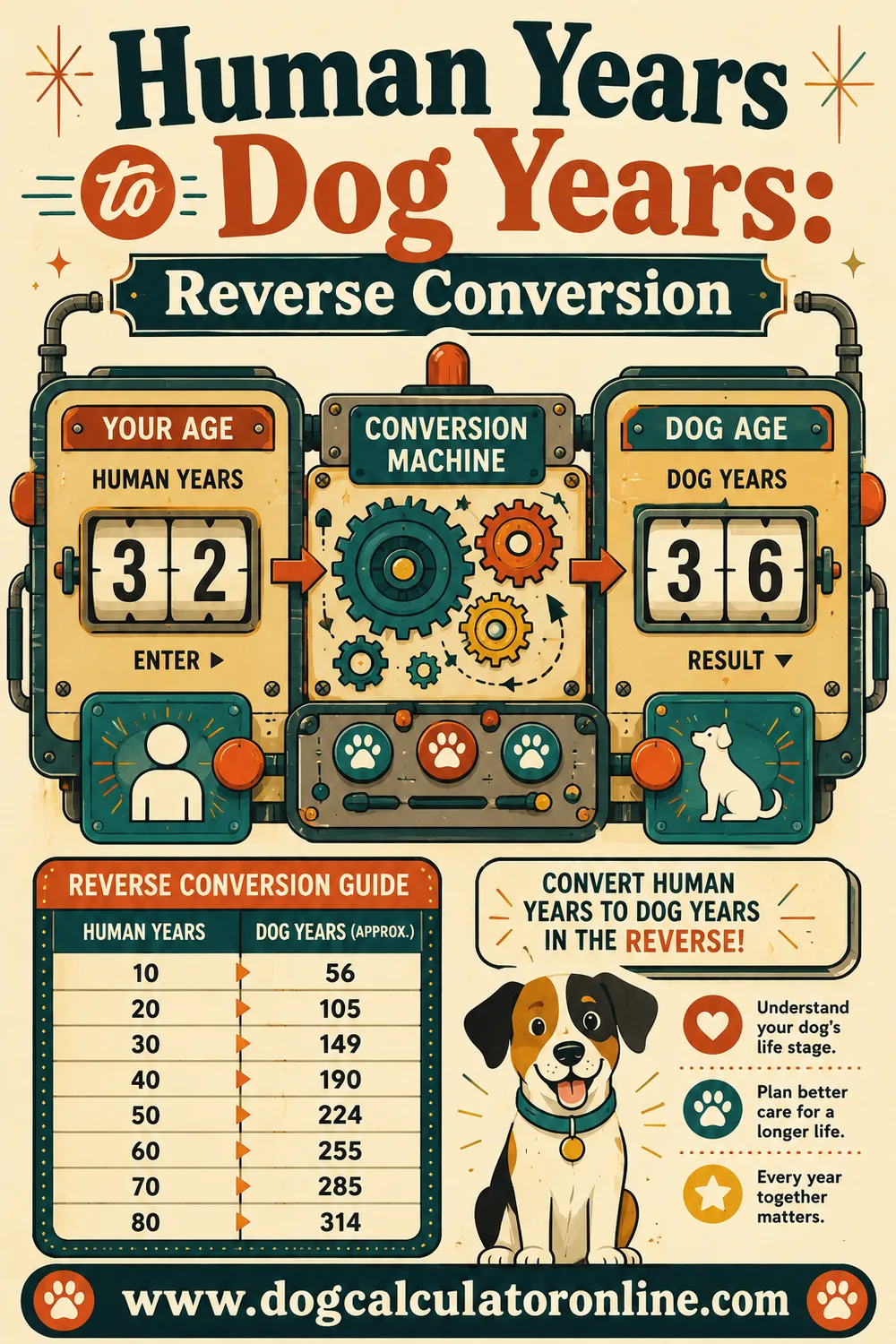
🐾 Human age → matching dog age
Tap a human age to see the roughly equivalent dog age (medium breed):
Tap a human age above.
Why Reverse Conversion Is Trickier Than It Looks
Most dog-age math runs one way: dog age in, human age out. Reversing it — human age in, dog age out — trips people up because dog aging isn't linear. A dog crams about 15 human years into its first 12 months, another 9 into its second, then slows to 4–7 human-equivalent years per calendar year depending on size.
So you can't just divide a human age by seven (that rule was never accurate anyway). To go backwards you have to "unwind" the same curve vets use forward. The good news: it's very doable with a table, and the dog age calculator does it in one tap.
The Size-Adjusted Method (Forward, So You Can Reverse It)
The standard veterinary guideline, which the reverse conversion undoes:
- Year 1 ≈ 15 human years.
- Year 2 ≈ +9 human years (so a 2-year-old dog ≈ 24).
- Each year after ≈ +4 to +7 human years, by size: +4 small, +5 medium, +6 large, +7 giant.
To reverse it, work down from a human age:
- If the human age is 15 or less → the dog is roughly 1 or younger.
- If it's between 15 and 24 → the dog is between 1 and 2.
- Above 24 → subtract 24, then divide the remainder by the size multiplier (4/5/6/7) and add 2.
Formula: dog age ≈ 2 + (human age − 24) ÷ (size multiplier), for human ages above 24.
Reverse Conversion Table
Here's the reverse mapping for a medium-sized dog (the +5 rate), which is the most common default:
| Human age | Equivalent dog age (medium) |
|---|---|
| 15 | 1 year |
| 24 | 2 years |
| 29 | 3 years |
| 34 | 4 years |
| 39 | 5 years |
| 44 | 6 years |
| 49 | 7 years |
| 59 | 9 years |
| 64 | 10 years |
| 74 | 12 years |
| 84 | 14 years |
Because the multiplier changes with size, the same human age maps to different dog ages across size classes:
| Human age | Small dog (+4) | Medium (+5) | Large (+6) | Giant (+7) |
|---|---|---|---|---|
| 40 | ~6 years | ~5 years | ~4.7 years | ~4.3 years |
| 50 | ~8.5 years | ~7 years | ~6.3 years | ~5.7 years |
| 60 | ~11 years | ~9 years | ~8 years | ~7.1 years |
Read that table sideways and the size story jumps out: a human age of 60 matches an 11-year-old small dog but only a 7-year-old giant breed. Big dogs reach any given "human age" in fewer calendar years.
Worked Examples
"I'm 30. How old would I be as a dog?"
Above 24, so: 2 + (30 − 24) ÷ 5 = 2 + 1.2 ≈ 3.2 years old as a medium dog. You'd be a young adult, past the adolescent phase, in your athletic prime.
"My grandmother is 72 — what dog age is that?"
2 + (72 − 24) ÷ 5 = 2 + 9.6 ≈ 11.6 years old for a medium dog. A senior, but for a small breed that same 72 maps to about age 14, and for a giant breed only about age 9.
"A newborn baby?"
Human age near 0 maps to a very young puppy — but this is where the analogy strains. A newborn puppy is far more developed than a newborn human within weeks. The conversion works best for adults; at the extreme young end, life stage beats arithmetic.
When Reverse Conversion Is Actually Useful
It's mostly a fun thought experiment — "what dog age am I?" — but it has a couple of genuine uses:
- Explaining a dog's life stage to kids or family. Saying "our dog is like a 70-year-old grandpa" lands better than "he's 11."
- Setting expectations for a rescue. If you know roughly how "old" a dog seems in human terms, you can reverse into a calendar-age estimate to guide care timing.
- Understanding the curve. Working the reverse math makes it obvious why the 7:1 rule fails — the multiplier isn't constant, so no single reverse division works either.
For the everyday question most owners actually have — how old is my dog in human years? — you want the forward conversion, which our dog age calculator also provides alongside the reverse.
Where People Get the Reverse Wrong
Two mistakes account for almost every bad reverse conversion:
- Dividing by seven. If someone hears "I'm 35" and answers "so 5 in dog years," they've used the debunked 7:1 rule backwards. It gives roughly the right ballpark by luck in the middle ages, but it's wildly off at the ends — it would make a 15-year-old human a 2-year-old dog (should be about 1) and a 70-year-old human a 10-year-old dog (should be about 11–12 for a medium breed). Close-ish sometimes, wrong often.
- Ignoring the flat first stretch. The curve isn't a straight line from zero. A human age of 15 already maps to a 1-year-old dog, and everything from 15 to 24 crams into the dog's second year. If you try to spread those human years evenly, you'll misplace every young-dog answer.
The reliable method is the size-adjusted formula: below a human age of 24 use the anchors (15 ≈ 1 year, 24 ≈ 2 years), and above 24 use dog age ≈ 2 + (human age − 24) ÷ your size multiplier. Or, as always, let the calculator carry the curve for you.
A Note on the DNA Formula
The 2019 UC San Diego epigenetic study produced a forward formula from Labrador DNA: human_age = 16 × ln(dog_age) + 31. You can algebraically reverse it too — dog_age = e^((human_age − 31) ÷ 16) — but it gets unintuitive fast, and it was built on one breed. For casual reverse conversion, the size-adjusted table above is friendlier and maps better onto real life stages. The calculator can show both.
A Quick Way to Do It in Your Head
You don't always have a calculator handy, so here's a mental shortcut that lands close for a medium dog:
- Anchor at 24 = 2 years. Memorize this one pair; it's the hinge of the whole conversion.
- For human ages above 24, subtract 24, then divide by 5, then add 2. Example: age 44 → (44 − 24) ÷ 5 = 4, plus 2 = a 6-year-old dog.
- For human ages between 15 and 24, the dog is between 1 and 2 — closer to 1 near 15, closer to 2 near 24.
- Adjust for size at the end: if the dog is small, nudge the result up a little (they age slower per year); if giant, nudge it down.
It won't be exact — the size adjustment and the rounding see to that — but it'll get you within a year, which is plenty for a dinner-table "so what age is that in dog years?" moment. For anything you actually want to be right, the dog age calculator does the precise version instantly.
Related Guides
If this helped, these go deeper on the same question:
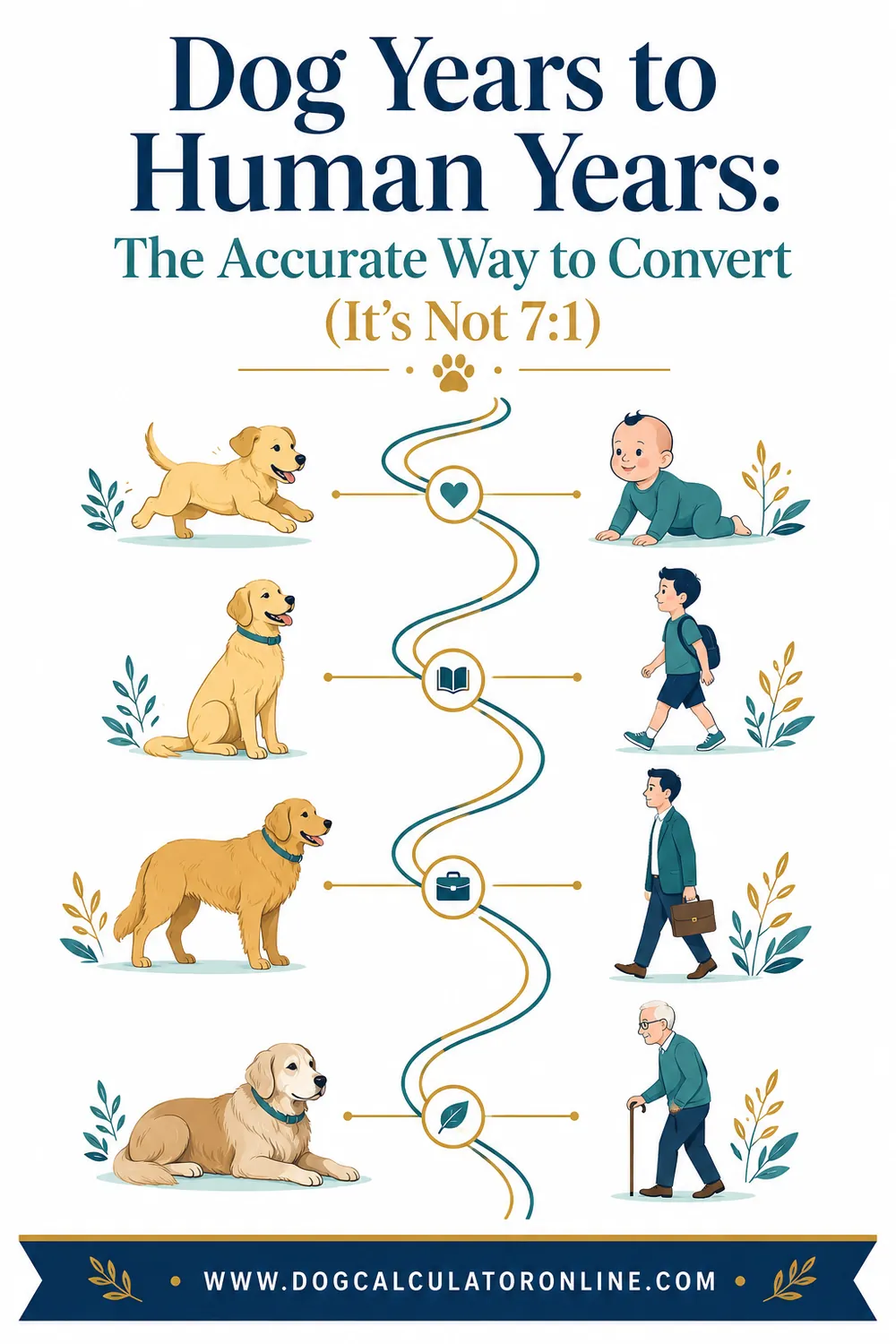
- Dog Years to Human Years: The Accurate Way to Convert (It's Not 7:1)
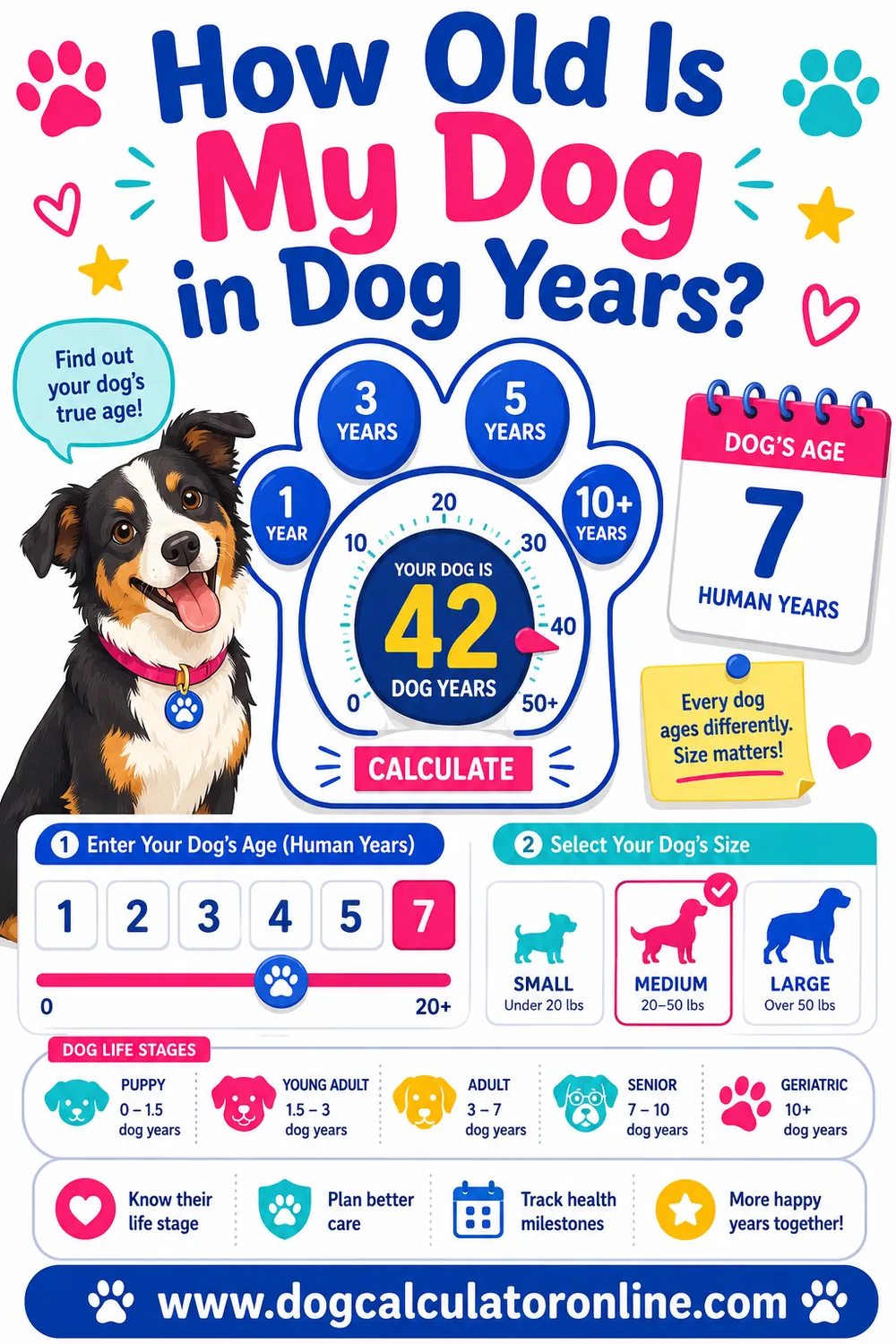
- How Old Is My Dog in Dog Years?
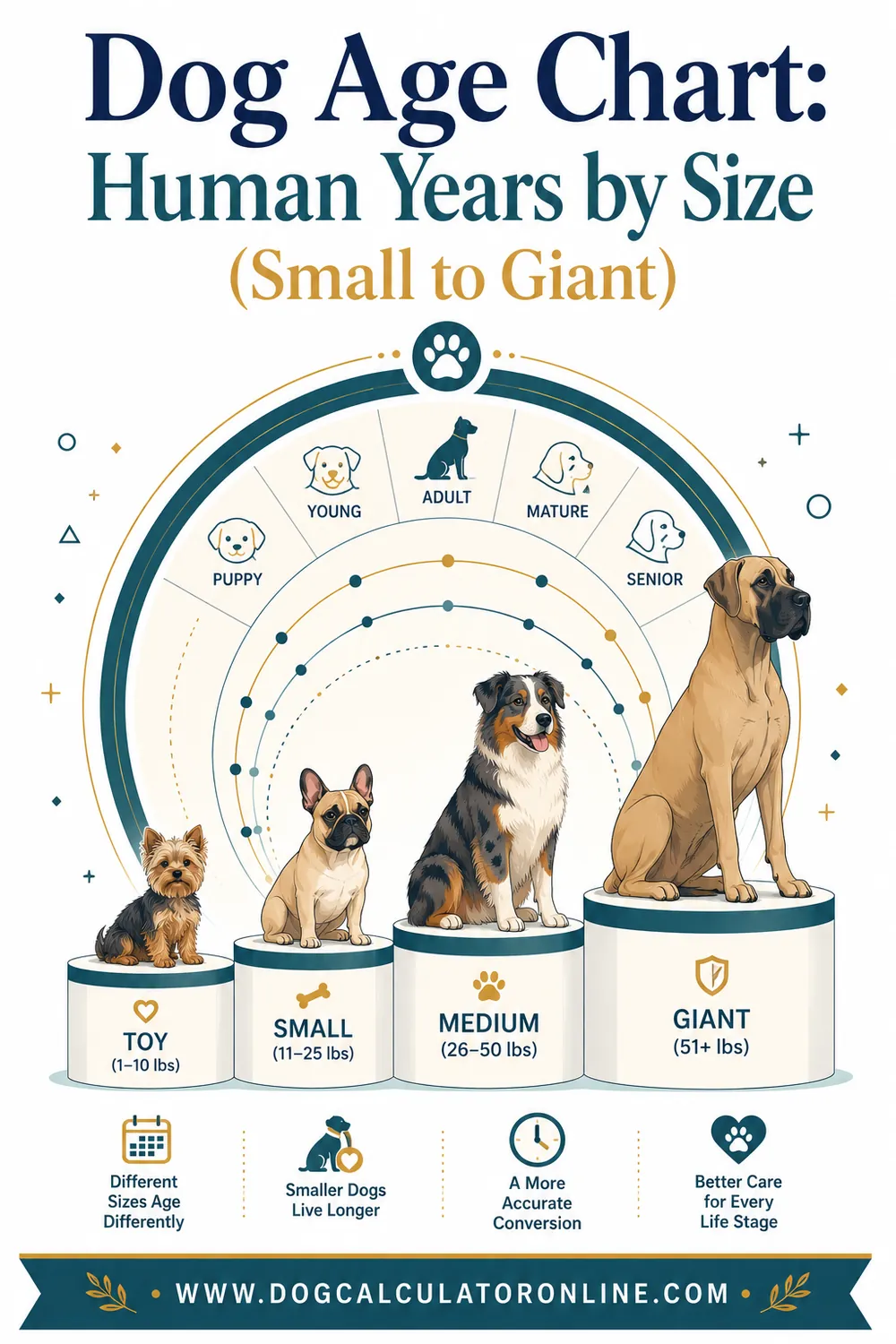
- Dog Age Chart: Human Years by Size (Small to Giant)
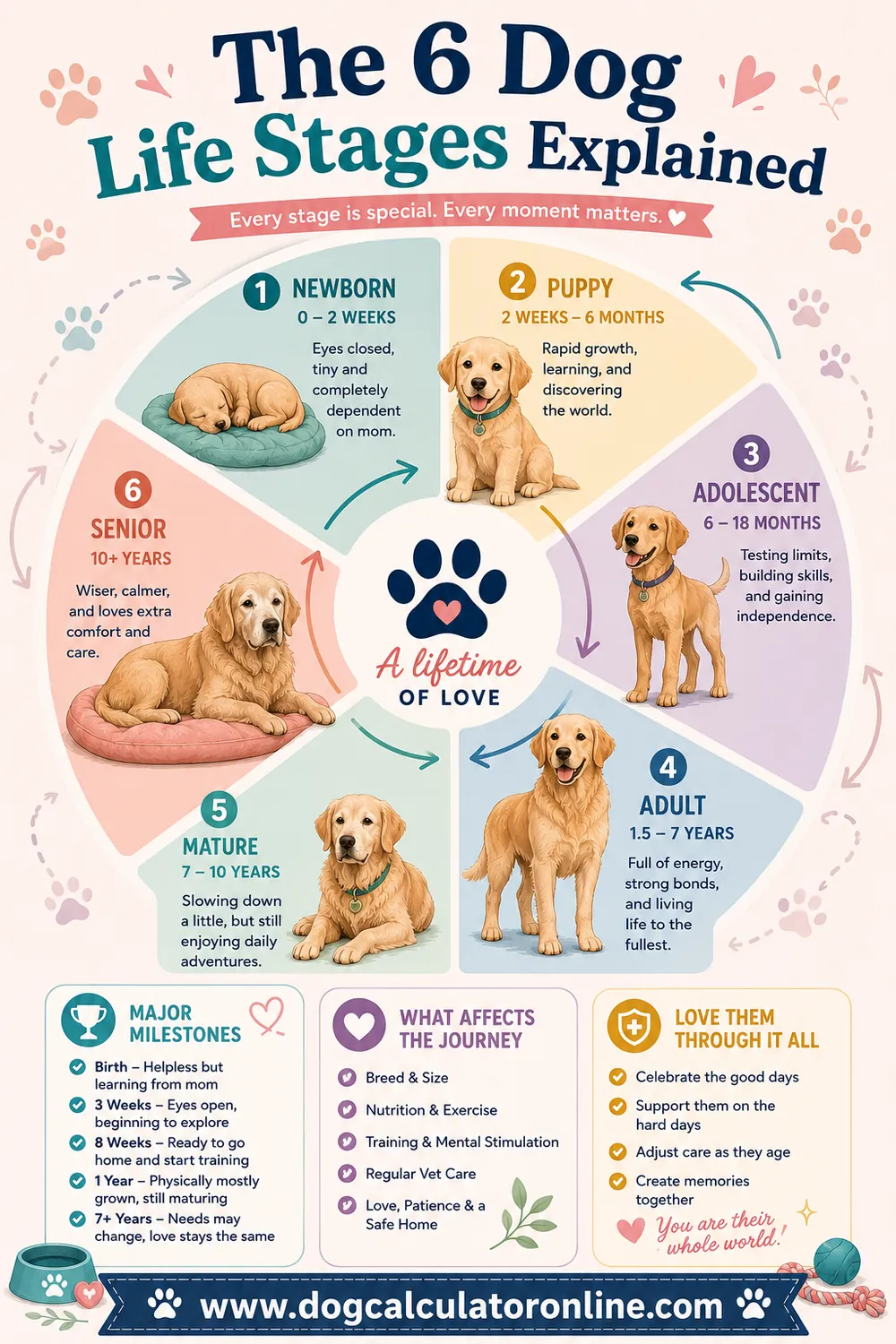
- The 6 Dog Life Stages Explained
And if you just want your own dog's number, the free dog age calculator does it in one tap.
FAQ
How do I convert human years to dog years?
For human ages above 24: dog age ≈ 2 + (human age − 24) ÷ size multiplier (4 for small, 5 medium, 6 large, 7 giant). Below 24, a human age of 15 ≈ a 1-year-old dog and 24 ≈ a 2-year-old dog.
What dog age is 30 human years?
About 3 years old for a medium dog — a young adult in athletic prime. It shifts slightly by size: roughly 3.5 for a small dog, closer to 3 for a giant.
Why can't I just divide by 7?
Because dog aging isn't linear. A dog's first year equals about 15 human years and the second adds 9, then the pace slows. Dividing by a flat 7 gives the wrong answer in both directions.
Does size change reverse conversion?
Yes. The same human age maps to an older dog if the dog is small and a younger dog if it's giant — because big dogs age faster per calendar year.
Is reverse conversion useful or just fun?
Mostly fun, but it helps explain a dog's life stage to others and can back into a calendar-age estimate for a rescue. For most needs, forward conversion (dog → human) is what you want.
Where can I do both conversions automatically?
Our free dog age calculator handles dog-to-human and human-to-dog using the size-adjusted method — no formula memorizing required.
What human age matches a senior dog?
Senior status begins around age 7 for small and medium dogs (roughly 44–49 human years), 6–7 for large breeds (about 48–54), and 5–6 for giants (about 45–52). In every case, "senior" maps to the human late 40s and 50s — middle age tipping into the golden years.
Does the reverse formula work for puppies?
Not well. The math is built for adult dogs. In the first weeks of life a puppy develops far faster than a human infant, so life stage — not arithmetic — is the better guide for very young dogs. The reverse conversion becomes reliable once a dog is past its first birthday.
The Bottom Line
Converting human years to dog years means unwinding a non-linear curve, not dividing by seven. Use the reverse formula — dog age ≈ 2 + (human age − 24) ÷ your dog's size multiplier — and remember that size shifts the answer: a human age of 60 is an 11-year-old small dog but a 7-year-old giant.
Skip the arithmetic entirely: the free dog age calculator converts in both directions using the size-adjusted method, so you get an accurate answer whichever way you're asking.