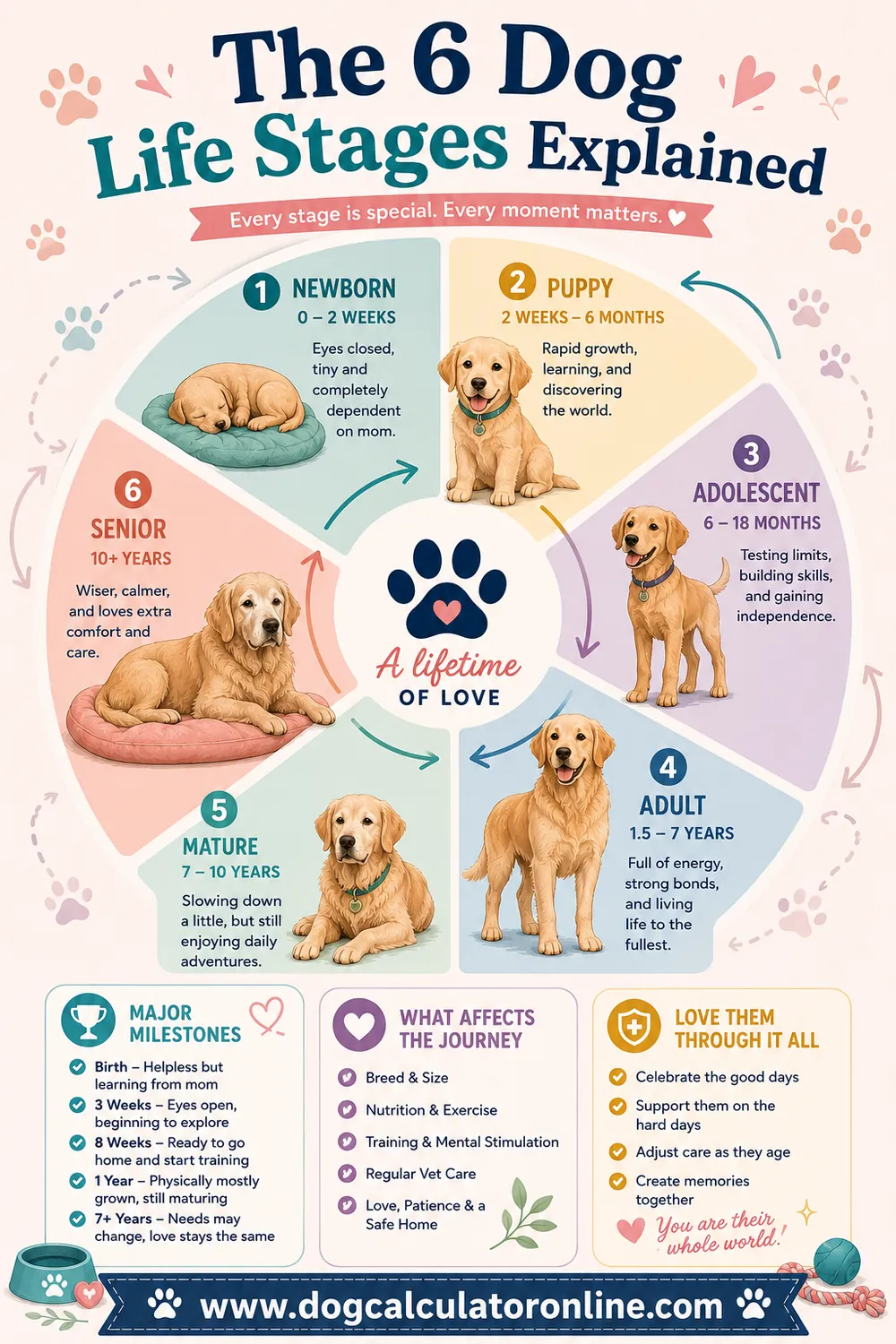
The 6 Dog Life Stages Explained
Dogs move through six life stages: puppy (birth to ~6 months), adolescent (~6–18 months), young adult (1–3 years), mature adult (3–7 years), senior (roughly the last quarter of expected lifespan), and geriatric (advanced old age). The calendar ages shift by size — big dogs reach the later stages years before small dogs do.
To see which stage your dog is in right now, our free dog age calculator converts age and weight into a human-year equivalent — the fastest way to make a life stage feel concrete.
🐾 Which life stage is your dog in?
Tap your dog’s age (medium-sized dog, 21–50 lb):
Tap an age above. Large breeds hit each stage earlier, small breeds later.
Why Life Stages Beat Birthdays
A dog's age in years tells you surprisingly little on its own, because size warps the timeline: a 6-year-old giant breed is a senior while a 6-year-old terrier is barely middle-aged. Life stages fix that — they describe where a dog functionally is, which is what actually determines the right food, exercise, training focus, and vet schedule.
Veterinary guidelines use this framing for exactly that reason: care recommendations attach to stages, not birthdays. Here's each stage, what's happening, and what your dog needs from you.
Stage 1: Puppy (Birth to ~6 Months)
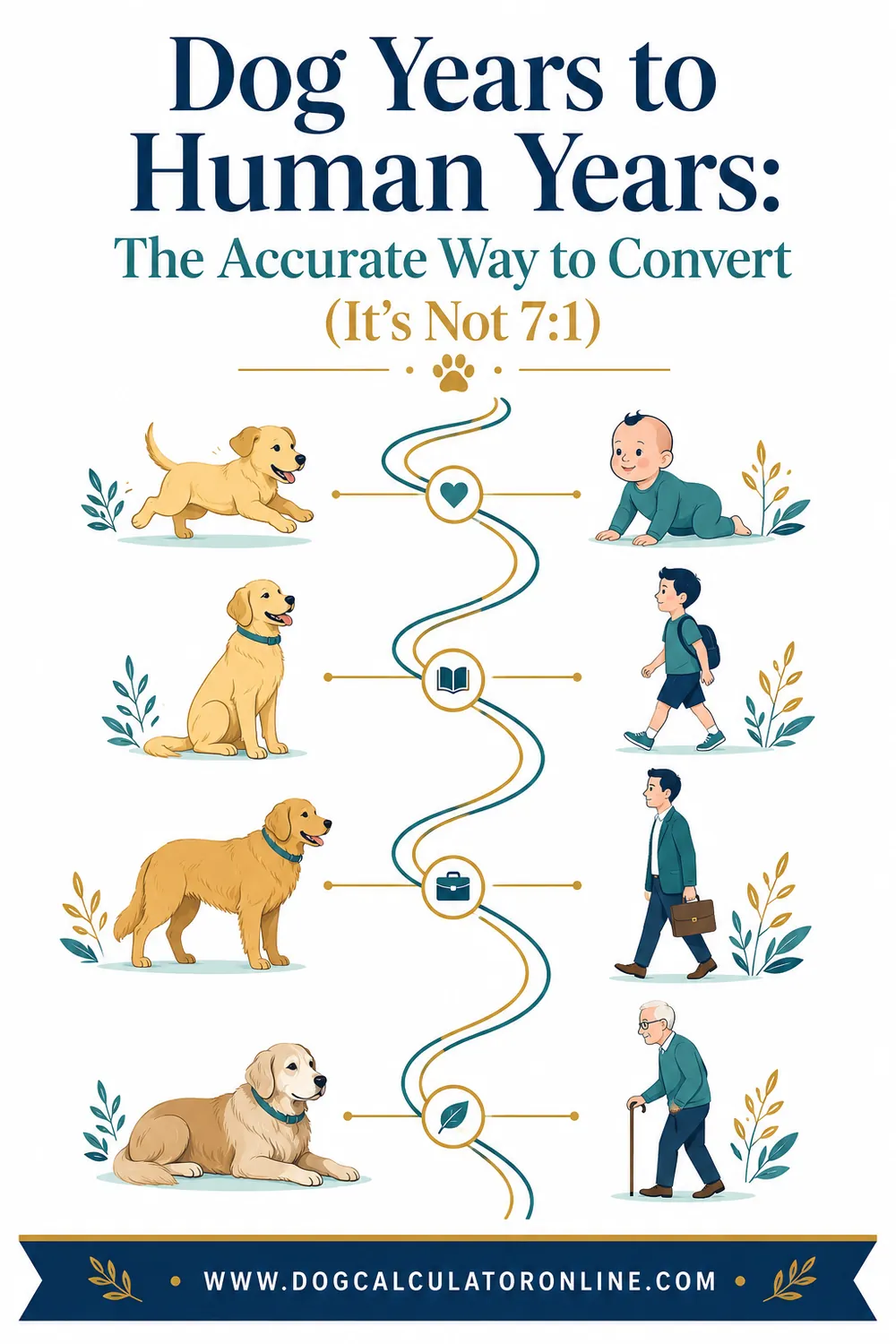
Human equivalent: infancy through childhood. Dogs compress a human decade into months — under the size-adjusted formula vets use, a dog's entire first year equals about 15 human years.
What's happening: fastest growth of their lives, baby teeth in and out (a full adult set of 42 arrives around 6–7 months), and — most critically — the socialization window (roughly 3–14 weeks) when puppies form lifelong impressions about what's safe and normal.
What they need:
- Socialization, urgently. Positive, gentle exposure to people, dogs, sounds, surfaces, and handling during the window. It's the highest-leverage investment in a dog's future temperament — and it can't be rescheduled.
- Puppy-formula food in several small meals a day.
- Vet basics: vaccination series, parasite prevention, and the spay/neuter conversation.
- Short, positive training. Name, recall, house training, bite inhibition. Attention spans are tiny; sessions should be too.
Puppy Sub-Stages: Neonatal, Transitional, Socialization (0–12 Weeks)
Stage 1 covers a lot of ground. The first three months alone hold several distinct mini-stages, and knowing them helps you understand why breeders keep puppies with their litter for the first couple of months and why the weeks right after homecoming matter so much. This is also why some guides talk about "7 stages" of a dog's life: they split puppyhood into these smaller steps.
Neonatal (Birth to ~2 Weeks)
Newborn puppies are born with their eyes and ear canals closed. They can't see, hear, or keep themselves warm, so they spend nearly all their time sleeping and nursing, pressed against their mother and littermates for heat. They move by crawling, and they need their mother to help them go to the bathroom. Steady weight gain is the main sign that things are going well. For a day-by-day look at this period, see newborn puppy care week by week.
Transitional (~2–4 Weeks)
The world switches on. Eyes open at around two weeks, hearing follows soon after, and puppies start wobbling onto their feet. Baby teeth begin to appear, tails start to wag, and the first play bows and littermate wrestling show up. Toward the end of this stage, many puppies start tasting soft food as weaning begins.
Socialization (~3–12 Weeks, and Up to ~14)
This is the critical window mentioned above. Puppies learn how to be dogs from their mother and littermates, including bite inhibition, and they form lasting impressions of people, places, sounds, and handling. Weaning is usually finished by around 7–8 weeks, and most puppies go to their new homes at 8 weeks or later. Many trainers also describe a short "fear period" somewhere in this window, when a puppy can be startled more easily, so keep new experiences gentle and upbeat. Our puppy socialization checklist lays out what to introduce and when.
Juvenile (~3–6 Months)
After the socialization window closes, puppies enter a busy juvenile phase before adolescence. Growth is fast, adult teeth push out the baby teeth (see the puppy teething timeline), and confidence grows. It's a great time for short, fun training sessions while their attention is still easy to win.
| Sub-stage | Age | Key milestones | Your focus |
|---|---|---|---|
| Neonatal | 0–2 weeks | Eyes and ears closed; sleeps and nurses | Warmth, nursing, steady weight gain (mostly the breeder's job) |
| Transitional | 2–4 weeks | Eyes and ears open; first steps; baby teeth start | Gentle handling, a safe space to explore |
| Socialization | 3–12 (to ~14) weeks | Learns dog manners; weaning ends; goes home ~8 weeks+ | Positive exposure to people, sounds, surfaces, handling |
| Juvenile | 3–6 months | Fast growth; adult teeth come in | Short training sessions, chew toys, routine |
For a more detailed week-by-week breakdown, see puppy growth stages week by week.
Stage 2: Adolescent (~6–18 Months)
Human equivalent: the teenage years — and it shows.
What's happening: sexual maturity (typically 6–12 months) arrives well before mental maturity. Hormones surge, boundaries get tested, and the puppy who came when called develops sudden, mysterious deafness. Big breeds are still physically growing throughout this stage; small breeds finish their bones early in it.
What they need:
- Consistency, not disappointment. Regressions are normal and temporary. Keep rewarding recall like it's day one.
- Exercise with guardrails. Energy is at its lifetime peak, but large-breed growth plates may still be open — free play over forced repetitive running until your vet confirms growth is done.
- Continued exposure. Adolescents can get selectively suspicious; keep positive experiences flowing.
- The food switch. Most dogs move from puppy to adult formula as growth ends — around 9–12 months for small breeds, up to 18–24 months for giants. Ask your vet about timing.
Stage 3: Young Adult (1–3 Years)
Human equivalent: roughly 15 to 29. Year two adds about 9 human years (a 2-year-old dog ≈ 24), and each year after that adds 4–7 depending on size.
What's happening: the body finishes, then the brain follows. Somewhere in this stage the adolescent chaos quietly resolves into an adult personality — usually between 18 months and 3 years, later for big breeds.
What they need:
- A real exercise habit. This is peak athletic life; build the daily routine you'll both keep.
- Training beyond the basics. Young adults have the focus adolescents lacked — ideal for skills, sports, or fixing the rough edges adolescence left behind.
- Weight discipline early. The lean-body habit set now is the single best-documented longevity lever an owner controls.
- Annual vet care and a dental-care routine before tartar gets a head start.
Stage 4: Mature Adult (3–7 Years)
Human equivalent: roughly 30 to 50, size depending. A 5-year-old medium dog is about 39; a 5-year-old giant is already about 45.
What's happening: prime of life, gradually shading toward middle age. Metabolism eases off. Big breeds begin exiting this stage around 5–6, when their senior years start; small breeds cruise through it until 7 or later.
What they need:
- Portion vigilance. Middle-age spread is the classic mature-adult problem — same food, less burn. Weigh monthly; adjust with your vet.
- Dental upkeep. By now most dogs have some dental disease without care. This is the stage to stay ahead of it.
- Exercise consistency as enthusiasm self-regulates — the weekend-warrior injury pattern starts here.
- Baseline bloodwork toward the end of the stage (age 5–6 for big dogs, ~7 for small) so later changes have something to compare against.
Stage 5: Senior (Last Quarter of Expected Lifespan)
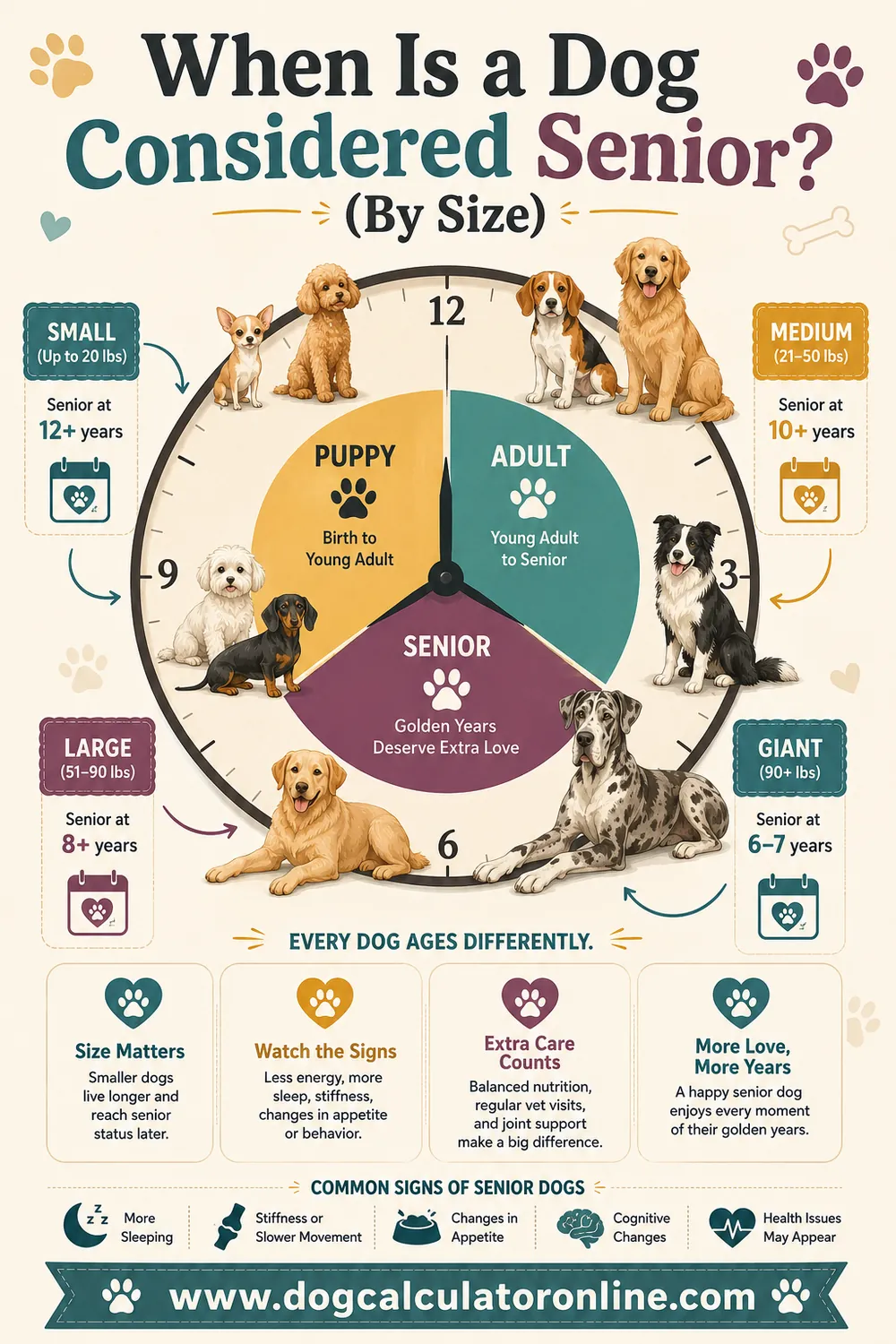
Human equivalent: roughly the 50s through early 70s. Senior status begins around age 7 for small and medium dogs, 6–7 for large breeds, and 5–6 for giants.
What's happening: aging becomes measurable — graying muzzle, stiffness after rest, slower recovery, duller senses, more sleep. Age-related conditions (arthritis, kidney/heart/thyroid changes, lumps) become common, and most are far more manageable caught early.
What they need:
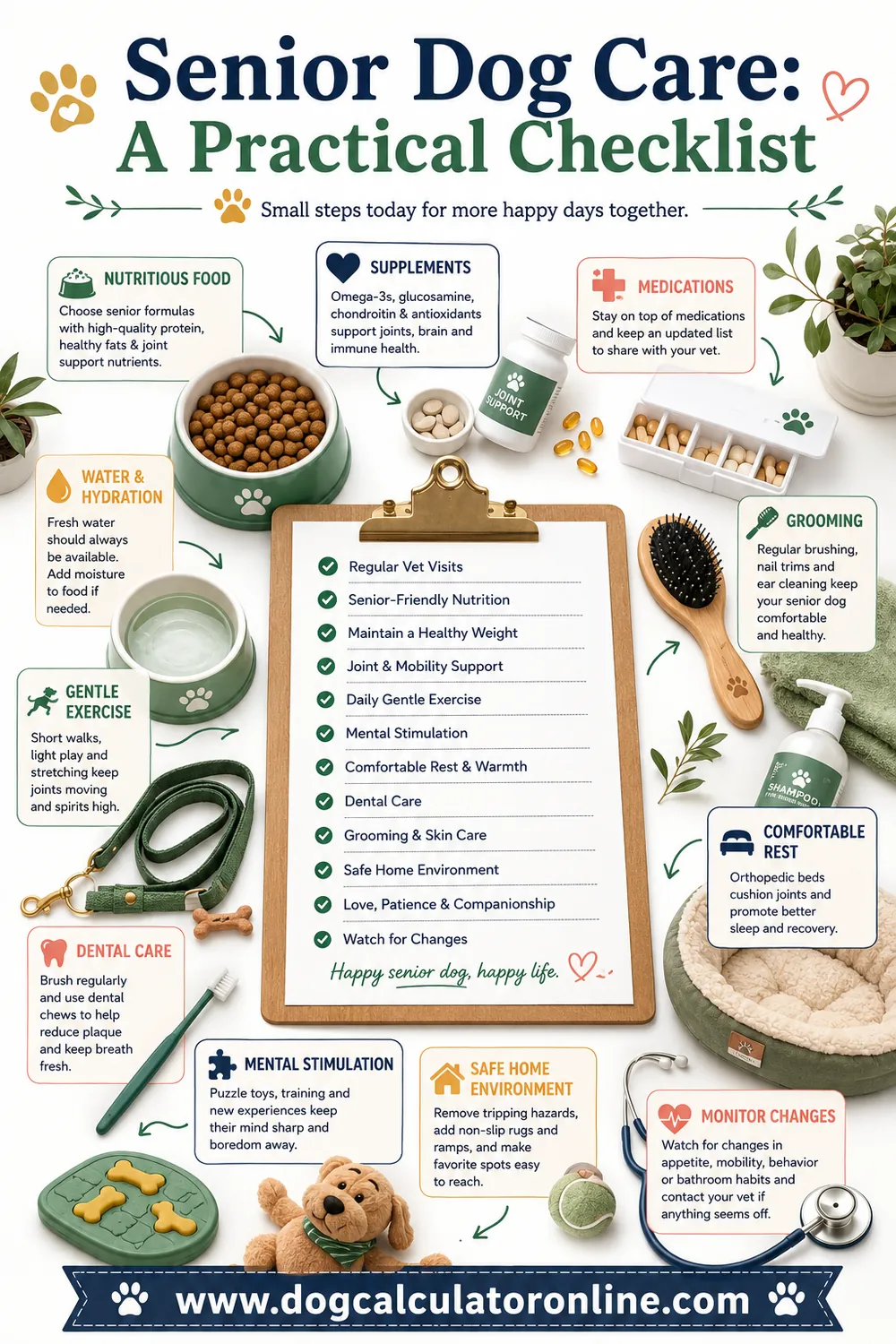
- Twice-yearly vet visits with bloodwork and urinalysis — the core senior habit.
- Lean weight, watched monthly. Gain stresses joints; unexplained loss is an early-illness flag.
- Daily gentler exercise to preserve the muscle that supports aging joints.
- Diet review with your vet — many seniors benefit from adjusted formulas, but it's individual.
- Home comforts: traction on floors, ramps, an orthopedic bed, night lighting.
Stage 6: Geriatric (Advanced Old Age)
Human equivalent: late 70s and beyond. A 14-year-old medium dog is about 84 in human years; a 10-year-old giant is around 80.
What's happening: this is genuine old age. Most geriatric dogs are managing at least one chronic condition. Senses fade further, sleep deepens, and cognitive changes (night pacing, confusion, house-training lapses) may appear.
What they need:
- Comfort as the organizing goal. Pain management (vets have many options — never medicate a dog yourself), warmth, soft bedding, low-effort routines.
- Close partnership with your vet, often with visits or check-ins more frequent than twice yearly.
- Routine and patience. Predictability lowers anxiety; accidents and odd hours are symptoms, not misbehavior.
- Quality-of-life awareness. Appetite, mobility, comfort, and joy in familiar things are the honest metrics. Your vet can help you track them objectively.
Geriatric years can be tender, close, genuinely happy ones — many owners call them the sweetest of all.
How to Use Life Stages Day to Day
Knowing the stages is only useful if it changes what you do. A quick guide to the decisions each stage should drive:
- Food: puppy formula through growth, adult formula for young and mature adults, and a vet-guided senior diet once your dog reaches its senior stage. Timing the switches to stages (not fixed ages) prevents both under-fueling a growing giant and over-fueling a slowing senior.
- Vet frequency: puppies need their vaccine series and frequent early visits; adults do fine with annual exams; seniors benefit from twice-yearly visits with bloodwork. The frequency should climb as the stage advances.
- Exercise: protect growth plates in adolescence, build a real fitness habit in young adulthood, keep it consistent through maturity, and shift to gentler, joint-friendly movement in the senior and geriatric stages.
- Training focus: socialization in puppyhood, consistency through adolescence, skill-building in young adulthood, and patience with age-related changes later on.
The single most common mistake is treating a dog by its birthday instead of its stage — feeding a barely-grown giant "adult" food too early, or assuming a spry small dog can't be a senior at 8. When calendar age and life stage seem to disagree, the stage (and your vet) should win.
The Stages at a Glance
| Stage | Small/medium dogs | Large/giant dogs | Human equivalent |
|---|---|---|---|
| Puppy | 0–6 months | 0–6 months | Infancy–childhood |
| Adolescent | 6–12 months | 6–18 months | Teens |
| Young adult | 1–3 years | 1–3 years | ~15–29 |
| Mature adult | 3–7 years | 3–5 years | ~30–50 |
| Senior | 7+ years | 5–7 years | ~50s–early 70s |
| Geriatric | ~11–12+ years | ~8–9+ years | Late 70s+ |
Boundaries are soft — dogs slide between stages rather than crossing lines. For your own dog's position, the free dog age calculator gives the size-adjusted human-year number instantly.
Dog Life Stages by Age in Years (1–18)
Looking up a specific age? This table shows the life stage and the approximate human-age equivalent (in parentheses) for every year from 1 to 18, using the same size-adjusted formula as our calculator: year one ≈ 15, year two ≈ 24, then about 4 human years per year for small dogs, 5 for medium, 6 for large, and 7 for giants. A dash means few dogs of that size live to that age.
| Dog's age | Small | Medium (21–50 lb) | Large | Giant |
|---|---|---|---|---|
| 1 year | Adolescent (~15) | Adolescent (~15) | Adolescent (~15) | Adolescent (~15) |
| 2 years | Young adult (~24) | Young adult (~24) | Young adult (~24) | Young adult (~24) |
| 3 years | Mature adult (~28) | Mature adult (~29) | Mature adult (~30) | Mature adult (~31) |
| 4 years | Mature adult (~32) | Mature adult (~34) | Mature adult (~36) | Mature adult (~38) |
| 5 years | Mature adult (~36) | Mature adult (~39) | Mature adult (~42) | Senior (~45) |
| 6 years | Mature adult (~40) | Mature adult (~44) | Senior (~48) | Senior (~52) |
| 7 years | Senior (~44) | Senior (~49) | Senior (~54) | Senior (~59) |
| 8 years | Senior (~48) | Senior (~54) | Senior (~60) | Geriatric (~66) |
| 9 years | Senior (~52) | Senior (~59) | Geriatric (~66) | Geriatric (~73) |
| 10 years | Senior (~56) | Senior (~64) | Geriatric (~72) | Geriatric (~80) |
| 11 years | Geriatric (~60) | Geriatric (~69) | Geriatric (~78) | Geriatric (~87) |
| 12 years | Geriatric (~64) | Geriatric (~74) | Geriatric (~84) | Geriatric (~94) |
| 13 years | Geriatric (~68) | Geriatric (~79) | Geriatric (~90) | Geriatric (~101) |
| 14 years | Geriatric (~72) | Geriatric (~84) | Geriatric (~96) | — |
| 15 years | Geriatric (~76) | Geriatric (~89) | Geriatric (~102) | — |
| 16 years | Geriatric (~80) | Geriatric (~94) | Geriatric (~108) | — |
| 17 years | Geriatric (~84) | Geriatric (~99) | — | — |
| 18 years | Geriatric (~88) | Geriatric (~104) | — | — |
So what stage is a 12-year-old dog in? For a small or medium dog, 12 is geriatric (about 64 or 74 in human years), though many small dogs are still lively at that age. A 12-year-old large dog is well into geriatric territory at about 84. An 18-year-old dog of any size is in very advanced old age; it happens most often with small breeds. Stage boundaries are soft, so treat the table as a guide and let your dog's health and energy fill in the details. For the full conversion chart, see our dog age chart, and for typical lifespans by size, see dog life expectancy by size.
How Breed Size Changes the Timeline
Every dog goes through the same stages in the same order. What changes is the speed. Size is the biggest factor, and the pattern is surprising: big dogs grow up more slowly but age faster later on.
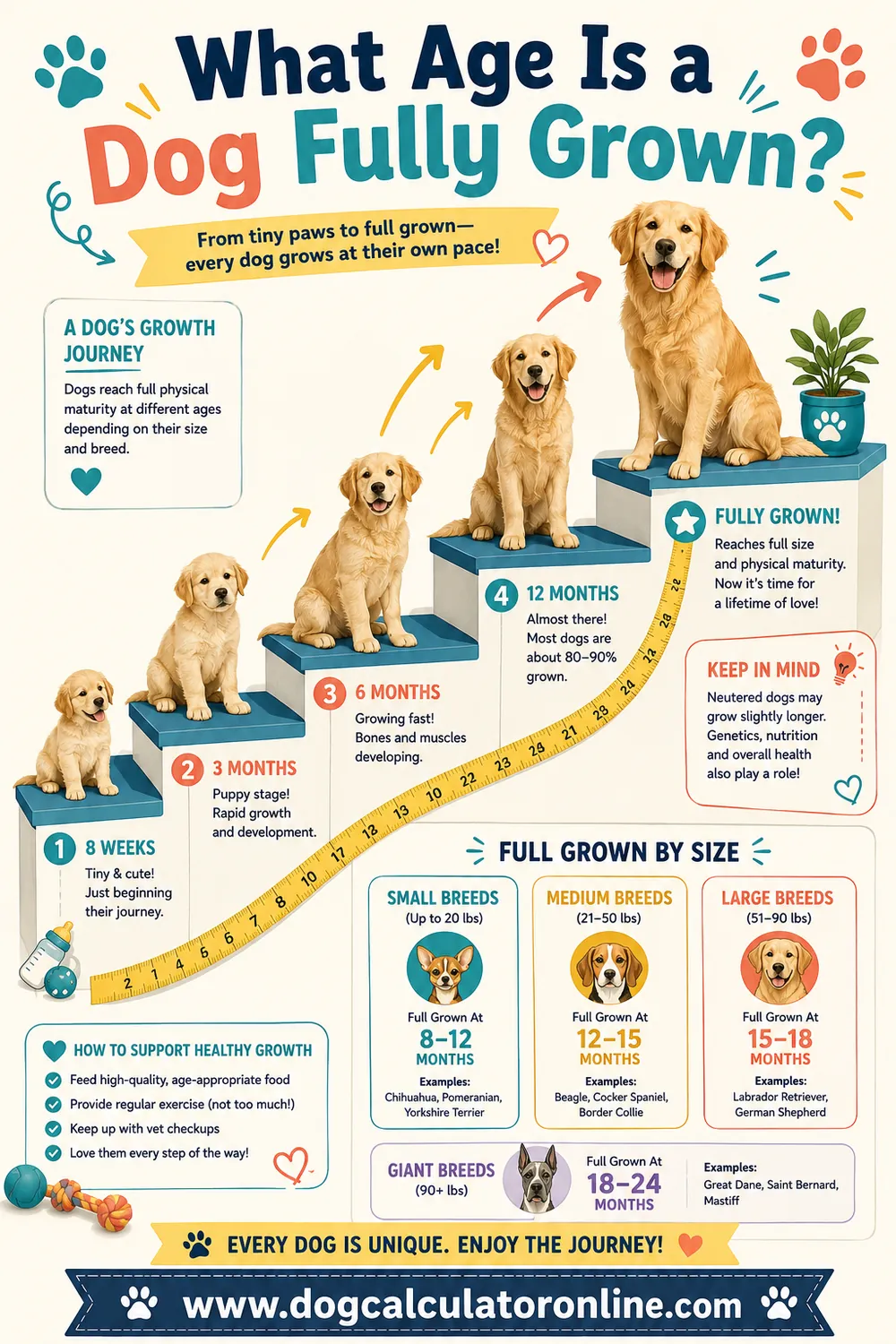
- Small breeds (think Chihuahuas, Yorkies, and toy breeds) usually finish growing by around 9–12 months, reach senior status later, and often enjoy the longest lives.
- Medium breeds (think Beagles and Border Collies) sit in the middle on every measure, and their timeline matches the classic stage ages most guides use.
- Large breeds (think Labradors and German Shepherds) can keep growing well into their second year, then move into their senior years earlier, often around 6–7.
- Giant breeds (think Great Danes and Mastiffs) may not be fully grown until about 18–24 months, yet they can be seniors by 5–6 and geriatric by 8 or 9.
Not sure which size group your dog falls into? Check average dog weight by size category, and for growth questions, see what age a dog is fully grown.
Feeding and Vet Care Priorities by Stage
Here's a quick reference for what changes at the food bowl and at the vet's office as your dog moves through each stage. Your vet will tailor the details to your dog, especially the vaccine schedule, which depends on your dog's health, lifestyle, and local rules.
| Stage | Feeding priorities | Vet care priorities |
|---|---|---|
| Puppy | Puppy formula, several small meals a day (often 3–4 for young puppies) | Vaccine series with boosters every few weeks, usually until about 16 weeks; deworming and parasite prevention |
| Adolescent | Puppy formula until growth slows, then a planned switch to adult food | Finish boosters, rabies vaccine as required, spay/neuter discussion |
| Young adult | Adult formula, usually two meals a day, portions set for a lean body | Annual exam, dental checks, booster vaccines on schedule |
| Mature adult | Watch portions as activity slows; weigh monthly | Annual exam, dental cleanings as needed, baseline bloodwork late in the stage |
| Senior | Vet-guided senior diet if needed; watch for weight gain or loss | Exams about twice a year with bloodwork and urinalysis |
| Geriatric | Easy-to-eat meals, steady routine, appetite tracked closely | Frequent check-ins, pain management, quality-of-life reviews |
For the details on each switch, see when to switch a puppy to adult food, puppy feeding schedule by age, and how much a senior dog should eat.
Where These Stages Come From
The stage names on this page follow the way vets talk about a dog's life. The American Animal Hospital Association (AAHA) publishes Canine Life Stage Guidelines that group a dog's life into puppy, young adult, mature adult, senior, and end-of-life stages, and they define the senior stage as the last quarter of a dog's expected lifespan. This guide adds an adolescent stage, because the teenage months come with their own training and growth needs, and uses "geriatric" for advanced old age. Your own vet is the best judge of exactly where your dog is right now, and our guide to signs your dog is getting old can help you spot the changes between visits.
Related Guides
If this helped, these go deeper on the same question:
- Dog Years to Human Years: The Accurate Way to Convert (It's Not 7:1)
- When Is a Dog Considered Senior? (By Size)
- What Age Is a Dog Fully Grown?
- Senior Dog Care: A Practical Checklist
And if you just want your own dog’s number, the free dog age calculator does it in one tap.
FAQ
What are the life stages of a dog?
Six: puppy (to ~6 months), adolescent (~6–18 months), young adult (1–3 years), mature adult (3–7), senior (last quarter of expected lifespan), and geriatric (advanced old age). Exact ages shift with size.
How long is each dog life stage?
Puppyhood and adolescence together span roughly the first 1–2 years for all dogs. After that, size takes over: big dogs move through adulthood into senior years by 5–6, while small dogs may not be seniors until 7–10.
What stage is a 2-year-old dog in?
Young adulthood — about 24 in human years. Physically finished (except some giants), mentally just about done with adolescence.
When does a dog become a senior?
Around 7 for small and medium dogs, 6–7 for large breeds, 5–6 for giants — roughly the final quarter of expected lifespan.
Do small and large dogs have the same life stages?
The same sequence, on different clocks. A giant breed can be geriatric at 9; a small breed may not be until 13. That's why size-adjusted age conversion matters.
How do I know my dog's human-age equivalent?
Year one ≈ 15 human years, year two adds 9, then +4 to +7 per year by size class. The free dog age calculator computes it from age and weight in one tap.
What are the 7 stages of a dog's life?
Guides that list seven stages usually split puppyhood into smaller steps: neonatal (0–2 weeks), transitional (2–4 weeks), socialization (3–12 weeks), juvenile (3–6 months), then adolescent, adult, and senior. It's the same journey as the six stages on this page, just with puppyhood broken down further.
What stage is a 12-year-old dog?
A 12-year-old small or medium dog is in the geriatric stage, about 64 to 74 in human years. A 12-year-old large dog is around 84 in human years, and a giant breed that reaches 12 is in very advanced old age. Many small dogs are still active at 12, so health matters more than the number.
When is a dog fully grown?
Small breeds usually finish growing around 9–12 months, medium breeds around 12–15 months, large breeds around 15–18 months, and giant breeds can keep growing until about 18–24 months. Mental maturity often takes longer, arriving somewhere between 18 months and 3 years.
How old is a dog in the neonatal stage?
The neonatal stage runs from birth to about 2 weeks old. Puppies this age have closed eyes and ears, can't keep themselves warm, and spend almost all their time sleeping and nursing.
The Bottom Line
Six stages, one sliding timeline: every dog runs the same course, but size sets the pace — giants reach each milestone years before toy breeds. Match the care to the stage, not the birthday: socialize the puppy, outlast the adolescent, condition the adult, screen the senior, comfort the geriatric.
Find your dog's stage in seconds: enter age and weight into the free dog age calculator and see exactly where they are on the curve.