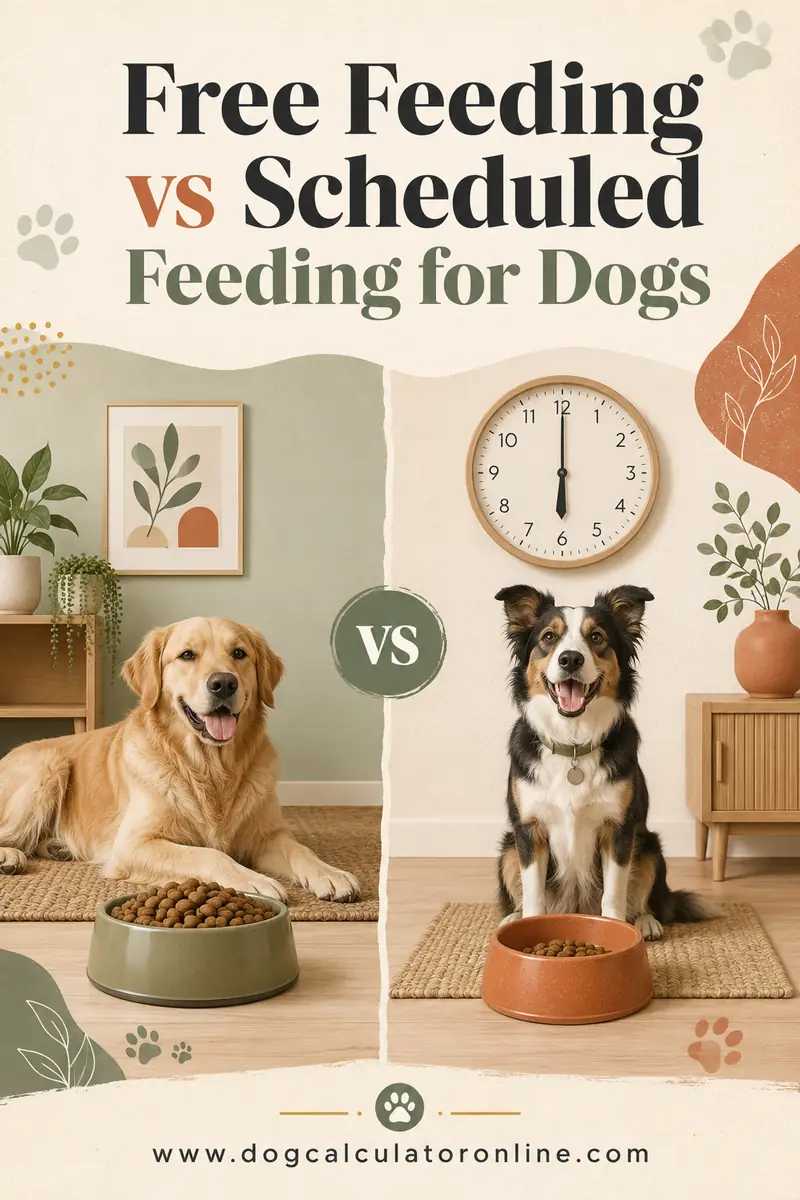
Free Feeding vs Scheduled Feeding for Dogs
For most dogs, scheduled feeding beats free feeding — measured meals at set times give you weight control, house-training predictability, and an early-warning system for illness, all of which a permanently full bowl takes away. Free feeding (leaving food out for grazing) works acceptably for a minority of dogs: healthy adults with genuine self-regulation, in single-dog homes, eating dry food only. But even for those dogs, it mostly trades away information and control for convenience.
The good news is that switching a grazer to meals takes about a week, and the portion math takes seconds — the free dog food calculator turns your dog's weight, age, and activity into the daily amount those meals should contain. Below: an honest accounting of both systems, who each one actually suits, what the choice does to training and multi-dog households, and the step-by-step switch.
🍲 Which feeding style fits your dog?
Tap your situation for the usual answer:
Tap an option above. When in doubt, measured meals are the safe default.
The Two Systems, Defined
Free feeding (also called free-choice or ad libitum feeding): food sits out all day, the dog eats whenever it likes, and the human's job is refilling. It only works at all with dry food — wet and raw spoil within hours.
Scheduled feeding: measured portions served at fixed times — for adult dogs, typically two meals 8–12 hours apart — with the bowl picked up after 15–20 minutes whether finished or not.
There's also a middle path worth naming: portion-controlled free access, where the day's correct measured amount goes out in the morning and the dog paces itself. It fixes free feeding's biggest flaw (unlimited quantity) while keeping its convenience — but it still blurs meal timing, which matters more than most owners expect. You'll see why below.
Here's how the two systems stack up on the things that actually matter day to day:
| What matters | Free feeding | Scheduled feeding |
|---|---|---|
| Convenience | High — keep the bowl full, no set times | Lower — two short appointments a day (or an automatic feeder) |
| Weight control | Weak — no lever to pull when weight creeps | Strong — measured portions you can adjust by 10% |
| Monitoring appetite | Poor — early appetite loss hides under a topped-up bowl | Excellent — a skipped meal is obvious the same morning |
| House-training | Unreliable — input all day means output all day | Predictable — bowels follow the meal clock |
| Multi-dog homes | Risky — can't tell who ate what; invites guarding | Works — separate, measured meals per dog |
| Medication timing | Awkward — "give with food" becomes guesswork | Easy — you control exactly when eating happens |
| Food types | Dry food only — wet and raw spoil | Any diet, including wet, raw, and vet-prescribed |
The Case for Scheduled Feeding
Vets and trainers land on scheduled meals for reasons that compound:
- Weight control you can actually steer. Obesity is among the most common preventable health problems in dogs, and portion control is the primary tool against it. Scheduled feeding is portion control; free feeding is portion hope. When a scheduled dog gains weight, you cut each meal 10% and re-check in a month — a lever free feeding simply doesn't have.
- Appetite as an early-warning system. Appetite loss is one of the earliest, most reliable signs of illness in dogs. A scheduled dog who skips breakfast gets noticed by 7:05 a.m.; a free-fed dog's fading appetite can hide under a topped-up bowl for days — days that matter with many conditions.
- House-training runs on it. Food in on schedule means bowels move on schedule (usually within about 30 minutes of eating). Puppy potty training is built on that predictability, and it never stops being useful.
- Mealtimes are training capital. A dog whose food arrives from you at known times is a dog with a reason to check in with you. Meals can be delivered by hand, through training sessions, or via puzzle feeders — turning the day's biggest resource into engagement instead of background furniture.
- Medication and vet logistics. "Give with food" instructions, pre-surgery fasting, and glucose-timed feeding for diabetic dogs all assume you control when eating happens.
- Freshness and pests. Kibble sitting out all day oxidizes, loses appeal, and — depending on where you live — advertises to ants, mice, and enterprising raccoons.
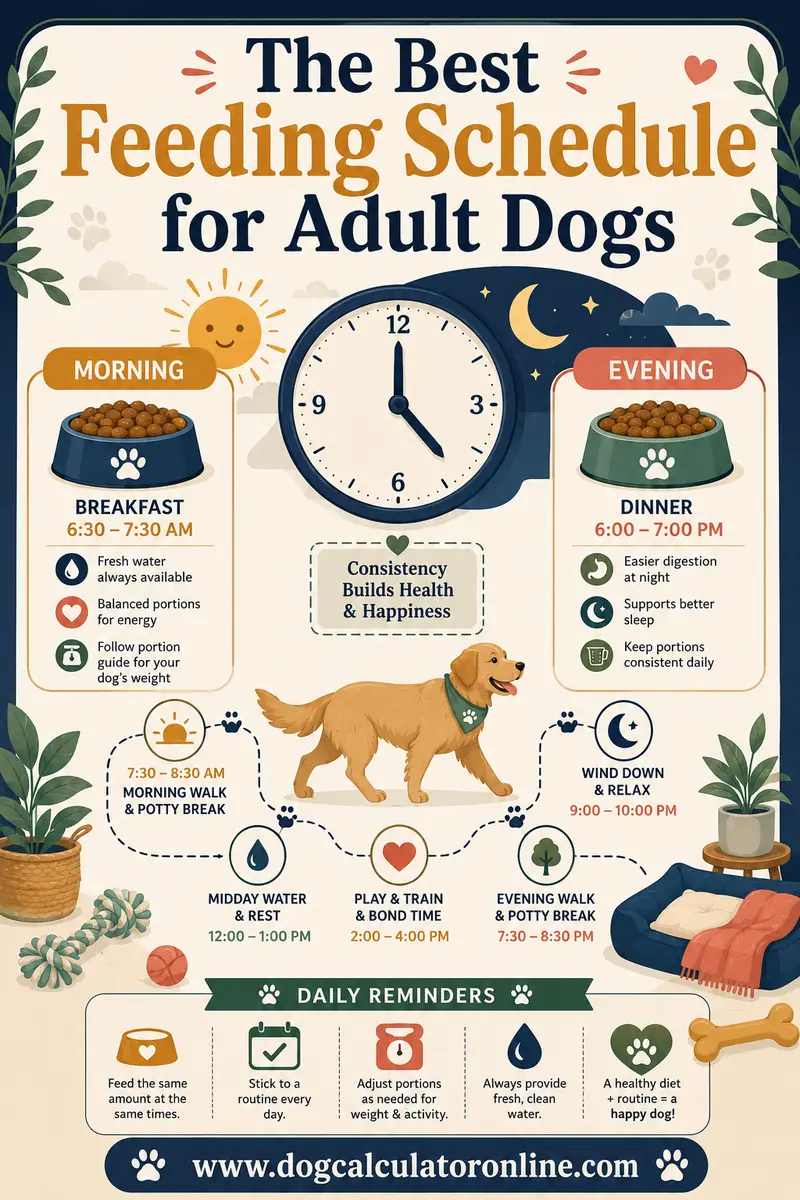
If you're building the schedule itself — times, spacing, exercise buffers — the full blueprint is in the best feeding schedule for adult dogs.
The Honest Case for Free Feeding
Free feeding persists because it has real advantages, and pretending otherwise helps no one:
- Convenience. No 6 p.m. obligation, no sitter instructions beyond "keep the bowl full." For chaotic schedules, that's genuinely valuable.
- Some dogs truly self-regulate. A minority of dogs — often lean, busy, food-indifferent types — eat exactly what they need from a full bowl for years and never gain an ounce. If you have one, you know.
- It can reduce food obsession in specific dogs. For a rare few anxious dogs, the certainty that food is always available lowers the temperature around it. (For most dogs the effect runs the other way — scarcity isn't what drives typical food obsession.)
- Grazing suits some small stomachs. Toy breeds prone to low blood sugar benefit from frequent small intake — though scheduled frequent small meals achieve the same thing with the information benefits intact, which is why vets usually suggest that instead.
Notice what's missing from the list: any health advantage for a typical dog. Free feeding's wins are about human convenience and edge-case dogs. That's not nothing — sustainable routines matter — but it frames the real question: is your dog one of the edge cases, and is the convenience worth what you give up?
Where Free Feeding Goes Wrong
The failure modes, in rough order of frequency:
- The slow pudge. Most dogs are opportunistic eaters, not self-regulators — descendants of animals for whom "eat it now" was sound policy. Calories drift up, weight follows at a pound or two a year, and because nobody's measuring, nobody notices until the vet's scale does. The signs are easy to miss from inside the household — signs you're overfeeding your dog covers what to look for.
- The invisible sick day. The bowl is half-full at bedtime. Did she eat this morning? Yesterday? With no mealtime baseline, early appetite loss — the cheap, early signal — is unreadable.
- Multi-dog arithmetic. With two dogs and one buffet, you know only the combined intake. The classic discovery: one dog has been eating 70% of the food for a year — you find out when one is fat and the other is thin, or when someone's on medication that must be given "with food" and you can't say whether she ate.
- Resource guarding. A permanently available bowl is a permanently contested resource in some multi-dog homes. Scheduled, separated meals defuse most of it.
- House-training chaos. Input all day means output all day. Puppies especially can't be reliably potty-trained on a grazing diet.
- Picky-eater theater. Perpetual availability makes food boring. Some free-fed dogs eat poorly because the bowl never leaves, then earn ever-fancier toppings from worried owners.
Special Situations That Decide the Question for You
Some dogs aren't candidates for free feeding at all:
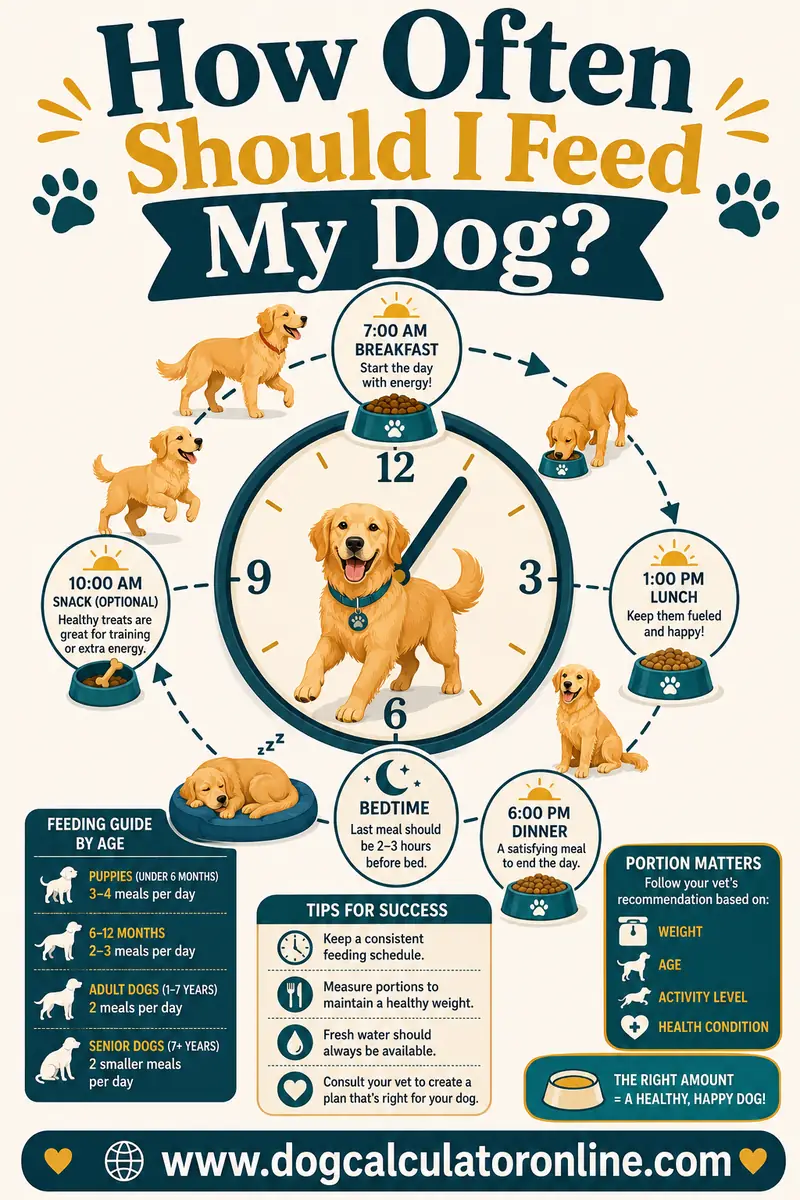
- Puppies: scheduled, full stop — for house-training, for growth-portion accuracy, and because young puppies need 3–4 measured meals a day. (How often should I feed my dog covers the by-age meal counts.)
- Overweight dogs: scheduled. Weight loss requires measured intake by definition.
- Diabetic dogs and others on timed medication: scheduled, per your vet — feeding time is part of the treatment.
- Large, deep-chested breeds: scheduled meals let you manage meal size and exercise timing as part of sensible bloat precautions.
- Multi-dog households: scheduled and separated, unless you enjoy mysteries.
- Wet or raw diets: scheduled by physics — they spoil.
How to Switch a Free-Fed Dog to Meals
The transition takes most dogs less than a week:
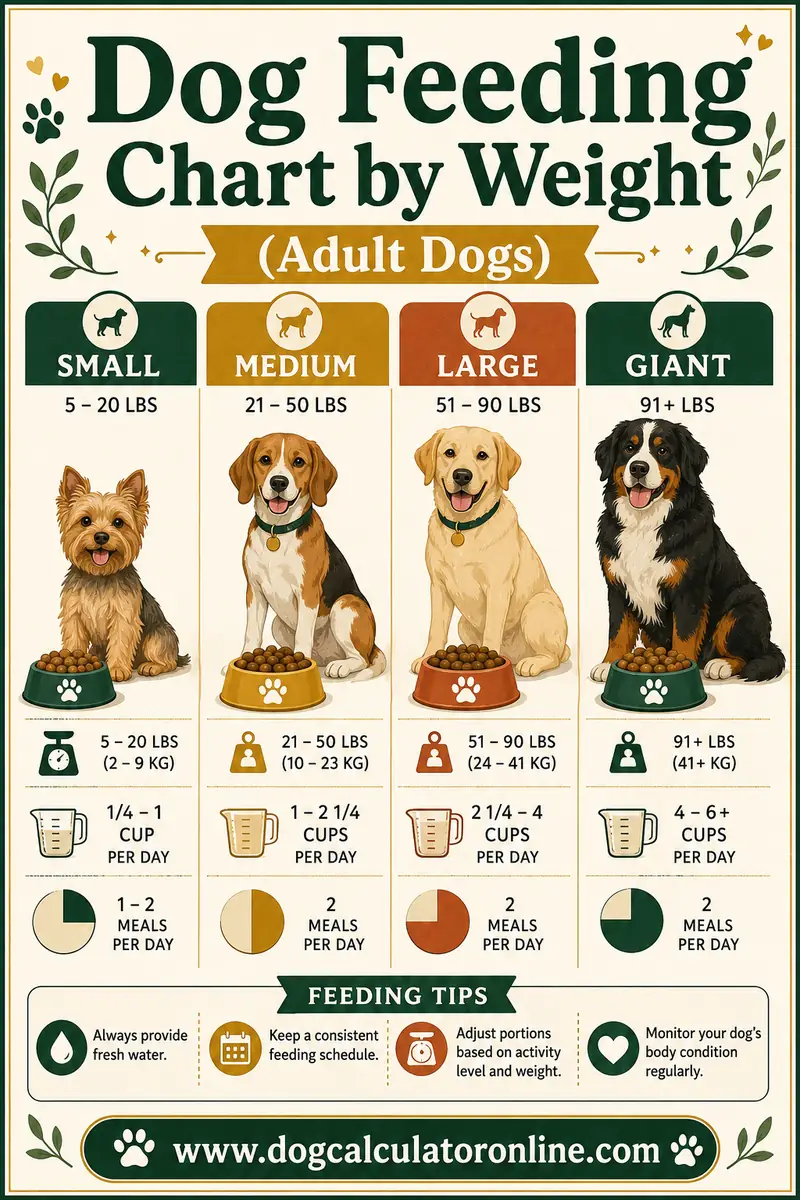
- Calculate the daily amount for your dog's weight, age, and activity — the dog food calculator or the feeding chart by weight gets you there in seconds. Split it into two meals (more for small breeds or per your vet).
- Pick your times — say 7 a.m. and 6 p.m. — and put the bowl down for 15–20 minutes. Calm, boring, no ceremony.
- Lift whatever remains. No snacks, no top-ups, no negotiations until the next scheduled meal. Water stays out always.
- Repeat. A healthy adult dog may skeptically under-eat for a day or two — that's the old economy dying, not starvation. Nearly all dogs are eating enthusiastically at meal times within three to five days.
- Hold the line on the theatrics. The dog who trained you into free feeding will file appeals. Sad eyes at 3 p.m. are not hunger; they're a negotiation tactic.
Safety valves: a dog who refuses food entirely for more than about 24 hours (sooner for toy breeds, puppies, or seniors), or who shows lethargy or vomiting during the switch, gets a vet call — the transition should be boring, and drama means something else is going on. Diabetic dogs and other medical cases should switch only under vet guidance.
The automatic-feeder option: if your schedule is the obstacle, a timed feeder delivers measured portions at set times — scheduled feeding's benefits without your physical presence. It solves timing and quantity; it can't watch the dog eat, so keep an eye on the bowl remotely or at day's end.
"But My Dog Has Always Grazed" — Switching a Long-Term Free-Feeder
A dog who's grazed for eight years is a special case of the switch, and worth its own notes. The method is identical — measured meals, 15–20 minutes, lift the bowl — but the adjustment curve runs longer and the humans usually crack before the dog does.
Expect a stubborn phase of three to seven days rather than two or three: an older free-feeder has years of evidence that food is ambient, and updating that belief takes repetition. Keep meals at the same times daily (rhythm is what finally convinces them), resist the urge to garnish an ignored bowl, and don't mistake initial light eating for a crisis — weigh the dog weekly during the transition instead, and let the scale arbitrate. A stable weight on modest eating means the previous grazing volume was padding, which is common.
Two groups deserve extra care: seniors switching for the first time should get a vet check first (sudden diet-pattern changes can unmask, or mask, brewing issues), and any long-term grazer who was free-fed because of pickiness should switch gradually — set mealtimes first while leaving amounts generous, then tighten portions once the rhythm is established. One change at a time, as always.
FAQ
Is free feeding or scheduled feeding better for dogs?
Scheduled, for most dogs — it enables weight control, makes appetite loss (a key illness signal) visible immediately, supports house-training, and fits medication timing. Free feeding suits only healthy, lean, self-regulating adults in single-dog homes, and even then trades away useful information.
Is it OK to leave food out all day for my dog?
It's workable for a minority of dogs — dry food only, single-dog home, dog maintaining a lean weight. If your dog is chubby, still house-training, on medication, or sharing the house with another dog, measured meals are the better call.
Why do vets recommend scheduled feeding?
Three big reasons: portion control against obesity (one of the most common preventable problems in dogs), appetite as an early illness signal, and predictable digestion for house-training and medical management.
Will my dog starve itself if I switch from free feeding?
No. Healthy dogs may under-eat for a day or two while the rules change, then adapt. Offer meals for 15–20 minutes and lift the rest. Refusing all food beyond about 24 hours — sooner for small breeds, puppies, or seniors — is a vet question, not a standoff to win.
Can I free feed one dog and schedule the other?
Practically, no — the scheduled dog will patrol the buffet. Multi-dog homes do best with everyone on scheduled, separated meals; it also ends the mystery of who's eating what.
What if I'm not home at meal times?
An automatic feeder dispenses measured portions on schedule — the benefits of meal feeding without your presence. Or shift meal times to fit your real day; dogs adapt to any consistent clock.
The Bottom Line
Free feeding asks very little of you and tells you very little back. Scheduled feeding costs two short appointments a day and pays you in control and information — the two things that matter most the day your dog's weight drifts or appetite dips. Measure the meals, set the times, and let the bowl become data. The measuring part is the easy bit: the free dog food calculator gives you your dog's exact daily amount, and the feeding schedule guide turns it into a routine.