The Best Feeding Schedule for Adult Dogs
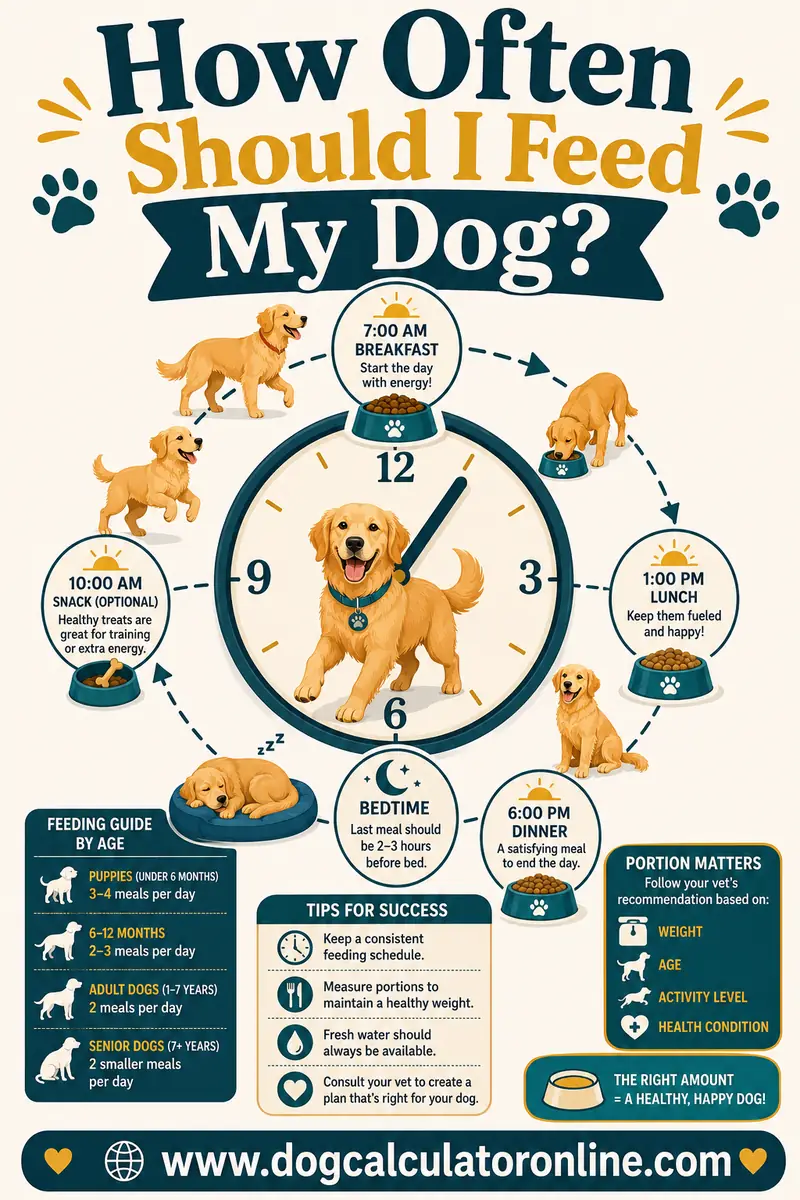
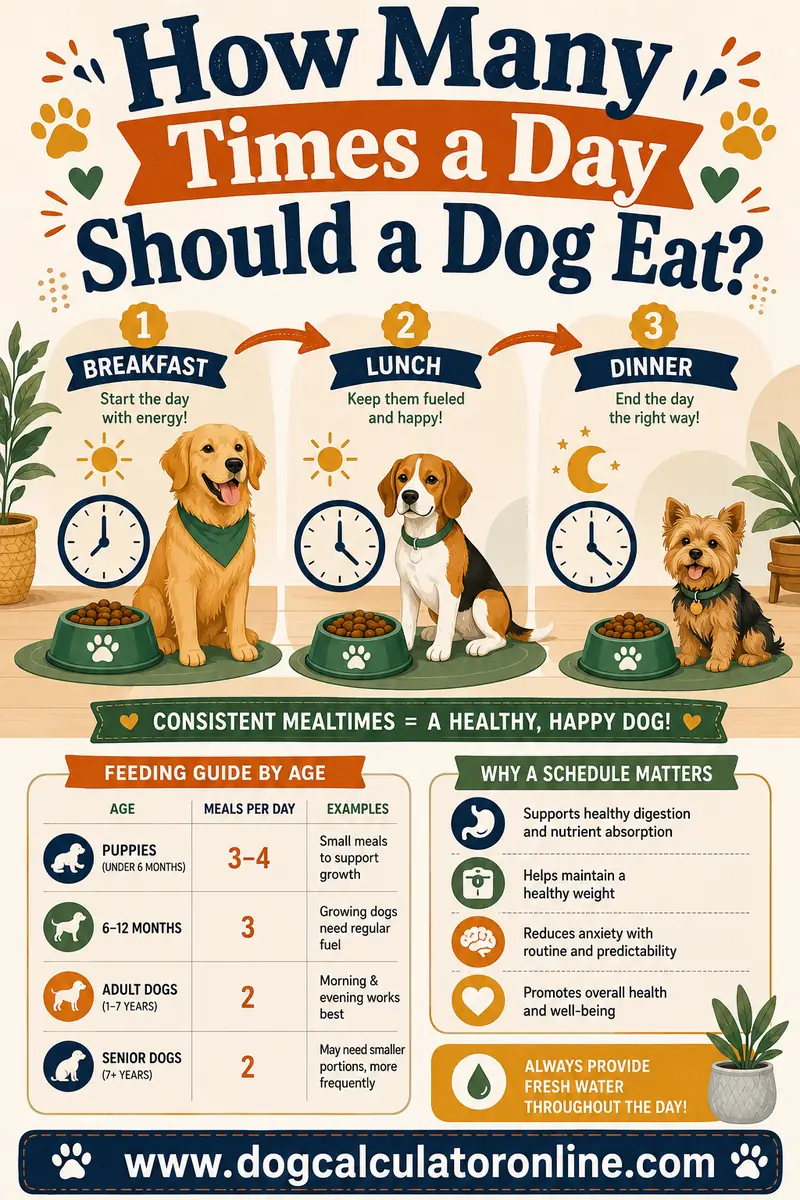
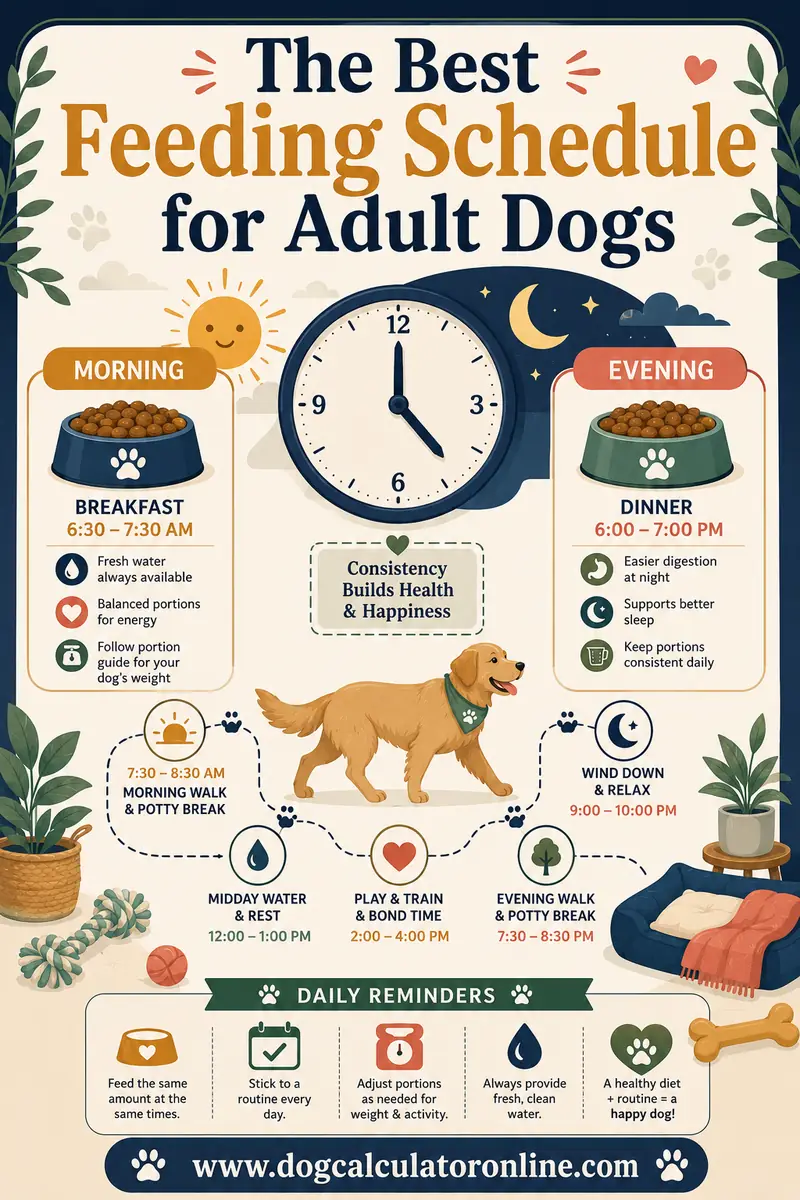
The best feeding schedule for most adult dogs is two meals a day, roughly 8–12 hours apart, at consistent times — say 7 a.m. and 6 p.m. — with the daily food total split evenly between them. Two meals keeps hunger, energy, and digestion steadier than one big meal, fits neatly around human routines, and gives you two built-in daily health checks, because appetite changes are one of the earliest signals dogs send.
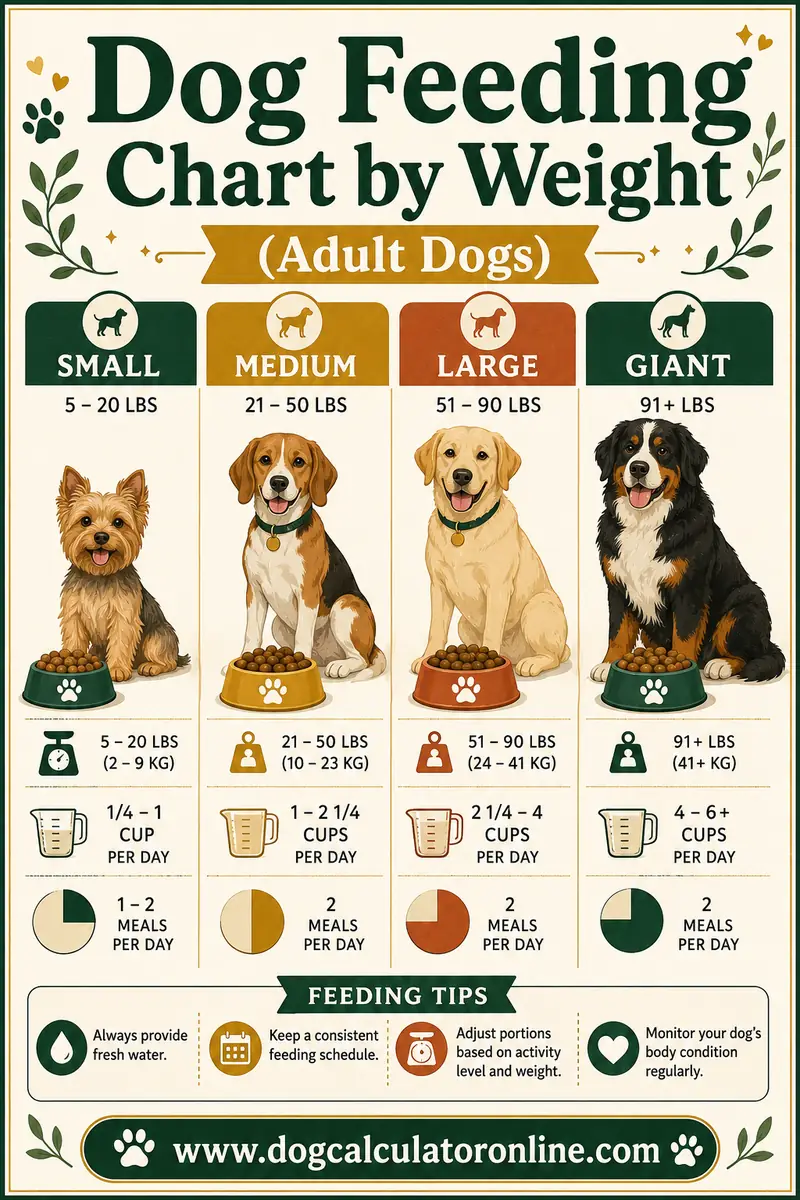
Schedule and amount are separate questions: this article settles when; the free dog food calculator settles how much from your dog's weight, age, and activity. Below: why twice a day wins, sample schedules for different households, how to time meals around exercise, and the dogs who genuinely need a different pattern.
⏰ Build your dog’s day
Tap your household type for a schedule that fits:
Tap an option above. Consistency matters more than the exact clock times.
Why Two Meals Beats One (and Beats Grazing)
Veterinarians overwhelmingly recommend twice-daily feeding for adult dogs, and the reasons are practical:
- Steadier hunger and digestion. A dog fed once a day spends hours very full and hours very empty. Splitting the ration smooths both ends — and reduces the hunger-vomiting (empty-stomach bile) some once-a-day dogs develop.
- Steadier energy and behavior. Mealtimes anchor a dog's internal clock. Dogs on consistent schedules tend to settle better between meals and pester less.
- Two daily health checks. Appetite is a leading indicator. A dog who skips breakfast gets noticed by dinnertime; a grazing dog's declining appetite can hide for days under a topped-up bowl.
- House-training synergy. Meals in on schedule means output on schedule — the input side of predictable potty timing.
- Weight control. Measured meals are countable; a full-time bowl isn't. (The full case against grazing is in free feeding vs scheduled feeding.)
Once a day isn't dangerous for every dog, and some do fine on it — but it offers no advantage for a typical pet, and the smoother two-meal pattern is the safer default. More on meal-count options in how many times a day should a dog eat.
Sample Schedules That Work
The classic (most households):
| Time | What happens |
|---|---|
| 6:45 am | Morning potty trip / short walk |
| 7:00 am | Breakfast — half the daily ration |
| 7:30 am | Potty trip (meals move bowels) |
| Midday | Walk or play; water always available |
| 5:30 pm | Evening walk or exercise |
| 6:15 pm | Dinner — the other half (≈45 min after hard exercise) |
| 9:30 pm | Last potty trip |
The early-bird variant: breakfast 5:30 am, dinner 5:00 pm. Fine — just keep the overnight gap from stretching much past 12–13 hours, or you may meet the 4 a.m. hunger-vomit.
The staggered-household variant: one person feeds breakfast, another dinner. Works well with one rule: a visible tally (whiteboard magnet flipped to "FED") so the dog doesn't successfully invoice both humans for the same meal.
The clock times are yours to choose; dogs don't care about a.m. and p.m., they care about rhythm. Pick times you can hit 90% of days — a schedule you keep beats a perfect one you don't.
Timing Meals Around Exercise
The mealtime-exercise question matters most for large, deep-chested breeds (Great Danes, German Shepherds, Standard Poodles, Weimaraners and similar), which carry a higher risk of bloat (GDV) — a life-threatening twisting of the stomach. The evidence on exact causes is genuinely mixed, but the widely followed common-sense precautions are:
- Leave a buffer between meals and hard exercise — roughly an hour before vigorous activity, and let a dog cool down (30–60 minutes) after hard exercise before feeding.
- Discourage frantic gulping. Slow-feeder bowls or scattered feeding stretch a 30-second inhale into 10 minutes.
- Split the ration into two meals rather than one large one — one of the reasons twice-daily is the default advice for big breeds in the first place.
- Know the emergency signs: unproductive retching, a swelling or hard belly, sudden distress and pacing after a meal = emergency vet, immediately, no waiting.
For everyone else, timing is looser: a gentle leash walk after dinner is fine for most dogs, and the potty benefits are real. When in doubt about your particular dog's risk profile, that's a one-question conversation at the next vet visit.
Water, Treats, and the Rest of the Day
A feeding schedule covers more than the two bowls:
- Water is never scheduled. Fresh water stays available all day, every day — meals are rationed, water isn't. (Intake norms are in how much water a dog should drink.)
- Treats come out of the budget. Keep them under ~10% of daily calories and mentally subtract from dinner. A schedule with generous randomized treats is just grazing with extra steps.
- Use part of the ration for enrichment. A scoop of breakfast in a puzzle feeder or snuffle mat turns a 30-second meal into 15 minutes of occupation — especially valuable for dogs left alone during the workday.
- Kongs and chews count too. A stuffed Kong can carry 100+ kcal depending on the filling. Schedule it, count it, and shrink dinner accordingly.
When the Standard Schedule Needs Adjusting
Two-meals-at-set-times fits most adult dogs, but not all:
- Small and toy breeds with tiny fuel tanks sometimes do better on three smaller meals — particularly the very small ones prone to low blood sugar.
- Seniors may prefer smaller, more frequent meals as digestion slows, and appetite changes in an older dog always earn a vet mention.
- Dogs with medical conditions — diabetes above all — need meals timed to treatment. A diabetic dog's schedule comes from the vet, and consistency stops being "nice" and becomes essential.
- Medication-with-food dogs: if a prescription must be taken with meals, the schedule inherits the prescription's timing.
- Working and sporting dogs often eat a small pre-work portion and the main meal after cooling down — ask whoever manages the dog's conditioning program.
- The formerly free-fed: transitioning a grazer to meals takes about a week — put the bowl down for 15–20 minutes twice daily and lift whatever remains. A healthy dog learns the new economy in a few days. (A skipped meal is normal during the switch; two full days without eating is a vet call.)
Puppies are their own universe — three to four meals a day on a schedule that changes with age. That system is covered separately in the puppy feeding schedule by age.
Sitters, Travel, and Keeping the Schedule Portable
A good schedule should survive contact with real life. Three habits make it portable:
- Write it down once. A card on the fridge — times, amounts in level measuring cups, treat rules, and "call the vet if she skips two meals" — turns any sitter, boarder, or visiting relative into a competent substitute. Most feeding mishaps with sitters aren't negligence; they're improvisation.
- Pre-portion for absences. Bag each meal individually before a trip. A sitter with labeled bags can't over-scoop, and you'll know exactly what was eaten by what's left.
- Travel on the dog's clock where you can. Across time zones, shift meals gradually (30–60 minutes per day) toward local time rather than jumping. For car-travel days, feed lighter and earlier — a full stomach and a winding road are old enemies.
Boarding facilities will generally match your schedule if you hand them one — and dogs settle noticeably faster in strange places when mealtimes, at least, stay familiar.
Reading the Signals a Schedule Gives You
The quiet superpower of scheduled feeding is diagnostics. When meals happen at fixed times in fixed amounts, deviations become visible instantly:
- A skipped meal in an otherwise normal dog = watch closely; dogs occasionally take a pass.
- Two skipped meals, or a skipped meal plus lethargy, vomiting, or hiding = call the vet today.
- Sudden ravenousness — finishing in seconds, counter-surfing, begging that's new rather than habitual — sustained over days can signal underfeeding or a metabolic issue worth a checkup.
- Slowing down at the bowl — eating half, walking away, coming back — in a senior dog is worth mentioning at the next visit; dental pain and nausea both start this way.
Free-fed dogs send all the same signals — but nobody sees them until they're loud. Scheduled dogs get their problems caught at the whisper stage.
FAQ
What is the best feeding schedule for an adult dog?
Two meals a day, 8–12 hours apart, at consistent times — for example 7 a.m. and 6 p.m. — with the daily amount split evenly and fresh water available at all times.
Is it better to feed a dog once or twice a day?
Twice, for most dogs: steadier digestion and energy, fewer empty-stomach issues, and two daily appetite checks. Once-daily works for some dogs but offers no real advantage for a typical pet.
What times should I feed my dog?
Any pair of times roughly 8–12 hours apart that you can hit consistently. Dogs adapt to your clock — the repetition matters, not the specific hours.
Should I walk my dog before or after feeding?
Gentle walks are fine either side. For vigorous exercise — especially with large, deep-chested breeds — leave about an hour after eating, and let the dog cool down before the post-exercise meal, as part of sensible bloat precautions.
How long after eating do dogs poop?
Commonly within about 30 minutes of a meal — the gastrocolic reflex — which is why a post-meal potty trip is built into good schedules. Individual dogs vary; a week of observation maps yours.
Can I change my dog's feeding times?
Yes — shift gradually (30–60 minutes a day) rather than jumping hours overnight, and keep the new times consistent once you land. Dogs adjust to a new rhythm within days.
The Bottom Line
Feed your adult dog twice a day at times you can keep, split the daily total evenly, buffer hard exercise around meals, and let the schedule's consistency work as a free daily health monitor. The other half of the equation — exactly how much goes in each bowl — takes ten seconds with the free dog food calculator, and the dog feeding chart by weight shows the numbers behind it.