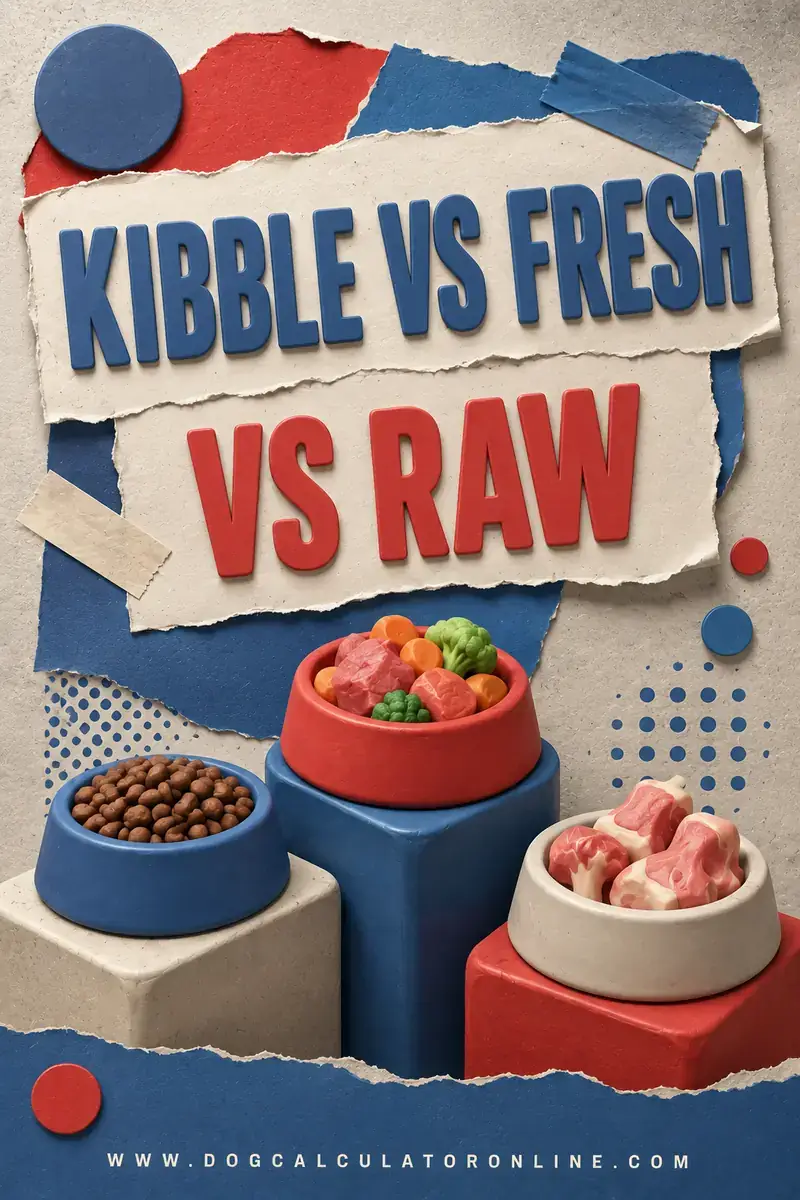
Kibble vs Fresh vs Raw: Cost per 1,000 Calories
Comparing dog foods by price per pound is close to meaningless, because a pound of kibble and a pound of fresh food are not the same amount of food. Kibble is about 10% water; canned food is about 78%; fresh cooked and raw sit somewhere between. You can pay for a lot of water. The honest comparison is cost per 1,000 calories, and the formula fits on one line: (package price ÷ total kcal in the package) × 1,000. Run it once and the gaps become obvious — mainstream kibble commonly lands around $0.60–$2.50 per 1,000 kcal, while fresh and raw usually land around $4–$12. Get your dog's daily calorie number from the free dog food calculator and you can turn any of those into a real monthly bill.
🐾 Roughly what does each format cost?
Tap a food type for a typical range per 1,000 kcal:
Tap an option above. Ranges vary hugely by brand and region - run the formula on your own food.
Why Price per Pound Lies
The problem is moisture, and it is much bigger than most people picture.
Water weighs the same as food and feeds nobody. A 13 oz can of dog food contains roughly 10 oz of water. If you compare it to kibble by weight, you are comparing 3 oz of actual food against 13 oz.
Calorie density is the real unit. Dry kibble typically runs about 3,200–4,200 kcal per kilogram. Canned food runs roughly 800–1,300 kcal/kg. Fresh cooked food is usually somewhere around 1,100–1,800 kcal/kg. A pound of one is not remotely a pound of the other.
Dogs eat calories, not volume. Whatever format you pick, your dog needs the same daily calorie total — that number is what how many kcals your dog needs is for. So calories are the fair denominator.
Even within kibble, density varies by 25% or more. Two 30 lb bags at the same price are not the same value if one is 3,300 kcal/kg and the other is 4,100.
Which is why subscriptions are hard to compare at all. Fresh-food plans quote a price per day for your dog, not a price per unit. Converting to cost per 1,000 kcal is the only way to line them up beside a bag of kibble.
The Formula, and How to Find Each Number
Three numbers, one division. You can do it on your phone in the aisle.
Cost per 1,000 kcal = (package price ÷ total kcal in the package) × 1,000.
Step 1 — package price. What you actually pay, after any repeat-delivery discount. Include shipping for subscriptions; it is part of the cost.
Step 2 — total calories in the package. For dry food: weight in kg × the kcal/kg from the calorie content statement. For a 30 lb bag, that is 13.61 kg. For canned food: kcal per can × number of cans. For subscriptions: ask, or take the daily calories they say they are supplying and multiply by the days covered.
Step 3 — divide and scale. Price ÷ total kcal, then × 1,000.
Where to find kcal/kg. The calorie content statement on the label, usually near the guaranteed analysis or the feeding chart. It is required on US pet food, and it is the single most useful number on the bag — the full label walkthrough is in how to read a dog food label.
If a brand will not tell you the calorie density, that is an answer too. Every legitimate manufacturer knows it and will supply it if you ring or email.
A Worked Comparison, Same Dog, Five Foods
Take one dog and price five ways of feeding it. Our dog is a 50 lb (23 kg) neutered adult needing about 1,160 kcal a day.
Food A — mid-range kibble, 30 lb bag at $55, 3,600 kcal/kg.
Total kcal = 13.61 × 3,600 = 49,000. Cost per 1,000 kcal = (55 ÷ 49,000) × 1,000 = $1.12.
Daily = 1.16 × 1.12 ≈ $1.30. Monthly ≈ $39.
Food B — budget kibble, 40 lb bag at $42, 3,500 kcal/kg.
Total kcal = 18.14 × 3,500 = 63,500. Per 1,000 kcal = $0.66.
Daily ≈ $0.77. Monthly ≈ $23.
Food C — canned, 13 oz cans at $2.80, 450 kcal per can.
Per 1,000 kcal = (2.80 ÷ 450) × 1,000 = $6.22.
Daily ≈ $7.22. Monthly ≈ $217.
Food D — fresh cooked subscription at $6.50 a day for this dog's calories.
Per 1,000 kcal = (6.50 ÷ 1,160) × 1,000 = $5.60. Monthly ≈ $195.
Food E — commercial frozen raw, 2 lb pack at $8.50, roughly 1,300 kcal per pack.
Per 1,000 kcal = $6.54. Daily ≈ $7.59. Monthly ≈ $228.
Those figures are illustrations built from realistic package prices, not survey averages — brands, regions and retailers move them a lot. Run the formula on the actual prices in front of you. But the ratio is the durable finding: feeding this dog fresh or raw costs roughly five to nine times what budget kibble costs.
The Comparison Table
| Format | Typical calorie density | Typical cost per 1,000 kcal | Monthly cost, 50 lb dog | Monthly cost, 15 lb dog |
|---|---|---|---|---|
| Budget dry kibble | 3,300–3,700 kcal/kg | $0.55–$0.90 | $19–$31 | $8–$13 |
| Mid-range dry kibble | 3,500–3,900 kcal/kg | $0.90–$1.60 | $31–$56 | $13–$23 |
| Premium / grain-free kibble | 3,600–4,200 kcal/kg | $1.60–$2.50 | $56–$87 | $23–$36 |
| Canned wet food | 800–1,300 kcal/kg | $4.00–$9.00 | $139–$313 | $58–$130 |
| Fresh cooked subscription | 1,100–1,800 kcal/kg | $4.00–$10.00 | $139–$348 | $58–$145 |
| Commercial frozen raw | 1,200–1,800 kcal/kg | $5.00–$12.00 | $174–$418 | $72–$174 |
| Freeze-dried / air-dried | 4,000–5,000 kcal/kg | $10.00–$25.00 | $348–$870 | $145–$362 |
Monthly figures assume roughly 1,160 kcal a day for the 50 lb dog and 480 kcal a day for the 15 lb dog, at 30 days. These are planning ranges, not quotes. For the same numbers framed as an annual household budget, see how much it costs to feed a dog.
What the Cost Difference Does and Does Not Buy
Worth saying plainly, because the price gap invites strong opinions in both directions.
All formats can be complete and balanced. A kibble carrying an AAFCO adequacy statement for your dog's life stage meets the same nutrient profile as a fresh food carrying the same statement. Price is not a proxy for adequacy.
Fresh and raw genuinely differ in digestibility and palatability for some dogs. Fussy eaters, dogs recovering from illness and some seniors do visibly better on food that smells like food. That is a real benefit, just not one that scales to every dog.
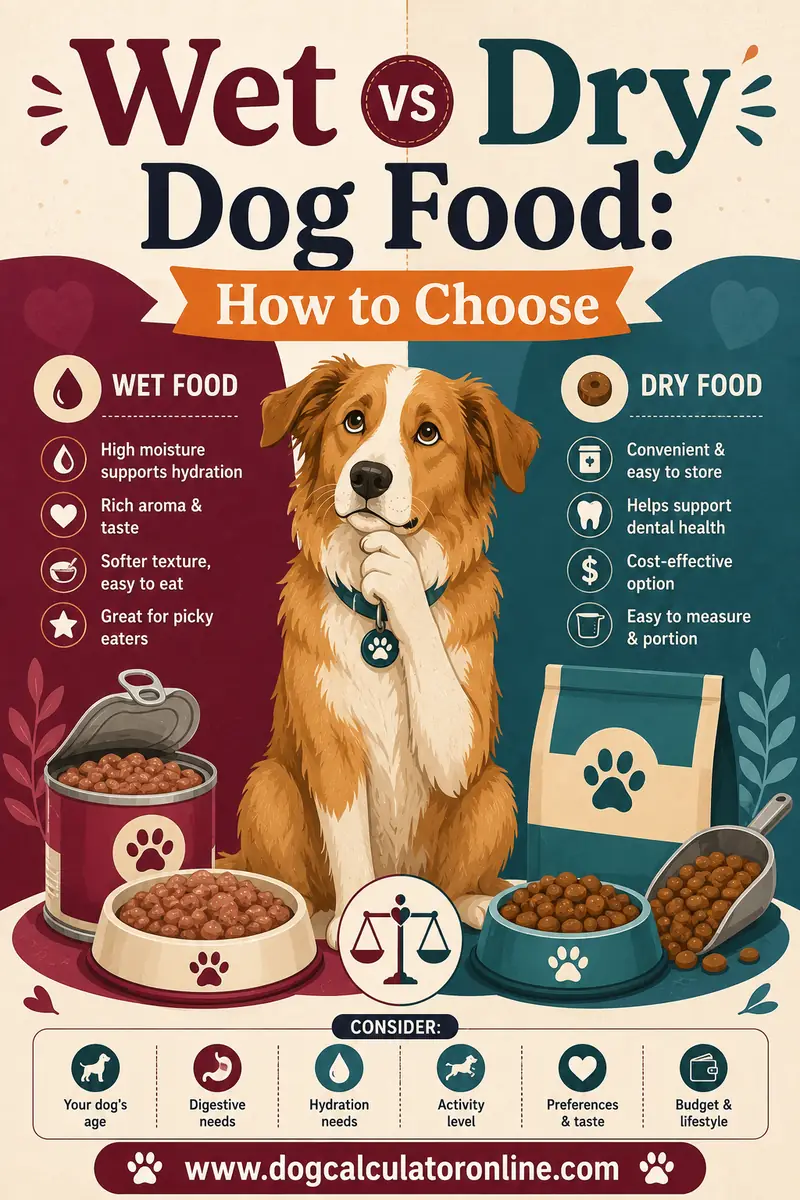
Moisture has a real value for some dogs. Dogs prone to urinary issues, or who simply drink little, benefit from water arriving in the bowl. That is the main argument for wet food, and it is covered in the wet vs dry comparison.
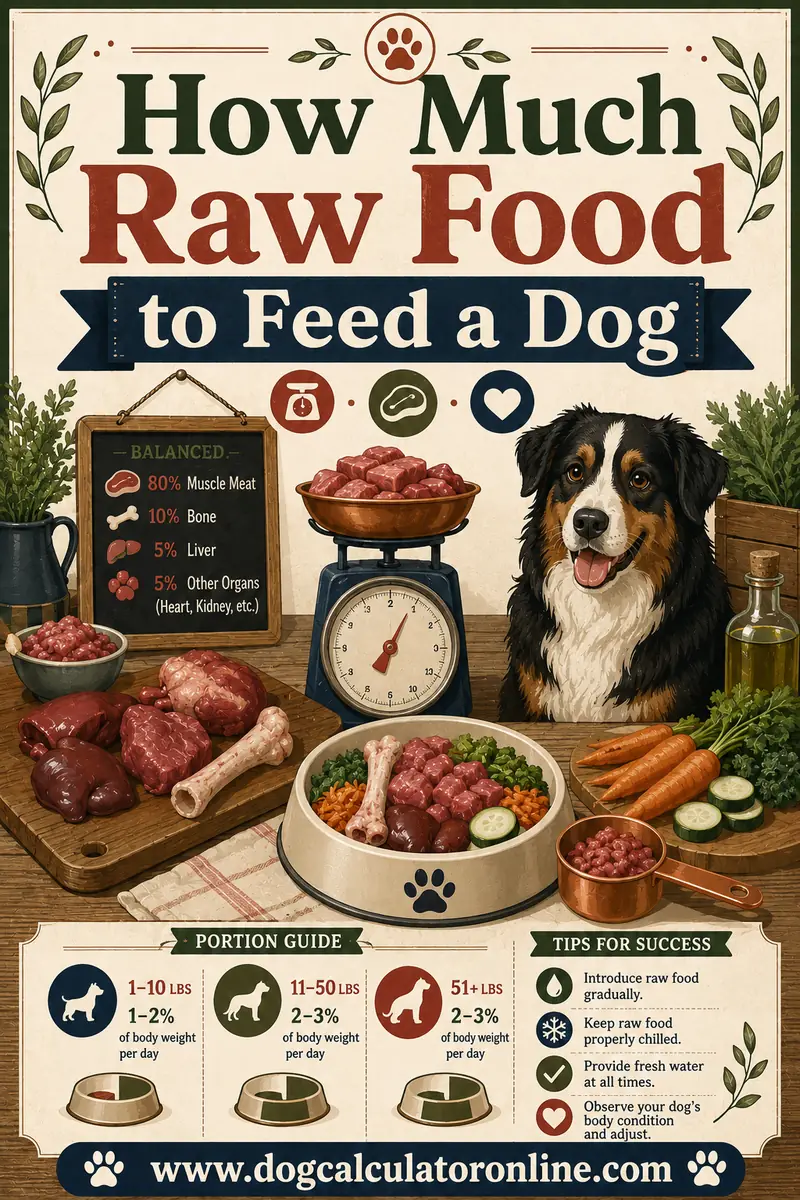
Raw carries handling obligations. Bacterial risk to the household is real, freezer space is required, and portioning takes planning — see how much raw food to feed a dog.
What the money does not reliably buy is a longer, healthier life. There is no good evidence that any of these formats outperforms the others on lifespan for a normal healthy dog. Body condition, dental care and veterinary attention do far more.
Cheaper Ways to Get the Same Benefit
If the fresh-food logic appeals but the price does not, there is a middle path that actually works.
Use fresh food as a topper, not the whole diet. Putting 10–20% of the daily calories in as fresh or wet food on top of kibble captures most of the palatability and moisture benefit at a fraction of the cost. Our 50 lb dog getting 15% of its calories fresh costs roughly $39 + $19 ≈ $58 a month rather than $195.
Subtract the topper's calories from the kibble. This is the step everyone skips, and it is how dogs get fat on a "small" addition. Reduce the bowl by exactly what you added.
Buy the largest bag your dog finishes in about six weeks. Bigger bags are cheaper per pound, but kibble fat oxidises after opening — the trade-off is worked through in how long a bag of dog food lasts.
Use autoship discounts. Most retailers offer around 5–10% on repeat delivery, which compounds across a year.
Count the treats. Treats commonly add 10–15% to the food bill and are usually the most expensive calories in the house per 1,000 kcal. Carrot sticks and green beans cost almost nothing.
And feed the right amount. Overfeeding by 15% is a 15% higher food bill plus a future weight-management problem. It is the only saving that pays twice.
Common Mistakes That Skew the Comparison
Five things that quietly wreck an otherwise sensible calculation.
Comparing an on-offer price to a full price. Use the price you will pay on an ordinary week, not the introductory deal a fresh-food brand offers for the first box.
Forgetting shipping and delivery. Frozen shipping in particular is expensive and sometimes billed separately.
Using the bag's feeding chart instead of your dog's real portion. Bag charts run generous, which inflates the estimated monthly cost of kibble and understates the gap to subscriptions that price by actual calories.
Ignoring waste. Half a bag binned because it went stale is a real cost. So is a fresh-food pack thrown away at the end of its fridge window.
Comparing a puppy price to an adult price. A growing puppy eats a calorie-dense food and its portion rises for months, so a quote based on today's intake understates the first year badly. Price the puppy year on the portion your dog will be eating at six months, not eight weeks.
Assuming the small bag and the big bag cost the same per calorie. They rarely do. Stepping up a bag size typically cuts the per-pound price by 25–45%, which moves the per-1,000-kcal figure just as much — so always compare the size you would actually buy, not the size on the shelf edge label.
Leaving out everything except food. Bowls, treats, supplements, dental chews and the food-adjacent extras add up. To see food in the context of the whole annual cost of a dog, the dog cost calculator builds the full picture.
Running the Numbers on Your Own Dog
Five minutes, and you will not have to redo it for a year.
1. Get the daily calorie target. Use the free dog food calculator, or your vet's figure if your dog is on a weight plan or has a medical condition.
2. Find the kcal/kg or kcal/can on each food you are considering. On the label, or from the manufacturer.
3. Divide package price by package calories, times 1,000. Write the answer on your phone's notes next to the brand name.
4. Multiply by your dog's daily calories, divided by 1,000. That is the daily cost. Times 30 for monthly, times 365 for yearly.
5. Redo it when anything changes. A new food, a price rise, a weight-loss plan, or a puppy who has finished growing. The formula is the same every time; only the inputs move.
And judge the food on the dog, not the spreadsheet. Stable weight, firm stools, good energy and a decent coat are what you are actually buying. The cheapest food your dog genuinely thrives on is the right answer.
FAQ
How do I compare dog food prices fairly?
Use cost per 1,000 calories, not price per pound or per bag. Divide the package price by the total calories in the package and multiply by 1,000. Total calories for dry food is the weight in kilograms times the kcal/kg on the label; for wet food it is kcal per can times the number of cans.
Is fresh dog food really more expensive than kibble?
Yes, substantially. Fresh cooked subscriptions typically run around $4–$10 per 1,000 calories against roughly $0.60–$2.50 for dry kibble — commonly four to eight times more. For a 50 lb dog that is often the difference between about $30–$50 a month and about $150–$250 a month.
How much does it cost to feed a dog raw?
Commercial frozen raw usually works out around $5–$12 per 1,000 calories, so roughly $175–$420 a month for a 50 lb dog and $70–$175 for a 15 lb dog. Prices vary widely by protein, brand and region, and you also need dedicated freezer space and safe handling routines.
Why is wet dog food so expensive per calorie?
Because it is roughly 78% water. A 13 oz can holds only about 3 oz of actual food, so you are paying to package and ship water. That is why wet food looks inexpensive per can but typically costs four to nine dollars per 1,000 calories, several times the price of kibble.
What is the cheapest way to feed a dog well?
A large bag of a complete-and-balanced dry food carrying an AAFCO adequacy statement, bought in the biggest size your dog finishes within about six weeks, with a repeat-delivery discount, portioned accurately, and with treats kept inside 10% of daily calories. That typically lands under $1 per 1,000 calories.
Does more expensive dog food mean better quality?
Not reliably. Price correlates loosely with quality at best. Judge a food on its AAFCO nutritional adequacy statement, whether the company employs a qualified nutritionist and runs feeding trials, and how your own dog does on it — weight, stools, energy and coat.
Price the Calories, Not the Bag
Once you start comparing dog foods per 1,000 calories, the market stops being confusing. Kibble is cheap because it is dry and dense. Wet food costs several times more because most of what you carry home is water. Fresh and raw sit at the top because they are perishable, lightly processed and shipped cold. None of that makes any of them wrong — it just means you should know the real gap before you decide. Take your dog's daily calories from the free dog food calculator, divide package price by package calories, and compare like with like. Then, if you want to see where food sits against vet care, insurance and everything else, the dog cost calculator puts the whole year on one page.