How Much Raw Food to Feed a Dog
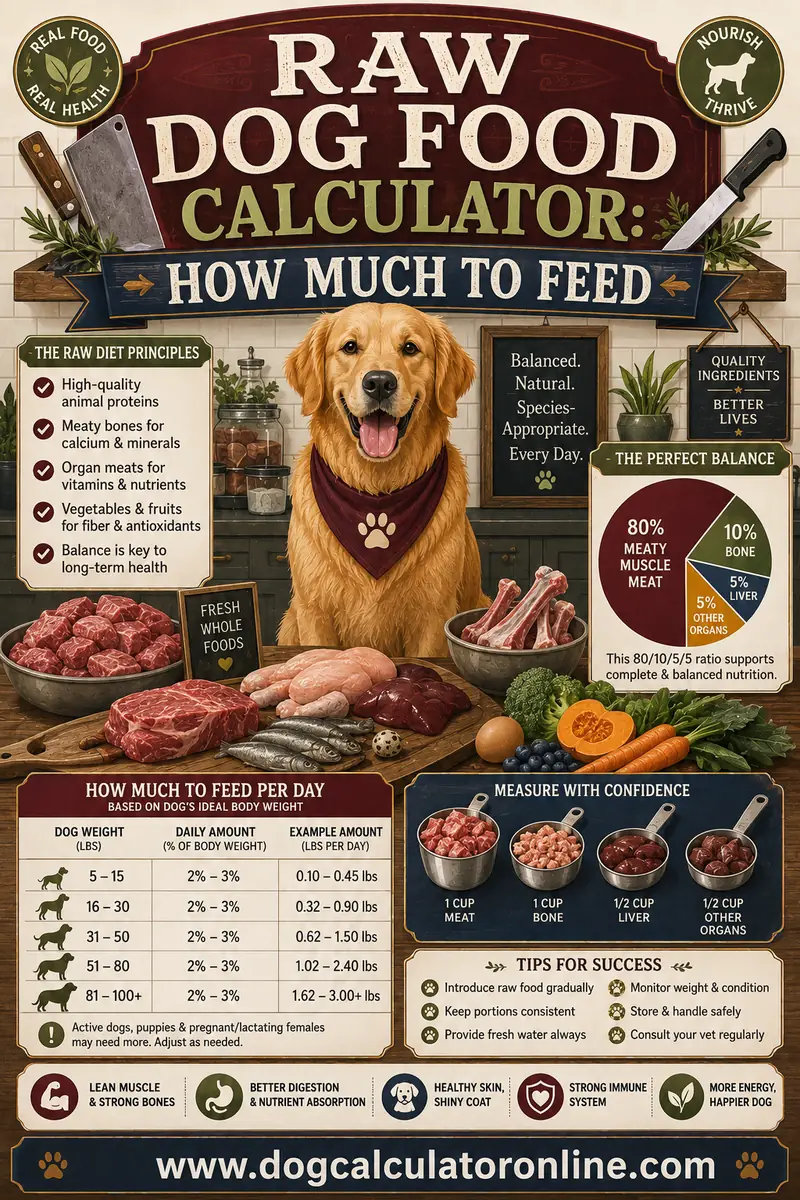
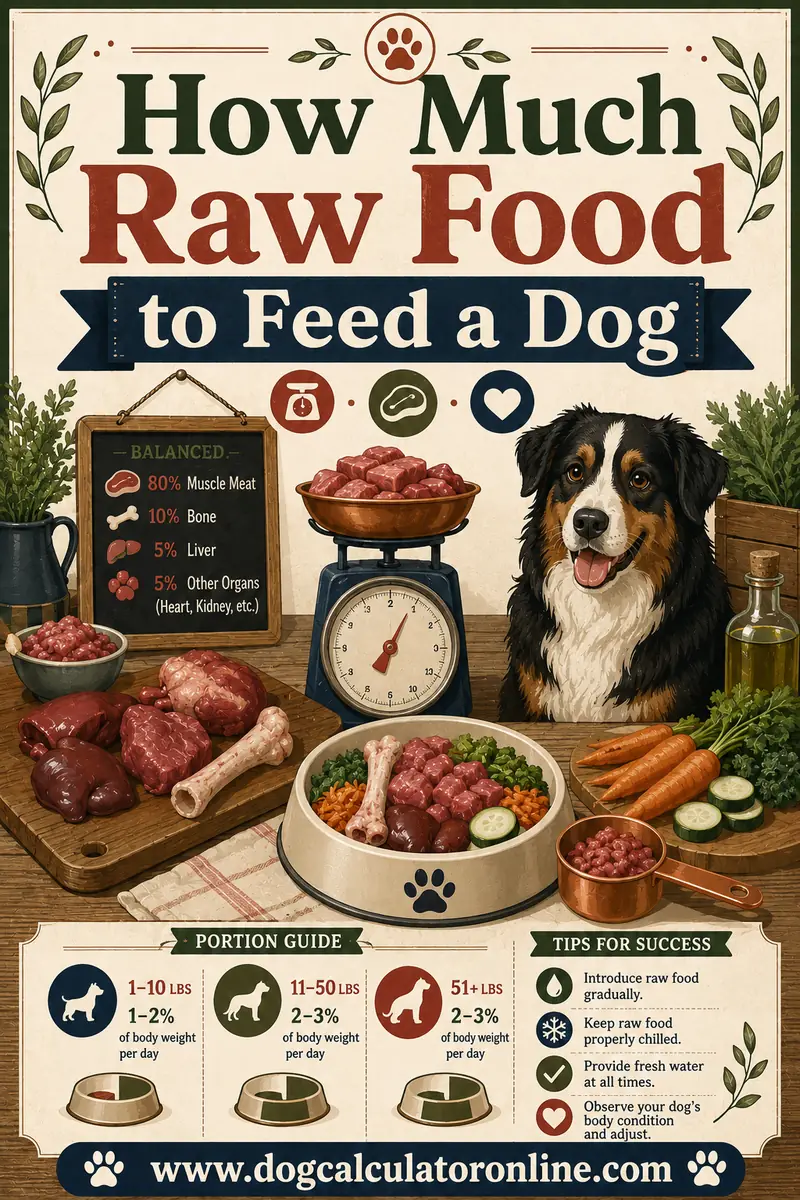
The standard starting guideline for raw feeding is 2–3% of your adult dog's ideal body weight per day — about 1 lb (16 oz) of raw food daily for a 50-lb dog, half a pound for a 25-lb dog, and 1½–2 lb for a 75-lb dog, usually split into two meals. Highly active dogs may need 3–4%, easy keepers and seniors closer to 1.5–2%, and the number should always be tuned to body condition rather than followed blindly.
Raw portions are calculated by weight percentage rather than cups, which makes the math simpler in one way and easier to fumble in another. The free dog food calculator has a raw mode that converts your dog's weight and activity into a daily portion in seconds. Below: the percentage chart in pounds and ounces, how to adjust it, what a balanced raw ration has to include, and the food-safety rules that matter more with raw than with any other way of feeding.
🥩 Raw portion check
Tap your adult dog’s weight for a typical daily raw amount (2–3% rule):
Tap a weight above. Activity and body condition move the percentage.
The Raw Feeding Chart (2–3% Rule)
Daily raw food amounts for adult dogs at ideal body weight:
| Dog's ideal weight | 2% (low end) | 2.5% (typical) | 3% (high end) |
|---|---|---|---|
| 10 lb | 3.2 oz | 4 oz | 4.8 oz |
| 20 lb | 6.4 oz | 8 oz | 9.6 oz |
| 25 lb | 8 oz | 10 oz | 12 oz |
| 40 lb | 12.8 oz | 1 lb | 1 lb 3 oz |
| 50 lb | 1 lb | 1 lb 4 oz | 1 lb 8 oz |
| 65 lb | 1 lb 5 oz | 1 lb 10 oz | 1 lb 15 oz |
| 75 lb | 1 lb 8 oz | 1 lb 14 oz | 2 lb 4 oz |
| 100 lb | 2 lb | 2 lb 8 oz | 3 lb |
Where to start inside the range: 2.5% of ideal body weight is the usual starting point for an average neutered adult. Weigh portions on a kitchen scale — raw feeding is a weight game, and eyeballed portions drift badly. And note the word ideal: an overweight dog gets portioned at the weight it should be, not the weight it is. If you're unsure what that target is, your vet can give you one in a single visit.
Adjusting the Percentage for Your Dog
The 2–3% band exists because dogs vary. Move within (or slightly beyond) it based on:
- Activity. A genuinely hard-working dog — sport, herding, long daily runs — can need 3–4% of body weight. A leash-walked apartment dog often maintains on 1.5–2%. Be honest; weekend fetch is not a working dog.
- Metabolism and age. Seniors and easy keepers drift toward the low end. Young adults with motors run high.
- Weight goals. For weight loss, feed the percentage against ideal weight (which is automatically a cut) and re-weigh monthly. For gain, nudge up half a percent at a time.
- Neuter status. Spayed and neutered dogs typically need the lower half of the range.
Then let the dog referee, exactly as with kibble: ribs you can feel easily under a light cover, a waist visible from above, a tuck from the side. Check monthly, adjust the daily weight by about 10%, and re-check in three to four weeks. If your dog gains or loses weight rapidly with no portion change, that's a vet visit, not a math problem — and the warning signs are the same ones covered in signs you're overfeeding your dog.
Percentage vs Calories: Why Both Views Help
The percentage rule is a convenient shortcut, but it's worth knowing what it approximates. Raw diets typically run somewhere around 35–50 kcal per ounce depending on fat content, and 2.5% of a 50-lb dog's weight (20 oz) lands in the same ballpark as the ~1,000–1,150 kcal that dog's calorie math would suggest. The two systems agree for average dogs — which is why the shortcut works.
Where they disagree is fat. A very fatty ration (lots of chicken skin, fatty trim) can pack half again more calories into the same ounces, quietly overfeeding a dog whose percentage looks textbook. If your dog gains weight on a "correct" percentage, fat content is the first suspect. The raw dog food calculator guide covers the percentage-to-calorie translation in more depth, and the calorie-first view in how much should I feed my dog applies to raw as much as kibble.
What a Balanced Raw Ration Includes
Amount is only half the assignment — a raw diet also has to be complete, and this is where home-built raw goes wrong most often. The commonly used framework for a prey-model-style ration:
- ~70–80% muscle meat — the calorie and protein base.
- ~10% edible bone — the main calcium source. Too little risks deficiency; too much causes constipation and mineral imbalance.
- ~5% liver plus ~5% other secreting organs (kidney, spleen) — vitamin-dense; liver especially.
- The remainder in many recipes: vegetables, eggs, fish (a source of omega-3s and vitamin D), or other whole-food extras.
Getting calcium, phosphorus, and trace nutrients right matters enormously over months and years — an unbalanced raw diet can look fine for a long time before problems surface. Both the AVMA and FDA also formally caution about pathogen risks in raw diets. The practical takeaway isn't "don't"; it's do this with your vet in the loop: tell them the diet plan, consider a veterinary-nutritionist-formulated recipe or a commercially prepared complete raw food, and keep regular checkups. Balanced commercial raw (look for a nutritional adequacy statement) removes most of the formulation risk and leaves you just the portion math.
Raw Food Safety: Non-Negotiables
Raw meat handling rules apply doubly when the diner licks your face:
- Freeze and thaw properly. Store raw portions frozen; thaw in the refrigerator, never on the counter.
- Serve, then clear. Give the meal 20–30 minutes, then lift and refrigerate or discard leftovers. Raw food doesn't sit out.
- Sanitize the supply chain. Bowls, scale, prep surfaces, and hands get hot soapy water after every meal. Keep raw prep away from human food prep.
- Mind the household risk profile. Homes with infants, elderly members, or immunocompromised people carry higher stakes for pathogen transfer — a genuine ask-your-vet (and ask-your-doctor) consideration before choosing raw.
- Source responsibly. Meat for raw feeding should be food-grade and handled cold from purchase to bowl.
- Bones: raw only, size-appropriate, supervised. Cooked bones splinter and are never safe. Even raw bones need matching to the dog — a gulper needs ground bone, not whole pieces.
Meal-Prep Logistics That Make Raw Sustainable
Most raw feeders who quit don't quit over the dog — they quit over the workflow. A batch system fixes it:
- Portion on arrival. The day meat comes home, weigh it into single-meal portions (freezer bags or small containers), label with weight and protein, and freeze. Daily feeding then becomes "move tomorrow's meals to the fridge tonight."
- Size the batch to your freezer. Two to four weeks of portions is the sweet spot for most households — enough to buy in bulk, small enough to rotate fresh.
- Keep a simple ratio sheet. If you build meals yourself, a one-page cheat sheet (meat/bone/organ grams per meal for your dog's current ration) prevents drift between batches.
- Budget check. Raw typically costs more per calorie than kibble, scaling with dog size — pricing a month honestly before committing beats discovering it at week three. Bulk buying, freezer sales, and working with local butchers narrow the gap.
Ten minutes of prep per week is what stands between "we tried raw once" and a system that runs itself.
Transitioning a Dog to Raw
Most raw feeders switch over about a week, and dogs' stomachs prefer ramps to cliffs:
- Days 1–2: replace ~25% of the old food with raw (many prefer starting with a single bland protein like chicken).
- Days 3–4: move to 50%, watching stool quality.
- Days 5–6: 75% raw.
- Day 7+: fully switched; introduce new proteins one at a time, several days apart.
Soft stool for a day or two mid-transition is common; ongoing diarrhea, vomiting, or refusal to eat means pause and call your vet. Expect smaller, firmer stools once fully switched — that's normal on raw. The general switching method (and troubleshooting) is the same as any food change: see how to transition your dog to new food.
FAQ
How much raw food should I feed my dog per day?
About 2–3% of ideal adult body weight daily — roughly 8–12 oz for a 25-lb dog, 1–1½ lb for a 50-lb dog — split into two meals, weighed on a kitchen scale, and adjusted to body condition.
How much raw food for a 50-lb dog?
Start near 2.5%: about 1¼ lb (20 oz) per day, split into two 10-oz meals. Very active dogs may need up to 1½ lb; couch companions may maintain on 1 lb.
Is 2% or 3% right for my dog?
Start at 2.5% for a typical neutered adult. Slide toward 2% for seniors, easy keepers, and low activity; toward 3% (or slightly above) for genuinely hard-working dogs. Monthly rib-and-waist checks make the final call.
Do I feed current weight or ideal weight?
Ideal weight, always. Feeding an overweight dog by its current weight preserves the extra pounds. Your vet can set the target if you're unsure.
Is raw feeding safe?
It carries real pathogen and nutritional-balance considerations — the AVMA and FDA both formally caution about raw diets. If you choose raw, use a complete, balanced recipe (commercial or nutritionist-formulated), strict cold-chain hygiene, and keep your vet in the loop.
How many times a day should a raw-fed dog eat?
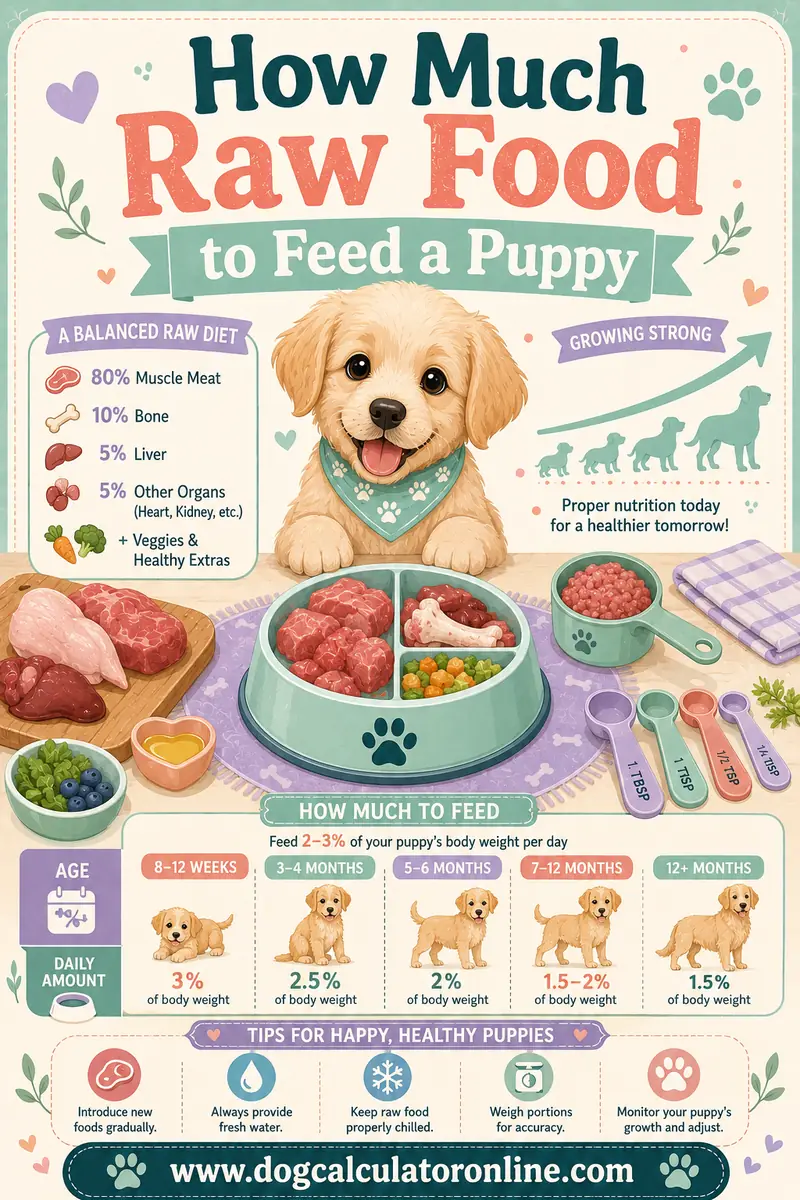
Twice daily suits most adults, same as kibble. The daily weight just gets split in half. Puppies need more meals and different percentages — see how much raw food to feed a puppy.
The Bottom Line
Weigh your dog, take 2.5% of ideal body weight as the starting daily ration, split it into two meals, and let monthly body-condition checks slide you up or down within the 2–3% band. Balance and hygiene are the parts that actually make raw feeding succeed — keep your vet involved on both. For the portion math done instantly, run your dog's numbers through the free dog food calculator in raw mode.