How Much Raw Food to Feed a Puppy
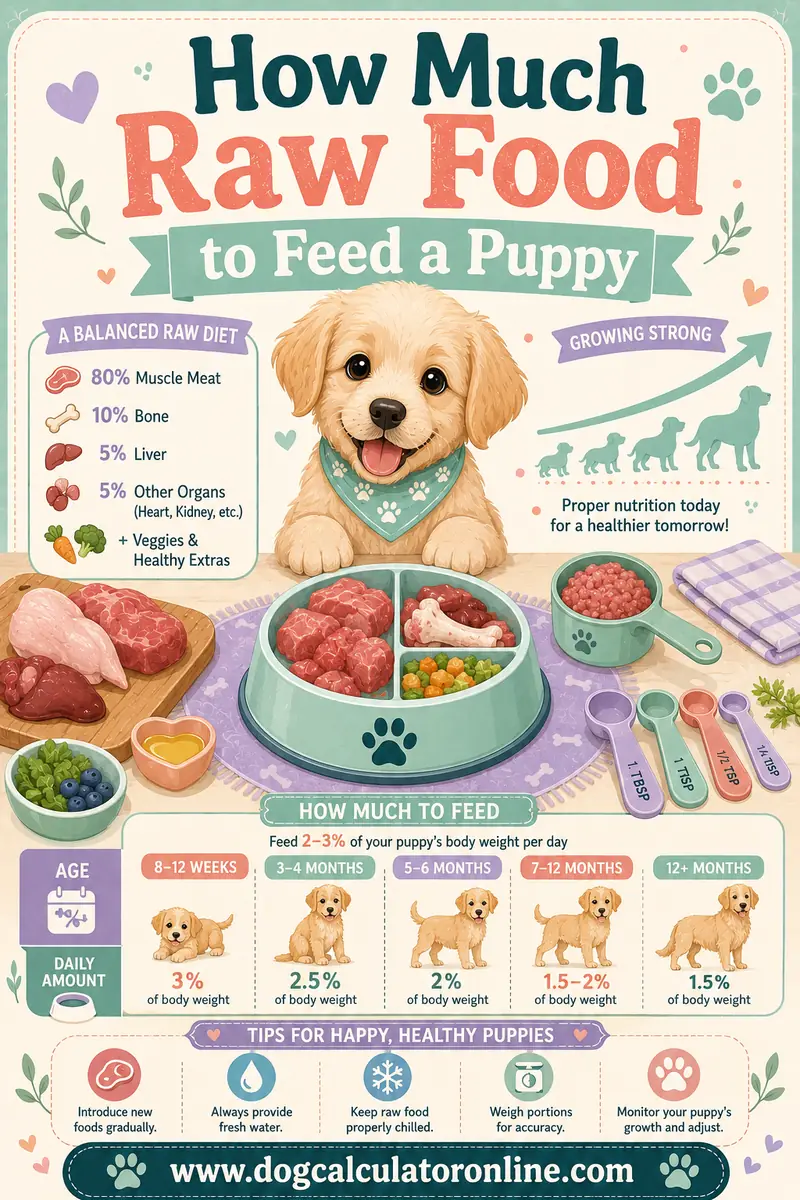
Raw-fed puppies typically eat 5–10% of their current body weight per day (highest for the youngest pups, tapering as they grow), or alternatively 2–3% of their expected adult weight — split into 3–4 meals for young puppies. A 10-lb, three-month-old puppy on the current-weight method eats roughly 8–16 oz of raw food a day, re-weighed and re-portioned every week or two, because the target moves as fast as the puppy grows.
An important framing note before the charts: raw feeding a puppy is the advanced course. Growing bodies are far less forgiving of calcium, phosphorus, and calorie imbalances than adult ones, and mistakes made during growth can be permanent — so a complete, balanced recipe and a vet who knows the plan are prerequisites, not suggestions. The free dog food calculator handles the portion math; this guide covers the amounts, the two methods, the balance rules, and the safety lines that matter most for pups.
🍖 Puppy raw portion check
Tap your puppy’s age band for the usual percent-of-current-weight range:
Tap an age above. Re-weigh your puppy every 1–2 weeks and re-portion.
Two Ways to Calculate Puppy Raw Portions
Raw feeders use two methods, and both land in similar territory. Pick one and stay consistent.
Method 1 — percent of current weight (tapering). Feed a percentage of what the puppy weighs today, starting high and stepping down with age:
| Puppy's age | % of current body weight/day | Meals/day |
|---|---|---|
| 8–16 weeks | ~8–10% | 4 |
| 4–6 months | ~6–8% | 3 |
| 6–9 months | ~4–6% | 2–3 |
| 9–12 months | ~3–4% | 2 |
| Adult | ~2–3% | 2 |
This method requires weekly or biweekly weigh-ins (bathroom scale: hold the pup, subtract yourself), because the portion is pegged to a moving number.
Method 2 — percent of expected adult weight. Feed 2–3% of the weight your puppy will reach as an adult, from weaning onward. A pup expected to mature at 60 lb eats roughly 1¼–1¾ lb a day throughout growth. This method is steadier — no recalculating — but it depends on a good adult-weight estimate (parents' sizes and breed averages help), and it can overfeed small young pups and underfeed adolescents at peak growth, so body-condition checks matter even more.
Worked example, both ways: a 4-month-old, 20-lb pup expected to mature at 50 lb. Method 1: 6–8% of 20 lb ≈ 19–26 oz/day over 3 meals. Method 2: 2.5% of 50 lb = 20 oz/day. Same neighborhood — which is the point.
Reading Your Puppy, Not Just the Chart
Growth makes feedback loops short and important:
- Ribs and waist, weekly. A raw-fed puppy should be lean: ribs easy to feel under a thin cover, visible waist from above. Lean growth is protective — especially for large breeds — while a chubby puppy is carrying construction-site loads on wet cement.
- Weight curve, not weight days. Plot the weekly weigh-ins. Steady gains along a curve = right ration. A flat or falling line in a growing pup = feed more and call the vet.
- Appetite swings are normal. Puppies inhale food during growth spurts and pick at it in the lulls. Portion to the chart and condition, not to the day's enthusiasm.
- Stool watch. Chalky, crumbly white stool usually means too much bone; persistent soft stool can mean too much organ meat or fat, or too-large meals. Adjust one variable at a time.
Balance: Where Puppy Raw Diets Succeed or Fail
For adult dogs, an unbalanced ration causes slow problems. For puppies, it can cause fast, permanent ones — skeletal development depends on getting calcium and phosphorus in the right amounts and the right ratio, every week of growth. This is the single strongest argument for feeding a complete, balanced commercial raw food (one with a nutritional adequacy statement for growth) or a recipe formulated by a veterinary nutritionist, rather than improvising.
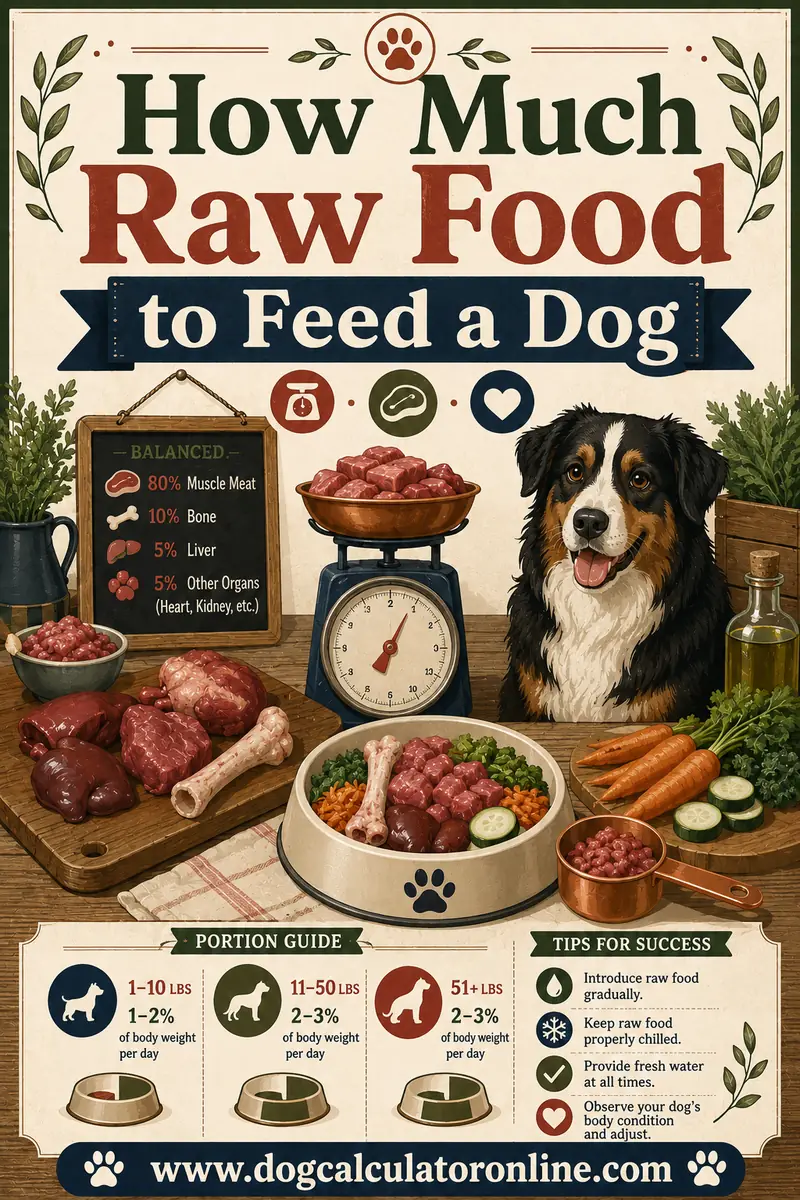
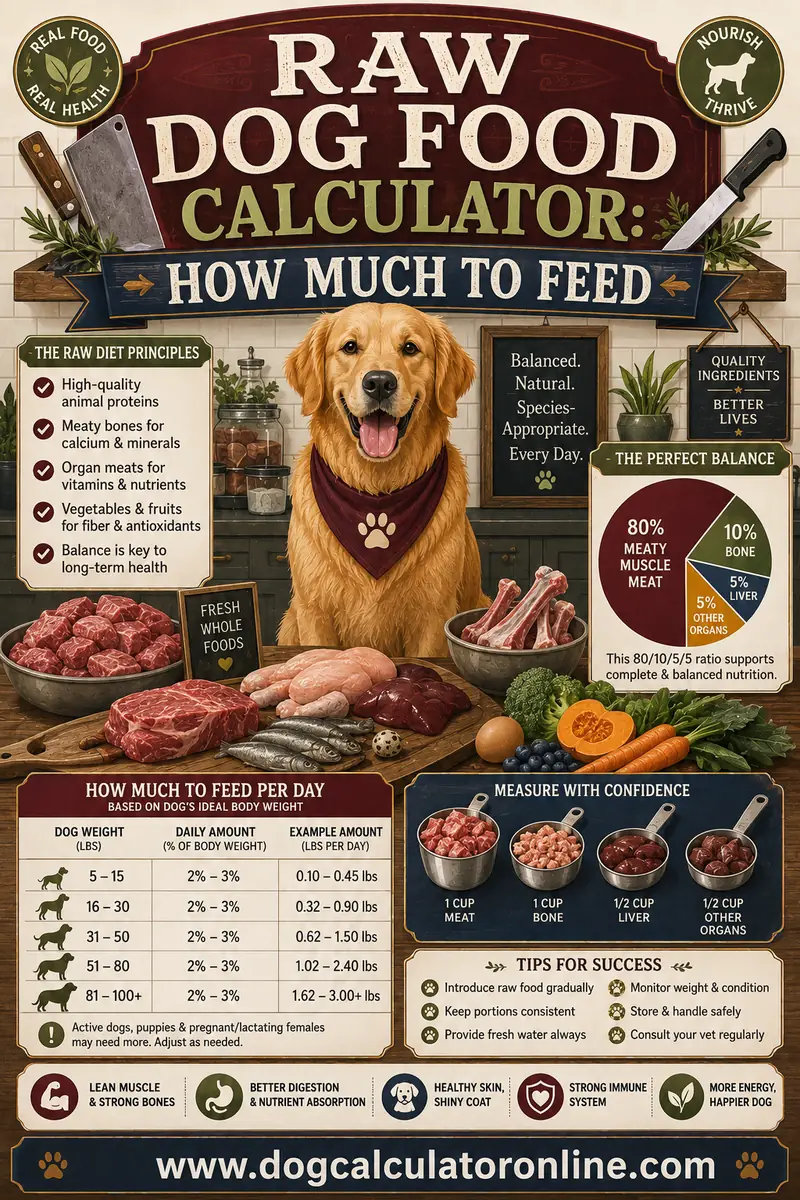
If you do build meals, the commonly used skeleton for growth looks like the adult prey-model ration — roughly 70–80% muscle meat, ~10% edible soft bone, ~5% liver, ~5% other secreting organ, plus extras like egg and oily fish — but with tighter tolerances and, crucially, no freelance calcium supplementation: too much calcium is actively harmful to growing joints, particularly in large breeds. Large and giant-breed puppies deserve special caution here for the same reason large-breed puppy kibble exists — their skeletons punish both excess calories and excess calcium. Tell your vet the plan, bring the recipe to an appointment, and keep growth checkups regular. (For how the balance rules relax in adulthood, see how much raw food to feed a dog.)
Food Safety With a Puppy in the House
All the adult raw-handling rules apply, with two puppy-specific amplifiers.
First, puppies are messier eaters — they step in it, drag it, and then lick everything you own. Feed on an easily washed surface (a mat or tray), wipe paws and muzzle after, and sanitize bowls, scale, and surfaces with hot soapy water every meal. Thaw in the fridge, serve cold or room-temp, and clear uneaten food after 20–30 minutes.
Second, immune systems are still maturing — the puppy's, and possibly your household's. Homes with babies, elderly family, or immunocompromised members carry higher stakes for pathogen transfer, and both the AVMA and FDA formally caution about raw diets on pathogen grounds. That doesn't decide the question for you, but it belongs in the decision — and in the conversation with your vet at the puppy's first visit.
Bones deserve their own line: raw only, never cooked, always size-matched, always supervised. For young puppies most raw feeders use ground bone or soft edible bone; a gulping puppy and a whole bone are a bad combination.
Transitioning a Puppy to Raw
Puppies generally adapt to food changes faster than adult dogs, but the ramp still helps:
- Days 1–2: ~25% raw (single bland protein — chicken is the usual starter) mixed into or alongside the current food.
- Days 3–4: ~50%, watching stools.
- Days 5–6: ~75%.
- Day 7+: fully raw; add new proteins one at a time, a few days apart, so any intolerance is traceable.
Pause the progression for more than a day of soft stool; stop and call your vet for vomiting, refusal to eat, or lethargy — young puppies dehydrate dangerously fast when GI trouble hits. And if the transition lands during another upheaval (new home, vaccinations, deworming), give it a week's buffer; one stressor at a time.
A Sample Week: Putting the System Together
Here's what the whole method looks like in practice for a 4-month-old pup currently at 20 lb (expected adult weight ~50 lb):
- Sunday: weigh the puppy — 20 lb this week. Calculate the ration: 7% of 20 lb ≈ 22 oz/day. Portion the week's meals from the freezer stash: 21 bags of ~7.3 oz (3 meals × 7 days), labeled and refrozen except the next day's three.
- Daily: breakfast, midday, and evening meals of ~7.3 oz each, served on a washable mat, cleared after 25 minutes, bowls and surfaces washed. Training treats come out of the daily total, not on top of it.
- Midweek: quick rib check during a cuddle — easy to feel, light cover. Stools formed and consistent. No changes.
- Next Sunday: re-weigh — 21.5 lb. Recalculate, re-portion, repeat.
That's the entire job: one weigh-in, one calculation, one prep session per week, and daily observation. When the weekly numbers start crawling instead of leaping (usually around 9–12 months), begin easing the percentage down toward the adult 2–3%.
When Raw Isn't the Right Fit (Yet)
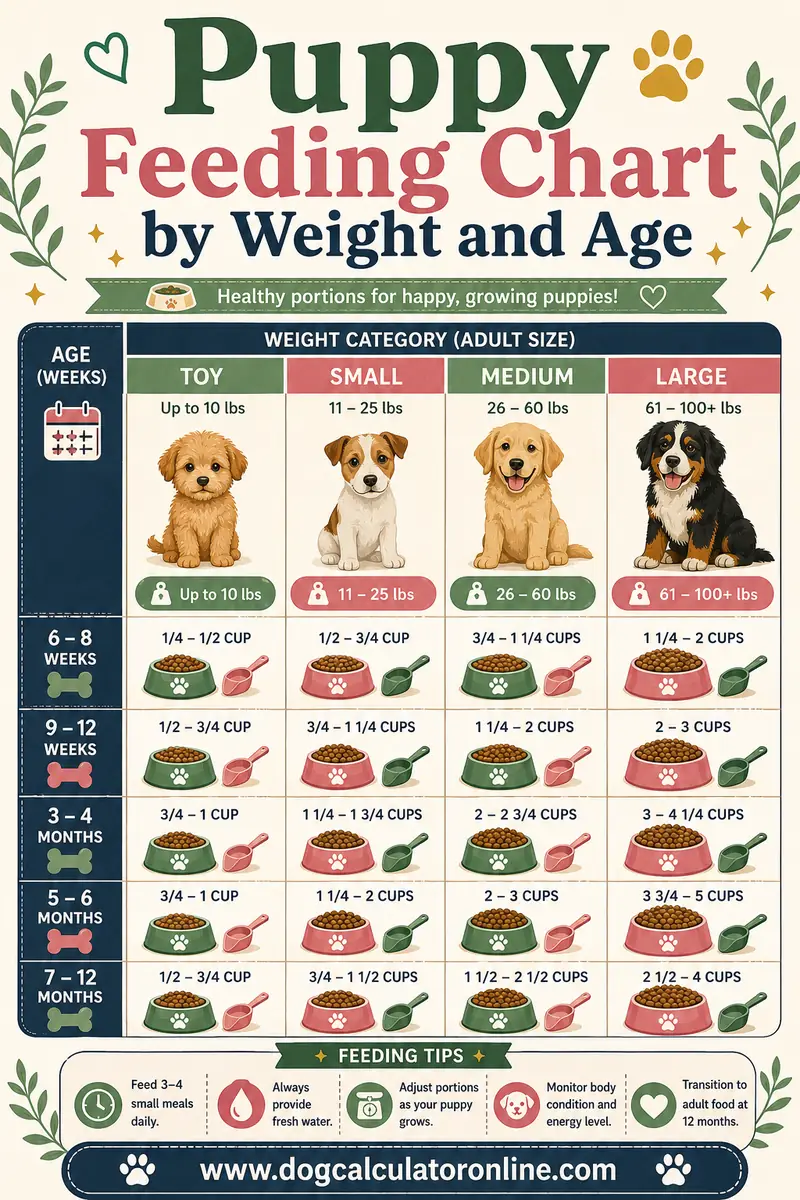
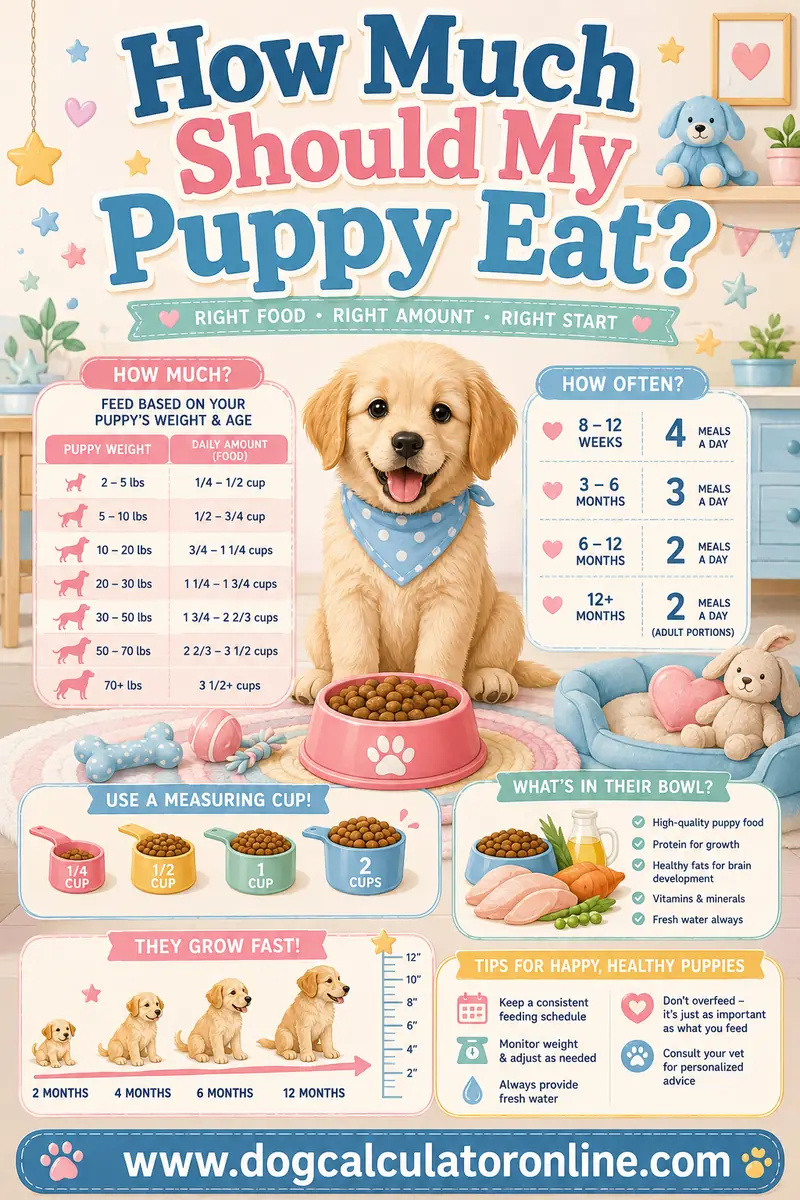
An honest section, because puppy raw feeding demands more than adult raw feeding: reliable access to balanced recipes or complete commercial raw, a kitchen scale and freezer space, strict hygiene discipline, weekly weigh-ins, and a vet you can consult. If any of those are missing right now, there's no shame — and no harm — in raising the puppy on a high-quality complete puppy kibble or wet food and revisiting raw in adulthood, when the tolerances loosen. The puppy feeding chart by weight and age covers that route in full, and how much should my puppy eat explains the calorie logic that applies either way. The goal is a lean, thriving puppy — the format is negotiable.
FAQ
How much raw food should a puppy eat per day?
Roughly 5–10% of current body weight (highest when youngest, tapering with age), or 2–3% of expected adult weight — split into 3–4 meals for young pups and re-calculated every week or two as the puppy grows.
How much raw food for a 3-month-old puppy?
About 8–10% of current weight daily over 4 meals. A 10-lb pup: roughly 13–16 oz per day, or about 3–4 oz per meal. Confirm against growth: steady weekly gains and easy-to-feel ribs mean the ration fits.
Current weight or adult weight — which method is better?
Both work. Current-weight tapering tracks the puppy precisely but needs frequent weigh-ins; adult-weight (2–3%) is steadier but relies on a good size estimate. Whichever you pick, weekly body-condition checks referee.
Can puppies eat the same raw food as adult dogs?
The ingredients overlap, but the balance requirements are stricter — growth depends on precise calcium and phosphorus. Use a complete raw food rated for growth (or a nutritionist-formulated recipe), and never add calcium supplements on your own.
Is raw feeding safe for puppies?
It carries higher stakes than adult raw feeding: nutritional imbalance during growth can cause permanent skeletal harm, and regulators (FDA) and the AVMA caution about pathogens. If you go raw, do it with a balanced growth recipe, strict hygiene, and your vet actively in the loop.
How many meals a day for a raw-fed puppy?
Four meals from 8–16 weeks, three from 4–6 months, then two to three until the adult two-meal pattern — the same schedule as any puppy, just with weighed raw portions.
The Bottom Line
Feed a raw-fed puppy 5–10% of its current weight (tapering with age) or 2–3% of expected adult weight, across 3–4 meals, re-weighed every week or two — and treat balance and hygiene as the real assignment, with your vet reviewing the plan. For the moving-target math, the free dog food calculator gives you today's number in seconds, and the raw dog food calculator guide covers the percentage system end to end.