How Long Does a Bag of Dog Food Last?
A bag of dog food lasts as long as its weight divided by your dog's daily portion — so a 30 lb bag fed to a dog eating 320 g a day (about 11 oz) lasts roughly 43 days. That single line answers the question, and the rest of this page is about the parts that quietly ruin the estimate: treats you forgot to count, a puppy whose portion climbs every week, and a second dog raiding the same bin. As a rough anchor, a 30 lb bag feeds a 10 lb dog for about five months and a 100 lb dog for about three and a half weeks. Get your dog's real daily number from the free dog food calculator first — everything below hangs off it.
🐾 How long will your bag last?
Tap your dog's size for a 30 lb bag estimate:
Tap an option above. Bag weight divided by daily portion is the whole trick.
How Do You Work Out How Long a Bag Will Last?
One sum, two numbers. You need the bag weight and your dog's daily portion, in the same units.
The formula, in grams. Days per bag = (bag weight in pounds × 453.6) ÷ grams fed per day. The 453.6 is just pounds converted to grams; use 454 if you like round numbers, it changes nothing that matters.
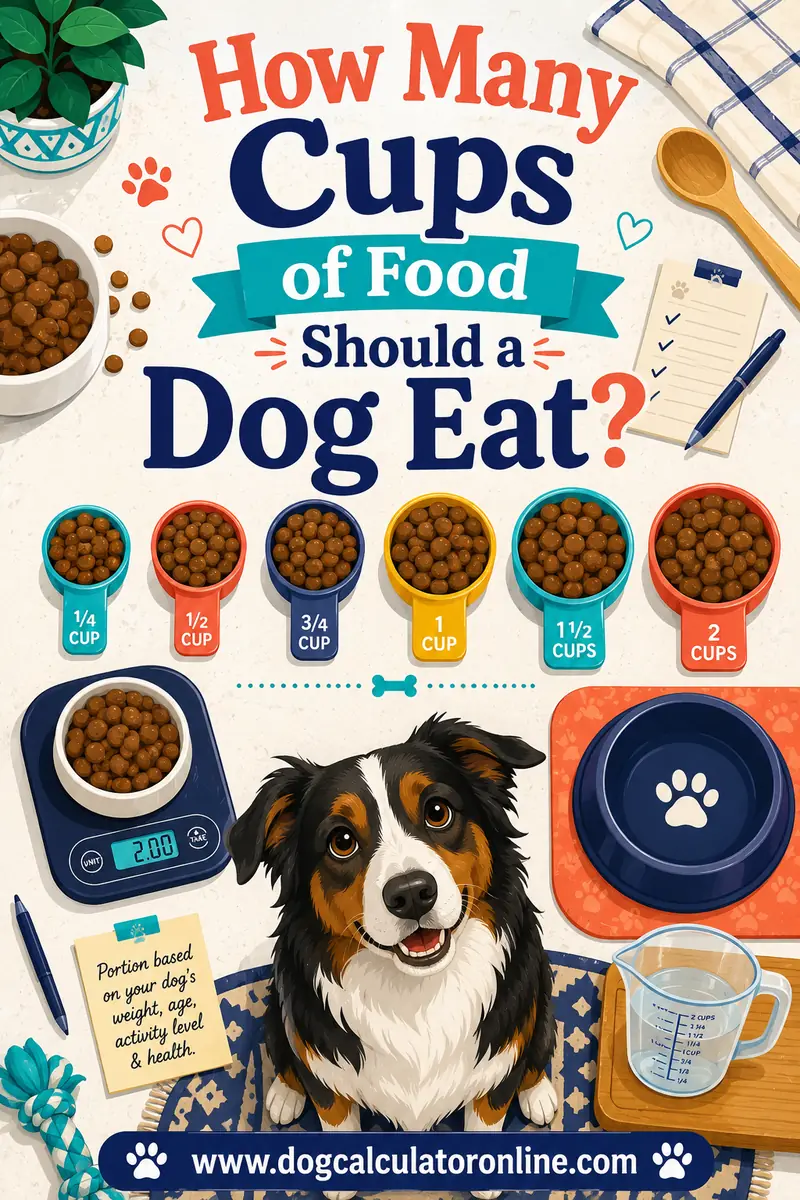
The formula, in cups. If you feed by cup, days per bag = total cups in the bag ÷ cups fed per day. The bag usually prints "approximately X cups" somewhere, or you can work it out: a standard 8 oz measuring cup of typical adult kibble weighs roughly 100–120 g, so a 30 lb bag holds somewhere around 113–136 cups. That spread is exactly why cups are a shakier unit than grams — kibble shape and density change the weight per cup by 20% or more between foods. Our guide to how many cups of food a dog should eat explains the conversion properly.
Where the daily portion comes from. Not the bag. The feeding chart on the back is a broad average built for an unspecified dog, and it is usually generous. Use the dog food calculator or your vet's number, then check it against your dog's body condition over a few weeks.
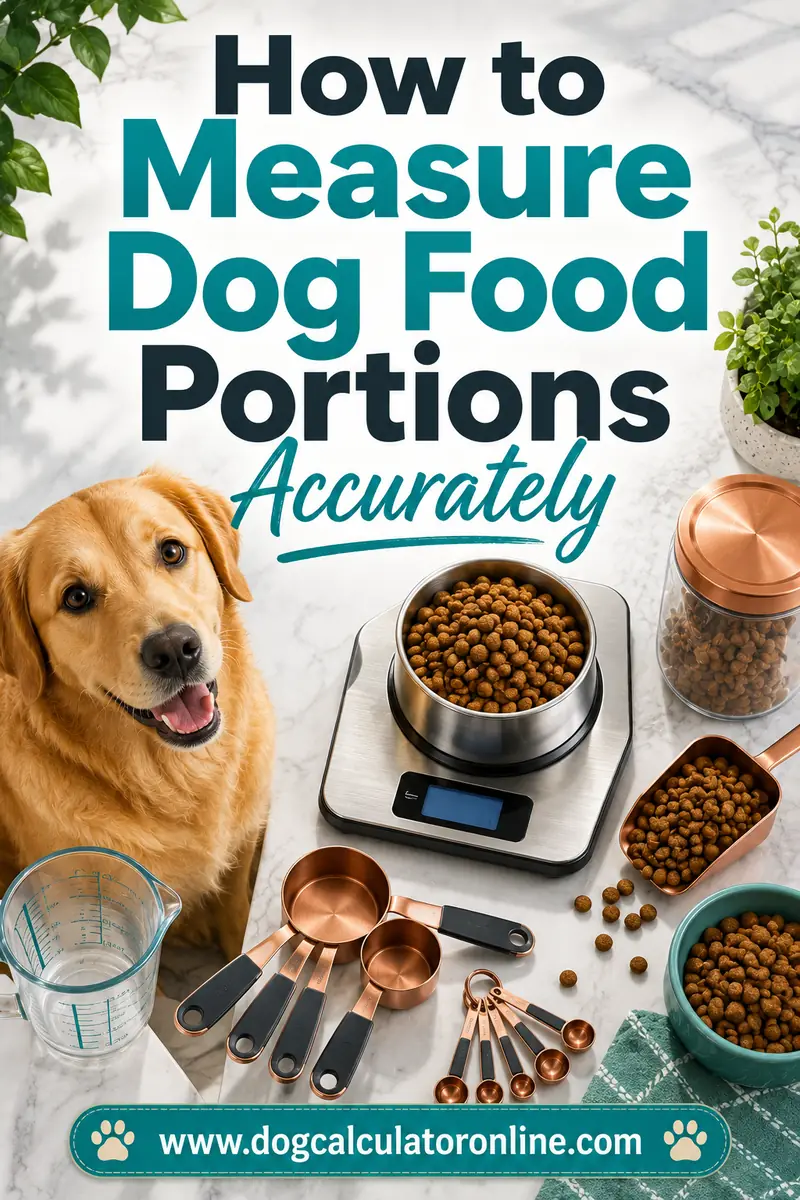
Weigh, don't scoop. The sum is only as good as the portion, and a scoop that runs 15% heavy will empty the bag two weeks early on a 90-day estimate. A $12 kitchen scale removes the whole problem — see how to measure dog food portions for the ten-second method.
A Worked Example, Start to Finish
Here is the whole thing on one dog, so you can copy the steps with your own numbers.
Step 1 — the daily calories. A 50 lb (22.7 kg) neutered adult Labrador with normal activity needs roughly 1,100–1,200 kcal a day. Call it 1,160.
Step 2 — the food's calorie density. Find the calorie content statement on the bag. It is printed as kcal per kilogram and usually also kcal per cup. Say this food is 3,600 kcal/kg.
Step 3 — calories to grams. (1,160 ÷ 3,600) × 1,000 = 322 g a day. Round to 320.
Step 4 — the bag. A 30 lb bag is 30 × 453.6 = 13,608 g.
Step 5 — divide. 13,608 ÷ 320 = 42.5 days. Six weeks, near enough.
Step 6 — sanity-check it against reality. Mark the date you open the bag on your phone. When it runs out, compare. If it emptied in 35 days instead of 43, you are feeding about 20% more than you think you are — and that gap is worth finding, because it is the same 20% that shows up on the scales six months later.
Notice that the answer changed nothing about the dog and everything about the arithmetic. Two foods can both be "30 lb bags" and last different lengths of time, because a 4,100 kcal/kg food needs fewer grams per day than a 3,300 kcal/kg one to deliver the same calories.
How Long Does Each Bag Size Last by Dog Size?
This table assumes a healthy, neutered adult dog on a mid-density dry food at 3,600 kcal/kg, fed to maintain weight, with no treats. Real dogs vary by 20–30% either way — a working farm dog and a sofa-loving senior of identical weight are not the same customer.
| Dog weight | Typical daily portion | 4 lb bag | 15 lb bag | 30 lb bag | 40 lb bag | 50 lb bag |
|---|---|---|---|---|---|---|
| 10 lb (4.5 kg) | ~95 g (3.4 oz) | 19 days | 72 days | 143 days | 191 days | 239 days |
| 25 lb (11 kg) | ~190 g (6.7 oz) | 10 days | 36 days | 72 days | 95 days | 119 days |
| 50 lb (23 kg) | ~320 g (11 oz) | 6 days | 21 days | 43 days | 57 days | 71 days |
| 75 lb (34 kg) | ~440 g (16 oz) | 4 days | 15 days | 31 days | 41 days | 52 days |
| 100 lb (45 kg) | ~545 g (19 oz) | 3 days | 12 days | 25 days | 33 days | 42 days |
Read down the 30 lb column and the shape of the problem jumps out. The same bag is a sensible six-week supply for a Labrador and a five-month marathon for a Jack Russell. That is the real reason bag size matters, and it is covered properly in what size bag of dog food you should buy.
Why Your Bag Runs Out Sooner Than the Math Says
Almost every owner who does this sum finds the bag empties early. Here is where it goes.
Treats are food. A handful of training treats, a dental chew and the crusts off your toast can easily add 100–200 kcal a day to a medium dog — 10–20% of the ration. If those calories are not coming out of the bowl, the bag drains at the same rate but the dog gains weight; if they are, the bag lasts longer than your sum. Either way, count them. The daily treat allowance guide sets the 10% rule out clearly.
Scoop drift. Nobody eyeballs downward. A scoop that started level ends up rounded, and the rounding is invisible day to day.
The generous second person. In a two-adult household, "did you feed the dog?" gets answered wrong a few times a month. A whiteboard or a magnet on the bin fixes this faster than any conversation.
The stuff at the bottom. The last inch of any bag is dust and crumbs. It is perfectly edible, but it does not scoop like kibble and most people bin some of it. Budget a day or two of loss on a large bag.
Spillage and the bag you never finished. Half a bag left in a hot garage that goes stale is a 100% loss, not a rounding error — which is why the dog food storage guide is worth five minutes.
What About Puppies, Whose Portions Keep Rising?
A puppy breaks the formula, because the divisor moves. This is the single most common reason a bag runs out "early" for no apparent reason.
Growth is fastest early and slows down. A puppy's daily portion climbs steeply from about 8 weeks, keeps climbing through 4–6 months, then flattens as growth slows. A medium-breed puppy might go from 150 g a day at 10 weeks to 300 g a day at 5 months — the same bag lasts half as long by the end.
Do the sum on next month's portion, not this month's. If your calculator says 200 g a day today, plan the bag around 230–250 g a day for a fast-growing pup. You will be closer.
Or just buy smaller bags during growth. Puppies are the one time a smaller, more frequently bought bag genuinely makes sense — the portion is a moving target and puppy food is calorie-dense, so a big bag drains fast anyway. The puppy feeding chart by weight and age shows how steeply the numbers climb.
Large-breed puppies climb longest. A Great Dane puppy is still adding to its portion at 9–12 months, long after a Cocker Spaniel has plateaued. Recheck the portion monthly until growth stops.
The bag will also change. At some point you switch from puppy to adult food, and the new bag has a different calorie density. Redo the sum then, not by habit.
Two Dogs Sharing a Bag: How the Sums Change
Multi-dog households do this wrong constantly, usually by treating the bag as a household unit rather than a sum of individuals.
Add the portions, then divide once. Two dogs eating 320 g and 190 g share 510 g a day. A 30 lb bag lasts 13,608 ÷ 510 ≈ 27 days. Not "half as long as one dog" — it depends entirely on the pair.
Weigh each dog's bowl separately. Free-feeding two dogs from one bowl makes it impossible to know who ate what, and in almost every pair one dog is quietly getting fat while the other stays lean.
The big-bag math finally works. Two 60 lb dogs eating a combined 750 g a day empty a 50 lb bag in 30 days — so a household like that can buy the largest, cheapest-per-pound bag and still finish it fresh. That is a genuine saving, and it is one of the few times the biggest bag is the right call. Our guide to what it costs to feed a dog puts the numbers in monthly terms.
Watch the third dog: the cat. If a cat helps itself to the dog bowl, your bag math will never reconcile, and the cat is eating a food that is not formulated for it.
Freshness vs Frugality: Should the Bag Last That Long?
Here is the part the bag-size decision really turns on, and it surprises people.
Kibble fat oxidises once the bag is open. Dry food is roughly 10–20% fat, and fat reacts with oxygen. Every time you open the bag you swap in fresh air. Oxidation is what makes old kibble smell like crayons or old cooking oil, and it degrades fat-soluble vitamins along the way.
The best-before date assumes an unopened bag. A date 14 months out tells you about a sealed bag in a warehouse. It says nothing about the bag you opened six weeks ago.
The working rule: finish an opened bag within about 4–6 weeks. That is a rule of thumb rather than a hard cliff — food does not spoil at day 43 — but it is the window most nutritionists and manufacturers point at, and it keeps you comfortably inside the food's real quality life.
Which makes the biggest bag the wrong buy for a small dog. A 50 lb bag is cheaper per pound than a 15 lb bag, always. But if it takes your 10 lb terrier eight months to finish it, you have bought seven months of slowly staling food to save a few dollars. Cheaper per pound is not cheaper per good pound.
How to Time Your Reorder So You Never Run Dry
The panic buy — the wrong food from the corner shop at 8pm — is worth engineering out, because sudden food changes upset stomachs.
Write the open date on the bag in marker. Two seconds. It anchors everything else.
Set a reminder at 75% of the estimate. On a 43-day bag, that is day 32. That leaves a comfortable week and a half of buffer for a delayed delivery.
Keep a week's overlap, not a month's. One small spare bag is prudence. Three spare bags is a stockpile that ages.
Overlap the changeover deliberately. If you are switching brands, having both bags in hand lets you mix over 7–10 days instead of switching cold, which is far kinder to the gut.
Recalculate after any real change. New food, a weight-loss plan, a neuter, a winter of shorter walks, a new diagnosis — all of them move the daily portion, and the bag math with it.
FAQ
How long does a 30 lb bag of dog food last?
For a typical adult dog on a 3,600 kcal/kg dry food: about 143 days for a 10 lb dog, 72 days for a 25 lb dog, 43 days for a 50 lb dog, 31 days for a 75 lb dog, and 25 days for a 100 lb dog. Divide 13,608 g by your dog's daily grams for an exact figure.
How do I calculate how long my dog food will last?
Multiply the bag weight in pounds by 453.6 to get grams, then divide by your dog's daily portion in grams. A 15 lb bag is 6,804 g; a dog eating 190 g a day finishes it in 36 days. If you feed by cup, divide the bag's total cups by cups per day instead.
How many cups are in a 30 lb bag of dog food?
Roughly 113–136 standard 8 oz cups, because typical adult kibble weighs about 100–120 g per cup. Dense small-breed kibble sits at the high end and large airy pieces at the low end, so check your own bag's stated cup count rather than assuming.
Does dog food go bad after opening?
It degrades rather than spoils suddenly. The fat oxidises once air gets in, which dulls flavor and reduces fat-soluble vitamins over weeks to months. Aim to finish an opened bag within about 4–6 weeks, keep it sealed and cool, and bin it if it smells sour, oily or like crayons.
Why does my dog food run out faster than expected?
Usually uncounted treats, a heaping scoop, or two people feeding the same dog. Growing puppies also empty bags faster each month as their portion rises. Weigh a portion on a kitchen scale once and compare it to your scoop — the gap is often 10–20%.
Is it cheaper to buy the biggest bag of dog food?
Cheaper per pound, yes — but only worth it if your dog finishes it within about six weeks. For a small dog, a 40 or 50 lb bag takes six months to eat, so you trade a small saving for months of staling food. Match the bag to the dog, not to the shelf price.
Buy for Six Weeks, Not for the Discount
The arithmetic is genuinely simple: bag weight in grams, divided by the daily portion in grams, equals days. Everything that goes wrong with it goes wrong at the second number — treats nobody counted, a scoop that crept upward, a puppy whose needs rose while your sum stayed still. So pin the portion down with the free dog food calculator, weigh it once on a kitchen scale to see what it actually looks like, and write the open date on the bag. Then buy the bag size that lands you near six weeks. That single habit keeps the food fresh, the dog the right shape, and the 8pm emergency trip to the corner shop off your calendar.