How to Store Dog Food Properly
Keep the kibble in its original bag and put the whole bag inside your storage container — do not tip the food in loose. Almost everyone does the opposite, and it costs them twice. The bag has a grease-resistant liner that a plastic bin does not, so pouring food straight into the bin leaves a fat film on the walls that goes rancid and taints every batch after it. And the bag carries the lot code and best-before date, which is the only way to know whether your food is affected if there is ever a recall. Beyond that, the rules are short: cool, dry, dark, sealed, and finished within four to six weeks. Knowing your dog's daily portion from the free dog food calculator is what makes that last part possible.
🐾 Is your storage setup right?
Tap where you keep the food:
Tap an option above. Cool, dry, sealed, and always keep the original bag.
Why the Original Bag Matters More Than the Container
This is the point that changes how most people store food, so it goes first.
The bag is engineered, the bin is not. Modern kibble bags are multi-layer, with a grease-resistant inner liner designed to hold oily food without letting the fat migrate into or through the material. Household plastic bins are made to hold flour and cereal.
Fat soaks into plastic and stays there. Pour kibble loose into a bin and a thin film of oil coats the walls. When the bin empties, that film stays behind, keeps oxidising, and the next bag sits on top of rancid fat. Owners who do this often notice the food "goes off faster" and blame the brand.
The lot code is on the bag, not the food. Every recall is announced by lot number and best-before date. If your food is in an unlabelled bin, you genuinely cannot tell whether yours is included, and the honest answer is to throw it out. Keeping the bag makes that a ten-second check instead.
You also keep the feeding chart and the calorie statement. Both are printed on the bag, and the calorie figure is what your portion is built from. Losing it means guessing — see how to measure dog food portions for why that guess matters.
So the setup is: bag inside container, lid on. The container provides the airtight seal, pest protection and rigidity. The bag provides the fat barrier and the paperwork. You want both.
Cool, Dry, Dark: The Conditions That Actually Matter
Storage is really about slowing one chemical reaction — fat reacting with oxygen — and preventing one biological problem, mold.
Temperature is the biggest lever. Aim for a stable spot below about 80°F (27°C). Heat accelerates oxidation substantially; a bag stored at 95°F (35°C) will stale noticeably faster than the same bag in a 68°F (20°C) cabinet.
Avoid temperature swings, not just heat. A garage that goes from 40°F (4°C) at night to 90°F (32°C) by afternoon drives condensation inside the bag. Moisture plus warmth is what mold wants.
Keep it dark. Light degrades some vitamins and speeds fat breakdown. Another reason the opaque original bag beats a clear plastic bin.
Keep it off a damp concrete floor. Concrete wicks moisture. A shelf, a pallet or even a plank raises the bag out of it.
Do not store it in the garage if you have any alternative. Heat, damp, temperature swings, fumes, and rodents — the garage manages to hit every risk at once. A hall cabinet, a pantry or under the stairs is far better. If the garage is genuinely the only option, buy smaller bags; the bag size guide explains how to size down without losing much money.
The Four-to-Six Week Rule for an Opened Bag
The best-before date on a bag applies to an unopened bag. Once you break the seal, a different clock starts.
Oxygen is the problem, and you add more twice a day. Every scoop exchanges the air inside the bag. Over months, that is hundreds of fresh doses of oxygen meeting a food that is 10–20% fat.
Rancid fat is a quality issue, not usually an acute danger. Dogs rarely get ill from mildly stale kibble. But it smells worse, tastes worse, and the fat-soluble vitamins riding in that fat degrade with it.
Aim to finish an opened bag within about four to six weeks. It is a rule of thumb, not a hard deadline. But it keeps you well inside the food's real quality life, and it is why buying the biggest bag is often a false economy — the full arithmetic is in how long a bag of dog food lasts.
Write the open date on the bag. A marker line on the front turns an abstract rule into something you can actually check.
Squeeze the air out before you clip it. Press the bag down, roll the top over two or three times, clip it, then put it in the container. Less headspace means less oxygen sitting on the food.
Storing Wet Food, Raw Food and Toppers
Different formats, different rules — and this is where genuine food-safety risk lives.
| Food type | Unopened | Once opened or thawed | Left in the bowl |
|---|---|---|---|
| Dry kibble | Until best-before, cool and dry | 4–6 weeks, sealed | Fine for a day; wash the bowl daily |
| Canned or pouch | 1–2 years, cool cabinet | Cover and refrigerate; use within 5–7 days | Pick up after 1–2 hours at room temperature |
| Fresh cooked (subscription) | Frozen until the use-by | Refrigerate; follow the brand's window, often 3–5 days | Pick up after about 1 hour |
| Commercial frozen raw | Frozen at 0°F (−18°C) | Thaw in the fridge; use within 2–3 days | Pick up after 20–30 minutes |
| Freeze-dried / air-dried | Until best-before | Reseal; weeks, not months | As for kibble, but rehydrated food is perishable |
Refrigerate opened cans properly. Use a plastic can lid or transfer to a lidded tub — not foil balanced on top. Cold food straight from the fridge puts some dogs off; a few seconds of standing at room temperature helps, but do not microwave it into hot spots.
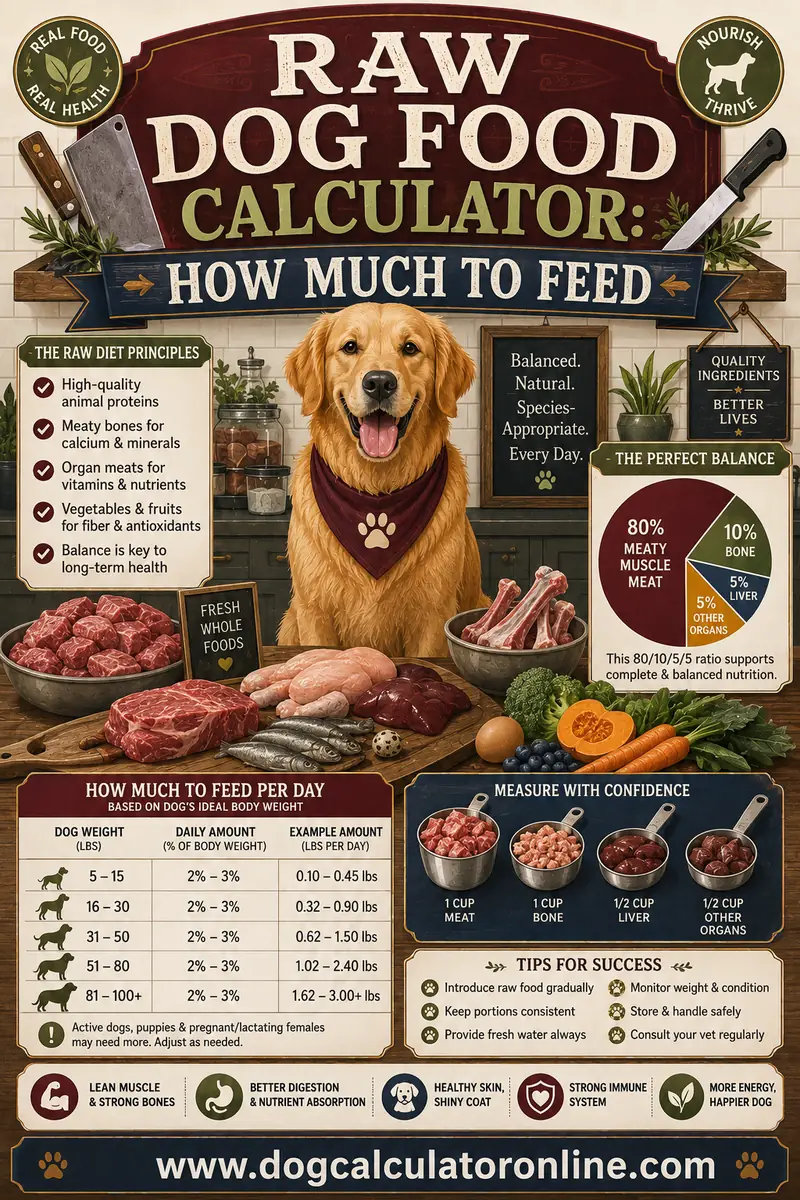
Raw food is a human hygiene issue as much as a dog one. Thaw in the fridge on a plate, never on the counter. Use separate boards and utensils, wash hands and surfaces with hot soapy water, and be extra careful if anyone in the house is pregnant, very young, elderly or immune-compromised — the bacteria that raw diets can carry are a risk to people even when the dog seems fine. If you feed raw, the raw feeding amount guide covers portioning it safely.
Never refreeze thawed raw food. Portion before freezing so you only thaw what you need.
Containers: What to Buy and How to Clean It
The container is the easy part, but there are a couple of choices worth getting right.
Food-grade, airtight, opaque, with a real seal. A gasket lid or a clamp beats a lid that just rests on top. Size it to hold your whole bag comfortably — you want to drop the bag in, not force it.
Metal or thick food-grade plastic both work. Metal does not absorb fat, which is a genuine advantage if you refuse to keep the bag. Wheeled bins are useful for 40 lb-plus bags.
Wash it between bags, not between scoops. Hot soapy water, rinse well, and — the step everyone skips — dry it completely before the next bag goes in. A damp container is the single easiest way to grow mold in dry food.
Keep the scoop out of the container. A scoop buried in the food carries hand oils and crumbs back in each time. Hang it on a hook, and wash it weekly.
Wash food and water bowls daily. Stainless steel is easier to sanitize than plastic; scratched plastic bowls harbor bacteria and are a common cause of the crusty chin rash sometimes called plastic-dish dermatitis.
Heat, Damp and Pests: The Three Things That Ruin Food
Each has a distinct signature, and each has a simple fix.
Heat leaves no visible trace. The food looks identical and smells slightly off. Losses are in vitamins and palatability. Fix: move it somewhere cooler, buy smaller bags in summer.
Damp shows as clumping, softness or a musty smell. Kibble should snap, not bend. Fix: dry container, off the floor, sealed lid, and never wash the container without drying it.
Mold is a bin-it-immediately problem. Fuzzy patches, black or green specks, or a strong musty basement smell. Mold on cereals and grains can produce mycotoxins, some of which are seriously harmful to dogs.
Pests announce themselves. Small moths flying out of the cabinet, fine webbing in the corners, tiny beetles, or chewed corners on a bag. Fix: bin the food, empty and wash the container, check nearby human dry goods, and store future bags sealed and indoors.
Mice in a garage are a health issue, not just a nuisance. They chew through bags and contaminate the food with droppings and urine. A rigid container with a locking lid is the practical defense.
How to Tell If Dog Food Has Gone Off
Your nose does most of this work, and it is worth using it every time you open a new bag so you know the baseline.
Fresh kibble smells faintly toasty, meaty, or of very little. The specific smell varies by brand; the consistency is what you are tracking.
Rancid smells sour, waxy, oily, or like crayons or old chip fat. That is oxidised fat. Do not feed it — most dogs will refuse anyway.
Greasy clumping or an oily film inside the bag means the fat has separated. The food is past its best.
Color change, dullness, or a dusty gray cast on kibble that used to look uniform is worth taking seriously.
Your dog's refusal counts as evidence. A dog who has eaten the same food happily for a year and suddenly hesitates over the last third of a bag is often right. Check the food before you decide the dog is being difficult.
Sudden soft stools or vomiting after opening a new bag deserves a call to your vet, and hold on to the bag — that lot code is exactly what a vet or the manufacturer will ask for. Keep the food rather than binning it if you suspect a problem with a specific bag.
When Storage Becomes a Vet Question
Most storage mistakes cost you money and nothing more. A few do not.
Moldy food is the one to take seriously. Some molds produce tremorgenic mycotoxins. If your dog has eaten visibly moldy food and then becomes wobbly or unsteady, develops muscle tremors or twitching, vomits repeatedly, seems disoriented, or has a seizure, treat it as an emergency and call your vet or an out-of-hours clinic straight away. Take a sample of the food with you if you safely can.
A dog that raids the food bin needs a vet call, not just a telling-off. Gorging on dry kibble that then swells with water can cause serious bloating, and in deep-chested breeds it is a risk factor for gastric dilatation and volvulus (a twisted stomach) — a true emergency. Signs are a swollen hard belly, unproductive retching, restlessness and drooling. Do not wait it out.
Store food where the dog cannot reach it. A clip-lid container inside a closed cabinet is not paranoia if you have a Labrador.
Keep it away from things that are genuinely toxic. Do not store dog food next to open bags of raisins, chocolate, xylitol-sweetened products, or garden chemicals. The foods dogs should never eat list is worth a read if you keep the dog food in a kitchen pantry.
If in doubt about a bag, bin it. A replacement bag costs less than one consultation, and far less than a night in a clinic. When you are weighing which format to keep on hand for a household like yours, the wet vs dry comparison covers the practical trade-offs.
FAQ
Should you keep dog food in the bag or a container?
Both. Put the whole original bag inside an airtight container. The bag has a grease-resistant liner that stops fat soaking into plastic and turning rancid, and it carries the lot code and best-before date you would need in a recall. The container supplies the airtight seal and pest protection.
How long does dry dog food last once opened?
About four to six weeks in a cool, dry, sealed environment. The best-before date on the bag applies to an unopened bag only; once air reaches the food the fat begins to oxidise. Heat shortens the window, so a bag stored in a hot garage will stale considerably faster.
Can you store dog food in the garage?
It is the worst of the common options. Garages get hot in summer, swing in temperature overnight, are often damp, and attract mice that chew through bags. If the garage is unavoidable, buy smaller bags, use a rigid container with a locking lid, and keep it off the concrete floor.
Can you freeze dry dog food?
Yes, for genuine long-term storage. Portion it into sealed freezer bags with the air pressed out, and thaw each portion while still sealed so condensation forms on the outside of the bag rather than on the kibble. Damp kibble grows mold, which is the main risk to manage.
How do you know if dog food has gone bad?
Smell it. Rancid food smells sour, oily, waxy or like crayons. Look for clumping, an oily film, dullness, mold, webbing or insects. A dog who suddenly refuses a food it has always eaten is worth listening to. Any visible mold means bin the bag immediately.
How long can wet dog food stay in the fridge?
An opened can or pouch keeps about five to seven days refrigerated in a covered container. Food left in the bowl should be picked up within one to two hours at room temperature, and sooner in warm weather. Fresh cooked subscription food usually has a shorter window — follow the brand's instruction.
Keep the Bag, Watch the Calendar
Good dog food storage is four habits, and none of them take effort. Keep the food in its original bag, inside a sealed container, somewhere cool and dark that is not the garage. Roll the bag down and squeeze the air out each time you close it. Write the open date on the front, and aim to reach the bottom within four to six weeks. Wash and thoroughly dry the container between bags. That is genuinely the whole job — and it protects both the nutrition you paid for and your ability to check a lot code if a recall ever lands. Pin down how quickly you will actually get through a bag with the free dog food calculator, and buy accordingly.