How to Read a Dog Food Label
The most useful sentence on any bag of dog food is the one almost nobody reads: the AAFCO nutritional adequacy statement, usually in tiny print near the feeding chart. It tells you whether the food is complete and balanced, for which life stage, and — crucially — whether that was established by calculation or by actually feeding it to dogs. Everything on the front of the bag is marketing. Four things on the back are regulated and genuinely informative: the adequacy statement, the ingredient list, the guaranteed analysis, and the calorie content statement. Once you can read those four, you can compare any two foods honestly — and the free dog food calculator turns the calorie number into your dog's actual portion.
🐾 What does that label line mean?
Tap a phrase you have seen on a bag:
Tap a phrase above. The back of the bag is regulated; the front is advertising.
The AAFCO Statement: The Most Important Line on the Bag
In the US, the Association of American Feed Control Officials sets the nutrient profiles that pet foods are judged against. Its statement is usually a single sentence in small type.
Two wordings, two different strengths of evidence. One reads roughly: "[Product] is formulated to meet the nutritional levels established by the AAFCO Dog Food Nutrient Profiles for [life stage]." The other reads: "Animal feeding tests using AAFCO procedures substantiate that [Product] provides complete and balanced nutrition for [life stage]."
"Formulated to meet" means it was checked against a table. The recipe was designed, and either calculated from ingredient data or analyzed in a lab, to hit the required nutrient levels. That is a real standard and most foods on the shelf use it. But no dog was involved.
"Animal feeding tests" means dogs actually ate it. AAFCO's protocol requires a group of dogs to be fed the food as their sole ration for a set period — 26 weeks for adult maintenance — with weight, physical condition and specific blood values monitored, and defined limits on how many dogs may drop out. It is a modest trial by human-medicine standards, but it catches problems that a spreadsheet cannot: poor digestibility, nutrients that are present but not absorbable, dogs who simply do not thrive on it. Where you have the choice, the feeding-test wording is the stronger claim.
Check the life stage, not just the presence of a statement. Options are growth, maintenance, all life stages, and gestation/lactation. "All life stages" food is formulated to puppy requirements, which means it is richer than an average adult dog needs — fine for some, a weight problem for others.
Look for the large-breed puppy clause. A growth food may say "including growth of large size dogs (70 lb or more as an adult)". That phrase signals controlled calcium levels, which matter a great deal for big puppies' developing joints. A puppy food without it should not be the sole diet of a Great Dane pup.
"For intermittent or supplemental feeding only" is a red flag if you are feeding it as a meal. It means the food is not complete. Some toppers, some raw foods and many "gourmet" cans carry this. As a small topper it is fine; as dinner it is not.
The Ingredient List and the Water Problem
The ingredient list is ordered by weight — and that ordering is more misleading than almost anyone realises.
Weights are taken before cooking, including water. Fresh chicken is roughly 65–70% water. When it is cooked down into kibble, most of that water disappears. So "chicken" sitting proudly in first place may contribute less actual protein to the finished food than "chicken meal" sitting in third — because chicken meal is already rendered and dried, at around 10% moisture.
This is why "first ingredient real chicken" is a weaker claim than it sounds. It is not a lie, and it is not a bad thing. It just is not the guarantee of a meat-rich food that the front of the bag implies.
Meal is not a lesser ingredient. "Chicken meal" means chicken tissue rendered and dried. It is concentrated protein. The word sounds industrial next to a photograph of a roast chicken, which is precisely why the photograph exists.
Ingredient splitting shifts the order. A manufacturer can list peas, pea protein, pea flour and pea fiber as four separate items. Individually each falls below the meat; added together they might outweigh it. The same trick works with rice (brewers rice, rice flour, rice bran) and corn. If you see one plant appearing in several forms down the list, mentally add them up.
The list tells you what is in it, not how good it is. Ingredient quality, digestibility and how the nutrients are balanced are not visible from names alone. Two foods with near-identical lists can perform very differently in a dog.
Read past the first five for the useful bits. Named fat sources, the vitamin and mineral pack, and preservatives live further down. Mixed tocopherols are vitamin E used as a natural preservative; they work but give a shorter shelf life than synthetic options.
The Guaranteed Analysis: Minimums, Maximums, and What They Hide
The guaranteed analysis is the small table of percentages. It is legally binding — and much less informative than it looks.
They are guarantees, not measurements. Protein and fat are stated as minimums: the food contains at least that much. Fiber and moisture are maximums: at most that much. The actual analysis is often meaningfully different.
Two foods both claiming "min 26% protein" are not equivalent. One might test at 26.5%, the other at 33%. The label cannot tell you which. If you need real numbers, most reputable manufacturers will send you a typical nutrient analysis if you ring or email them — and their willingness to do so is itself informative.
Percentages are as-fed, so wet and dry cannot be compared directly. A canned food at 8% protein and a kibble at 26% look worlds apart, but the can is about 78% water. To compare fairly, convert to a dry-matter basis: divide the percentage by (100 − moisture) and multiply by 100.
| Line on the label | What it means | The catch |
|---|---|---|
| Crude Protein (min) | Nitrogen-based estimate of protein | A floor only; says nothing about quality or amino acid balance |
| Crude Fat (min) | Total fat | Drives calorie density; a floor, so the food may be fatter |
| Crude Fiber (max) | Indigestible plant matter | A ceiling; higher fiber often means a lower-calorie diet food |
| Moisture (max) | Water content | ~10% for kibble, ~75–80% for canned — must be corrected for before comparing |
| Ash (sometimes) | Total mineral content | Not required in the US; useful for comparing mineral load |
| Calorie content | kcal/kg and kcal per cup or can | The only line you can portion from — see how many kcals your dog needs |
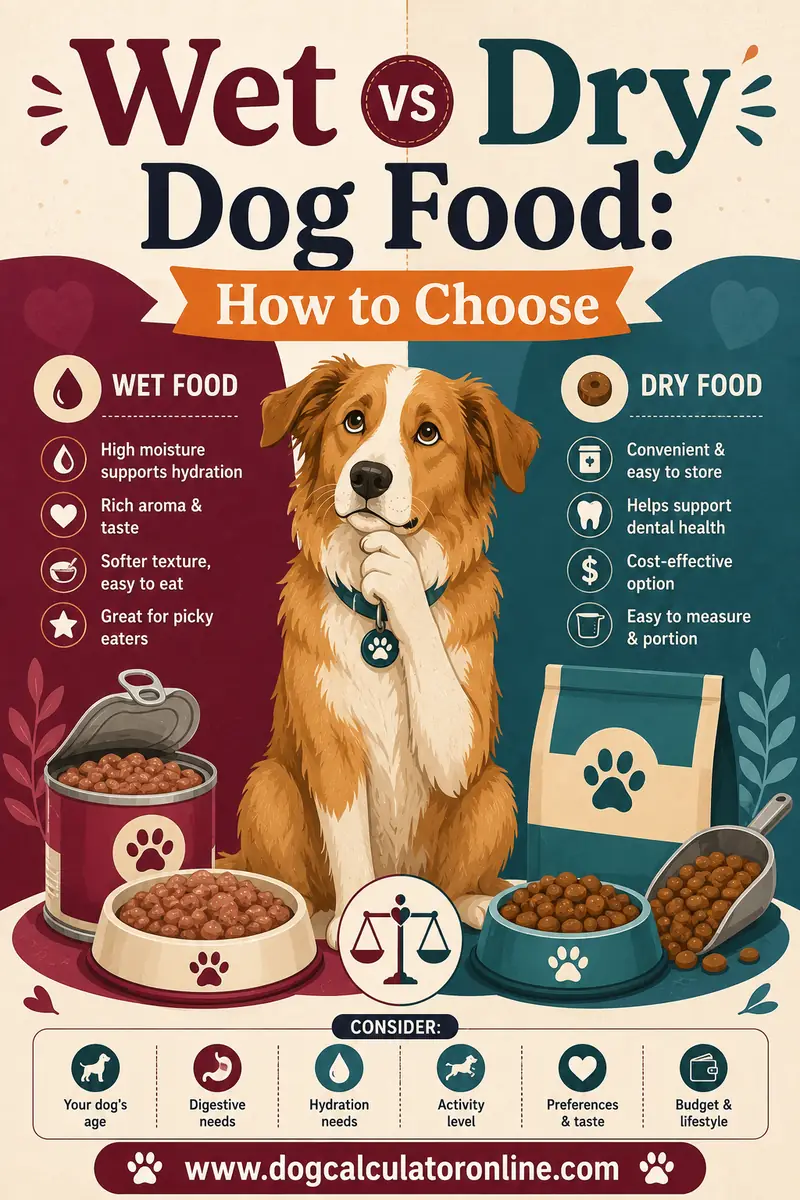
Worked conversion. A canned food at 8% protein and 78% moisture: 8 ÷ (100 − 78) × 100 = 36% protein on a dry-matter basis. A kibble at 26% protein and 10% moisture: 26 ÷ 90 × 100 = 29%. The can that looked far weaker is actually the richer food. Our wet vs dry comparison goes further into where each format wins.
The Calorie Content Statement: The Line You Actually Feed From
If you only take one number off a bag, take this one.
It is required, and it is usually the easiest to find. Expressed as kcal per kilogram, and normally also as kcal per cup for dry food or kcal per can for wet.
Calorie density varies far more than people expect. Adult maintenance kibbles typically run somewhere around 3,200–4,200 kcal/kg. Weight-management foods sit lower; performance and puppy foods sit higher. That range means the same volume of two foods can differ by 25% in calories.
Which is why "feed the same number of cups" after a food change is a real hazard. Switch from a 3,300 kcal/kg diet food to a 4,100 kcal/kg puppy-style formula, keep the scoop identical, and you have just increased your dog's intake by roughly a quarter without touching the bowl.
The conversion, once, so you have it: grams per day = (daily kcal ÷ label kcal/kg) × 1,000. A dog needing 900 kcal on a 3,700 kcal/kg food gets (900 ÷ 3,700) × 1,000 = 243 g a day.
Weigh that, do not scoop it. Cups drift; grams do not. The portion measuring guide covers the ten-second scale method and how to calibrate a scoop if you must use one.
Front-of-Bag Claims and What They Legally Mean
The front panel is where the money is spent, and there are actual rules behind the phrasing — they just are not the rules people assume.
The "95% rule". If the product is simply named Chicken for Dogs, chicken must make up at least 95% of the product excluding water added for processing.
The "dinner rule" — 25%. Chicken Dinner, Chicken Entrée, Chicken Formula, Chicken Recipe, Chicken Platter all mean chicken is at least 25% of the product. That is the wording most premium foods use.
The "with" rule — 3%. Dog Food with Chicken needs only 3% chicken. One word, an enormous difference.
The "flavor" rule — detectable. Chicken Flavor requires only that the flavor is detectable by a testing method. There may be almost no chicken in it at all.
Unregulated words carry no definition. Premium, super-premium, gourmet, holistic, human-grade (loosely used), natural (loosely defined), ancestral, biologically appropriate. None of these have an enforceable nutritional meaning. They tell you about the brand's positioning, not the food. The same goes for most grain-free marketing — the evidence on that is worth reading separately in grain-free dog food explained.
The Small Print Most People Skip
Three more items on the label earn their space.
The manufacturer statement. "Manufactured by" means the company makes it in its own plant. "Manufactured for" or "Distributed by" means someone else makes it — a co-packer that may produce dozens of brands. Neither is automatically bad, but owning your plants means controlling your quality testing.
The batch or lot code and best-before date. Usually stamped or printed near the seam. Photograph it, or keep the bag. If there is ever a recall, the lot code is what identifies whether your bag is affected — and it is the reason to store food in its original bag rather than tipping it into a bin.
The feeding guidelines. Treat them as a starting point that runs generous. They are built for an average, intact, moderately active dog, and most pet dogs are neutered and less active than that. Puppy charts age out fast too; see when to switch a puppy to adult food for the timing.
Contact details. A phone number and email are required. Companies that answer nutrition questions with real answers — typical analysis, who formulated the diet, whether they run feeding trials — are telling you something useful about themselves.
Comparing Two Foods in Five Minutes
A practical routine you can run standing in the aisle with your phone.
1. Find the AAFCO statement on both. Right life stage? Feeding-tested or formulated? Rule out anything that says supplemental only.
2. Compare kcal/kg, not price per bag. This is the honest basis for both nutrition and cost. The method is set out in cost per 1,000 calories.
3. Convert both guaranteed analyzes to dry matter if one is wet and one is dry. Otherwise compare as-fed.
4. Scan the ingredient list for splitting. Add up the repeated plant items, and note whether the meat is fresh or meal.
5. Check who makes it, and whether they employ a qualified nutritionist. A veterinary nutritionist or a PhD in animal nutrition on staff is a meaningful quality signal; a marketing department is not.
Then ask your vet. Especially if your dog has a diagnosed condition, is a large-breed puppy, or is losing or gaining weight. Labels tell you what is in the bag. Your vet knows your dog.
FAQ
What is the most important thing on a dog food label?
The AAFCO nutritional adequacy statement. It confirms the food is complete and balanced, names the life stage it is suitable for, and says whether that was established by formulation or by feeding tests in real dogs. Anything without such a statement, or marked "supplemental feeding only", should not be a dog's whole diet.
Does the first ingredient in dog food matter?
Less than the marketing suggests. Ingredients are listed by weight including water, and fresh meat is about 70% water, so it can outrank a dried ingredient that contributes more to the finished food. Read the whole list, watch for the same plant split into several entries, and check the guaranteed analysis.
What does "formulated to meet AAFCO profiles" mean?
It means the recipe was checked against AAFCO's nutrient table by calculation or laboratory analysis, without being fed to dogs as a test. It is a legitimate standard used by most foods. The alternative wording, "animal feeding tests using AAFCO procedures", means dogs were actually fed the diet for at least 26 weeks.
Is a higher protein percentage on the label better?
Not necessarily. The figure is a minimum, not the actual amount, and it says nothing about protein quality or digestibility. It also cannot be compared between wet and dry food without converting to a dry-matter basis. Most healthy adult dogs do well across a wide protein range.
How do I compare wet and dry dog food on the label?
Convert both to a dry-matter basis: divide each percentage by (100 minus the moisture percentage) and multiply by 100. A canned food at 8% protein and 78% moisture is 36% protein dry-matter, versus 29% for a kibble labeled 26% at 10% moisture.
Where do I find calories on a dog food bag?
In the calorie content statement, usually near the guaranteed analysis or the feeding chart. It is given as kcal per kilogram and often also kcal per cup or per can. Divide your dog's daily calorie target by the kcal/kg figure and multiply by 1,000 to get grams per day.
Read the Back, Ignore the Front
The front of a dog food bag is designed to make you feel something. The back is regulated, and it is where the answers live. Find the AAFCO statement and check the life stage and whether dogs actually ate the food in a trial. Read the ingredient list knowing that water inflates fresh meat and that plants get split into several entries. Treat the guaranteed analysis as floors and ceilings rather than facts. And take the calorie content statement seriously, because it is the only number you can genuinely portion from. Feed that number into the free dog food calculator, weigh the result once, and you have turned a bag of marketing into an actual meal plan.