How Long Do Large & Giant Dogs Live?
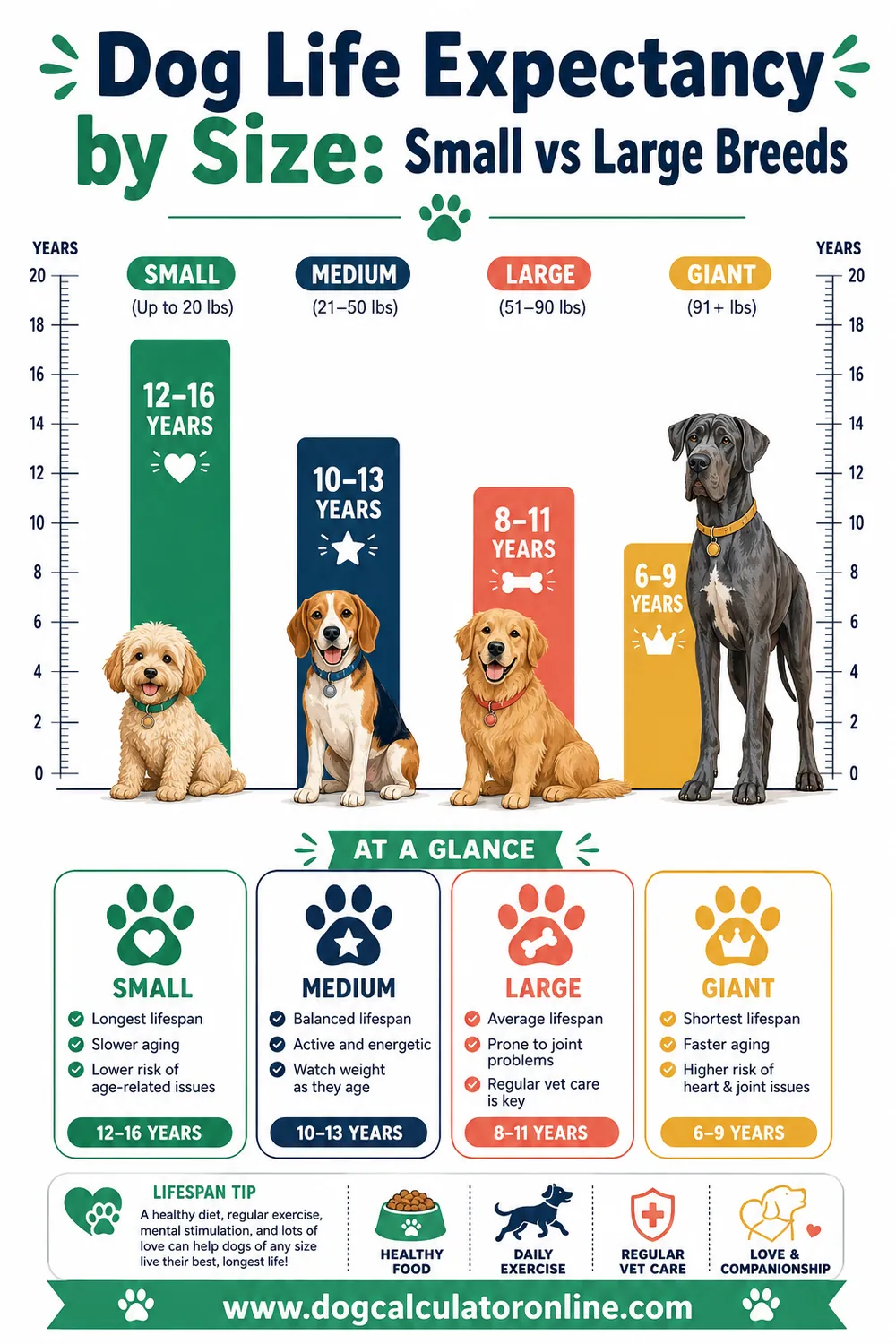
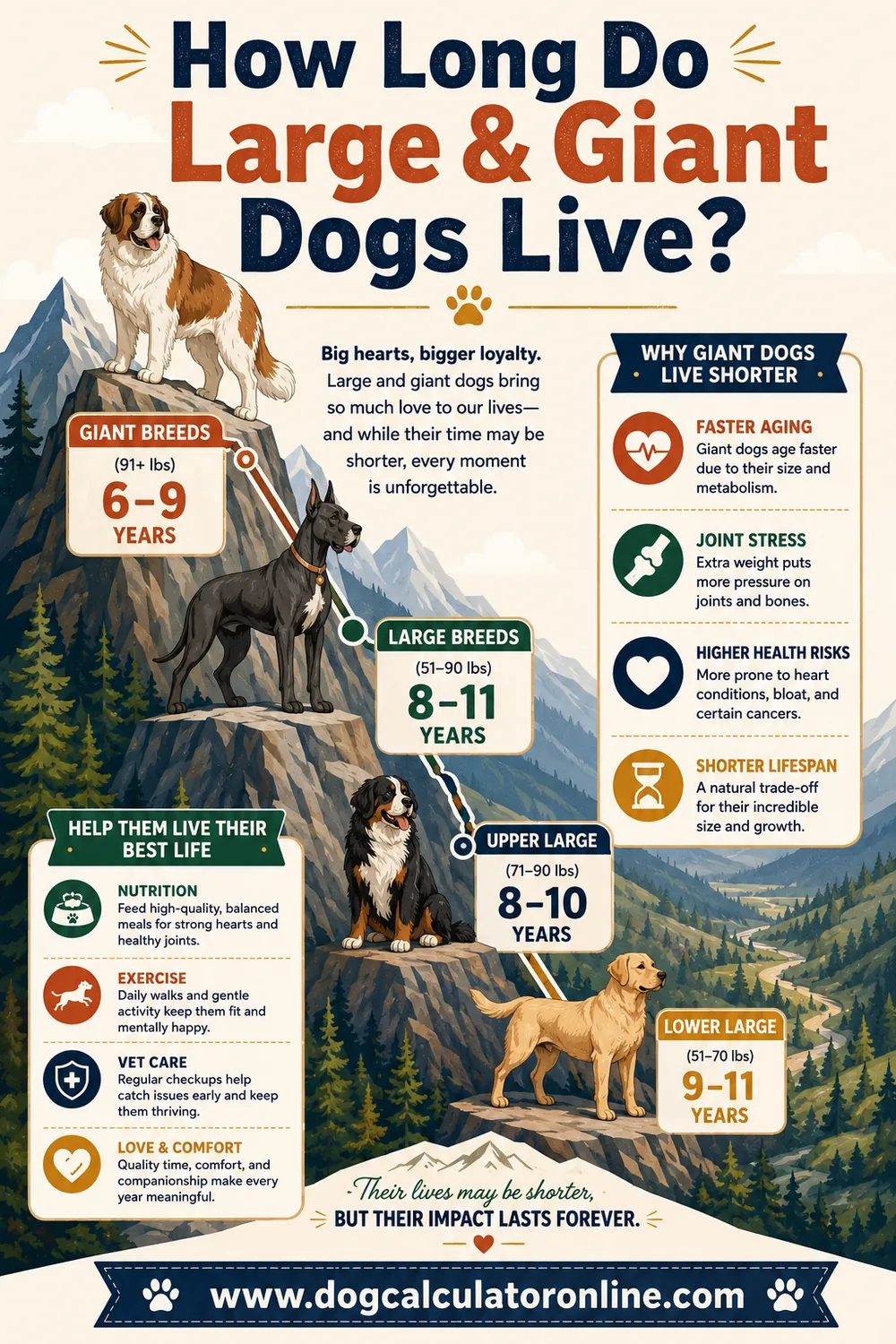
Large dogs (51–90 lb) typically live 9 to 12 years, and giant breeds (over 90 lb) average just 7 to 10. Big dogs age faster than small ones at every stage after puppyhood — a large breed becomes a senior around age 6 or 7, and a giant breed as early as 5.
If you want to know how old your big dog is in human years right now, our free dog age calculator applies the faster aging rates that large and giant breeds actually follow. It takes seconds.
🐾 Big dog age check
Tap your dog’s age to see the human-year equivalent for a large breed (51–90 lb):
Tap an age above. Giant breeds (over 90 lb) age about one year faster per step.
The Numbers: Large vs Giant
The bigger the dog, the shorter the expected life — the pattern is remarkably consistent across veterinary datasets:
| Size class | Adult weight | Typical lifespan | Senior around |
|---|---|---|---|
| Large | 51–90 lb | 9–12 years | Age 6–7 |
| Giant | Over 90 lb | 7–10 years | Age 5–6 |
| (Compare: small) | Under 20 lb | 12–16 years | Age 7+ |
And here's what those years "cost" under the size-adjusted aging guideline vets use — after age 2, a large dog adds about 6 human-equivalent years per calendar year, and a giant breed about 7 (versus 4 for a small dog):
| Calendar age | Large dog (human yrs) | Giant dog (human yrs) |
|---|---|---|
| 2 | 24 | 24 |
| 5 | 42 | 45 |
| 7 | 54 | 59 |
| 9 | 66 | 73 |
| 11 | 78 | 87 |
A 9-year-old Great Dane is, biologically speaking, in his early 70s. That single fact should shape everything about how big-dog owners plan care.
Typical Lifespans for Popular Big Breeds
Individual dogs vary widely, but these ranges reflect common breed data:
Large breeds (51–90 lb):
- Labrador Retriever — commonly 10–12 years
- Golden Retriever — commonly 10–12 years
- German Shepherd — commonly 9–13 years
- Boxer — commonly 10–12 years
- Rottweiler — commonly 9–10 years
- Doberman Pinscher — commonly 10–12 years
- Standard Poodle — commonly 12–15 years (a notable long-lived exception)
Giant breeds (over 90 lb):
- Great Dane — commonly 7–10 years
- Bernese Mountain Dog — commonly 7–10 years
- Mastiff — commonly 6–10 years
- Saint Bernard — commonly 8–10 years
- Irish Wolfhound — commonly 6–8 years
- Newfoundland — commonly 9–10 years
- Great Pyrenees — commonly 10–12 years (long-lived for its size)
Notice the exceptions: Standard Poodles and Great Pyrenees outperform their weight class. Breed genetics can bend the size rule — but they never break it entirely.
Why Big Dogs Age Faster
Dogs are the strange case in biology where, within one species, bigger means shorter-lived. The main explanations researchers point to:
- Explosive growth. A giant-breed puppy can multiply its birth weight more than a hundredfold in under two years. All that rapid cell division appears to accelerate aging and raise the lifetime risk of certain cancers — bone cancer in particular is far more common in large and giant breeds.
- Higher IGF-1. Big dogs carry more insulin-like growth factor 1, a hormone that drives size but is linked across species to faster aging.
- Earlier disease onset. Arthritis, heart conditions like dilated cardiomyopathy, and many cancers simply arrive earlier on the calendar in big dogs.
The 2019 UC San Diego DNA-methylation study confirmed the broader shape of dog aging — very fast early, then flattening — and its authors noted that breed size likely shifts the curve. Our dog age calculator handles this by asking your dog's weight and applying the right rate automatically.
The Big-Dog Health Watchlist
Owning a large or giant breed means knowing a short list of conditions your vet will also be watching for:
Joint disease
Hip and elbow dysplasia are far more common in big breeds, and arthritis arrives early even in well-built dogs carrying heavy frames. Lean body condition is the single best protection — extra weight multiplies joint stress every step.
Bloat (GDV)
Gastric dilatation-volvulus — the stomach filling with gas and twisting — is a life-threatening emergency seen mostly in large, deep-chested breeds. Know the signs (unproductive retching, a swollen tight belly, sudden distress) and get to a vet immediately if you see them. Ask your vet whether preventive measures make sense for your dog.
Heart disease
Dilated cardiomyopathy (a weakening of the heart muscle) appears disproportionately in large and giant breeds. Regular checkups give your vet a chance to catch murmurs or rhythm changes early.
Cancer
Several big breeds carry elevated cancer risk, and osteosarcoma (bone cancer) is strongly associated with size. Any new lump, limp, or unexplained swelling in a big dog deserves a vet visit rather than a wait-and-see.
None of this is a reason for dread — it's a checklist that makes early detection much more likely, and early detection is where outcomes are best.
Helping a Big Dog Live Longer
- Keep them lean — seriously. In a famous lifetime study of Labrador littermates, dogs fed to a lean body condition lived meaningfully longer than their heavier siblings. For big dogs, lean isn't cosmetic; it's joint protection, heart protection, and time.
- Grow them slowly. For puppies, controlled growth on an appropriate large-breed diet protects the developing skeleton. Fast, chubby growth is a risk factor, not a sign of health.
- Start senior care early. Twice-yearly vet visits and baseline bloodwork from age 5–6 (giants) or 6–7 (large breeds). Big dogs hide problems behind stoicism.
- Exercise consistently, not extremely. Daily moderate activity maintains muscle that supports aging joints. Weekend-warrior intensity on an unconditioned body invites injury.
- Make the home body-friendly. Traction on slippery floors, ramps instead of car leaps, and a supportive bed pay off from middle age onward.
- Act fast on symptoms. Because big-dog diseases move quickly, "let's watch it for a month" is riskier than it is in a small breed.
The Puppyhood That Sets Up a Long Life
For big breeds, the choices made during the first two years echo for the rest of the dog's life — more so than for any small breed. That long growth window (large breeds finish around 18 months, giants up to 24) is when the skeleton they'll live on gets built, and it's surprisingly easy to build it wrong with good intentions.
Three things matter most:
- Don't overfeed for fast growth. A chubby, rapidly-growing giant puppy isn't a thriving one — fast growth is a documented risk factor for skeletal problems like hip dysplasia and joint disease. Large-breed puppy formulas exist specifically to support slower, steadier growth; ask your vet whether one suits your dog.
- Protect the growth plates. Until your vet confirms growth is done, favor free play over forced repetitive exercise — no long leashed jogs, no marathon fetch, and go easy on repeated jumping off furniture or out of the car.
- Keep them lean from the start. The lean-body habit that extends life is easiest to build before it's ever a weight-loss project. A lean big-breed puppy becomes a lean big-breed adult.
Get these right and you've protected the joints, heart, and frame your big dog needs to reach the top of its range. It's the rare case where puppyhood decisions have measurable payoffs a decade later.
Planning Around a Shorter Timeline
The compressed big-dog timeline is easier to work with when you translate it into human terms:
| Your big dog is... | A large breed is roughly... | A giant breed is roughly... |
|---|---|---|
| 3 years old | 30 human years | 31 human years |
| 5 years old | 42 | 45 |
| 7 years old | 54 | 59 |
| 9 years old | 66 | 73 |
So the "middle-age health audit" a person might do at 45–50 belongs at age 5–6 for your Lab and age 4–5 for your Dane. Owners who make that mental shift catch problems years earlier. If you want the exact figure for your dog's age and weight, the free dog age calculator gives both the vet-standard number and the DNA-study estimate instantly.
Related Guides
If this helped, these go deeper on the same question:
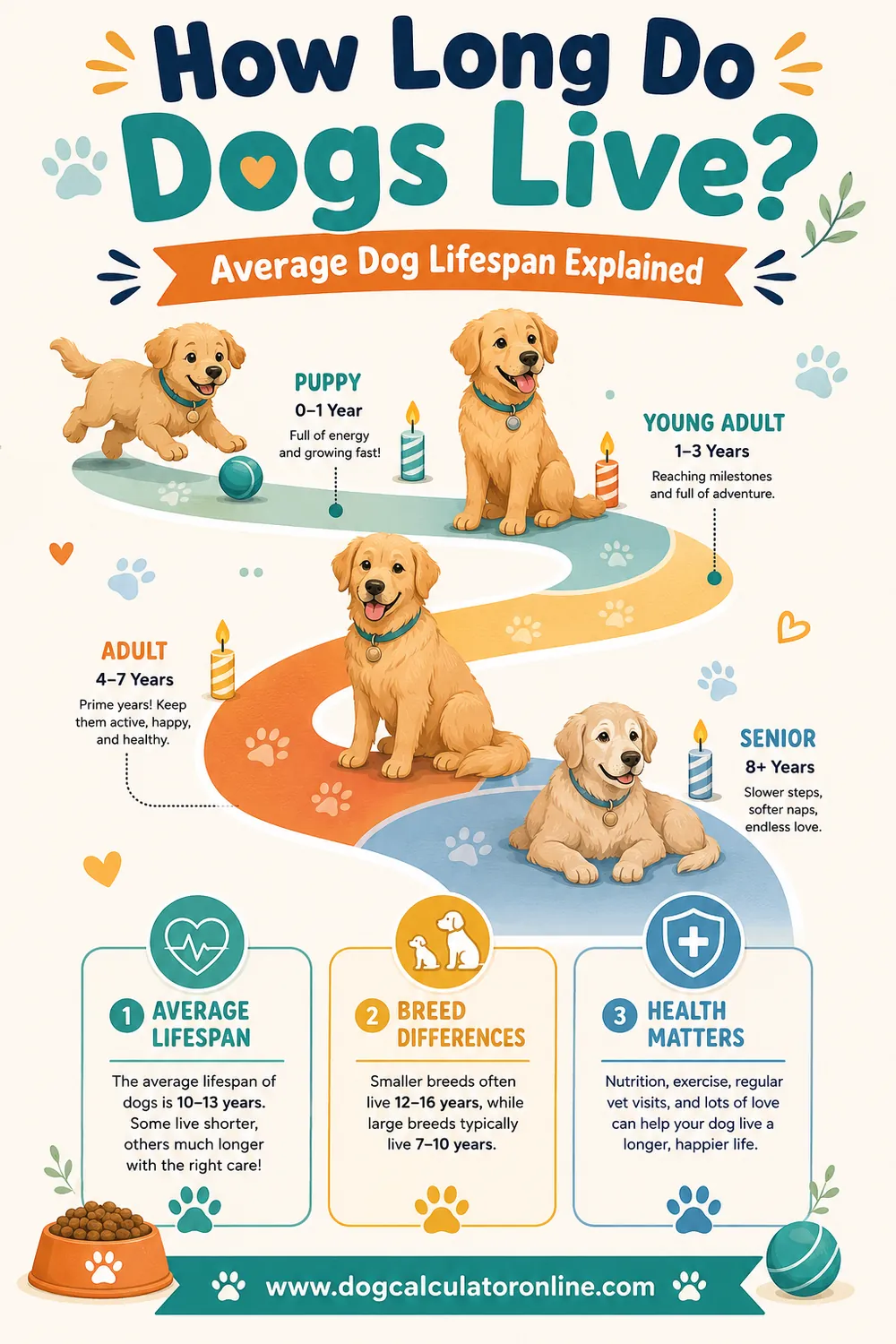
- How Long Do Dogs Live? Average Dog Lifespan Explained
- Dog Life Expectancy by Size: Small vs Large Breeds
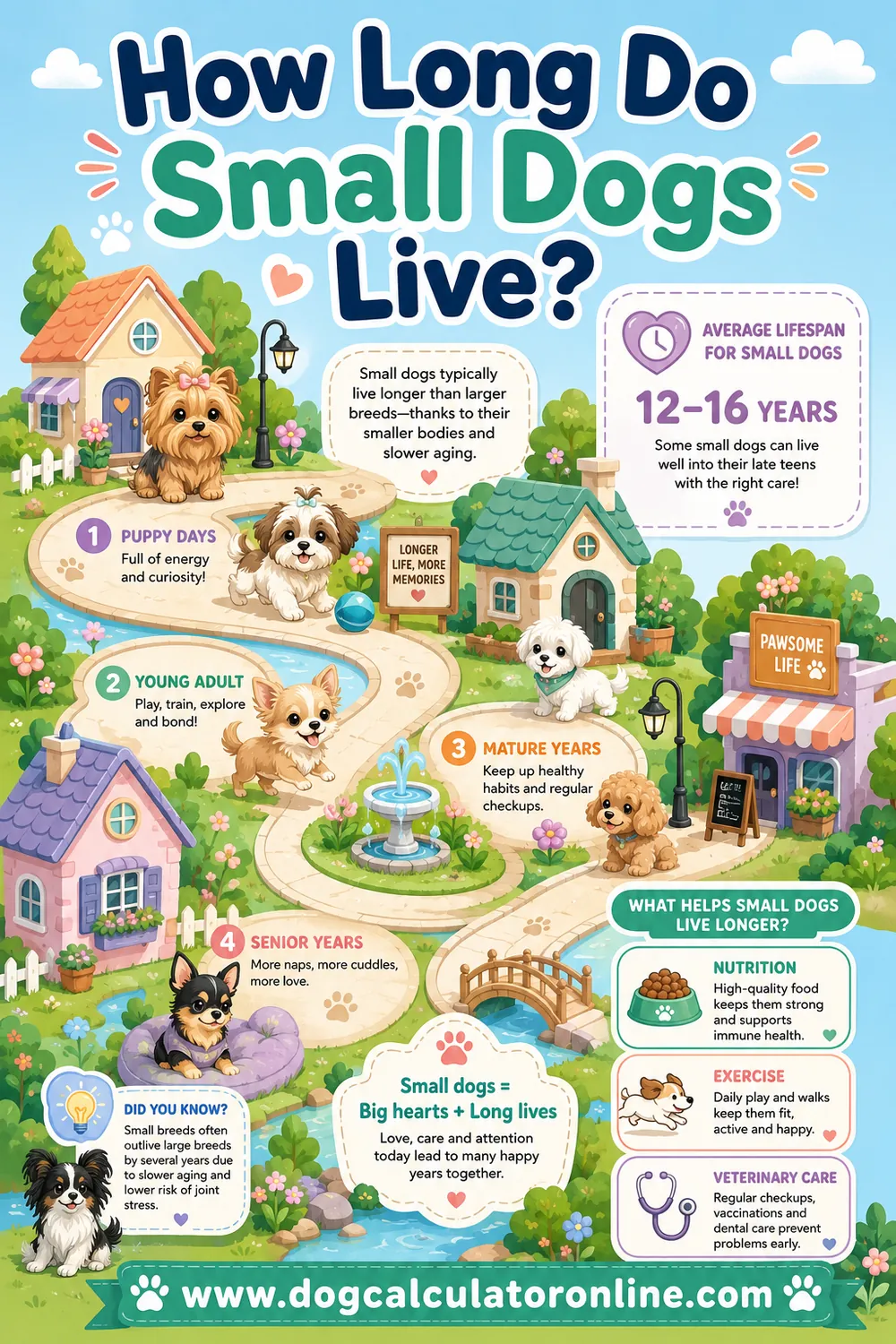
- How Long Do Small Dogs Live?
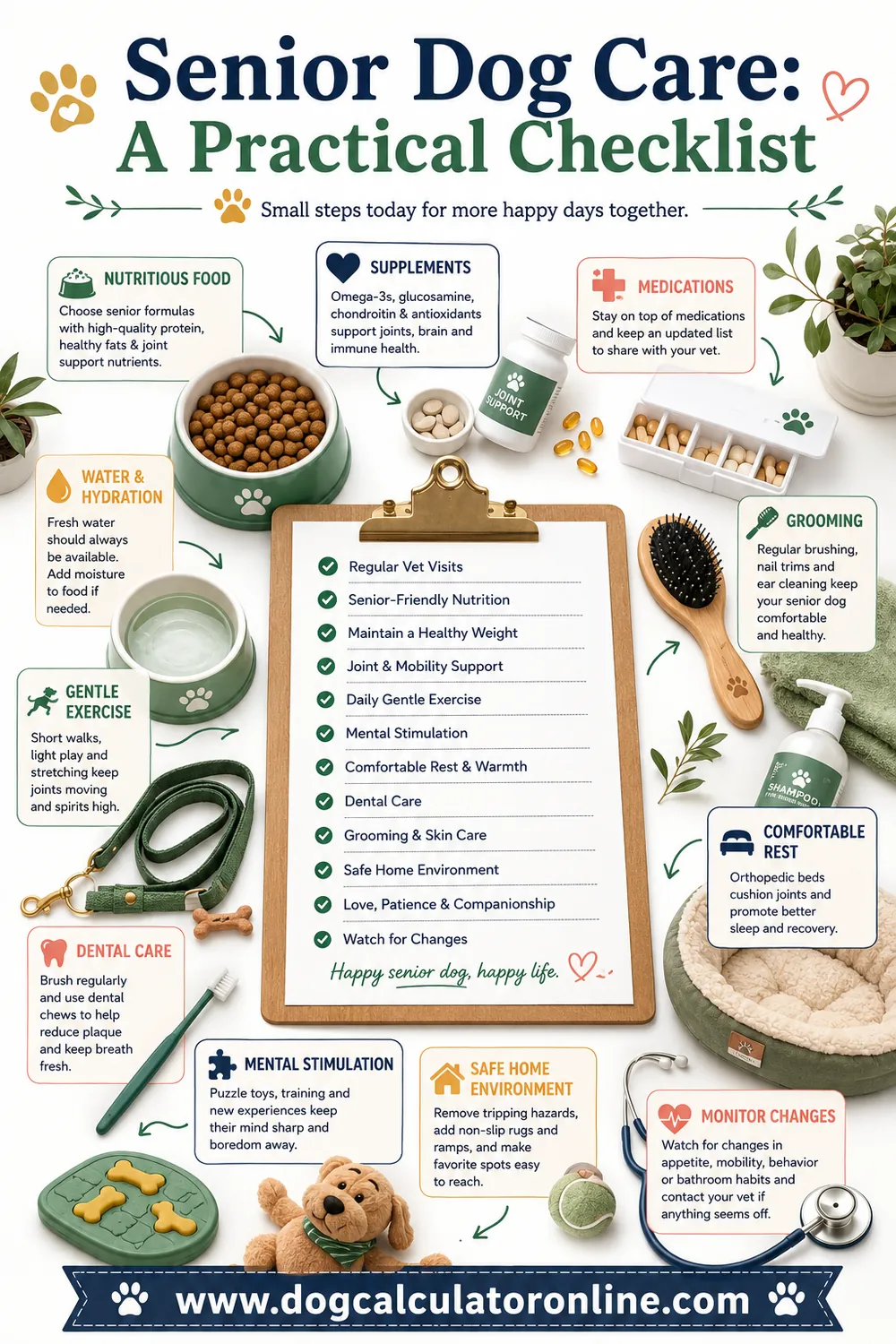
- Senior Dog Care: A Practical Checklist
And if you just want your own dog’s number, the free dog age calculator does it in one tap.
FAQ
How long do large dogs live?
Typically 9 to 12 years for breeds in the 51–90 lb range, such as Labs, Goldens, and German Shepherds. Individual genetics, weight, and care shift dogs within (and sometimes beyond) that range.
How long do giant breeds live?
Typically 7 to 10 years for breeds over 90 lb. Great Danes and Bernese Mountain Dogs average 7–10; Irish Wolfhounds are often 6–8.
Why do big dogs die younger?
Their extremely rapid growth appears to accelerate aging and cancer risk, they carry higher levels of the growth factor IGF-1, and age-related diseases start earlier in big-bodied dogs.
When is a large dog considered a senior?
Around age 6–7 for large breeds and 5–6 for giants — earlier than the age-7 benchmark used for small and medium dogs.
Which big breeds live the longest?
Standard Poodles (12–15 years) and Great Pyrenees (10–12) notably outlive their weight classes. Among common large breeds, well-bred German Shepherds and Dobermans often reach 12–13.
How old is my 8-year-old big dog in human years?
About 60 for a large breed and about 66 for a giant breed, using the vet-backed size-adjusted method. Get the exact number for any age and weight with our free dog age calculator.
The Bottom Line
Large dogs average 9–12 years and giants 7–10 — and they spend those years aging 6–7 human-equivalent years at a time. The best response isn't worry; it's a shifted calendar: lean body condition from puppyhood, senior screening starting around age 5–6, and quick action on symptoms.
Want to see exactly where your big dog is on that accelerated curve today? Enter their age and weight into the free dog age calculator for the size-adjusted answer in seconds.