Pet Insurance Cost for Multiple Dogs
Pet insurance for two dogs typically costs $70–$130 per month combined in the US — roughly double the single-dog price, minus a multi-pet discount that usually shaves 5–10% off the total. There's no true "family plan" in pet insurance: each dog gets its own policy, its own premium, its own deductible, and its own pre-existing condition list, so a second dog is close to a second full bill. This guide walks through the real math for two and three dogs, how the discounts actually work, and the honest case for insuring only one of them. To see where premiums fit in your household's total dog budget, the free dog cost calculator adds up everything in about a minute.

How Much Does Pet Insurance Cost for Two Dogs?
Take the single-dog number and multiply. A typical accident-and-illness policy for one adult dog runs $40–$70 per month, so two dogs land in the $70–$130 range after a modest discount, or $850–$1,600 per year. Industry data from NAPHIA (the North American Pet Health Insurance Association) has put the average accident-and-illness premium for a dog at roughly $650–$680 per year in recent reports, which squares with that math: two average dogs means somewhere around $1,300 a year before discounts.
The spread is wide because the two dogs themselves can be wildly different quotes. A three-year-old mixed-breed might come in at $35/month while the senior French Bulldog sharing her couch quotes $95. Your household total isn't "the average dog times two" — it's the sum of two individual risk profiles. Our guide to the average pet insurance cost for a dog breaks down what a single policy looks like; for a multi-dog home, you're stacking two or three of those, each priced on its own merits.
A quick sanity check for budgeting: whatever your first dog costs to insure, expect the second dog to add 85–100% of its own standalone quote, not 50%. Pet insurance has no spouse-and-dependents pricing. The second dog is a second customer.
Do Insurers Offer Multi-Pet Discounts?
Most do, and the shape is fairly consistent across the industry: a percentage off, usually in the 5–10% range. Where insurers differ is what the discount applies to. Some apply it only to each additional pet after the first; others apply it to every pet on the account once you have two or more. That distinction changes the math more than the headline percentage does.
Here's what that looks like on a household where dog one quotes $60/month and dog two quotes $50/month:
| Discount structure | Dog 1 | Dog 2 | Monthly total | Annual savings |
|---|---|---|---|---|
| No discount | $60.00 | $50.00 | $110.00 | $0 |
| 10% off additional pets only | $60.00 | $45.00 | $105.00 | $60 |
| 10% off all pets | $54.00 | $45.00 | $99.00 | $132 |
| 5% off all pets | $57.00 | $47.50 | $104.50 | $66 |
Two honest observations about that table. First, the savings are real but modest — $60–$130 a year on a $1,300 bill. A multi-pet discount is a nice tiebreaker between otherwise similar quotes, not a reason to pick a policy. Second, the discount never changes the fundamental structure: you're still buying two separate policies that happen to share a login and a bill.
One more wrinkle worth knowing: discounts apply to premiums, not to deductibles or limits. A 10% discount doesn't shrink what you pay out of pocket when claims actually happen — it only trims the monthly subscription price.
Why Is Each Dog a Separate Policy?
Because insurers price risk per animal, and the differences between two dogs in the same house can be enormous. Age, breed, and location drive quotes more than anything else — our guide to what affects pet insurance premiums covers the full list — and only location is shared between housemates. A two-year-old Lab mix and a nine-year-old Cavalier are, from an actuary's chair, two completely unrelated bets.
Separate policies mean four things in practice:
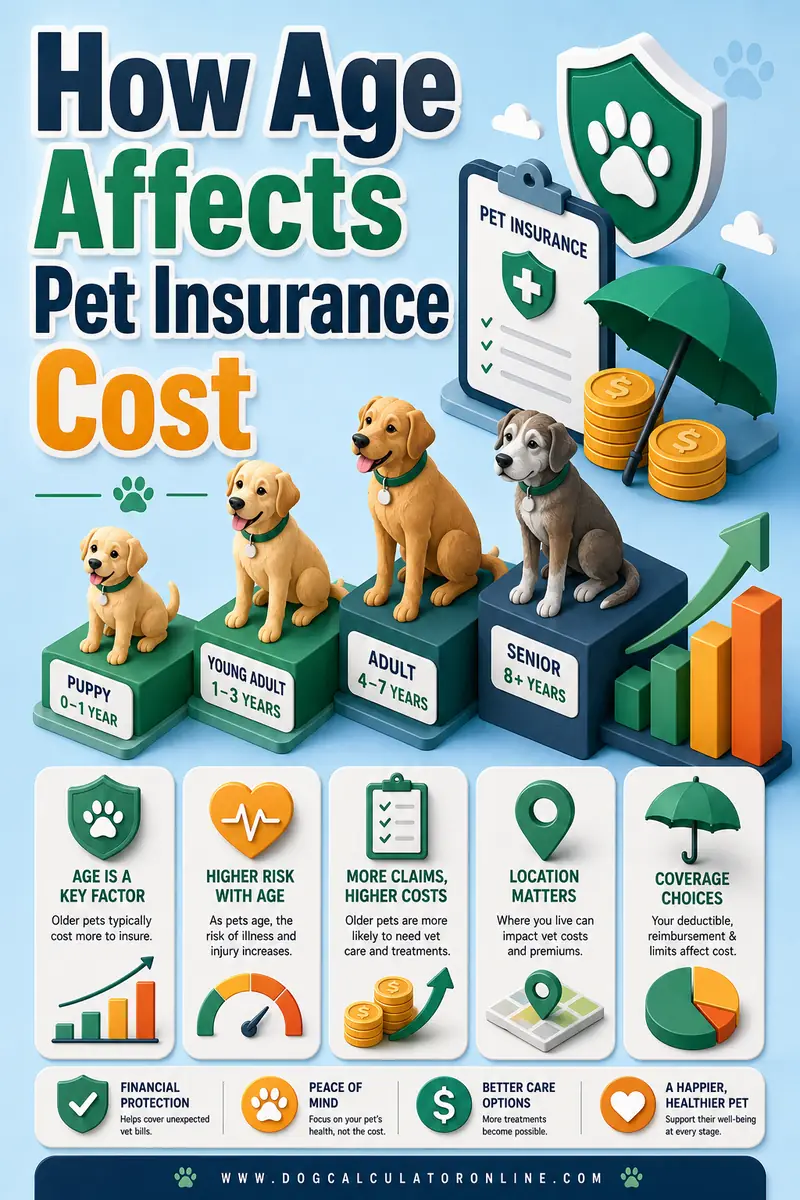
- Separate premiums. Each dog is quoted individually. Adding a puppy is cheap; adding a senior is not. The cost-by-age breakdown shows how steeply the curve climbs.
- Separate deductibles. If both dogs carry a $500 annual deductible and both have a claim year, you pay up to $1,000 out of pocket before reimbursement math starts. Deductibles never pool across pets.
- Separate annual limits. One dog's $12,000 emergency doesn't eat into the other dog's coverage ceiling. This cuts in your favor.
- Separate pre-existing lists. Each dog's medical history is evaluated independently at enrollment. Insuring dog one early doesn't grandfather dog two in later — the pre-existing conditions rules reset for every new enrollment.
The separate-deductible point is the one that surprises people. A "bad year" in a two-dog home can genuinely mean two deductibles, and in a three-dog home, three. When you compare plan options, model the worst realistic year, not the average one.
What Does the Math Look Like for Two or Three Dogs?
Let's put real shapes on it. These are illustrative households using honest, typical ranges — your quotes will differ, but the structure won't.
| Household | Dogs | Likely monthly total | Likely annual total |
|---|---|---|---|
| Two young mixed-breeds | 2 and 3 years old | $65–$95 | $780–$1,140 |
| Young dog + middle-aged dog | 2 and 7 years old | $85–$130 | $1,020–$1,560 |
| Two purebreds, one high-risk breed | 3 and 5 years old | $95–$160 | $1,140–$1,920 |
| Three dogs, mixed ages | 2, 5, and 9 years old | $130–$220 | $1,560–$2,640 |
A few things jump out. Three dogs at typical rates crosses $2,000 a year — real money that deserves a real decision rather than a default. And the age mix matters more than the head count: two young dogs can cost less to insure than one senior. If your dogs are staggered in age (which is common — many multi-dog homes add a puppy every few years), expect the household premium to climb steadily as each dog ages up the pricing curve, then drop when a younger dog joins the rotation.
It's worth running your numbers annually. Premiums rise at renewal for every dog, and the household total that felt fine at $90/month can quietly become $150/month three years later. That's not a reason to cancel — canceling forfeits each dog's pre-existing lock-in — but it is a reason to re-tune deductibles and reimbursement rates per dog rather than treating the bill as fixed.
Can You Insure Just One of Your Dogs?
Yes, and nobody will stop you. Policies are per-dog, so a household can absolutely insure the fragile one and self-insure the sturdy one. Done thoughtfully, this is one of the most rational moves in the multi-dog playbook — partial protection aimed at the biggest risk beats either extreme.
The dog that most deserves the policy is usually the one with:
- The riskiest breed profile. Flat-faced breeds, giant breeds, and breeds with known hereditary issues (hips, hearts, spines) generate bigger and more frequent claims. A Frenchie or a Great Dane is a stronger insurance case than a healthy 45-pound mystery mix.
- The younger age. Counterintuitive, but insuring the puppy locks in a clean pre-existing slate for life, while an older dog may already have chart notes that exclude the conditions most likely to cost you money. Coverage you buy at eight can't cover the arthritis diagnosed at seven.
- The higher replacement-cost vet profile. Some dogs are simply accident magnets — the fence-jumper, the sock-swallower, the one who thinks garbage is charcuterie. You know which of your dogs this is.
The flip side: if the uninsured dog has the catastrophe, you're covering it in cash. The one-dog strategy only works if you pair it with a genuine emergency fund for the others — the insurance versus savings account comparison walks through what "genuine" means in practice. A useful rule: insure the dog whose worst-case bill would break you, self-insure the dog whose worst-case bill would merely hurt.
What you shouldn't do is insure neither dog because insuring both feels expensive. That's letting the combined sticker price make a decision the individual risks should make. Evaluate each dog on its own — the same way the insurer does.
How Can You Lower the Total for a Multi-Dog Household?
You have more levers than the multi-pet discount, and most of them are bigger:
- Raise deductibles on the lower-risk dog. Moving one dog from a $250 to a $750 deductible can cut that policy's premium meaningfully while keeping full catastrophe protection. You're trading small-claim reimbursement for a cheaper month — a good trade on a healthy young dog.
- Mix coverage levels per dog. Nothing forces identical plans. The senior might carry 90% reimbursement while the young mix carries 70%. Tailor each policy to each dog's actual risk.
- Consider accident-only for one dog. Accident-only coverage is much cheaper and still handles the swallowed sock and the broken leg. It's a defensible middle path for a young, healthy dog in a budget-strapped year — just understand illness claims won't be covered, and switching to full coverage later means any diagnoses in between become pre-existing.
- Skip wellness add-ons across the board. Routine care is predictable; pre-paying it through an insurer for multiple dogs multiplies a convenience fee. Budget vaccines and checkups directly.
- Keep every dog on autopay. A lapsed policy in a multi-dog account quietly converts that dog's accumulated chart notes into exclusions on any future policy. The more dogs you manage, the easier it is to fumble one renewal.
- Re-shop at natural breakpoints — carefully. Switching insurers resets waiting periods and re-evaluates pre-existing conditions for that dog. For a young dog with a clean chart, shopping around is low-risk. For an older dog with history, staying put usually protects more than a cheaper premium saves.
And zoom out: premiums are one line in a multi-dog budget that also includes double food, double preventives, and double boarding. The dog cost calculator lets you build the full per-dog picture so the insurance decision happens in context instead of in isolation.
Is Insuring Two Dogs Worth It?
The worth-it logic doesn't change with head count — it just runs twice. Insurance earns its keep when a surprise $3,000–$5,000 bill would strain your finances; with two dogs, the probability that someone in the house generates that bill in any given year roughly doubles, while your emergency fund doesn't. That's the quiet argument for coverage in multi-dog homes: more dogs means more draws from the same deck of risks, against the same savings account.
A concrete version of that logic: picture two insured dogs at $100/month combined, or $1,200 a year. If one dog needs a $6,000 emergency surgery in year three — a thoroughly ordinary claim, not a horror story — a typical plan ($500 deductible, 80% reimbursement) returns about $4,400, wiping out several years of premiums for both dogs in one event. That's the scenario multi-dog coverage is built for, and with two dogs you get two chances per year at it.
The counterargument scales too, though. Two sets of premiums at $1,300+/year is $13,000+ over a decade, and in the lucky scenario most of that outlasts its usefulness. If your finances can absorb a five-figure bad year, self-insuring both dogs with a well-fed dedicated fund is legitimate — the general is pet insurance worth it framework applies dog by dog. Most multi-dog households land somewhere in the middle: full coverage on the high-risk or young dogs, leaner coverage or savings on the rest, and an honest annual review of whether the mix still matches the dogs.
Frequently Asked Questions
Is there a family plan that covers two dogs under one policy?
No. Pet insurance is priced and administered per animal, so two dogs means two policies — even at the same insurer, on the same account, on the same bill. Multi-pet discounts reduce the combined price a little, but there's no shared premium, shared deductible, or shared limit.
How big is a typical multi-pet discount?
Usually 5–10% — meaningful but modest. Some insurers apply it only to pets after the first, others to every pet on the account, which is worth checking because the second structure saves roughly twice as much. On a typical two-dog household, expect the discount to be worth $60–$130 a year.
Do my two dogs share a deductible?
No — deductibles are per dog, per policy. If both dogs carry $500 deductibles and both have claims in the same year, you could pay up to $1,000 out of pocket before reimbursements begin. Budget for the worst realistic year, not the average one.
Can I put my two dogs on different plans?
Yes, and you often should. Each dog can carry its own deductible, reimbursement rate, and annual limit — even different insurers entirely. A common setup is stronger coverage on the older or higher-risk dog and a higher-deductible, cheaper policy on the young healthy one.
Is it bad to insure only one of my two dogs?
It's a legitimate strategy, not a moral failing. Insuring the dog with the higher risk — the puppy, the high-risk breed, the accident-prone one — while self-insuring the sturdier dog concentrates your premium dollars where they're most likely to matter. Just pair it with a real emergency fund for the uninsured dog.
Does adding a second dog raise my first dog's premium?
No. Each policy is priced independently, so adding a puppy to your account doesn't change your existing dog's quote — if anything, a multi-pet discount that applies to all pets slightly lowers it. Your first dog's premium rises with age and vet inflation, not with head count.
The Bottom Line
Budget for pet insurance on two dogs the honest way: two full policies, roughly $70–$130 a month combined, with a discount that softens rather than transforms the total. Decide dog by dog — the young high-risk dog may clearly earn coverage while the healthy senior with existing exclusions may not — and re-tune each policy at renewal instead of auto-paying forever. Before you commit either way, put the whole picture on one screen with the free dog cost calculator: food, vet care, and premiums for every dog in the house, so the insurance line gets decided with real numbers around it.