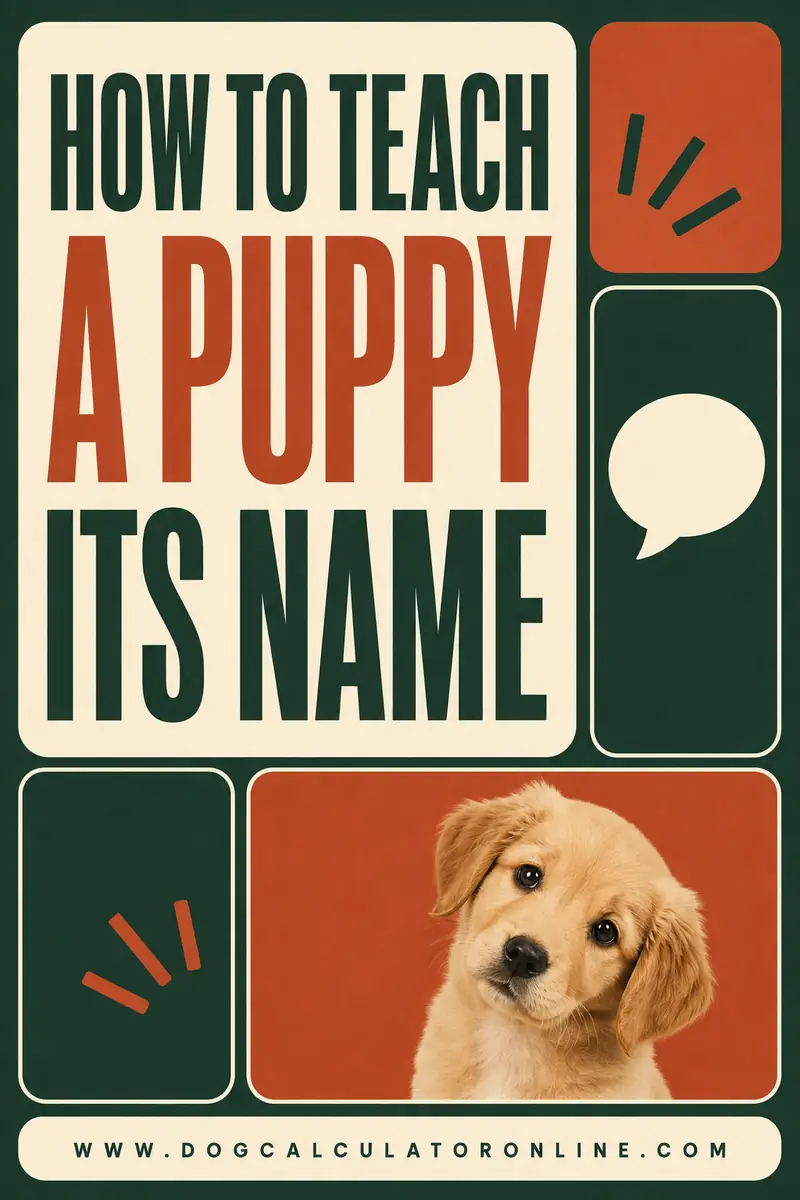
How to Teach a Puppy Its Name
A puppy's name is not a label — it is a cue that means "look at me, something good is about to happen", and it stops working the moment you use it for anything else. Most puppies learn to respond in two or three days of very small sessions. Most owners then spend the next six months quietly dismantling it by shouting the name at a puppy that is running away, or saying it before a bath, or repeating it fifteen times while the puppy sniffs a hedge. The teaching part is easy. Protecting it is the real skill. Growth is worth tracking alongside training with the puppy weight calculator.
🐾 Name training troubleshooter
Tap what is happening:
Tap an option above. Say the name once, then pay every single time.
Why the Name Is the Most Valuable Cue a Dog Owns
Everything else depends on it.
It buys attention, which is the raw material of training. You cannot cue a sit, a recall or a wait if the dog is not looking at you. The name is what makes the rest possible.
It is the safety cue. A dog whose head snaps round at its name can be stopped before it reaches a road, a dropped chicken bone or another dog. That is worth more than any trick.
It is the one cue used hundreds of times a day, which means it takes hundreds of small deposits or withdrawals a day depending on how you use it.
It is also the easiest to teach. Three days of two-minute sessions gets most eight-week-old puppies to a reliable head turn indoors.
Start on day one. A puppy that arrives at eight weeks can begin the same afternoon — the general case for starting early is made in when to start training a puppy.
Teach it before you teach anything else, because every subsequent cue trains faster once attention is on demand.
What Does a Puppy Actually Hear?
Not a word in the way you mean it, and understanding that changes how you teach it.
A puppy does not know it "has" a name. It learns that a particular sound predicts something good, and turning toward the sound is what makes the good thing arrive. That is classical conditioning followed by a simple operant response.
Dogs discriminate sounds well but their attention filters aggressively. Your puppy hears its name perfectly at eight weeks; it simply has no reason yet to care.
Tone carries more than the word. A rising, light tone is far more likely to get a head turn than a flat or stern one, which is why the same name works in the kitchen and fails in the garden when you are irritated.
Repetition without payment devalues it fast. Say a word five times with nothing happening and the puppy learns the word is background noise. This is called habituation, and it is the commonest way a name is destroyed.
The name is not a recall. It means "look at me", not "come here". Those are two separate cues and blurring them weakens both.
Any word can be a name cue — the puppy has no attachment to the one on its paperwork.
The Charging Game: Teaching the Name in Three Days
The whole method, and it genuinely is this simple.
Get twenty small, soft, high-value treats — pieces the size of a pea. Some of the daily food ration works fine at eight weeks.
Wait until the puppy is not looking at you. Not asleep, not mid-chew, just facing elsewhere in a quiet room.
Say the name once, in a bright tone. Once. Not twice, not the name plus "come here".
The instant the head turns, mark it and pay. A cheerful "yes" or a clicker as the head moves, treat delivered within two seconds. If you are late, you are rewarding whatever came next.
If the head does not turn, do not repeat the name. Make a kissy noise or a small sound to get the turn, pay anyway, and make the environment easier next time.
Do five to ten repetitions, then stop. Two or three minutes at eight weeks, five at three months. Several tiny sessions a day beat one long one, and drilling produces avoidance — a puppy pushed past its limit starts leaving the room when the treats appear. That principle runs through every item on the puppy training checklist by age.
How Long Does It Take?
Most puppies show a reliable indoor head turn within three days. Here is a realistic schedule.
| Day | Where | Sessions | What you should see |
|---|---|---|---|
| 1 | Quiet room, no distractions | 4–6 of 2 min | Head turn about half the time |
| 2 | Same room, toy on the floor | 4–6 of 2 min | Head turn most times, quicker |
| 3 | Different rooms of the house | 4–6 of 3 min | Fast, consistent turns indoors |
| 4–7 | Garden, quiet times | 3–5 of 3 min | Some failures — pay extra out here |
| Week 2 | Garden with mild distraction | 3–4 of 3 min | Reliable in your own outdoor space |
| Week 3–4 | Quiet street, on leash | 3–4 of 5 min | Turns with people or cars nearby |
| Month 2+ | Parks, other dogs present | Little and often | Genuine reliability under distraction |
The gap between day three and month two is the part people skip. A puppy that responds perfectly in the kitchen has learned "this sound in this room means food". Every new environment needs its own easy repetitions before you can expect the same standard.
Never stop paying entirely. Move to intermittent food plus praise, a game, or being let off the leash — but the name should keep predicting something worth turning round for, for the dog's whole life.
What Ruins a Puppy's Name?
Six habits, all of them easy to fall into.
Using it as a warning. If the name is what you say sharply when the puppy is on the sofa or chewing a shoe, it starts to predict trouble, and the head stops turning.
Using it before something unpleasant. Nail trims, baths, ear drops, the end of a walk. Use a neutral phrase for those instead and keep the name clean.
Repeating it. Saying it five times while a puppy sniffs teaches that the word carries no information. Say it once; if it fails, make the situation easier rather than louder.
Using it as a recall. The name gets attention; a separate word brings the dog to you. Merging them means every failed recall also weakens the name.
Overusing it in conversation. Talking about the dog by name across a room, all day, is a slow devaluation. Plenty of households solve this with a nickname for chatter and the real name reserved as a cue.
Shouting it at a dog that is running away. Almost every dog owner has done it, and it is the single fastest way to teach a dog that its name means "the fun is about to end". Turn and run the other way instead — most puppies chase.
Does the Name Itself Matter?
Somewhat, though far less than how you use it.
Two syllables tend to work well — long enough to be distinctive, short enough to say urgently. Plenty of one-syllable names work perfectly; the two-syllable dog names list is a useful starting point if you have not chosen yet.
Hard consonants and a clear ending help. Sounds like k, t, p and a bright vowel ending cut through background noise better than soft, trailing names.
Avoid names that rhyme with cues. Kit and sit, Bo and no, Ray and stay, Jay and away. Dogs discriminate sounds well but there is no reason to make it harder.
Avoid names that rhyme with another pet's name in the same household, for the same reason.
Avoid anything you would be embarrassed to shout in a public park at seven in the morning. This is more practically important than it sounds.
The rest is taste, and there is no evidence that a puppy prefers any particular name — browse best dog names and pick something you will enjoy saying ten thousand times.
How Do You Proof the Name Outdoors?
By making it easier before you make it harder, and by paying much better outside.
Raise the value of the reward when you raise the difficulty. Kibble works in the kitchen; use cheese, chicken or liver in the garden and on the street. The competition is stronger out there and the pay should match.
Add distance before distraction. Practice at a range where the puppy can still succeed, then close in on the distraction over several sessions.
Use a long line for early outdoor work. It removes the risk of a failed response turning into a chase, and it keeps you from having to shout the name at a departing puppy.
Do not call the name into a losing situation. If a squirrel has just gone up a tree, you will lose, and the loss costs you more than the attempt gains.
Reward the check-in you did not ask for. A puppy that looks back at you spontaneously on a walk should be paid every time. That builds the same behavior without spending the cue.
Combine it with leash work, since both are about voluntary attention while the world is interesting — the approach is in how to leash train a puppy.
What If the Puppy Already Ignores Its Name?
Common, fixable, and often faster to solve by changing the word than by rehabilitating it.
Diagnose first. A name that has been repeated without payment is devalued; a name that has predicted scolding or baths is poisoned. Devalued names recharge easily; poisoned ones often do not.
Recharging. Two weeks of the charging game, in an easy room, with genuinely good food, and a strict household rule that nobody says the name for anything else. Most devalued names come back.
Changing it. Pick a new word, charge it from scratch, and simply retire the old one. Dogs have no attachment to their name, and this costs three days.
Adding a second cue. Plenty of sneakers keep the formal name for everyday use and charge a separate "look at me" word that is never wasted. This works well in busy households where you cannot control what everyone says.
Rescue dogs can be renamed at any age. An adult dog learns a new name in about the same three days a puppy does.
Get every household member on side. One person using the name as a telling-off will undo four people's careful work, and children need a specific rule rather than a general request. Once attention is reliable, the rest of the cues go in quickly — see basic commands to teach your puppy.
FAQ
How long does it take a puppy to learn its name?
Two to three days for a reliable head turn in a quiet room, using five to ten repetitions several times a day. Reliability outdoors and around distractions takes weeks to months, because each new environment has to be trained rather than assumed.
Should I use my puppy's name for recall?
No — keep them separate. The name means "look at me" and a different word means "come to me". Merging them means every failed recall also weakens the name, and the name is the cue you will use hundreds of times a day.
Can I change my puppy's name?
Yes, at any age, and it takes about three days. Dogs have no attachment to a name; they simply learn which sound predicts something good. Renaming is often quicker than rehabilitating a name that has been used as a telling-off.
Why does my puppy ignore me outside?
Because the name was learned indoors and never rebuilt outdoors. Cues in dogs are strongly context-bound. Go back to easy conditions in the garden, pay much better than you do inside, and add distraction gradually over several weeks rather than all at once.
How many times should I say my puppy's name?
Once. Repeating it teaches a puppy that the word carries no information, which is the fastest way to devalue it. If there is no response, use a noise to get the head turn, pay anyway, and make the next attempt easier.
What age can you start teaching a puppy its name?
The day it comes home, usually eight weeks. Sessions at that age are two minutes long and consist of nothing more than saying the name once and paying the head turn. It is the first thing worth teaching, because every other cue trains faster afterwards.
Keeping a Name Worth Answering
The teaching takes three days; the protecting takes the dog's life. Say the name once, in a bright tone, and pay every single response for the first few months. Keep it out of tellings-off, baths, nail trims and end-of-walk moments, and give the household a nickname to use for ordinary chatter. Rebuild it in the garden, then on a quiet street, then in a park, treating each place as a fresh start rather than assuming it transfers. A dog whose head turns instantly at its name, anywhere, is easier and safer to live with than one with a dozen polished tricks. Track growth alongside the training with the puppy weight calculator.