How Old Is 1 Dog Year in Human Years?
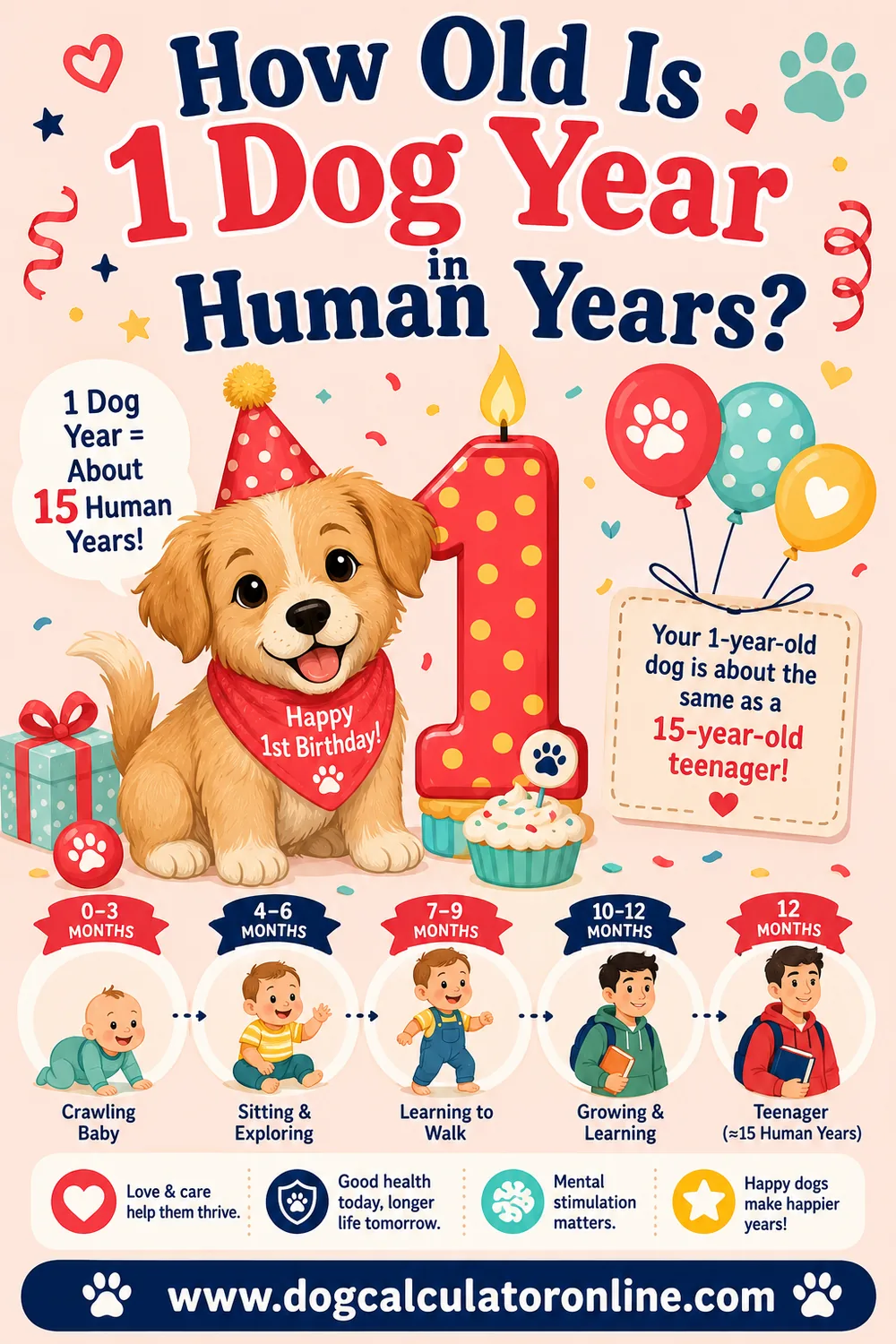
One dog year equals about 15 human years — not 7. That's the guideline veterinary organizations like the AVMA use, and it holds for small, medium, large, and giant breeds alike. By their first birthday, dogs have gone from helpless newborns to physically mature young adults, which is why that single year covers so much human ground.
Want the number for your dog's exact age and size? Our free dog age calculator does the vet-backed math (plus a DNA-study bonus formula) in seconds. If you're curious why year one is worth 15 and not 7, read on.
🐾 Quick check: puppy months → human years
Tap your puppy’s age to see a rough human-age estimate:
Tap an age above to see the estimate.
The Short Answer: 1 Dog Year ≈ 15 Human Years
The old "multiply by seven" rule says a 1-year-old dog is like a 7-year-old child. Anyone who has lived with a 1-year-old dog knows that's off. A 7-year-old human is in second grade. A 1-year-old dog can reproduce, has adult teeth, has nearly finished growing, and is deep into adolescence.
That's why the guideline vets actually use — the size-adjusted method endorsed by the American Veterinary Medical Association — assigns roughly 15 human years to a dog's first year of life. It's the fastest-aging year your dog will ever have.
Here's the full shape of the vet-backed conversion:
| Dog's age | Human-year equivalent |
|---|---|
| 1 year | ≈ 15 |
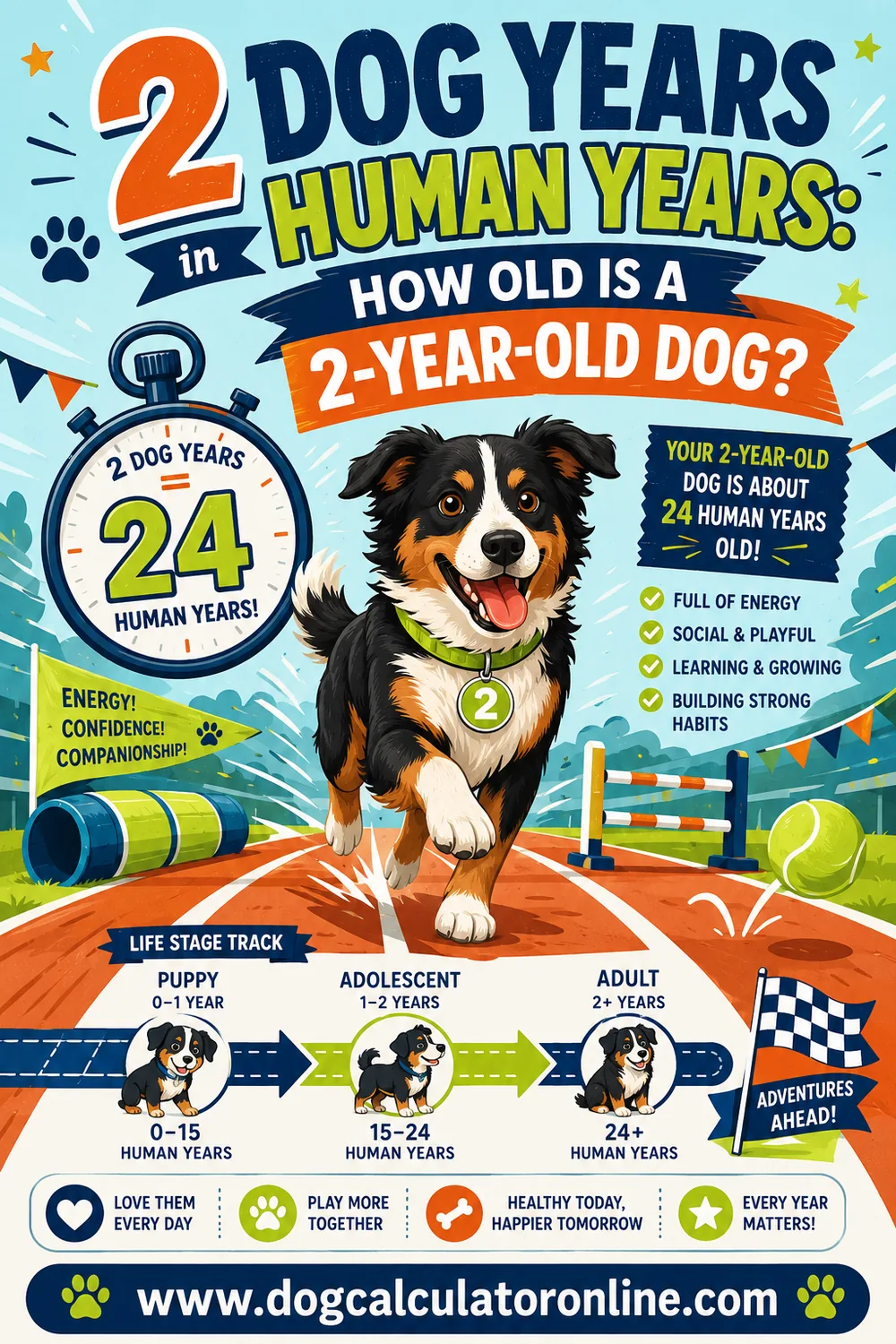
| 2 years | ≈ 24 |
| Each year after 2 | +4 to +7 per year, depending on size |
Notice something useful: at age 1, size doesn't change the answer much. Small, medium, large, and giant dogs all land around 15. The size-based differences (small dogs aging slower, giants aging faster) only kick in from about age 2 onward. So whether you have a Chihuahua or a Great Dane, a 1-year-old dog is roughly a 15-year-old in human terms.
Why One Year Covers So Much Ground
Fifteen years sounds like a lot to pack into twelve months, but look at what a dog accomplishes in that time:
- Birth to weaned: In eight weeks, a puppy goes from blind and deaf to walking, playing, barking, and eating solid food. Human babies take a couple of years to hit the same milestones.
- Baby teeth in, baby teeth out: Puppies grow a full set of baby teeth and replace them with adult teeth by about 6 months. Humans take 12 years.
- Sexual maturity: Most dogs reach it between 6 and 12 months — the biological equivalent of human puberty, which arrives in the early teens.
- Near-adult size: Small breeds are essentially fully grown by 10–12 months. Even large breeds have most of their height by their first birthday.
In other words, a dog compresses infancy, childhood, and early adolescence into one calendar year. Mapping that to "age 7" doesn't work — age 15 fits the biology far better.
What the 2019 DNA Study Says (Hold On — 31?)
In 2019, researchers at the University of California San Diego published a different way to convert dog years, based on DNA methylation — chemical marks on DNA that shift predictably as mammals age. By comparing the epigenetic clocks of Labrador Retrievers and humans, they produced this formula:
Human age = 16 × ln(dog age) + 31
Plug in a 1-year-old dog and you get 31 human years, because the natural log of 1 is zero. That's double the AVMA guideline — so which is right?
Both, in a way. They measure different things:
- The UCSD formula tracks molecular aging. At the DNA level, a 1-year-old Lab's cells carry wear patterns resembling a human of about 30. Dogs front-load a huge amount of molecular aging into their first year, then the curve flattens dramatically.
- The AVMA guideline tracks life stage — maturity, behavior, and health needs. A 1-year-old dog acts like a teenager, not a 31-year-old, and its care needs match adolescence: lots of exercise, ongoing training, and the tail end of growth.
For everyday questions ("how grown up is my dog?"), 15 is the more useful number. The DNA figure is a fascinating second opinion. Our free dog age calculator shows both side by side, so you don't have to choose.
Two caveats on the DNA number
- The study was built on about a hundred Labradors, and the researchers noted other breeds may follow different curves.
- Molecular age isn't a diagnosis or a destiny — it's a population-level pattern, not a report card for your individual dog.
A 1-Year-Old Dog Is a Teenager — And Acts Like One
If you map 15 human years onto behavior, a lot of first-birthday frustrations suddenly make sense. One-year-old dogs commonly:
- Test boundaries. Commands they "knew" at 5 months mysteriously stop working. That's adolescent selective hearing, not failed training.
- Have energy to burn. Teenage dogs need real daily exercise — walks, play, sniffing time — or they invent their own entertainment, usually involving your furniture.
- Push social limits. Adolescence is when many dogs get bolder or mouthier with other dogs. Continued socialization matters.
- Look grown but aren't done. Large and giant breeds keep filling out muscle and bone until 18–24 months, even though they look adult-sized.
The takeaway: don't expect adult-dog steadiness from a 1-year-old. In human terms you're living with a 15-year-old, and the calm usually arrives a year or two later — just like it does with people.
How the Conversion Continues After Year One
Year one is worth about 15 human years, but the pace changes fast after that:
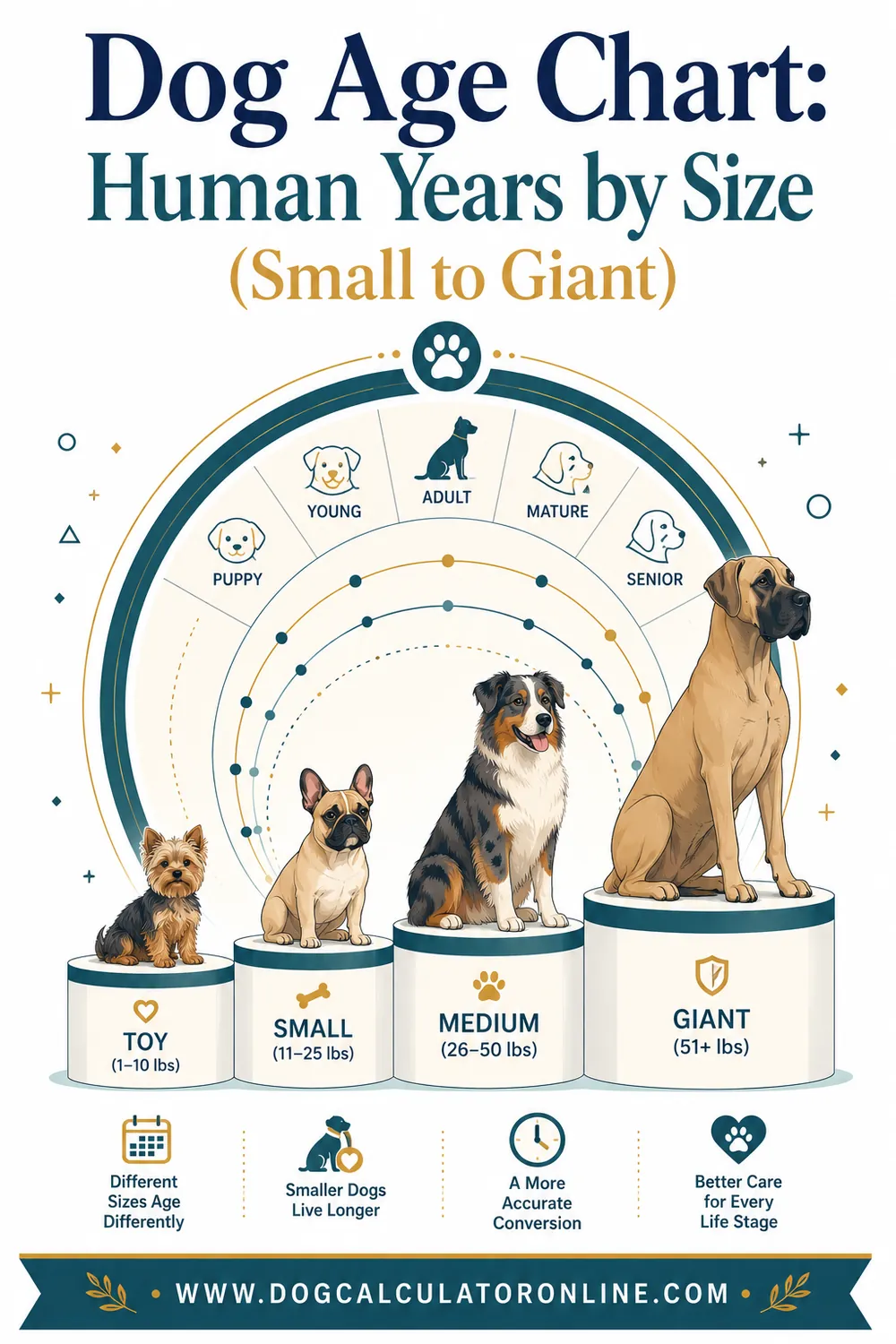
| Dog's age | Small (under 20 lb) | Medium (21–50 lb) | Large (51–90 lb) | Giant (over 90 lb) |
|---|---|---|---|---|
| 1 | 15 | 15 | 15 | 15 |
| 2 | 24 | 24 | 24 | 24 |
| 3 | 28 | 29 | 30 | 31 |
| 5 | 36 | 39 | 42 | 45 |
| 7 | 44 | 49 | 54 | 59 |
Year two adds about 9 human years, and every year after that adds 4 to 7 depending on your dog's adult weight. That's where size starts to matter: small dogs age the slowest, giant breeds the fastest. If your dog is past their first birthday, our dog age calculator applies the right size multiplier automatically.
Caring for a Dog at the 15-Human-Years Stage
Knowing your dog is effectively a teenager helps you time some real decisions. Around the first birthday:
- Ask your vet about switching to adult food. Small breeds often make the switch around 9–12 months; large and giant breeds usually stay on large-breed puppy food longer, sometimes to 18–24 months. Your vet can time it for your dog.
- Keep training going. Adolescence is exactly when training lapses. Short, consistent sessions through the second year cement good habits for life.
- Talk to your vet about spay/neuter timing if you haven't. Recommendations vary by breed and size, and this is the window when the conversation usually happens.
- Book the annual checkup. Year one closes out the puppy-vaccine series; the adult wellness routine starts now.
- Watch the waistline. Growth is slowing, so the puppy portions that fueled it can quietly become too much. Keeping a young dog lean is one of the best-documented ways to support a long life.
None of this is medical advice — it's a checklist of conversations worth having with your own vet as your dog turns "15."
How to Tell if a Rescue Dog Is About a Year Old
Adopted a dog with no paperwork? Vets estimate young-dog age from a few physical clues, and the one-year mark is actually one of the easier calls:
- Teeth are the best evidence. A full set of clean, white adult teeth with little to no wear points to a dog between roughly 7 months and 2 years. Baby teeth still present means under 6 months; yellowing and tartar usually mean older than 2.
- Body proportions. Dogs right around 1 often still look slightly leggy and narrow-chested, especially large breeds — adult height, but not yet adult bulk.
- Coat and behavior. Soft, puppyish fur patches and full-throttle adolescent energy both hint at the under-2 window.
Your vet can combine these clues into a good estimate. Once you have one, run it through the free dog age calculator to see where your new dog sits in human years — and adjust the birthday celebration accordingly.
Related Guides
If this helped, these go deeper on the same question:
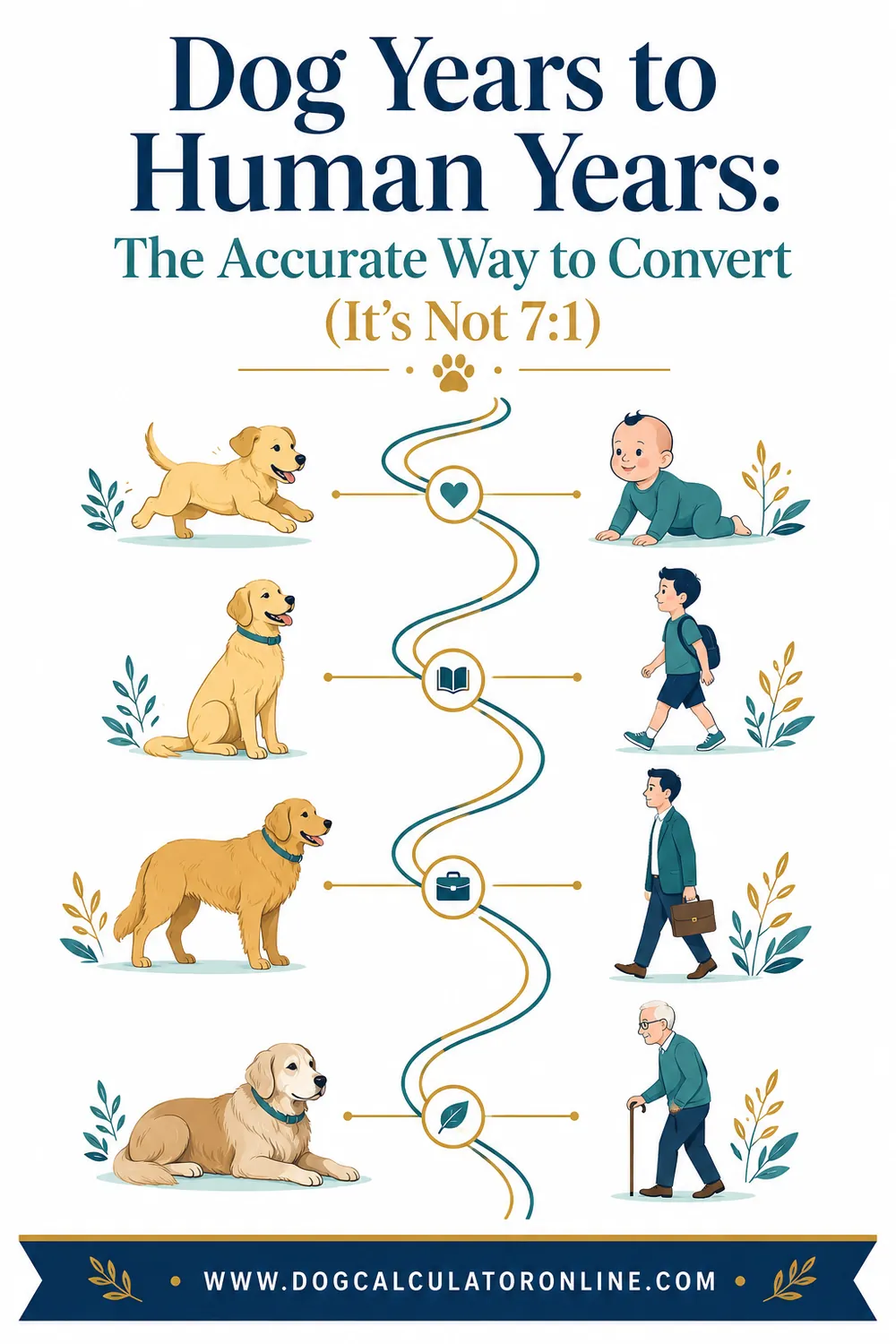
- Dog Years to Human Years: The Accurate Way to Convert (It's Not 7:1)
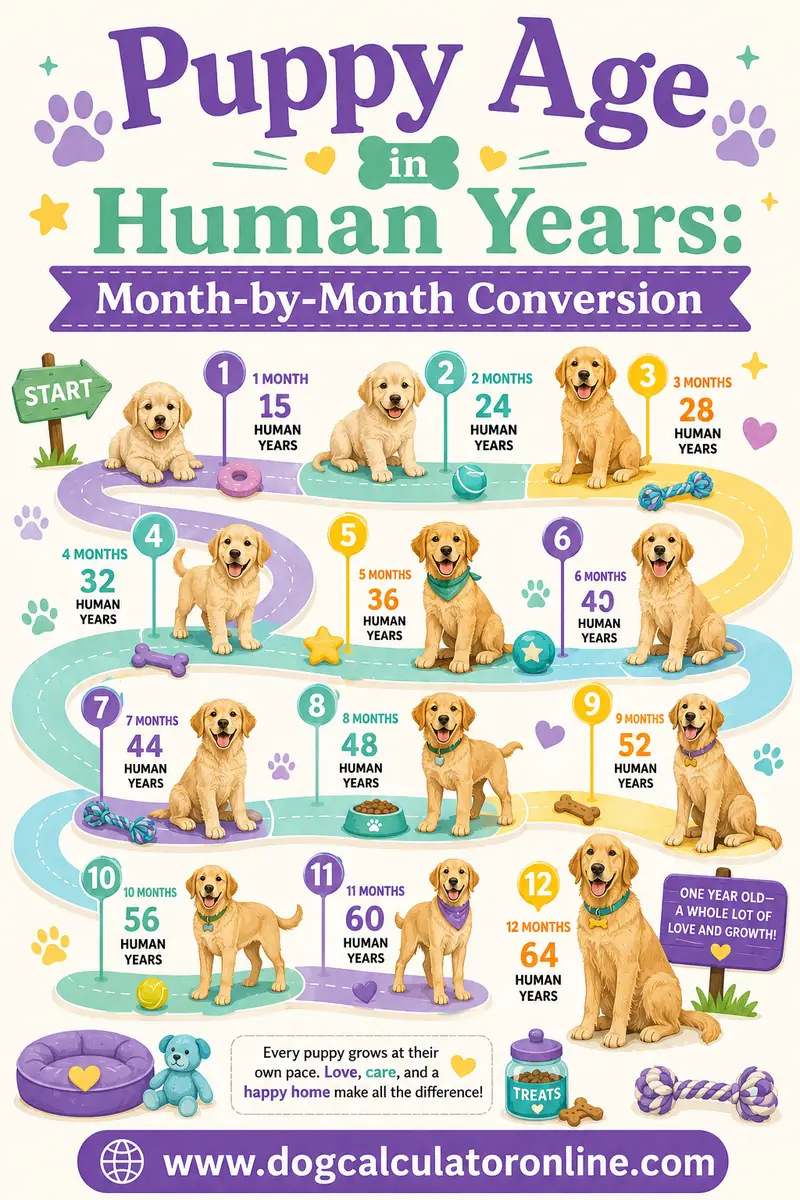
- Puppy Age in Human Years: Month-by-Month Conversion
- 2 Dog Years in Human Years: How Old Is a 2-Year-Old Dog?
- Dog Age Chart: Human Years by Size (Small to Giant)
And if you just want your own dog's number, the free dog age calculator does it in one tap.
FAQ
Is 1 dog year really 7 human years?
No. The 7:1 rule is a myth. Veterinary guidelines put a dog's first year at about 15 human years, because dogs reach adolescence and near-adult size within twelve months.
How old is a 1-year-old dog in human years?
About 15 human years by the AVMA-style size-adjusted method. The 2019 UCSD DNA study puts molecular age at about 31, but 15 better reflects real-life maturity and care needs.
Does breed size change the answer at age 1?
Barely. All size classes land around 15 human years at the first birthday. Size starts to matter from age 2 onward, when small dogs add about 4 human years per year and giant breeds add about 7.
Is a 1-year-old dog still a puppy?
Technically most dogs are adolescents at 1 — past puppyhood but not fully mature. Small breeds are close to full adulthood; large and giant breeds keep developing until 18–24 months.
How do I convert my dog's exact age?
Use the size-adjusted method: 15 for year one, +9 for year two, then +4 to +7 per year by size. Or skip the math — the free dog age calculator does it instantly, including months for puppies.
What is a 6-month-old puppy in human years?
Roughly 7–9 human years — a school-age kid. The first year isn't linear: puppies age fastest in their earliest months, then the pace eases toward the 15-year mark at their first birthday.
The Bottom Line
One dog year equals about 15 human years, not 7. Your dog packs infancy, childhood, and the start of the teenage years into twelve months — which explains both the astonishing growth and the adolescent attitude. After the first birthday, the pace slows and size takes over the math.
For the exact number at any age — 1 year, 14 months, or 14 years — enter your dog's age and weight into the free dog age calculator and get the vet-backed answer plus the DNA-study figure in one tap.