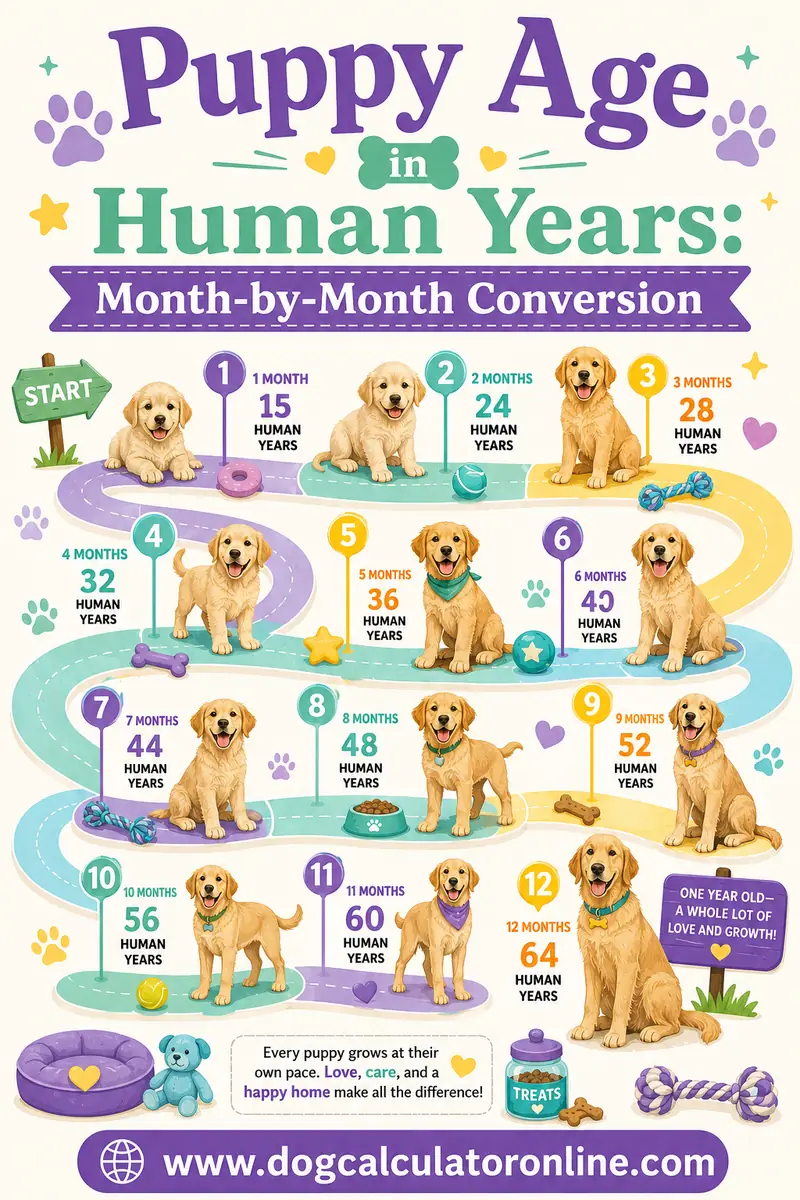
Puppy Age in Human Years: Month-by-Month Conversion
A puppy ages the equivalent of about 15 human years in its first twelve months — so puppy age converts by months, not years. Roughly: a 2-month-old puppy is like a 2–3 year-old toddler, a 4-month-old like a 5-year-old child, a 6-month-old like an 8-year-old kid, a 9-month-old like an 11-year-old preteen, and a 1-year-old like a 15-year-old teenager.
For your puppy's exact equivalent, the free dog age calculator accepts ages in months and does the math instantly. Below: the full month-by-month chart, what's happening at each stage, and why puppies age faster than any other animal in your house.
🐾 Puppy converter: months → human years
Tap your puppy’s age to see the human equivalent:
Tap an age above to see the estimate.
The Puppy Conversion Chart
The vet-backed size-adjusted method gives a dog's entire first year a value of about 15 human years. Spread across the months — weighted toward the explosive early weeks — the widely used approximation looks like this:
| Puppy's age | Human equivalent | Human comparison |
|---|---|---|
| 8 weeks (2 months) | ≈ 2–3 years | Toddler |
| 3 months | ≈ 4 years | Preschooler |
| 4 months | ≈ 5 years | Kindergartner |
| 5 months | ≈ 6–7 years | Early grade school |
| 6 months | ≈ 8 years | School kid |
| 8 months | ≈ 10 years | Tween |
| 9 months | ≈ 11 years | Preteen |
| 10 months | ≈ 12–13 years | Early teen |
| 12 months | ≈ 15 years | Teenager |
Treat these as smart estimates, not precision instruments — puppy development runs on a curve, and breeds mature at slightly different rates. But as a mental model, it's remarkably useful: it explains why an 8-week-old needs toddler-level supervision and why a 10-month-old suddenly has teenage opinions.
Why Puppies Age So Fast
No stage of a dog's life compresses more development into less time. In twelve months, a puppy travels the human road from birth to age fifteen:
- Weeks 1–2 (newborn): Blind, deaf, unable to regulate body temperature — the equivalent of early infancy, at fast-forward.
- Weeks 3–8 (infancy to toddlerhood): Eyes and ears open, first steps, first barks, weaning, littermate play that teaches bite control. Human babies take two-plus years to cover this ground.
- Months 2–6 (childhood): The great learning window. Housetraining, name recognition, basic cues, and — critically — socialization. Puppy teeth erupt and are already being replaced by adult teeth around month 4–6; human kids wait until age 6 to start losing theirs.
- Months 6–12 (adolescence): Sexual maturity arrives (typically 6–12 months), adult teeth complete, growth plates begin closing in small breeds, and the teenage brain takes the wheel — boundary-testing included.
This is also why the old "1 dog year = 7 human years" myth fails hardest at the young end: it would call a 1-year-old dog a 7-year-old child, when that dog is biologically closer to a high-school sophomore.
Size Matters — Even in Puppyhood
The famous size effect (small dogs aging slower than giants) mostly kicks in after age two, but size shapes puppyhood too — just in the opposite direction:
- Small breeds finish faster. A Chihuahua or Yorkie is essentially fully grown by 9–12 months. Their "15 human years" wrap up early and cleanly.
- Medium breeds finish growth around 12 months.
- Large breeds keep growing to 15–18 months — at their first birthday they're teenagers who still have height coming.
- Giant breeds grow until 18–24 months. A 1-year-old Great Dane is developmentally younger than a 1-year-old Beagle — closer to 13–14 human years than 15.
So for puppies of big breeds, shade the chart slightly younger; for tiny breeds, slightly older. From age two onward all sizes stand at about 24 human years, and only then does the small-dogs-age-slower divergence begin. The free dog age calculator handles both ends — puppy months and the adult size adjustment.
What Each Stage Needs From You
The human-age lens turns the chart into a parenting guide:
- 2–3 months ("toddler"): Supervise like you would a two-year-old, because that's who's chewing your shoe. Gentle routines, generous naps (18–20 hours of sleep is normal), and the start of socialization — positive, careful exposure to sights, sounds, surfaces, and people during this key window. Ask your vet how to socialize safely around the vaccine schedule.
- 4–6 months ("grade-schooler"): Prime learning years. Short, upbeat training sessions stick beautifully now. Teething peaks — supply legal chews and guard the furniture. Adult teeth mean adult-strength jaws; keep reinforcing bite manners.
- 6–9 months ("tween"): Energy surges, adolescence approaches. Keep exercise regular but joint-friendly for large breeds — growth plates are still open, so save the marathon fetch and forced running for later. Talk to your vet about spay/neuter timing.
- 9–12 months ("teenager"): Selective hearing arrives on schedule. Commands your puppy "knew" evaporate mid-zoomie. This is normal adolescent regression — stay consistent, keep sessions short and rewarding, and it passes. Discuss the transition from puppy food to adult food with your vet; small breeds often switch around 9–12 months, giants much later.
One steady thread across all stages: feed a puppy-appropriate diet in measured amounts. Growth is the one life stage where nutrition mistakes echo for years — your vet and the feeding chart on your puppy food label are the guides.
When Is a Puppy Not a Puppy Anymore?
There's no single graduation day, but three markers matter:
- Physical maturity: 9–12 months for small breeds, up to 18–24 for giants.
- Sexual maturity: typically 6–12 months — well before behavioral maturity, which is why "teenager" fits so well.
- Behavioral maturity: most dogs settle into adult steadiness between 18 months and 3 years, later for high-energy breeds.
By the size-adjusted conversion, the first birthday (~15 human years) ends childhood, and the second (~24) ends adolescence. Everything between is the teenage chapter — memorable, occasionally maddening, and over faster than you expect.
How Vets Estimate a Puppy's Age (Rescue Pups Welcome)
Adopted a puppy of unknown birthday? Teeth are the calendar. Puppy dental development runs on a famously reliable schedule, and vets read it like a timestamp:
| What the mouth shows | Approximate age |
|---|---|
| No teeth yet | Under 3 weeks |
| Baby teeth erupting | 3–6 weeks |
| Full set of 28 baby teeth | 8 weeks–3.5 months |
| Adult front teeth (incisors) arriving | 3.5–5 months |
| Adult canines and premolars coming in | 4–6 months |
| Full set of 42 clean adult teeth | 6–7 months+ |
Beyond teeth, vets weigh the evidence of body proportion (puppies are progressively less head-and-paws with age), coordination, and coat. The estimate is usually accurate within a few weeks for young puppies — tight enough to schedule vaccines correctly and to convert to human years meaningfully. Once you have the vet's estimate, the free dog age calculator turns it into a human-age equivalent instantly, months included.
Milestone Checklist: What Should Be Happening When
A quick reference for the first year — with the caveat that healthy puppies hit these windows, not exact dates:
- 8 weeks: Ready to leave the litter; first vaccines underway; sleeping most of the day (normal!).
- 10–12 weeks: Housetraining underway; socialization window wide open — prioritize safe, positive new experiences now, with your vet's guidance on disease precautions.
- 4 months: Baby teeth falling out (you may find tiny ones in the carpet); adult incisors arriving; name recognition and basic cues solid.
- 6 months: Most baby teeth gone; adolescent behavior stirring; many small breeds near adult height. Spay/neuter timing conversations often start here — timing varies by size and breed, so it's a vet decision.
- 9 months: Teenage phase in full swing; training consistency matters most right now.
- 12 months: Small breeds essentially grown; larges still filling out; the human-equivalent 15th birthday. Discuss the switch from puppy food to adult food with your vet — small breeds typically transition around now, giants closer to 18–24 months.
If your puppy is drifting far outside these windows — no adult teeth by 7 months, far behind on size, extreme lethargy — that's not a comparison-chart worry, it's a vet question. Growth is the life stage where checkups earn their keep.
Related Guides
If this helped, these go deeper on the same question:
- How Old Is 1 Dog Year in Human Years?
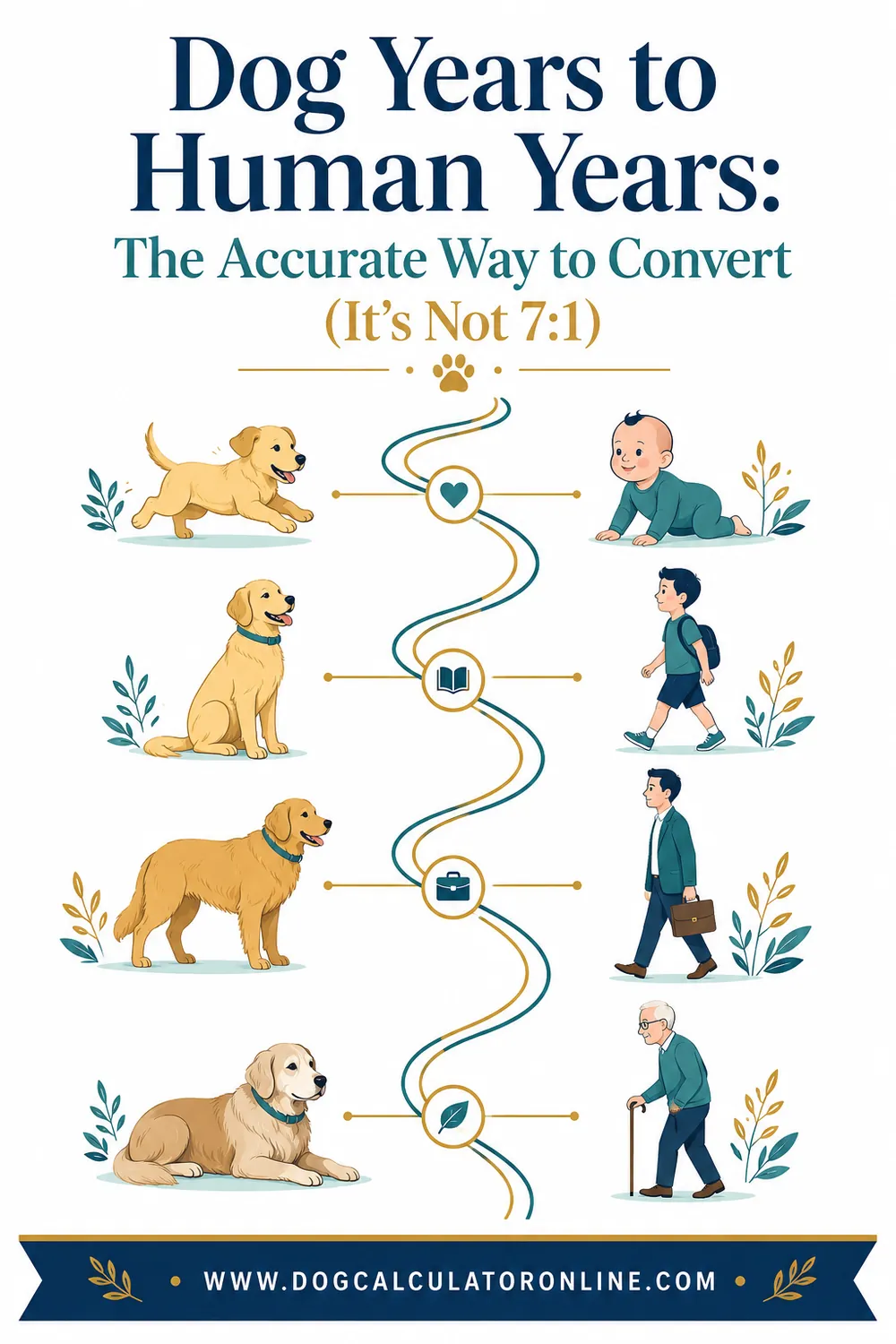
- Dog Years to Human Years: The Accurate Way to Convert (It's Not 7:1)
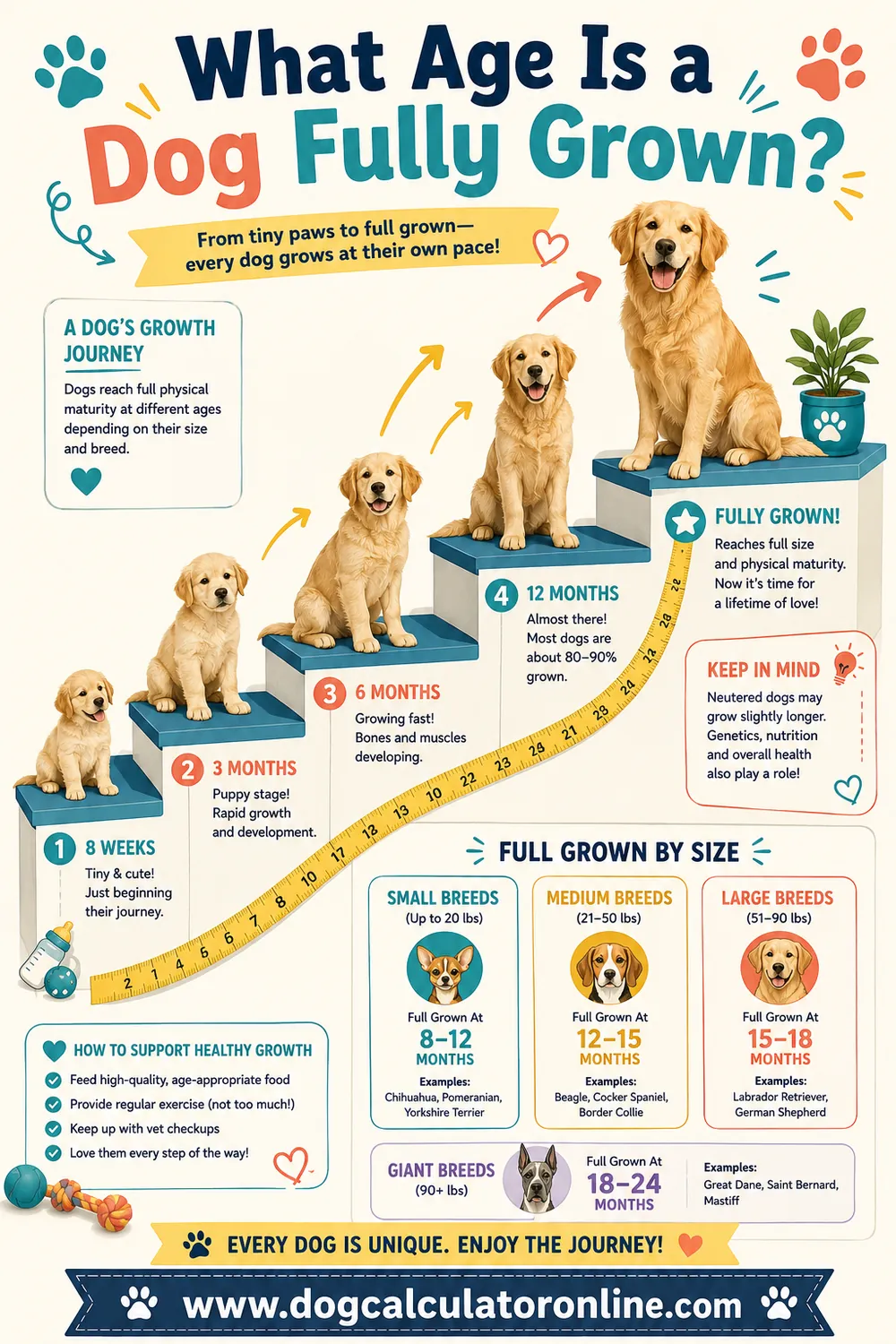
- What Age Is a Dog Fully Grown?
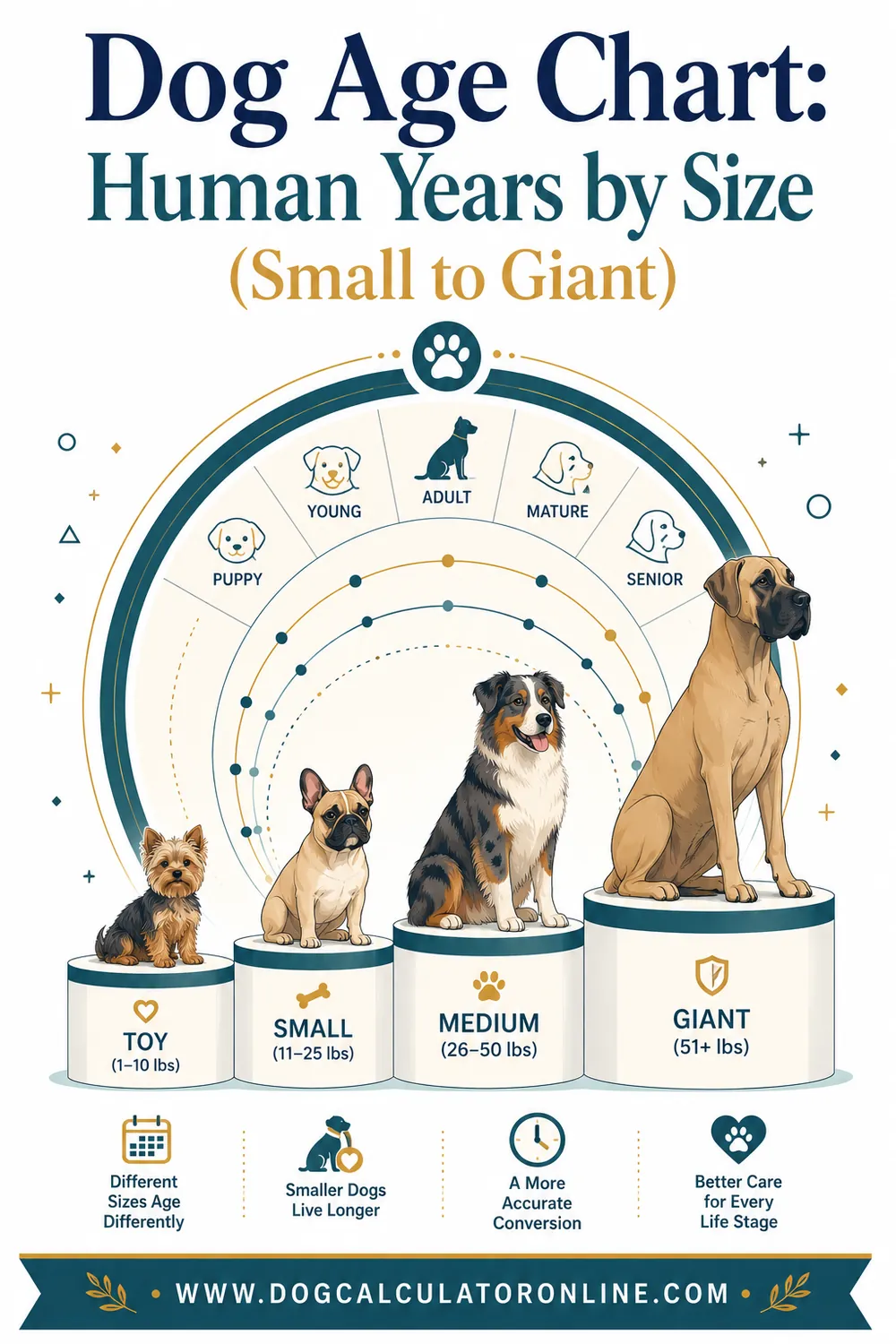
- Dog Age Chart: Human Years by Size (Small to Giant)
And if you just want your own dog’s number, the free dog age calculator does it in one tap.
FAQ
How old is my puppy in human years?
Roughly: 2 months ≈ 2–3 human years, 4 months ≈ 5, 6 months ≈ 8, 9 months ≈ 11, and 12 months ≈ 15. The free dog age calculator converts exact ages in months instantly.
How old is a 6-month-old puppy in human years?
About 8 human years — a school-age kid. It fits: six-month-olds are curious, teachable, full of energy, and losing their baby teeth.
Is 1 dog year really 15 human years?
For the first year, yes — that's the vet-backed guideline. Puppies reach adolescence and near-adult size in twelve months, which no "7 years" conversion can explain.
Do small and large puppies age at the same rate?
Almost, with edges: small breeds finish growing by 9–12 months, while giants grow until 18–24 months, making them slightly "younger" at the first birthday. All sizes converge at about 24 human years by age two.
When does a puppy become an adult dog?
Physically at 9–24 months depending on size; behaviorally between 18 months and 3 years. The conversion marks age one as a 15-year-old teen and age two as a 24-year-old adult.
How much should a puppy sleep?
A lot — 18–20 hours a day for young puppies is normal and necessary for growth. A sleepy puppy is usually a growing puppy, not a sick one; ask your vet if sleep comes with lethargy during awake time.
The Bottom Line
Puppy age runs on a months-to-years exchange rate: toddler at two months, kindergartner at four, school kid at six, teenager at twelve. Knowing where your puppy sits on the human scale makes the chewing, the zoomies, and the teenage deafness all make sense — and tells you what to teach when.
For the exact number — this month and every month until the size-adjusted adult math takes over — the free dog age calculator has it in two seconds.