Dog Breeds That Live the Longest: 15 Long-Lived Breeds
The longest-living dog breeds are almost all small ones. Chihuahuas, Toy Poodles, Maltese, Dachshunds, and small terriers routinely live 14–16 years, with individuals reaching 18 or beyond — while giant breeds often live only 8–10. Within the dog species, smaller means longer-lived, and it isn't close.
Curious how old your own dog is in human terms right now? The free dog age calculator converts any age with the vet-backed size adjustment in seconds. Here are the breeds built for the long haul, and what actually drives canine longevity.

🐾 Longevity check: typical lifespan by breed
Tap a breed to see its typical lifespan range:
Tap a breed above to compare.
The Longest-Living Dog Breeds
Typical lifespan ranges below reflect breed-club and veterinary consensus figures (AKC-style ranges). Individual dogs vary with genetics, weight, and care.
| Breed | Typical lifespan | Size |
|---|---|---|
| Chihuahua | 14–16 years | Toy |
| Toy Poodle | 14–18 years | Toy |
| Miniature Poodle | 14–17 years | Small |
| Maltese | 12–15 years | Toy |
| Yorkshire Terrier | 12–15 years | Toy |
| Dachshund | 12–16 years | Small |
| Shih Tzu | 10–16 years | Small |
| Jack Russell Terrier | 13–16 years | Small |
| Pomeranian | 12–16 years | Toy |
| Lhasa Apso | 12–15 years | Small |
| Miniature Schnauzer | 12–15 years | Small |
| Bichon Frise | 14–15 years | Small |
| Shiba Inu | 13–16 years | Small-medium |
| Beagle | 10–15 years | Medium |
| Australian Cattle Dog | 12–16 years | Medium |
A few standouts deserve a closer word:
- Chihuahua — the classic marathoner. The smallest recognized breed is among the most likely to see 16-plus, and well-cared-for Chihuahuas passing 18 are documented regularly.
- Toy and Miniature Poodles — longevity plus brains. Poodles combine long lifespans with famously trainable minds that stay sharp late in life.
- Dachshund — long body, long life. Many reach their mid-teens; keeping them lean is critical, since extra weight strains that famous back.
- Jack Russell Terrier — an engine that won't quit. Bred for stamina, they often stay energetic well past 13.
- Australian Cattle Dog — the medium-sized exception, and a legend: Bluey, an Australian Cattle Dog, holds the most famous canine longevity record at 29 years.
- Beagle — another medium overachiever, with sturdy genetics and lifespans regularly stretching past 13.
Why Small Dogs Outlive Big Dogs
Across the animal kingdom, larger species live longer — elephants beat mice by decades. Within dogs, the rule flips completely: a Chihuahua often doubles a Great Dane's lifespan. Researchers point to several interlocking explanations:
- Growth speed has a cost. A giant breed multiplies its birth weight roughly a hundredfold in its first year. That explosive cell division appears to accelerate aging and raise cancer risk later in life.
- Growth hormone (IGF-1) levels. Bigger dogs tend to carry higher levels of insulin-like growth factor 1. Across many species — worms, mice, dogs — lower IGF-1 activity correlates with longer life.
- Faster aging after maturity. This is exactly what the vet-backed age conversion encodes: after age two, small dogs add about 4 human-equivalent years per calendar year, while giants add about 7. Same birthday, different biological speed.
Run the numbers and the divergence is stark: at 10 years old, a small dog is roughly 56 in human years while a giant breed is about 80. You can see your own dog's trajectory on the free dog age calculator, which applies the correct size multiplier automatically.
Do Mixed Breeds Live Longer?
Often, modestly — yes. Large veterinary datasets have generally found mixed-breed dogs outliving purebreds of similar size by a modest margin, on average. The usual explanation is "hybrid vigor": a broader gene pool makes it less likely a dog inherits two copies of the same harmful mutation, and less exposure to breed-concentrated diseases.
Two important qualifiers:
- Size still rules. A 90-pound mixed breed will not outlive a purebred Chihuahua. Mixing helps within a size class; it doesn't override the size effect.
- Averages aren't individuals. Plenty of purebreds outlive plenty of mixes. Responsible breeding — health-tested parents, attention to longevity lines — narrows the gap considerably.
What Owners Control: The Longevity Levers
Breed sets the range; care determines where in the range your dog lands. The best-supported factors:
- Lean body weight — the big one. The landmark lifelong Labrador study found dogs fed to lean condition lived significantly longer than their heavier littermates — the strongest owner-controlled longevity effect ever documented in dogs. If you can't easily feel ribs, talk portions with your vet.
- Dental care. Chronic oral infection is linked to systemic disease and is nearly universal in dogs by age 3 without care. Brushing and professional cleanings protect more than teeth.
- Regular veterinary monitoring. Annual exams for adults, twice-yearly for seniors. Problems caught on routine bloodwork are managed; problems caught late are fought.
- Daily exercise, scaled to age. Muscle, joints, weight, and mood all depend on it — from puppy zoomies to senior sniff-walks.
- Spay/neuter, timed with your vet. Associated with longer average lifespans in large datasets; optimal timing varies by breed and size, so ask your vet.
Notice what's not on the list: no supplement, food brand, or gadget has evidence remotely comparable to "keep them lean and see the vet."
Longevity in Perspective: Dog Years to Human Years
What does a long dog life actually mean in human terms? Using the vet-backed size-adjusted conversion (year one ≈ 15 human years, year two ≈ +9, then +4 per year for small breeds):
| Small dog's age | Human-year equivalent |
|---|---|
| 10 | ≈ 56 |
| 12 | ≈ 64 |
| 14 | ≈ 72 |
| 16 | ≈ 80 |
| 18 | ≈ 88 |
A Chihuahua who reaches 18 has lived the equivalent of nearly nine human decades. And the record-holder — Bluey at 29 — sits so far off every chart that scientists still study cattle-dog longevity for clues.
Honorable Mentions: Long-Lived Dogs Beyond the Usual List
A few more breeds and categories with strong longevity reputations that didn't make the main table:
- Rat Terrier and Toy Fox Terrier — hardy American farm terriers frequently reaching 13–16.
- Papillon — the butterfly-eared toy breed regularly clears 14, with sharpness to match.
- Havanese and Coton de Tulear — sturdy little companion breeds commonly reaching 13–15.
- Miniature Pinscher — compact, athletic, and often deep into the teens.
- Lakeland, Border, and Cairn Terriers — the small working terriers as a group are notably durable, often 13–15.
- Small mixed breeds — arguably the strongest category of all: small size plus genetic diversity is the statistical sweet spot, and shelter mutts under 20 lb routinely post 15-plus lifespans.
Worth flagging in the other direction: a small frame doesn't rescue every breed. Flat-faced (brachycephalic) small dogs like French Bulldogs face breathing-related health burdens that pull their averages below other dogs their size — a reminder that structure, not just size, shapes lifespan.
How to Read Lifespan Ranges (Without Being Misled)
Breed lifespan figures get quoted with more confidence than they deserve, so a quick user's guide:
- They're typical ranges, not promises. "14–16 years" describes the middle of the distribution. Individuals fall short of it and sail past it constantly.
- Sources differ. Breed clubs, veterinary studies, and insurance datasets each measure slightly different populations, so you'll see a year or two of disagreement between reputable sources. That's normal.
- Averages hide preventable losses. Accidents and obesity-linked disease drag breed averages down; a supervised, lean, vet-monitored dog is playing a better game than the average describes.
- The second half is where care shows. Two Chihuahuas can both be "typical" — one comfortable and mobile at 15, one struggling. Lifespan ranges say nothing about healthspan, and healthspan is where the levers in the section above do their work.
Used properly, the ranges answer one question well: roughly how many years should I plan for? For where your dog stands today, in human-equivalent terms, the free dog age calculator gives the size-adjusted answer in seconds.
Related Guides
If this helped, these go deeper on the same question:
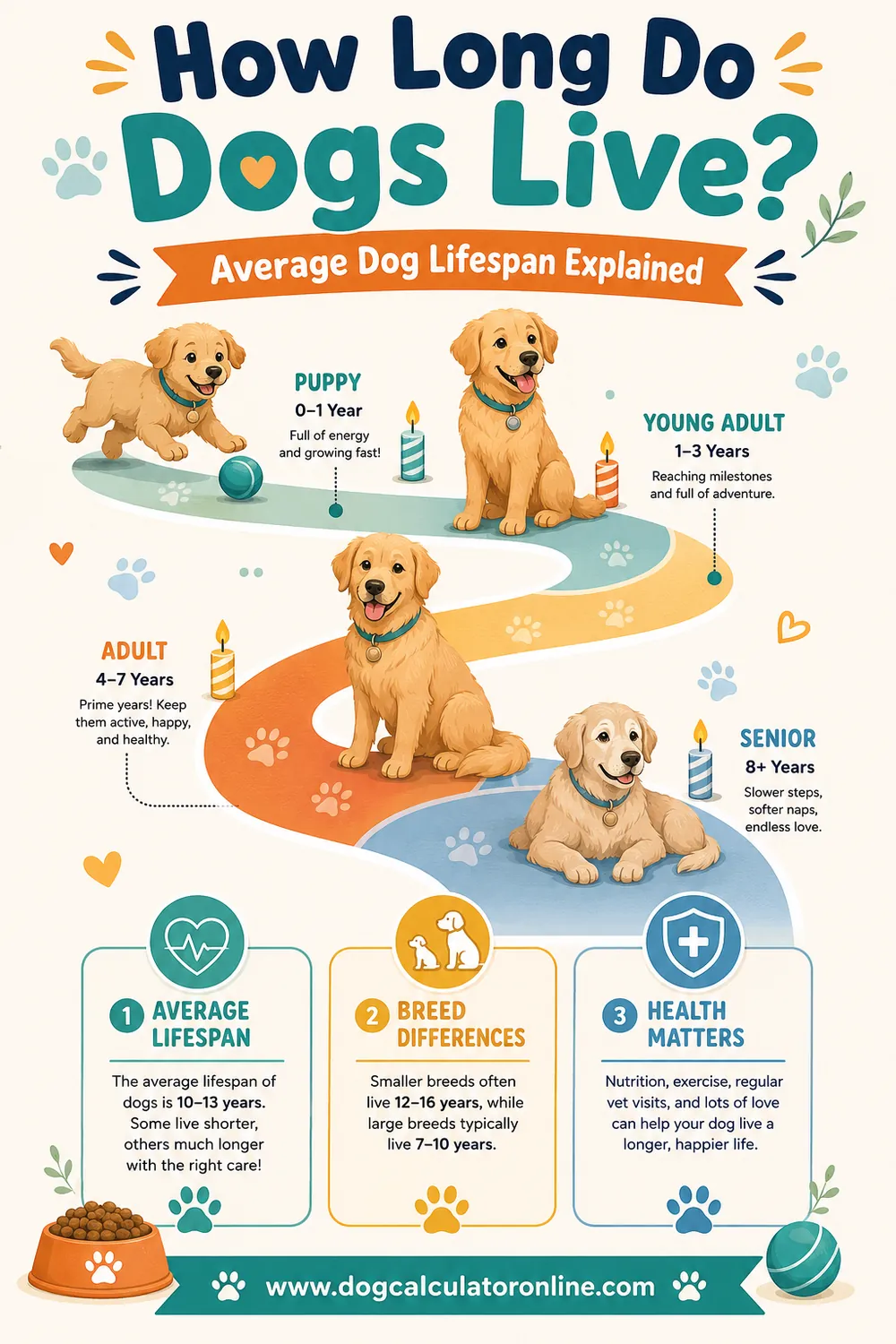
- How Long Do Dogs Live? Average Dog Lifespan Explained
- How Long Do Small Dogs Live?
- Do Mixed-Breed Dogs Live Longer?
- How to Help Your Dog Live Longer
And if you just want your own dog’s number, the free dog age calculator does it in one tap.
FAQ
What dog breed lives the longest?
Among recognized breeds, Chihuahuas and Toy Poodles are the most consistent long-livers, typically 14–16+ years. The individual longevity record belongs to Bluey, an Australian Cattle Dog credited with 29 years.
Which dog breeds live 15 years or more?
Chihuahuas, Toy and Miniature Poodles, Jack Russell Terriers, Pomeranians, Dachshunds, Shiba Inus, and Australian Cattle Dogs all commonly reach or pass 15 with good care.
Why do small dogs live longer than big dogs?
Within the dog species, rapid large-breed growth appears to accelerate aging and cancer risk, and bigger dogs carry higher levels of the growth factor IGF-1, linked to shorter lifespans. Small dogs also age more slowly after maturity — about 4 human-equivalent years per year versus 7 for giants.
Do mixed-breed dogs live longer than purebreds?
On average, modestly yes, within the same size class — likely due to greater genetic diversity. Size remains the dominant factor either way.
Can a big dog still live a long life?
Absolutely — large breeds regularly reach 12–13 with lean weight, dental care, and good veterinary monitoring, and medium breeds like Beagles can pass 15. Care shifts every dog toward the top of its breed's range.
How old is my dog in human years?
It depends on age and size — after age two, small dogs add about 4 human years per year and giants about 7. The free dog age calculator gives the exact figure instantly.
The Bottom Line
The longest-living dog breeds are the small ones — Chihuahuas, Toy Poodles, Dachshunds, Jack Russells — with 14–16+ year lifespans that giant breeds can only dream of. Genetics writes the ceiling, but owners control the two levers with the best evidence behind them: lean body condition and consistent vet care.
Wondering where your dog is on their journey right now? The free dog age calculator converts their age with the proper size adjustment — plus the 2019 DNA-study formula — in about two seconds.