Why Is My Puppy Not Gaining Weight? (Ask Your Vet)
The most useful thing to understand here is that two very different situations get described in the same words. A puppy that is small but gaining steadily every week is usually fine; a puppy whose weight has stalled or fallen is a medical problem, and in a puppy under eight weeks old it is an emergency the same day. The value on the scales matters far less than the direction of travel. Most stalls turn out to be either too few calories or intestinal parasites, both of which are straightforward to fix — but a handful of causes are serious and time-sensitive. Here is how to tell which you are looking at, and when to pick up the phone. Track the trend with the free puppy weight calculator.
🐾 How urgent is it?
Tap the closest description:
Tap an option above. The trend matters more than the number on the scales.
What Normal Weight Gain Actually Looks Like
Before deciding a puppy is failing to gain, it helps to know what gain should look like at that age.
| Age | Expected pattern | Rough daily gain |
|---|---|---|
| Birth to 2 weeks | Doubles birth weight by day 10–14 | 5–10% of body weight per day |
| 2–4 weeks | Steady climb, eyes open, starts moving | 10–25 g (small), 40–80 g (large breeds) |
| 4–8 weeks | Weaning onto solids, gain continues | 20–50 g (small), 80–150 g (large breeds) |
| 8 weeks–4 months | Fastest growth phase of the whole life | Roughly 5–10% of body weight per week |
| 4–8 months | Gain slows, frame fills out | 2–5% of body weight per week |
Newborn weights and daily gains are given in grams deliberately. Ounces are too coarse to show a single day's progress in a neonate, and a day is the timescale that matters at that age.
Any weight loss in a puppy under three weeks is an emergency. Neonates have almost no fat reserve and can deteriorate within hours.
From eight weeks, weekly is the right interval. Daily fluctuations of a few percent are normal once a puppy is eating solid food, and weighing daily creates false alarms.
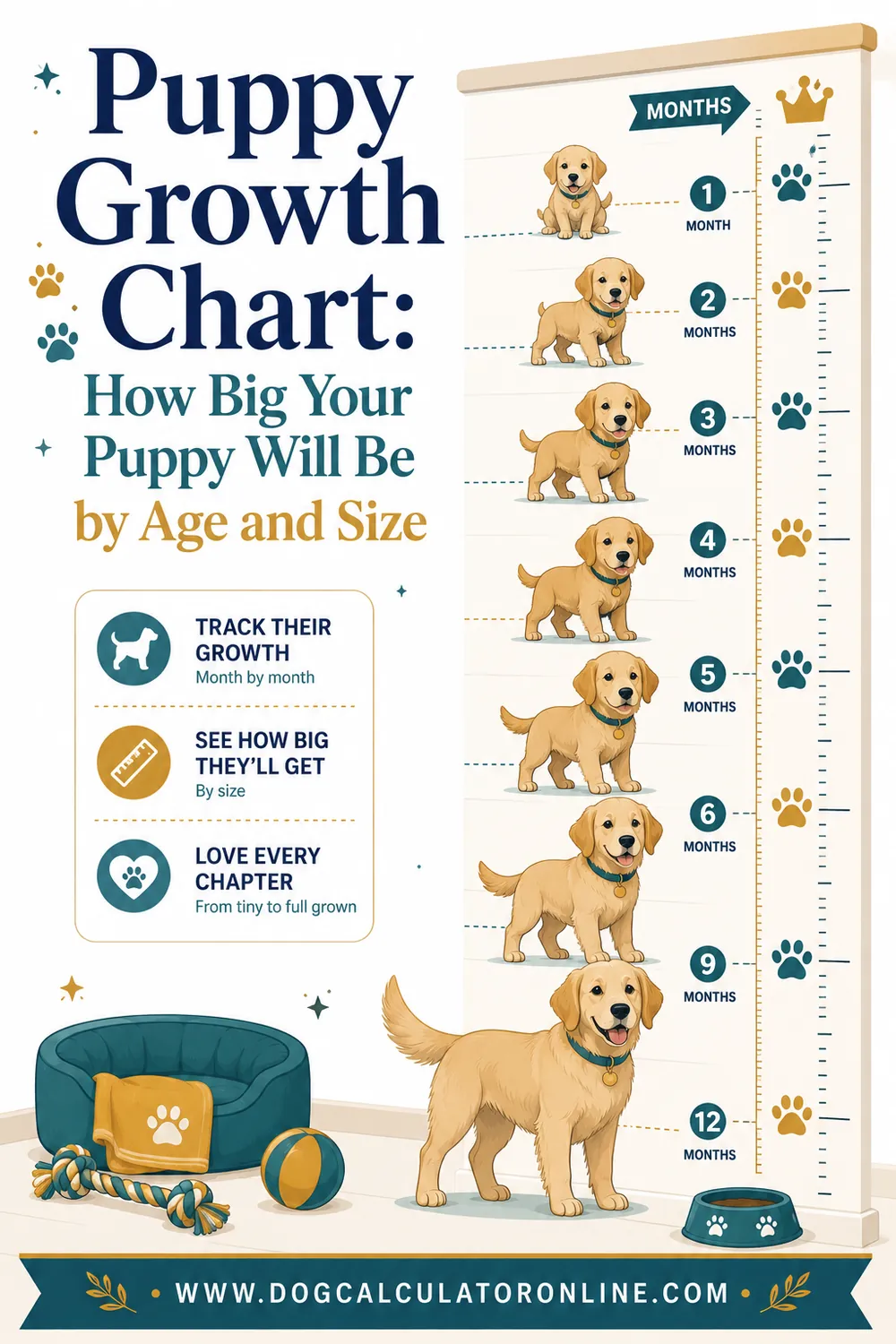
Expect the curve to flatten, not to stop. Growth slowing between four and twelve months is normal; growth stopping at ten weeks is not. How fast do puppies grow sets out the normal curve by size.
Small Is Not the Same as Not Gaining
This is the distinction that resolves most worried searches.
A runt that gains steadily generally catches up. Puppies born small frequently reach a normal adult size, and the early gap narrows through the first six months.
Breed and predicted adult size change the expected numbers enormously. A chihuahua puppy gaining 15 g a day and a great dane puppy gaining 150 g a day can both be perfectly normal.
Compare your puppy against itself, not against a littermate. Litters vary, and the sibling on the next chart may simply have been heavier at birth.
Body condition is a better guide than weight alone. Ribs easily felt with a thin fat covering, a visible waist from above and a tucked abdomen from the side is what a healthy growing puppy feels like.
Use a size-appropriate reference. Puppy growth chart gives expected ranges by adult size band, and how big will my puppy get covers projecting the finished weight.
Weigh Properly or the Data Is Useless
Most apparent stalls turn out to be measurement noise.
Use the same scales every time. Different scales disagree by 2–5%, which at this size is bigger than a week's real gain in a small breed.
Weigh at the same time of day, before a meal. A full stomach and bladder can account for 3–8% of a small puppy's body weight.
For small puppies, weigh in a bowl and subtract the bowl. Kitchen scales that read in grams are far more useful than bathroom scales for anything under 10 lb (4.5 kg).
For larger puppies, weigh yourself, then yourself holding the puppy. The difference is accurate enough once the puppy is over about 15 lb (7 kg).
Write it down with the date. A three-point trend answers the question; a single reading never does.
The Commonest Cause: Not Enough Calories
More often than anything medical, the puppy simply is not getting enough food in.
Puppies need roughly twice the calories per kilogram of an adult dog. A ration calculated from an adult chart will underfeed a growing puppy substantially.
Check the kcal per 100 g on the bag, not the cup count. Foods vary from about 330 to over 450 kcal per 100 g, so an identical volume can differ by a third in energy.
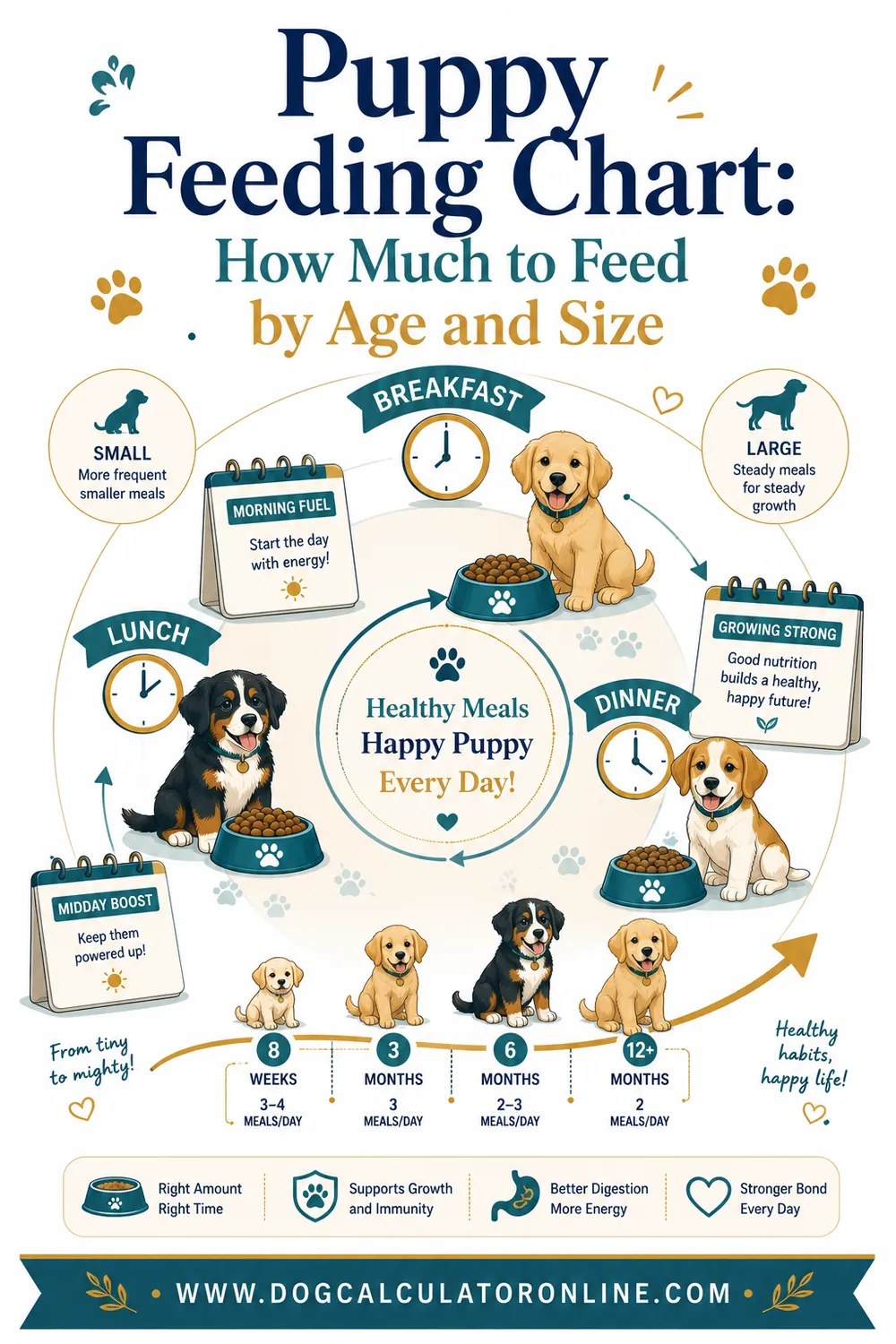
Meal frequency matters as much as volume. Puppies under four months usually need four meals a day, and three until about six months; a small stomach cannot take a day's calories in two sittings.
Competition at the bowl hides the problem. In a multi-dog household or a large litter, the smallest puppy can be quietly losing every meal. Feed separately for a week and re-weigh.
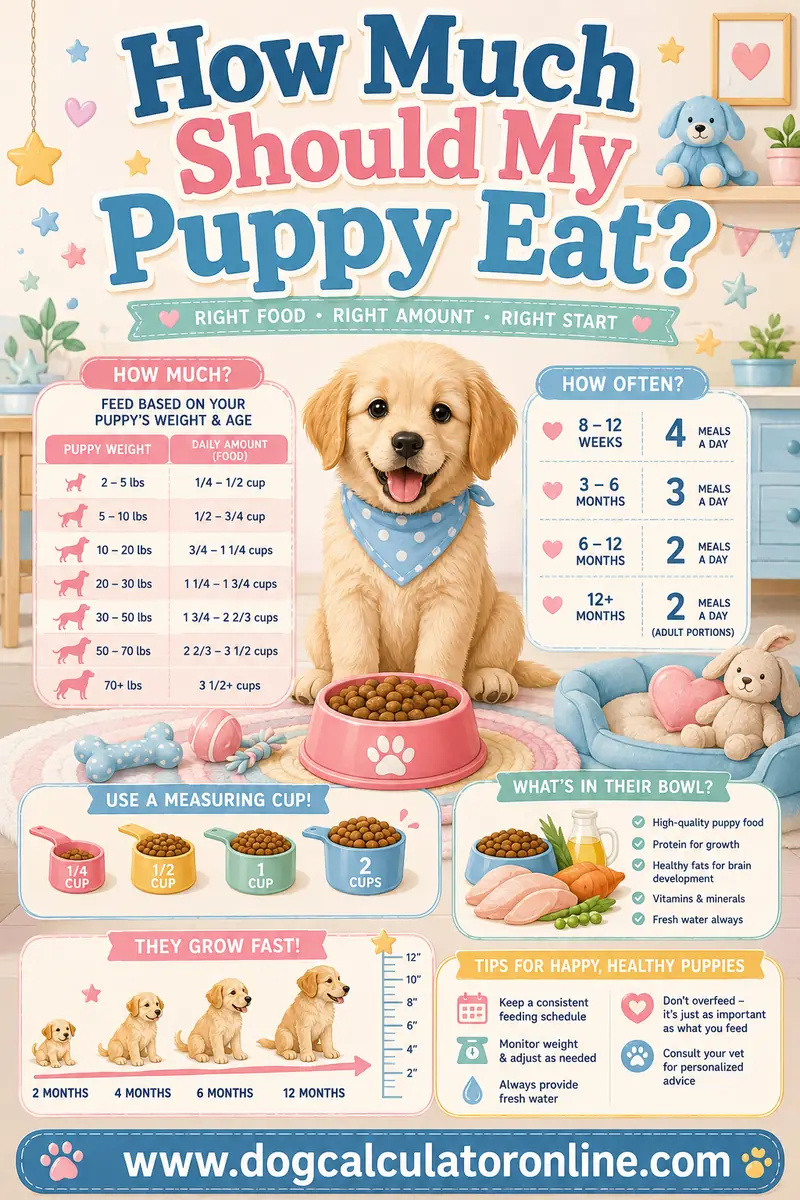
Free-fed dry food is often overestimated. Watch a full meal being eaten rather than assuming it was; how much should my puppy eat and the puppy feeding chart give ration figures by weight and age.
Parasites: The Most Common Medical Cause
If a puppy is eating well and still not gaining, this is the first thing a vet will look for.
Roundworms are near-universal in puppies. Many are infected before birth or through the milk, which is why worming starts at two weeks and repeats every two weeks until twelve weeks.
A pot-bellied puppy with a dull coat and poor gain is the classic picture, though plenty of infected puppies look normal.
Coccidia and giardia cause poor gain with soft stool. Both are common in puppies from kennels, shelters or crowded litters, and neither responds to ordinary wormers — they need specific treatment.
Take a fresh stool sample to the appointment. Ideally samples from three consecutive days, since shedding is intermittent and a single negative test does not rule parasites out.
Do not simply repeat an over-the-counter wormer and wait. If a puppy has been wormed appropriately and is still not gaining, the answer lies elsewhere and waiting costs time.
What Else the Vet Will Consider
These are less common, but they are the reason a stalled puppy needs an examination rather than more food.
Inadequate milk or poor latch in neonates. Mastitis, low milk supply or a cleft palate all present as a puppy that suckles but does not gain, and supplementary feeding may be needed urgently.
Congenital heart disease. A murmur, poor exercise tolerance and failure to thrive together are a recognized pattern, and puppies are routinely auscultated at their first vaccination for this reason.
Portosystemic shunt (a liver blood vessel abnormality). Typically a small puppy that is slow to grow, sometimes dull or unsteady after meals. It is diagnosed on bloodwork and imaging and is often treatable.
Malabsorption conditions such as exocrine pancreatic insufficiency. The signature is a ravenous appetite with large, pale, greasy stools and no weight gain.
Megaoesophagus or regurgitation after meals. Regurgitation without effort, usually shortly after eating, is different from vomiting and points to a specific set of causes.
None of this is a diagnosis you can make at home. These conditions overlap in appearance, are separated by tests rather than by observation, and several have good outcomes if caught early.
When to Call the Vet, and How Urgently
Use the timescale, not the anxiety level, to decide.
Call immediately — the same hour — if a puppy under three weeks has lost weight, is cold to the touch, limp, or will not suckle. Neonates decompensate in hours.
Call the same day if a puppy under eight weeks has failed to gain for two to three days, or any puppy has stalled weight alongside vomiting, diarrhea, lethargy, pale gums or a distended abdomen.
Book within the week if a puppy over eight weeks has not gained for two consecutive weeks despite eating what the chart suggests, or is gaining but the coat is dull and the stools are persistently soft.
Bring three things to the appointment: your written weight record with dates, the food packaging or a photo of the label, and a fresh stool sample.
Say what you have already tried. Worming dates and product, any diet change, and how the puppy eats compared with its littermates. This shortens the diagnostic path considerably.
What to Do While You Wait
There are useful things to do before the appointment, and one thing not to do.
Keep weighing on the same scales and keep the record. The trend across the days before the appointment is genuinely useful clinical information.
Feed separately and observe every meal. Note how much is offered, how much is eaten, and how long it takes.
Do not switch foods abruptly. A sudden diet change causes loose stools that confuse the picture, and a puppy with a stalled weight cannot afford a bout of diarrhea. Any change should be phased over five to seven days.
Keep small puppies warm. Neonates cannot thermoregulate well, and a cold puppy stops feeding, which accelerates the decline.
Do not add supplements or human food to bulk out the ration. Unbalanced additions can distort calcium and phosphorus levels during growth, which matters particularly in large breeds. Ask the vet before adding anything, and read signs you are underfeeding your dog for what genuine underfeeding looks like.
FAQ
How long can a puppy go without gaining weight before I worry?
Under three weeks, any loss or 24 hours without gain warrants a call. Under eight weeks, two to three days without gain needs a same-day appointment. Over eight weeks, two consecutive weeks without gain justifies a visit, sooner if there are any other signs.
My puppy eats well but stays thin — why?
Eating well with no gain points away from intake and toward parasites, malabsorption or an underlying condition rather than more food. Intestinal parasites such as roundworms, coccidia and giardia are the commonest explanation. Take fresh stool samples from three consecutive days to your vet.
Is it normal for a runt to be much smaller?
Being smaller than littermates is common and often resolves, provided the puppy gains steadily every week. A runt that keeps pace proportionally usually catches up substantially by six months. A runt whose weight stalls needs the same prompt assessment as any other puppy.
How often should I weigh my puppy?
Daily for the first three weeks, then weekly until six months. Use the same scales at the same time of day, before a meal, and write down each figure with its date. Daily weighing of an older puppy produces normal fluctuations that look alarming and mean nothing.
Could worming be the only thing needed?
Sometimes, and worming on the standard schedule — every two weeks until twelve weeks, then monthly to six months — is a reasonable first step in an otherwise well puppy. But if a correctly wormed puppy is still not gaining, stop repeating treatments and get an examination instead.
Should I change to a higher-calorie puppy food?
Only on veterinary advice. Increasing calories helps when the problem is genuinely intake, and does nothing when the problem is absorption or an underlying illness. Any change should also be phased over five to seven days to avoid diarrhea in a puppy with no reserves.
Watch the Trend, Then Make the Call
A single low reading on the scales tells you almost nothing; three readings across a week tell you nearly everything. Weigh on the same scales at the same time of day, write down the numbers, and judge the direction rather than the value. Steady gain in a small puppy is usually reassuring. A stall or a fall is not, and the younger the puppy the shorter the safe waiting time — hours in a neonate, days under eight weeks, a two weeks in an older puppy. Take your weight record, the food label and a fresh stool sample to the appointment. Keep the log going with the free puppy weight calculator.