How Long After Mating Is a Dog Pregnant?
The reason this question has such a messy answer is that dog pregnancy is a very precise 63 days from ovulation, but a very imprecise 58 to 72 days from a mating date. Both statements are true at once. Sperm survive for several days inside the female dog, the eggs are not even ready when they are released, and the fertile window is wide — so a mating can happen days before conception actually occurs. That single gap is why two female dogs mated on the same day can whelp two weeks apart and both be entirely normal. This page explains the arithmetic and how to tighten it. The figures themselves are worked out for you by the free dog pregnancy calculator.
🐾 Which date are you counting from?
Tap the information you actually have:
Tap an option above. The date you count from decides how wide your window is.
The Two Numbers, and Why Both Are Right
Almost every argument about dog gestation comes from mixing these up.
From ovulation, gestation is 63 days, and it is remarkably consistent. Give or take a day, that figure holds across breeds, across litter sizes, and across body sizes from Chihuahua to Great Dane.
From the LH surge — the hormonal signal roughly two days before ovulation — it is about 65 days, again within a day or so.
From the first day of cytological diestrus it is about 60 days, which is another laboratory-based anchor some breeders use.
From a mating date it is anywhere between 58 and 72 days. That is not sloppiness in the data; it is the honest observed range, and it is a direct consequence of when the mating happened relative to ovulation.
So the widely quoted "63 days" is an ovulation figure being used as a mating figure, which is the root of the confusion. The full breakdown of the gestation length itself is in dog gestation period.
The practical version: if all you have is a mating date, you have a two-week window, not a due date.
Why Sperm Survival Widens the Window
The first half of the gap comes from the male side.
Canine sperm remain viable for days inside the female dog. Five to seven days is the usual figure quoted, and there are documented cases considerably longer than that in favourable conditions.
This means a mating on the first day she stands can still fertilise eggs released nearly a week later. Conception is not an event that happens at mating; it happens whenever the eggs become available.
So an "early" mating stretches the apparent pregnancy. If she was mated on day 5 of standing heat and ovulated on day 9, she will appear to be pregnant for around 67 days when in fact she was pregnant for 63.
A "late" mating compresses it. Mated two days after ovulation, she may whelp 60 days after that mating, and owners panic about a premature litter that is nothing of the sort.
Multiple matings make the record murkier, not clearer. Breeders often mate every other day across the standing period, which is good practice for conception rates and hopeless for date-keeping.
Tie length, number of matings and the male's fertility do not change gestation. They affect whether she conceives, not how long she carries.
What Ovulation Actually Does to the Timeline
The second half of the gap comes from the female side, and it is genuinely unusual.
Dogs ovulate immature eggs. Unlike most mammals, the female dog releases primary oocytes that are not yet capable of being fertilised.
Those eggs take about two to three days to mature inside the oviduct before fertilisation can happen at all.
Once mature, they remain fertile for a further two to three days. So the genuine fertilisation window sits roughly two to five days after ovulation.
All the eggs mature on roughly the same schedule, which is why gestation measured from ovulation is so tight even in a large litter conceived from matings spread across a week.
This is also why a female dog can be mated by two different males and produce a mixed litter. Sperm from both are still present when the eggs mature.
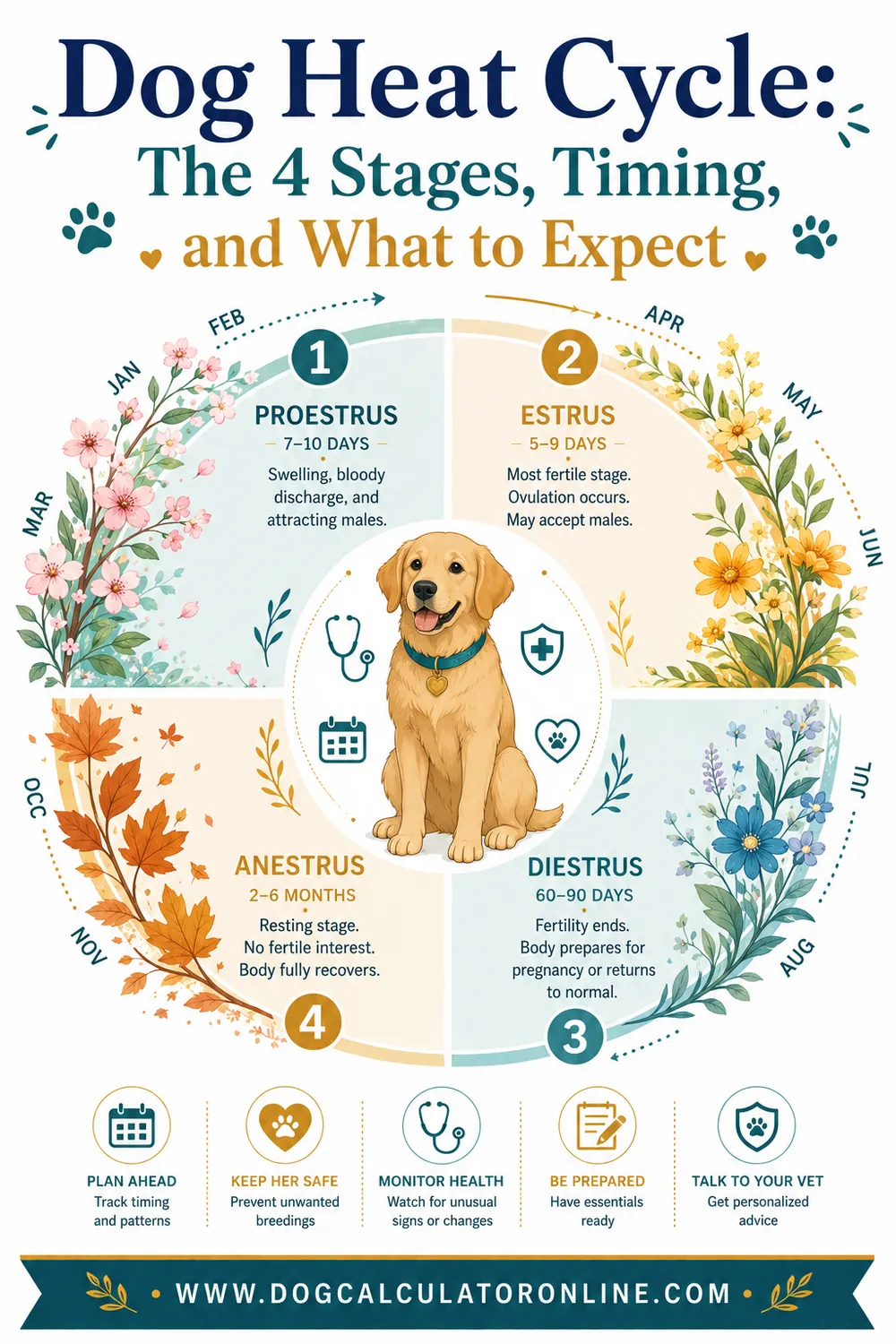
And it explains why the season length is a poor guide. The interval from the first bleeding to ovulation can be five days in one female dog and close to a month in another — the stages are set out in dog heat cycle.
Mating Date Versus Ovulation Date
Laid out side by side, the effect is easy to see.
| Reference point | Days to whelping | Typical variation | How you get it |
|---|---|---|---|
| LH surge | 65 | ±1 day | Serial progesterone or LH testing |
| Ovulation | 63 | ±1 day | Progesterone rising past ~5 ng/ml |
| First day of diestrus | 60 | ±2 days | Vaginal cytology |
| Single mating | 63 | 58–72 days | The date in your diary |
| First day of season | 65–70 | ±2 weeks or worse | Observation only |
The pattern is obvious: the closer your reference point is to a hormonal event, the tighter the prediction.
A mating date is not a hormonal event. It is a behavioral one, and behavior is a loose proxy for the underlying biology.
A two-week window is not a small inconvenience. It decides when you set up the whelping box, when you start taking temperatures, and how anxious you are on day 59.
Progesterone Testing: How It Pins the Date
This is the practical fix, and it is the reason serious breeders use it as a matter of routine.
Progesterone rises predictably through the season, and its level at a given point identifies where the female dog is in her cycle far more precisely than her behavior does.
Ovulation is generally taken as the point where progesterone passes roughly 5 ng/ml, having risen from a baseline of under 1. Different laboratories and machines use slightly different thresholds, so use the one your vet quotes rather than a number from a forum.
Testing is done serially, not once. Typically every two to three days from around day 5 to 7 of the season, becoming daily as the level starts to climb. A single test in isolation tells you very little.
Once ovulation is identified, the due date is 63 days from that point, plus or minus a day. That turns two weeks of uncertainty into a two-day window.
It improves conception rates and litter size as well as dates. Mating at the correct point after ovulation means fewer eggs are missed, which is measurable in the resulting litter.
The cost is real but modest against the alternative — several tests across a week, against the cost of a missed mating, a wasted stud fee or an unplanned emergency cesarean at three in the morning.
Estimating Without Progesterone Testing
Most owners reading this did not plan the mating at all, and are working backwards.
Use the last known mating for the earliest plausible date and the first for the latest. If she was mated on the 3rd and the 7th, plan for whelping any time from 58 days after the 7th to 72 days after the 3rd, and watch the whole span.
A scan between day 25 and day 30 can date the pregnancy independently. Fetal measurements — head diameter and body diameter — give an estimated whelping date to within a few days, which is far better than a mating-date guess.
An X-ray from day 45 helps too, both for the count and for confirming the pregnancy is as far along as you think.
Temperature monitoring is the reliable short-range tool. A drop of about 2°F (1°C) in rectal temperature, to somewhere near 99°F (37°C), usually precedes whelping by 12 to 24 hours. It does not predict weeks out, but it predicts the night — the detail is in how to know labor is close in dogs.
If she was mated by an unknown dog and you are not sure she is pregnant at all, confirmation comes first: the options and their timings are in how to tell if your dog is pregnant at home.
Whichever route you take, write the numbers down. A guessed date remembered vaguely is worse than a wide range recorded honestly.
What the Window Means Week by Week
The uncertainty is not evenly distributed across the pregnancy — it all lands at the end.
Weeks one to four look the same whichever date you count from. Nothing visible happens, and no test works before about day 21.
The confirmation window is forgiving. A scan booked at "day 28" is still useful at day 25 or day 32, so a few days of error costs nothing here.
The count window is fairly forgiving too. An X-ray at "day 45" works at day 48 or day 50 just as well; if anything, slightly later gives clearer images.
The end is where it bites. Setting up the whelping box, starting twice-daily temperatures and being at home rather than at work all depend on knowing whether day 58 is plausible or absurd.
Err early on every preparation. Have the box up by day 50, start temperatures by day 55, and have the out-of-hours number written down before you think you need it.
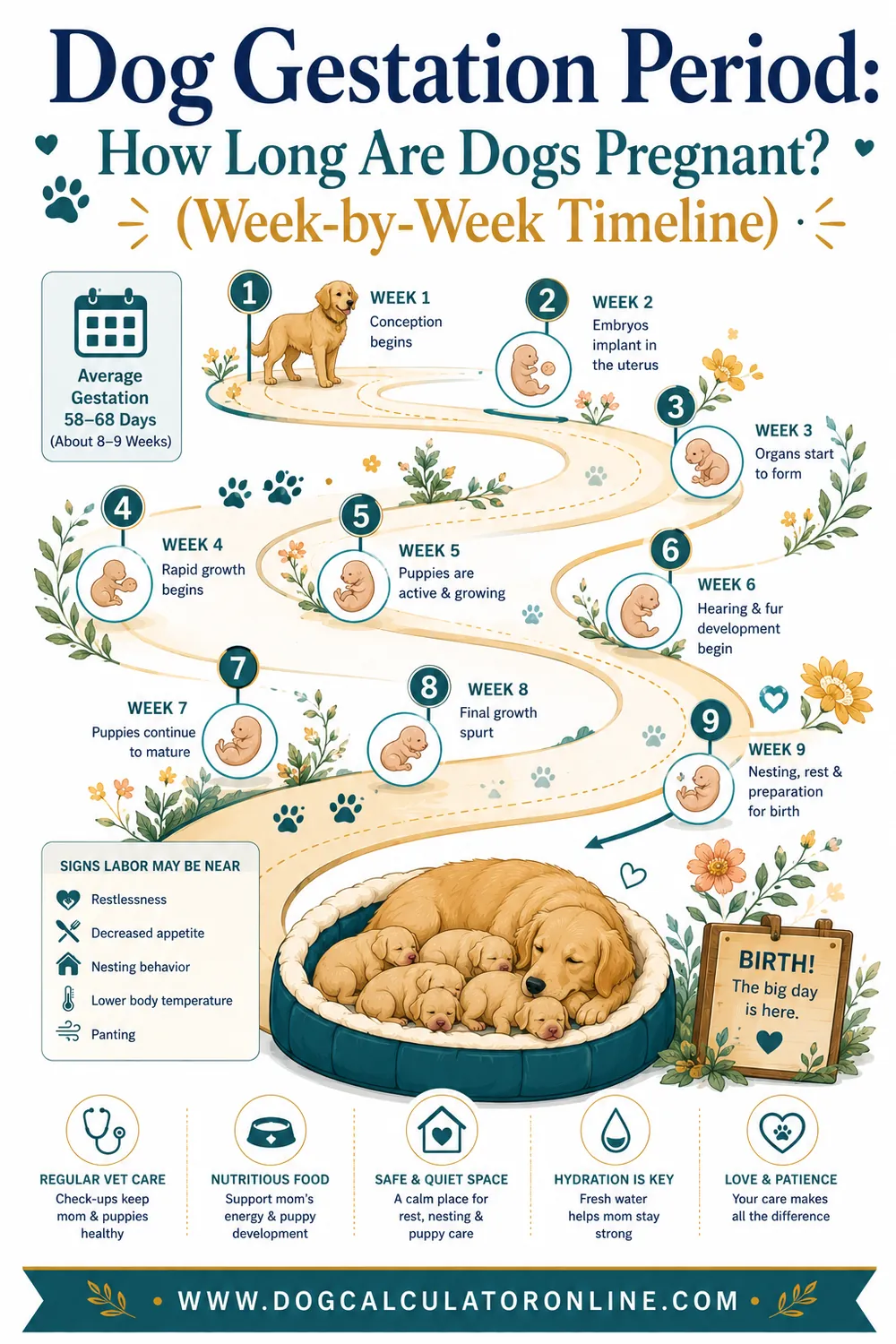
The stage-by-stage picture of what is happening inside during those nine weeks is in dog pregnancy week by week.
When Early or Late Is Actually a Problem
A wide normal range does not mean anything goes.
Whelping before day 58 from a known ovulation date is genuinely premature. Puppies born much before that often cannot maintain their temperature or suckle properly, and survival is poor without intensive care.
Whelping before day 58 from a mating date is usually not premature at all — it usually means the mating happened after ovulation. This distinction is the practical payoff of everything above.
Going past 65 days from a confirmed ovulation needs a veterinary call. Prolonged gestation risks the puppies becoming too large and can indicate a failure to initiate labor, which happens more often in singleton litters.
Going past 72 days from a mating date needs a call for the same reason, even without a confirmed ovulation. At that point the uncertainty has been exhausted.
Any of these are vet calls regardless of dates: green or black discharge before the first puppy, strong straining for 20 to 30 minutes with nothing produced, more than two hours between puppies with more still to come, or a female dog who is clearly unwell.
A temperature drop followed by more than 24 hours of nothing is also a reason to ring, not to keep waiting.
FAQ
How long after mating will my dog give birth?
Anywhere from 58 to 72 days after a single mating date, with 63 as the middle of that range. The width comes from sperm surviving several days inside the female dog, so the mating date is often not the conception date.
Why is dog pregnancy always described as 63 days?
Because it is 63 days from ovulation, and that figure is consistent to within about a day across all breeds. It is only imprecise when applied to a mating date, which can precede ovulation by up to a week.
Can a dog get pregnant from one mating?
Yes. A single well-timed mating is sufficient, and canine sperm remain viable for around five to seven days, so even a mating a few days before ovulation can result in a full litter.
How can I get an accurate due date?
Serial progesterone testing during the season identifies ovulation, and 63 days from that point predicts whelping to within a day or so. Failing that, a scan between days 25 and 30 dates the pregnancy from fetal measurements.
Does breed or litter size change how long she carries?
Not meaningfully. Gestation measured from ovulation is about 63 days regardless of size. Very large litters sometimes arrive a day or two early and singletons occasionally run late, but the effect is small.
When should I worry that she is overdue?
call the vet if she passes 65 days from a confirmed ovulation, or 72 days from a mating date. Also call immediately for green or black discharge before the first puppy, or strong unproductive straining.
Count From Ovulation Where You Can, Watch the Window Where You Cannot
Dog pregnancy is one of the more predictable events in veterinary medicine once you measure it from the right starting point. Sixty-three days from ovulation, sixty-five from the LH surge, and both accurate to within a day. Measured from a mating date it collapses into two weeks-wide range, because sperm outlive the mating and eggs are not ready when they are released. If you are planning a litter, progesterone testing converts that range back into a date and improves the litter size at the same time. If you are working backwards from a mating you did not plan, use the widest plausible window, book a dating scan, and start temperature monitoring by day 55. Set the range out properly with the free dog pregnancy calculator, and read when can a dog get pregnant if the timing question started earlier than this.