When Can a Dog Get Pregnant?
The answer that catches owners out is that a female dog is fully fertile from her very first season, which in a small breed can arrive at six months old — while she is still, by any sensible measure, a puppy herself. There is no grace period, no infertile first cycle and no age at which she is too young to conceive once she has come into season. That gap between being biologically capable and being physically and behaviourally ready is the whole subject of this page, and it is the reason both vets and kennel clubs advise against breeding on a first season. If a mating has already happened, work out where you stand with the free dog pregnancy calculator.

🐾 Could she get pregnant right now?
Tap her situation:
Tap an option above. Fertility starts far earlier than readiness does.
Fertile From the First Season, With No Exceptions
The biology here is blunt, and worth stating without hedging.
A first season means ovulation, and ovulation means she can conceive. There is no practice run. Whatever her age, if she is in standing heat and an entire male reaches her, a litter is possible.
Small breeds can have that first season at six months. A six-month-old Jack Russell is still growing, still in adolescence, and entirely capable of carrying a litter.
Accidental first-season litters are common in rescue intake figures, precisely because owners assume a young dog is safe. She is not.
Fertility is high from the start. First-season conception rates are not noticeably lower than later ones; the litters tend to be smaller, but the pregnancies happen readily.
A male does not need to be old either. Dogs can be fertile from around five to six months, so two puppies in the same household can produce a litter without anyone believing it was possible.
The age at which seasons begin, and the wide variation in it, is set out in what age do dogs go into heat.
First Season Age by Body Size
Size is the main predictor of when fertility begins, and the spread is wide.
| Size category | Typical adult weight | Usual first season | Skeletal maturity |
|---|---|---|---|
| Toy | under 11 lb (5 kg) | 6–9 months | ~10–12 months |
| Small | 11–22 lb (5–10 kg) | 6–10 months | ~12 months |
| Medium | 22–55 lb (10–25 kg) | 8–12 months | ~14–16 months |
| Large | 55–88 lb (25–40 kg) | 10–14 months | ~18 months |
| Giant | over 88 lb (40 kg) | 12–24 months | ~24 months |
The two right-hand columns are the point of the table. Fertility arrives months before the skeleton has finished growing, in every size category.
In giant breeds the first season can be as late as two years, and a female dog who has not cycled by 24 months is worth a veterinary conversation rather than immediate alarm.
Anything under about five months is unusual enough to check. Very early seasons occasionally indicate an underlying problem.
Mixed breeds follow their adult size, not their breed label. A collie-cross that will finish at 44 lb (20 kg) behaves like a medium dog.
The Fertile Window Inside a Season
Knowing when in the season she can conceive is more useful than knowing which season.
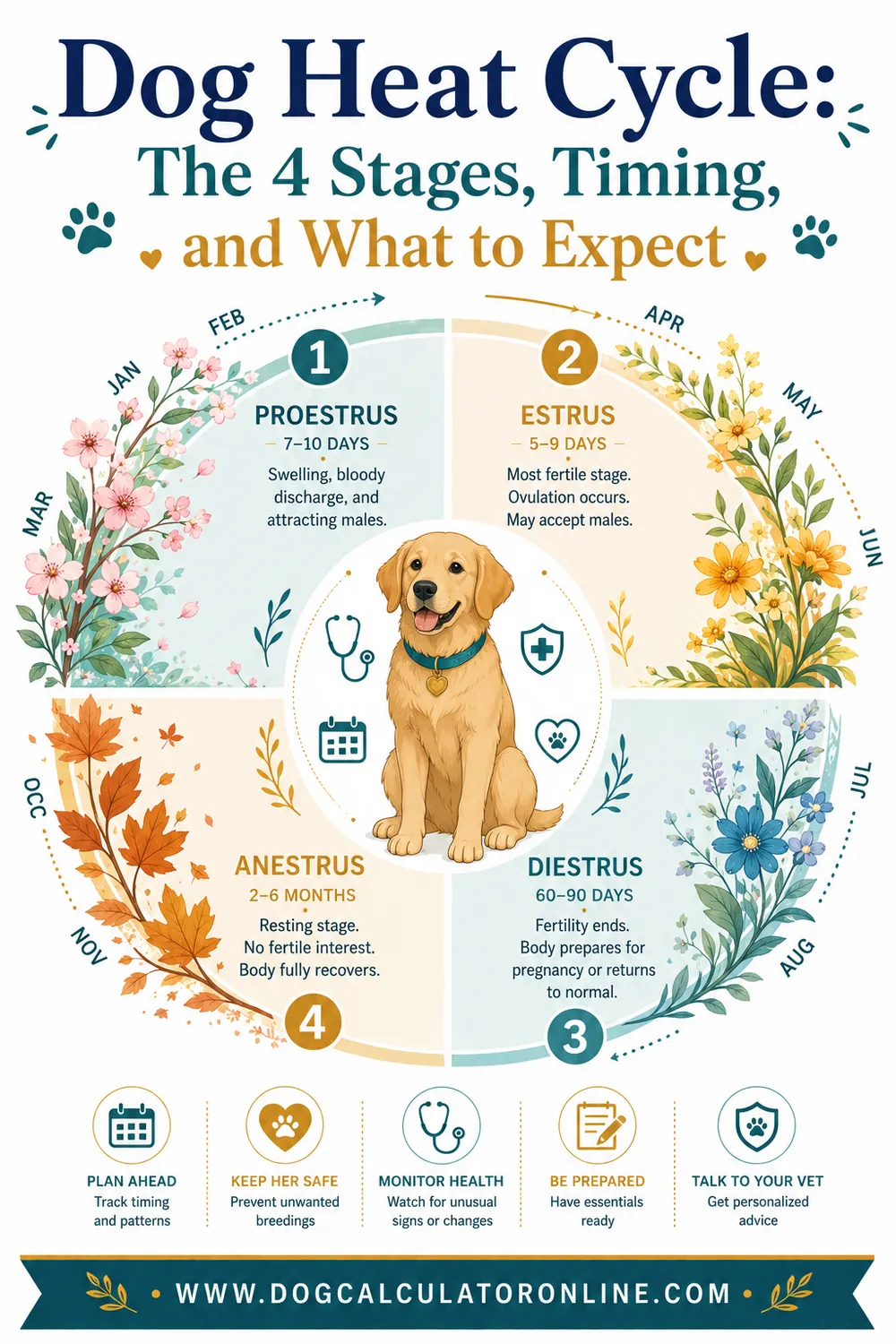
The season runs about two to three weeks in total, but the genuinely fertile part is a narrower slice inside it.
Standing heat is the behavioral marker. She stops snapping at males, stands still, and flags her tail to the side. That behavior usually starts around day 9 to 11 and is the period when matings succeed.
But the timing is highly individual. Ovulation has been documented anywhere from day 5 to day 25 of a season. Some female dogs ovulate before the bleeding stops, which is why "she is still bleeding so she is safe" is a myth that produces litters.
Sperm survival extends the risk backwards. Canine sperm remain viable for five to seven days, so a mating several days before ovulation can still result in pregnancy.
The eggs extend it forwards. Dogs release immature eggs that take two to three days to ripen and then stay fertile for another two to three, so the risk window carries on past ovulation itself — the timing arithmetic is explained in how long after mating is a dog pregnant.
Practically, treat the entire season plus a few days either side as fertile. The stage-by-stage detail is in dog heat cycle.
Why the First Season Is Too Early
This is where able and ready separate, and the reasoning is more than sentiment.
She is not finished growing. Pregnancy and lactation draw heavily on calcium, protein and energy at exactly the point her own skeleton and muscle are still developing. Both compete, and neither wins outright.
The pelvis is among the last things to mature. A female dog bred before skeletal maturity is more likely to have a pelvis that has not reached full adult dimensions, which raises the chance of a difficult birth.
Behaviourally she is an adolescent. Maternal behavior in very young female dogs is measurably less reliable — poorer nesting, more abandoned or crushed puppies, less tolerance of nursing.
Health testing has usually not been completed. Hip and elbow scoring cannot be done until 12 months at the earliest, and many eye and heart schemes have minimum ages. Breeding before testing means breeding blind.
The registries are explicit. The UK Kennel Club will not register a litter from a dam who was under 12 months at whelping, and there are equivalent minimums elsewhere. That is a floor, not a recommendation.
Veterinary and welfare consensus is to wait. The usual advice is the second or third season at the earliest, and in giant breeds not before two years — which usually means the second season anyway.
When She Is Actually Ready
If breeding is genuinely the plan, these are the conditions rather than a date.
Fully grown, with growth plates closed. In practice that means at least 18 months in a medium or large breed and around two years in a giant.
At least the second season, and often the third. This gives you a record of her cycle timing, which makes progesterone testing and mating far more accurate.
Health testing complete and results acceptable for the breed. Hips, elbows, eyes, and any breed-specific DNA tests. Results that are borderline are a reason to stop, not to proceed carefully.
Temperament assessed as an adult. Adolescent temperament is not adult temperament, and nervousness or aggression that emerges at 18 months is heritable and relevant.
In good body condition — neither thin nor overweight. Both extremes reduce litter size and complicate whelping.
And with the practical side thought through, because the cost, the time and the risks are substantial. That whole question is laid out honestly in should i breed my dog.
The Upper End: Dogs Have No Menopause
The other half of this question gets far less attention and matters just as much.
Female dogs continue to cycle for life. There is no canine menopause. A twelve-year-old female dog who has never been spayed can still come into season and can still conceive.
Fertility declines but does not disappear. Litter sizes shrink, conception rates fall, and the interval between seasons often lengthens — but none of that reaches zero.
The risks climb steeply with age. Older female dogs have higher rates of fetal resorption, stillbirth, uterine inertia and cesarean section, and a greater chance of not surviving the whelping.
Registries impose upper limits too. The UK Kennel Club will not normally register a litter from a dam over eight years old at whelping, and comparable limits apply elsewhere.
The realistic ceiling for responsible breeding is well below the biological one — usually around five to six years for a last litter, depending on breed and how previous whelpings went. That question is covered in how many litters can a dog safely have.
For a female dog who will never be bred, continued cycling is itself an argument for spaying, because the risk of pyometra rises with each season she goes through.
If a Mating Has Already Happened
This is why a large proportion of people read this page, so it deserves specifics.
Do not assume it did not take. A tie is not required for conception, a brief mating can be enough, and a young female dog is not protected by her age.
There is a veterinary option, and it is time-limited. In the UK and much of Europe, aglepristone can be given to terminate an unwanted pregnancy, usually within the first 45 days and most straightforwardly early. It is a prescription treatment given as two injections, and it needs a veterinary appointment quickly.
The old estrogen-based "mismating jab" is largely abandoned. It carried real risks of bone marrow suppression and pyometra, and most practices no longer use it.
Spaying is the other option, which ends the pregnancy and prevents any recurrence, though it is a bigger procedure on a pregnant uterus.
Or you carry on with the pregnancy, which is a legitimate choice but means preparing for a litter you did not plan, including finding homes for every puppy.
Whichever way, call the vet within days rather than weeks. Every option is easier and safer early, and the confirmation window does not even open until about day 25.
Preventing It Rather Than Discovering It
An unplanned litter is almost always a management failure rather than bad luck.
A female dog in season needs supervision, not a closed door. Entire males will dig, climb, and wait. Loose supervision in a garden is the most common failure point.
Walk her at quiet times and on a lead throughout, for the whole three weeks and a few days beyond.
Do not rely on other dogs in the household being related or being young. Neither prevents mating, and neither prevents conception.
Boarding kennels and daycare need telling. Many will not accept a female dog in season at all, and for good reason.
Spaying removes the question permanently, and the timing decision — before or after a first season, and at what age for her size — is its own discussion, set out in best age to spay or neuter a dog.
Keep a record of her season dates from the first one. Knowing her interval means you know roughly when the next three weeks of care will fall, which makes the whole thing manageable.
FAQ
Can a dog get pregnant on her first heat?
Yes. A first season involves normal ovulation and a female dog is fully fertile during it, sometimes as young as six months. Litters conceived on a first season are common, which is why supervision from the very first season matters.
At what age can a dog first get pregnant?
Typically from six to nine months in small breeds, eight to twelve in medium ones, and later in giants, since fertility begins with the first season. The youngest cases involve toy breeds cycling at around five to six months.
Can a dog get pregnant while still bleeding?
Yes. Some female dogs ovulate before the discharge stops, and sperm survive five to seven days inside her, so a mating during the bleeding phase can still produce a litter. Treat the whole season as fertile.
Is there an age when a dog is too old to get pregnant?
Not biologically — dogs have no menopause and can conceive into old age. Responsibly, breeding usually stops around five or six years, and the UK Kennel Club will not normally register a litter from a dam over eight.
How long after her season can a dog still get pregnant?
The fertile window closes once she stops standing, generally by the end of the third week, but a mating in the days beforehand can still result in pregnancy. Assume risk continues for a few days after visible signs end.
What should I do if my dog was mated accidentally?
call your vet within days. A prescription treatment such as aglepristone can end an unwanted pregnancy, most straightforwardly early and generally within the first 45 days. Spaying is the alternative, and continuing the pregnancy is a third option.
Able Early, Ready Much Later
A female dog can conceive from her first season, which for a small breed may mean six months old, and she can keep conceiving into old age because dogs have no menopause. Neither of those facts says anything about whether she should. Readiness is a separate question answered by full skeletal maturity, a second or third season, completed health testing, adult temperament and good body condition — a set of conditions that no dog meets at her first season and few meet before eighteen months. If breeding is not the plan, the practical work is three weeks of genuine supervision per season and a decision about spaying. If a mating has already happened, call your vet promptly and work out the dates with the free dog pregnancy calculator.