3 Dog Years in Human Years: How Old Is a 3-Year-Old Dog?
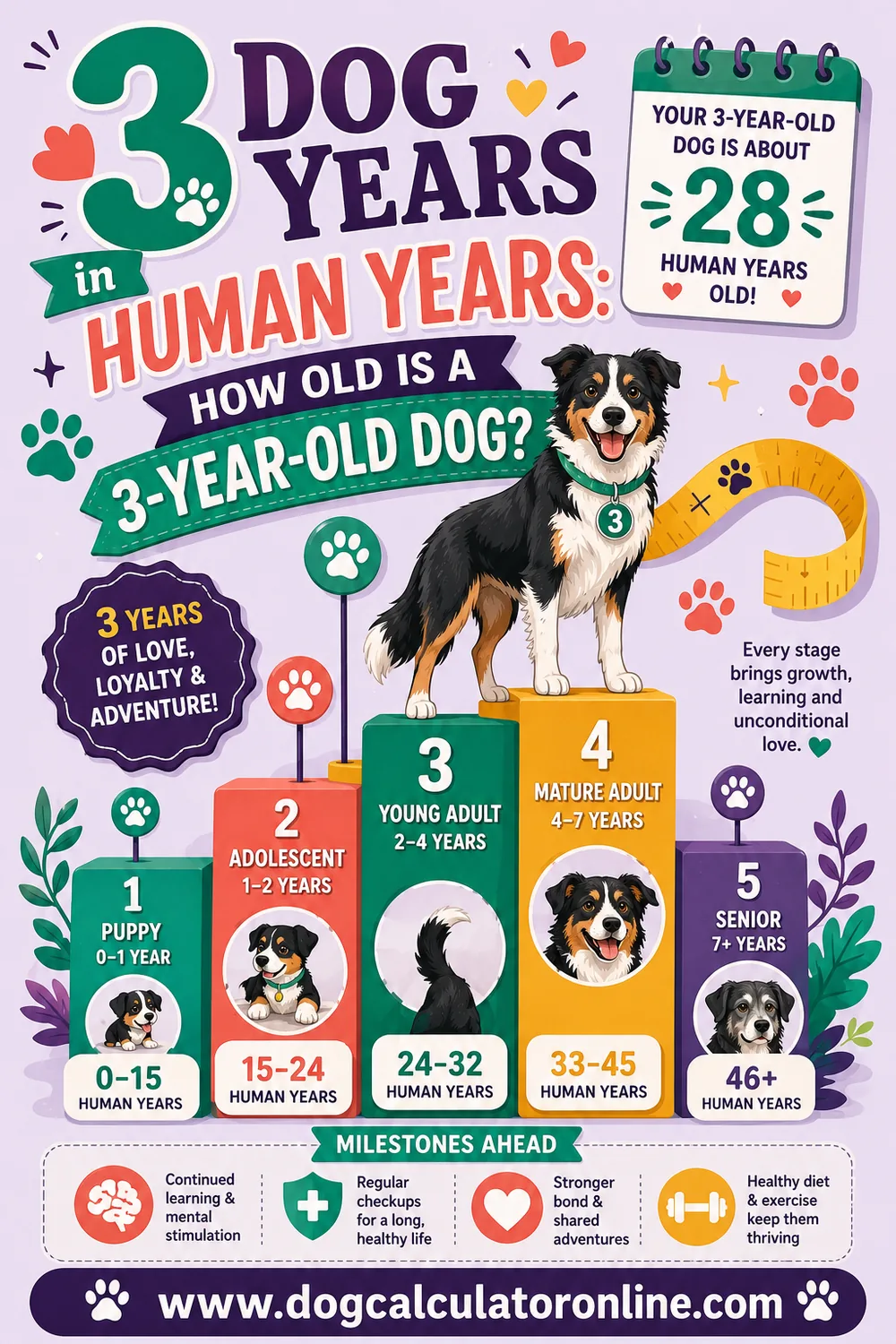
A 3-year-old dog is about 28 to 31 in human years, depending on size: roughly 28 for a small dog, 29 for a medium, 30 for a large, and 31 for a giant breed. Age 3 is the first birthday where size changes the answer — and the gap only grows from here.
For your dog's exact number, the free dog age calculator applies the right size adjustment automatically and shows the 2019 DNA-study figure alongside. Here's how the math works and what it means for a dog at this stage.
🐾 Quick check: how old is a 3-year-old dog?
Tap your dog’s size class to see the human-year equivalent at age 3:
Tap a size above to see the answer.
The Short Answer: 3 Dog Years ≈ 28–31 Human Years
The conversion vets actually use — the size-adjusted guideline associated with the AVMA — is simple:
- Year one ≈ 15 human years
- Year two ≈ 9 more (total: 24)
- Each year after that adds 4–7, based on adult weight
For a 3-year-old, that's 24 plus one size-adjusted year:
| Size class | Adult weight | 3 dog years in human years |
|---|---|---|
| Small | Under 20 lb | ≈ 28 |
| Medium | 21–50 lb | ≈ 29 |
| Large | 51–90 lb | ≈ 30 |
| Giant | Over 90 lb | ≈ 31 |
The old 7:1 rule would call your 3-year-old dog a 21-year-old human. It's not the worst estimate the myth ever produces — but it undershoots reality, and it gets worse every year. By age 10 the myth is off by up to 10 human years for a giant breed.
Age 3: Officially a Settled Adult
If age 1 is the teenage year and age 2 is the young adult finding their footing, age 3 is the dog equivalent of the late twenties: fully formed, confident, and settled into who they are.
Most owners notice these shifts by the third birthday:
- The adolescent chaos is gone. Even late-maturing, high-energy breeds have usually leveled out by 3. What you see now is your dog's true adult temperament.
- Behavior is predictable. Routines are locked in. Your dog knows the household rhythm — and holds you to it.
- Energy is strong but manageable. A 3-year-old still wants real daily exercise, but the frantic edge of the 1-to-2 window has softened.
- Training sticks. With maturity comes focus. Skills taught now tend to stay taught.
This stability is why trainers often call 3 the "golden age" for advanced work — sports, scent games, therapy-dog training. The body is still in its prime and the mind has caught up.
What the DNA Study Says About Age 3
The 2019 UCSD study offers a different measurement. Rather than mapping life stages, researchers compared DNA methylation — molecular marks that accumulate predictably with age — between about a hundred Labrador Retrievers and a large group of humans. Their formula:
Human age = 16 × ln(dog age) + 31
For a 3-year-old dog: 16 × ln(3) + 31 ≈ 49 human years.
That's a big gap from the guideline's 28–31. Here's why both can be true:
- The epigenetic clock races in early life. Dogs do a huge share of their lifetime molecular aging before age 3, then the curve flattens sharply — between ages 10 and 14, the formula adds only about 5 human years total.
- Molecular age and functional age are different things. A 3-year-old dog doesn't look, move, or behave like a 49-year-old human. It behaves like a 29-year-old — which is what the life-stage guideline captures.
Think of the AVMA-style number as "how old your dog acts and what care they need," and the UCSD number as "what their DNA looks like under a microscope." The free dog age calculator reports both, because they're both interesting answers to different questions.
Where Your Dog Is Headed: The Divergence Begins
Age 3 is the first point where a Chihuahua and a Great Dane get different numbers — and it's worth seeing how quickly the paths split from here:
| Dog's age | Small | Medium | Large | Giant |
|---|---|---|---|---|
| 3 | 28 | 29 | 30 | 31 |
| 5 | 36 | 39 | 42 | 45 |
| 7 | 44 | 49 | 54 | 59 |
| 10 | 56 | 64 | 72 | 80 |
| 13 | 68 | 79 | 90 | 101 |
At 3, the spread is just 3 human years. By 10, it's 24. That's the core reason bigger dogs reach their senior years so much earlier: giant breeds are considered seniors around age 6–7, while a small dog often isn't a senior until 9 or 10.
Scientists are still working out exactly why size flips the usual big-animals-live-longer rule inside the dog species. Leading explanations involve the sheer speed of large-breed growth and higher levels of the growth factor IGF-1, both linked to faster aging.
Making the Most of the Prime Years
In human terms, your dog is a 29-year-old with great knees. The priorities at this stage are about protecting that:
- Guard the waistline. Age 3 is when slowing metabolism quietly collides with unchanged portions. A landmark Labrador study found lean dogs lived meaningfully longer than their overweight littermates — body condition is the biggest longevity lever you control. If ribs are hard to feel, ask your vet about portions, or start from a label-based estimate and adjust.
- Take dental care seriously. Most dogs have some periodontal disease by age 3. Brushing a few times a week now can spare your dog (and your wallet) major dental work later.
- Keep the annual vet exam. Healthy 3-year-olds typically need just one visit a year. Consider baseline bloodwork if it's never been done — it makes future changes easier to spot.
- Feed the brain. Settled doesn't mean bored. New tricks, food puzzles, and varied walking routes keep a prime-age dog mentally sharp.
- Log the healthy baseline. Weight, resting energy, appetite, coat condition — knowing what "normal at 3" looks like helps you notice "not normal at 8" early.
Which Size Class Is My Dog? (The Edge Cases)
The whole conversion turns on one input — your dog's adult weight class — so it's worth getting right:
| Size class | Adult weight | Typical examples |
|---|---|---|
| Small | Under 20 lb | Chihuahua, Yorkie, Shih Tzu, Miniature Dachshund |
| Medium | 21–50 lb | Beagle, Border Collie, Cocker Spaniel, most mid-size mixes |
| Large | 51–90 lb | Labrador, Golden Retriever, German Shepherd, Boxer |
| Giant | Over 90 lb | Great Dane, Mastiff, Saint Bernard, Newfoundland |
Three common edge cases:
- Right on a boundary? A 20–22 lb dog can reasonably use either the small or medium multiplier — the difference at age 3 is a single human year. Pick the class that matches your dog's healthy weight, not their current weight if they're carrying extra.
- Mixed breed of unknown parentage? Use the adult weight you can see on the scale. Weight, not breed label, is what drives the aging-rate difference.
- Overweight dog? Classify by what your dog should weigh — your vet can give you that target. A Beagle who has reached 55 lb is still a medium-class ager (with a weight-loss conversation pending).
The free dog age calculator sorts all of this automatically from the weight you enter.
The Rescue-Dog Question: Is My New Dog Actually 3?
Adopters are often told a shelter dog is "about 3" — it's the most common placeholder age in rescue. Vets estimate a young adult's age from physical evidence: tooth wear and tartar (clean white teeth suggest 1–2; mild wear and some tartar, 3–5), muscle tone, coat condition, and eye clarity. The estimate gets less precise as dogs get older, but distinguishing a 3-year-old from a 7-year-old is usually straightforward for a professional.
If your rescue's age is a guess, ask the vet for their read at your first visit, then convert that estimate by size. Even a plus-or-minus-a-year answer meaningfully changes the human-age picture — and the care timeline that goes with it.
Related Guides
If this helped, these go deeper on the same question:
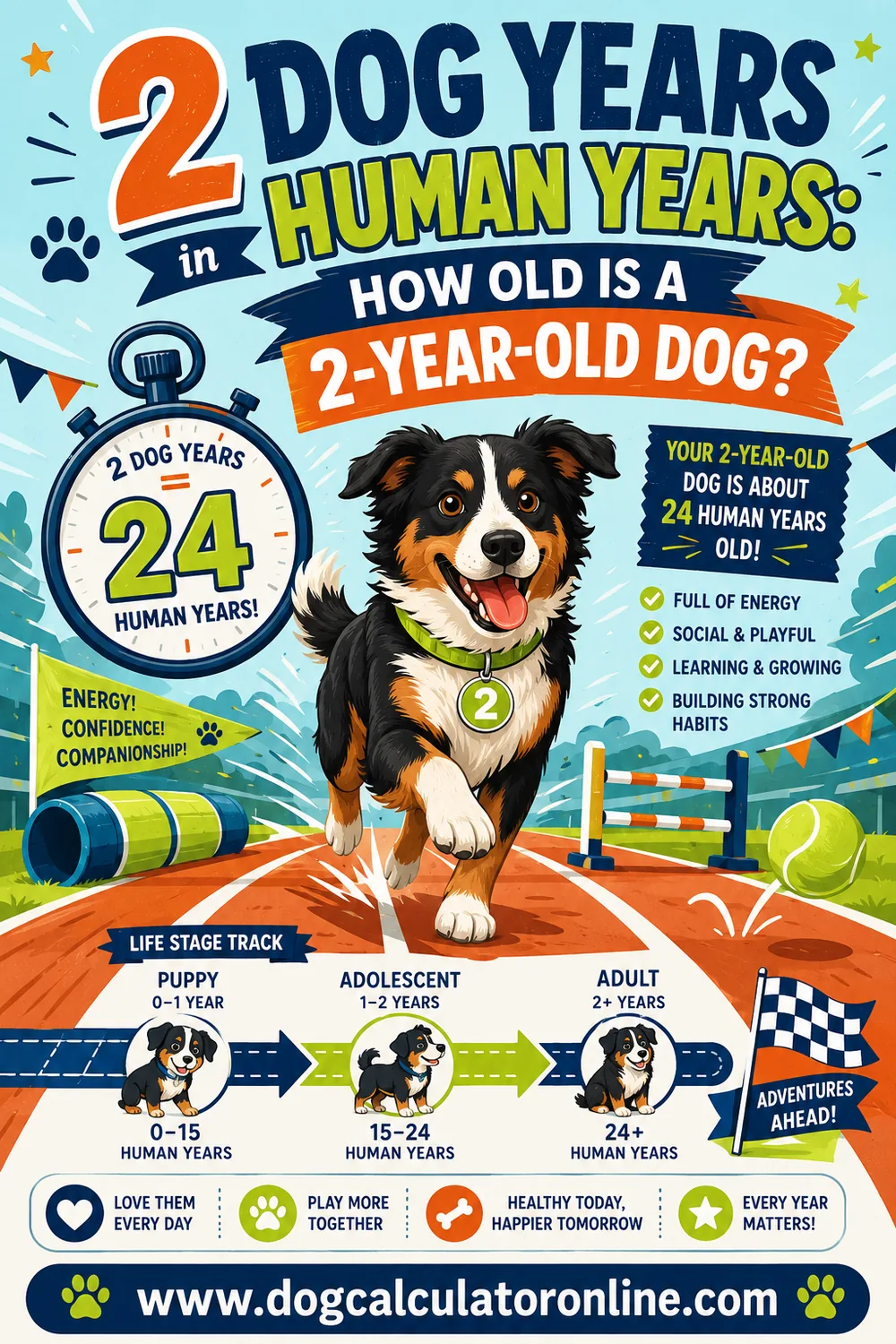
- 2 Dog Years in Human Years: How Old Is a 2-Year-Old Dog?
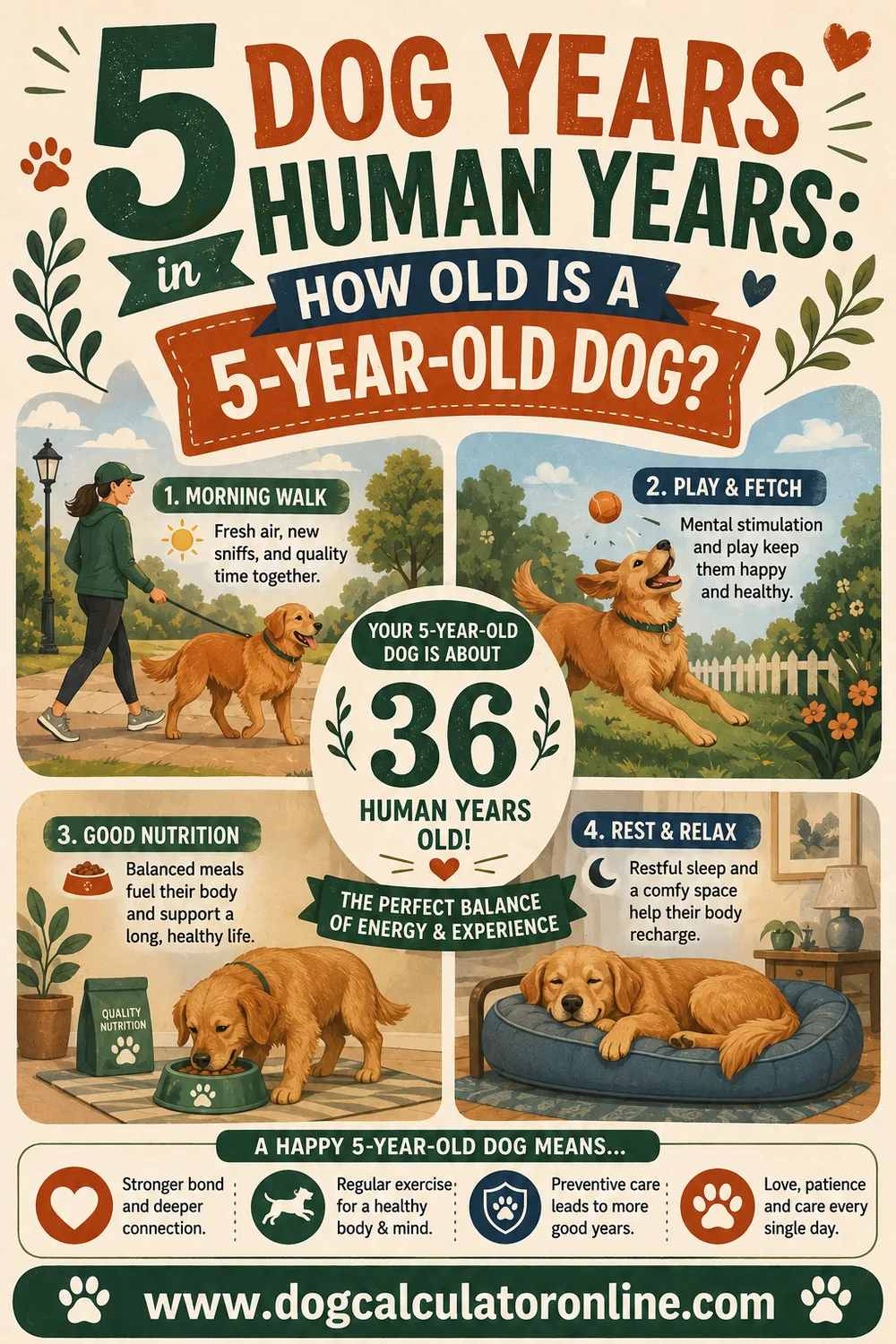
- 5 Dog Years in Human Years: How Old Is a 5-Year-Old Dog?
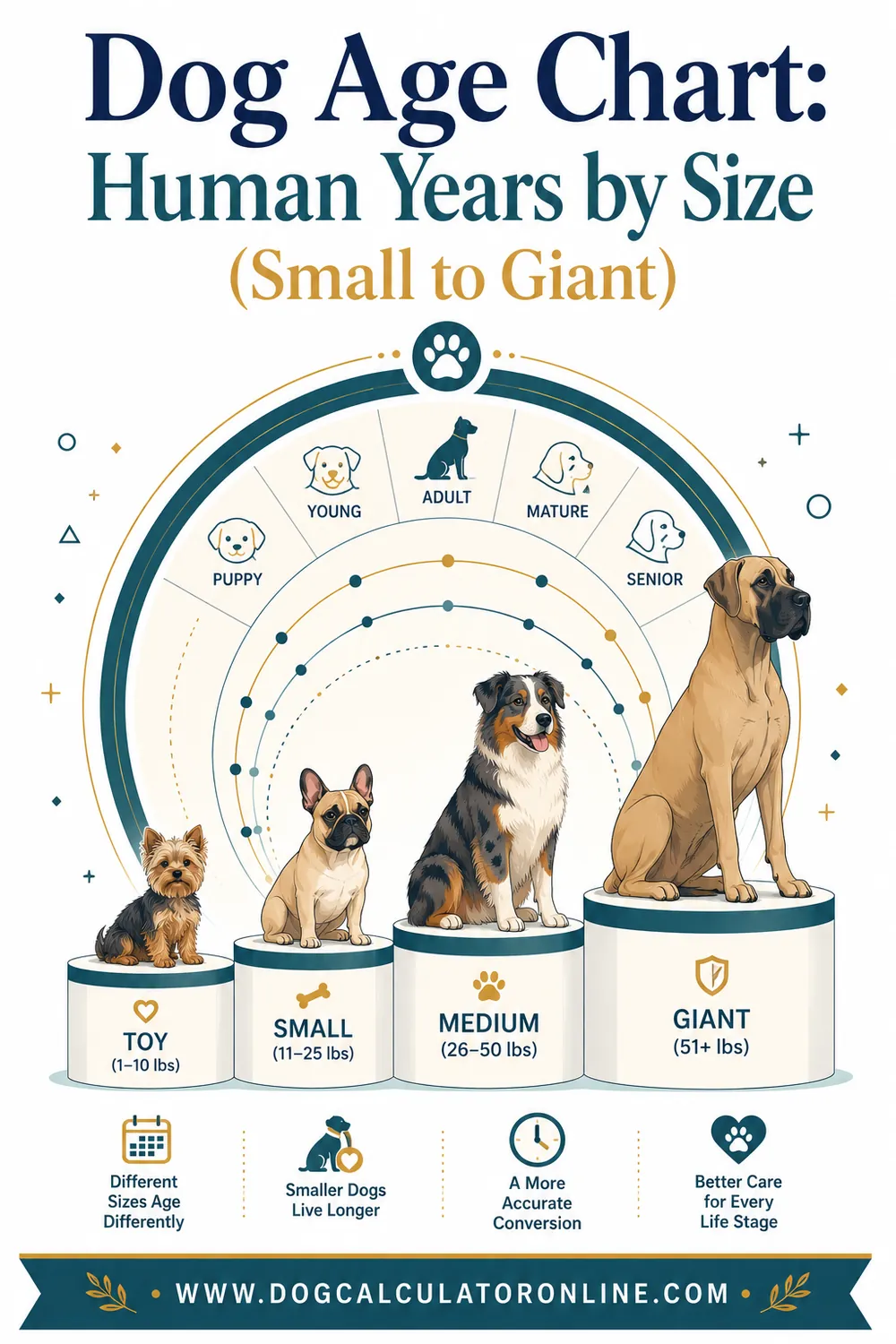
- Dog Age Chart: Human Years by Size (Small to Giant)
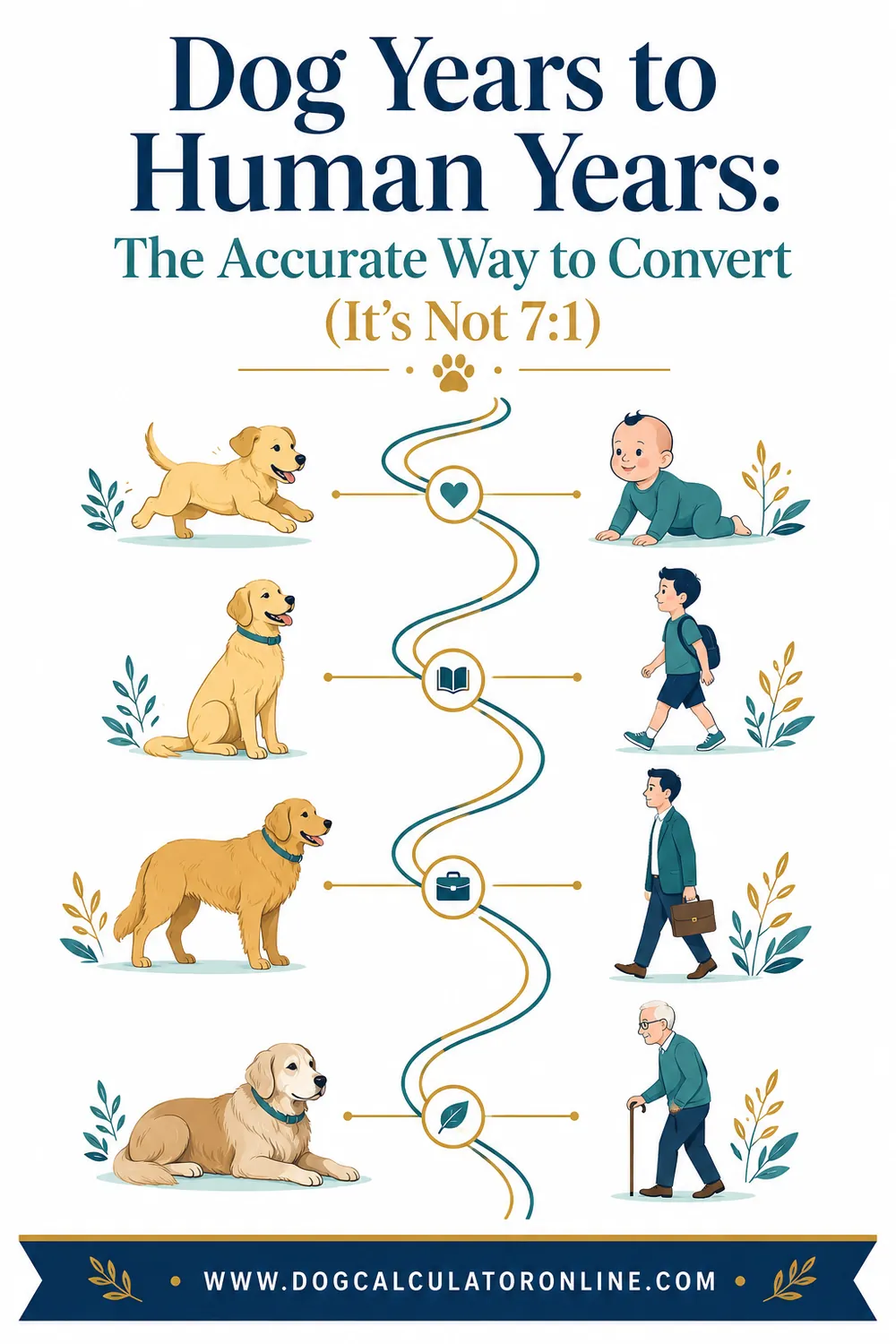
- Dog Years to Human Years: The Accurate Way to Convert (It's Not 7:1)
And if you just want your own dog's number, the free dog age calculator does it in one tap.
FAQ
How old is a 3-year-old dog in human years?
About 28–31, depending on size: 28 for small dogs (under 20 lb), 29 for medium (21–50 lb), 30 for large (51–90 lb), and 31 for giant breeds (over 90 lb).
Is a 3-year-old dog 21 in human years?
That's the old 7:1 myth. The vet-backed size-adjusted method puts a 3-year-old dog at 28–31 human years — a settled adult, not a college student.
What does the 2019 DNA study say for age 3?
The UCSD epigenetic formula (16 × ln(age) + 31) gives about 49 human years. It measures molecular aging, which runs fast early in life; the life-stage guideline of 28–31 better matches behavior and care needs.
Is 3 still young for a dog?
Yes. A 3-year-old is a prime-age adult with most of their life ahead: small breeds often live 14–16 years, medium 10–14, and large breeds 8–12.
Do all dogs mature by age 3?
Physically, yes — even giant breeds finish growing by 2. Behaviorally, age 3 is when nearly all dogs, including slow-maturing working breeds, have settled into their adult temperament.
How can I calculate my dog's exact human age?
Add 15 for year one, 9 for year two, then 4–7 per year based on size — or let the free dog age calculator do it instantly, including the DNA-study figure.
Is 3 a good age to adopt a dog?
Excellent, honestly. A 3-year-old arrives with adult temperament fully visible (no adolescent surprises), housetraining usually intact, and the vast majority of their lifespan still ahead — 7 to 13 more years depending on size. What you meet at the shelter is who you'll live with.
Should a 3-year-old dog still be on puppy food?
No — every size class, including giants, should have transitioned to adult food well before 3. If yours hasn't, make the switch gradually over a week or so and confirm portions with your vet.
The Bottom Line
Three dog years equal about 28–31 human years — late twenties, with size nudging the number for the first time. Your dog is now a fully settled adult in peak condition, and the habits you maintain through these prime years (lean weight, dental care, yearly checkups) buy the most good time later.
Want the precise figure for your dog, now and at every birthday ahead? The free dog age calculator converts any age with the correct size adjustment in about two seconds.