Should I Feed My Dog Once or Twice a Day?
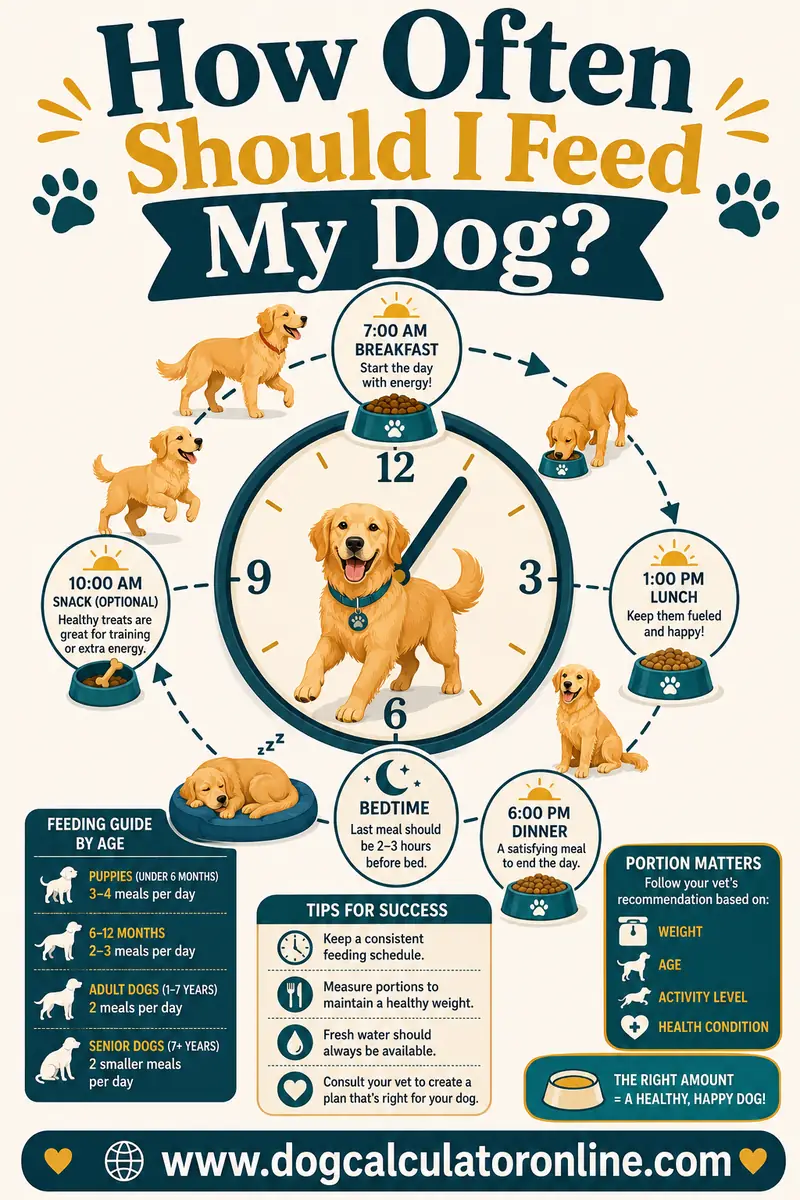
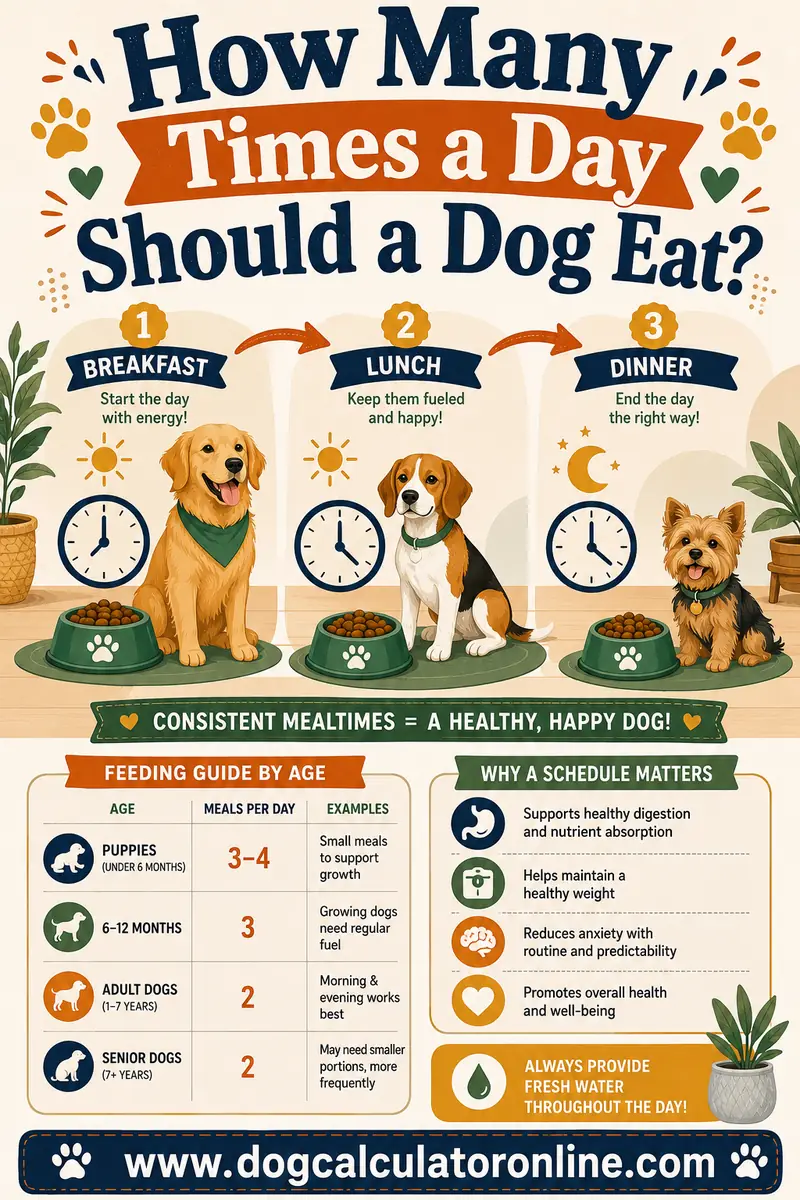
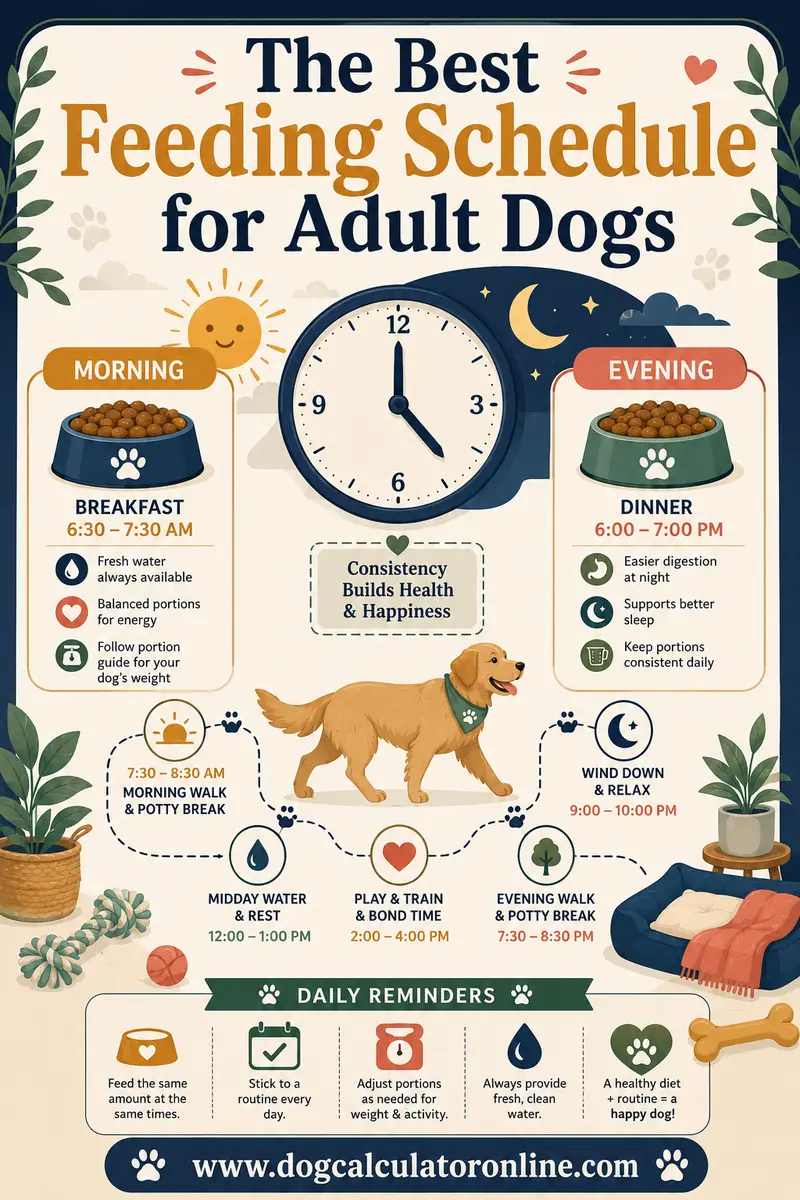
For most adult dogs, twice a day is the schedule most vets recommend — the same daily amount, split into a morning and an evening meal roughly 8–12 hours apart. Two meals keep hunger (and hunger behaviors) manageable, sit easier on the stomach than one large load, and give you two daily appetite checks instead of one. Once-a-day feeding isn't automatically wrong for every healthy adult, but it's the wrong choice for puppies, toy breeds, seniors with health conditions, and — importantly — large deep-chested breeds, where wolfing a single huge meal is a commonly cited risk factor for bloat.
Whichever schedule you pick, the total is what controls weight: same daily calories, just divided differently. The free dog food calculator gives you that daily number for your dog's weight, age, and activity in seconds. Below: the honest case for each schedule, the dogs that genuinely need more than one meal, and how to change schedules without a protest at the bowl.

🕒 Schedule check
Tap a feeding schedule to see who it suits:
Tap a schedule above. Total daily calories matter more than the split — but the split still matters.
The Case for Twice a Day (Why It's the Default)
Most vets land on two meals for adult dogs, and the reasons are practical rather than mystical:
- Steadier hunger, better behavior. A dog fed at 7 am and 6 pm never goes a full day on an empty tank. Long fasts show up as counter-surfing, trash raids, grass-eating, and the famous early-morning bile vomit (yellow foam on an empty stomach) that often stops the week a second meal starts.
- Smaller meals, easier digestion. Half-sized meals are gentler on the gut than one large load — less gulping, less post-meal discomfort, fewer "ate too fast" reversals.
- Two appetite checks a day. Appetite is one of the earliest illness signals dogs give. A twice-fed dog that skips breakfast gets noticed at 7 am; a once-fed dog's skipped meal might not register until tomorrow.
- Routine fits real life. Two anchored meals sync with walks, potty rhythm, work schedules, and any twice-daily medication.
- It matches how portions are planned. Feeding guides, vet plans, and our best feeding schedule guide all assume you can split rations — a 12-hour split is the tidy version.
The Honest Case for Once a Day
Once-a-day feeding has real-world defenders — working schedules, certain training approaches, and some owners of large lazy dogs who swear by it. A healthy adult dog can digest a full day's ration in one sitting, and some researchers have begun exploring meal frequency and health in dogs, though the science is far from settled — nothing there justifies switching a happy twice-fed dog.
The genuine downsides to weigh:
- The hunger gap is long. Twenty-plus hours between meals is a lot of scavenging motivation, and empty-stomach vomiting is more common on this schedule.
- One big meal is the risky shape. For large, deep-chested breeds (Great Danes, GSDs, Weimaraners, Standard Poodles and similar), a single large, fast-eaten meal is one of the commonly cited risk factors for bloat (GDV) — a rapid, life-threatening emergency. For these breeds, most vets advise splitting meals precisely to avoid the one-giant-dinner pattern. That alone rules out once-a-day for a big slice of the dog population.
- Fewer data points. One meal means one appetite check, one potty-predictable window, and less flexibility for medications that need food twice daily.
If once-a-day genuinely fits your dog and life, run it past your vet at the next visit — and it should be a considered choice for a healthy, medium-sized, slow-eating adult, not a default for convenience.
Dogs That Should NOT Eat Once a Day
For these dogs, meal frequency is a health matter, not a preference:
| Dog | Minimum meals | Why |
|---|---|---|
| Puppies under 6 months | 3–4/day | Tiny stomachs, fast metabolism, growth needs |
| Adolescents 6–12 months | 2/day | Still growing; long fasts don't fit |
| Toy breeds (any age) | 2–3/day | Hypoglycemia risk with long gaps |
| Large deep-chested breeds | 2+/day | Bloat risk with single large meals |
| Diabetic dogs | Per vet | Meals must match insulin timing |
| Dogs with GI conditions or on certain meds | Per vet | Smaller, frequent meals often prescribed |
| Pregnant/nursing dogs | Several/day | Sharply higher needs, limited stomach room |
When in doubt, this column of the decision is your vet's call — especially for any dog with a diagnosis. Our how often should I feed my dog guide covers frequency across the whole lifespan.
What Actually Controls Weight: The Total
A dog fed 1,200 kcal once a day and a dog fed 600 twice a day are eating identically as far as the waistline is concerned. Meal frequency shapes hunger, digestion, behavior, and risk profile — but daily calories set the weight. That has two practical consequences.
First, switching schedules should never change the total: moving from one meal to two means halving the meal, not doubling the feeding. It sounds obvious; it is the single most common way schedule changes cause weight gain, because a "meal" mentally defaults to a full bowl.
Second, you can't split a number you don't know. Get the daily target from the dog food calculator — weight, age, activity in, daily calories and portion out — then divide by your chosen meal count. Treats stay inside ~10% of the total on any schedule. And whichever frequency you choose, scheduled beats grazing: our free feeding vs scheduled feeding comparison covers why food-always-down loses on nearly every axis.
What Each Schedule Looks Like in Practice
Sometimes the easiest way to choose is to see the day laid out. Three sample days for the same 50 lb dog needing ~1,100 kcal:
Twice a day (the default):
| Time | What |
|---|---|
| 7:00 am | Meal 1 — 550 kcal, after the morning walk |
| Midday | Water always down; a couple of budgeted training treats |
| 6:00 pm | Meal 2 — 550 kcal, before the evening wind-down |
| 9:30 pm | Last potty trip |
Hunger stays even, both meals anchor potty-predictable windows, and any twice-daily medication has a food vehicle at both ends of the day.
Once a day (vet-cleared adults only):
| Time | What |
|---|---|
| 8:00 am or 5:00 pm | The meal — full 1,100 kcal, ideally in a slow-feeder |
| Rest of day | Water down, treats within budget, and a long food gap |
Morning versus evening is owner's choice; consistency is what matters. Watch the first weeks for empty-stomach vomiting and scavenging pressure — those are the usual reasons this schedule gets abandoned.
Three meals (puppies, toys, medical needs, or just preference):
| Time | What |
|---|---|
| 7:00 am | Meal 1 — ~365 kcal |
| 1:00 pm | Meal 2 — ~365 kcal |
| 7:00 pm | Meal 3 — ~365 kcal |
The midday meal is the scheduling pain point for working households — an automatic feeder or a midday walker solves it, and for the dogs that need three meals medically, it's non-negotiable rather than optional.
Note what's identical in all three tables: 1,100 kcal. The schedule redistributes the day; it never adds to it.
Switching Schedules Without Drama
From once to twice: easy — split the current ration in half and pick two anchor times 8–12 hours apart. Expect a few days of theatrical confusion at the old mealtime; consistency cures it. If mornings were previously food-free, a dog with occasional empty-stomach vomiting will usually improve within the week.
From twice to once (with vet blessing): go gradually — shrink one meal over a week or two while growing the other, so the gut adapts to the larger single load. Slow-feeder bowls help large-meal gulpers. Any vomiting, discomfort, or bloating: revert and rethink. For deep-chested breeds, skip this switch entirely.
Timing tips for any schedule: feed after exercise rather than immediately before or after intense running (commonly advised for bloat-prone breeds — ask your vet what window suits your dog), keep times consistent within an hour or so, and put the last meal early enough for a pre-bed potty rhythm that works.
FAQ
Is it OK to feed a dog once a day?
Some healthy adult dogs do fine on one daily meal, but most vets still recommend two — and once-a-day is a poor fit for puppies, toy breeds, diabetic dogs, and large deep-chested breeds where one big meal raises bloat concerns. If you're considering it, make it a vet conversation first.
What are the best times to feed a dog twice a day?
Roughly 8–12 hours apart at times you can keep consistent — 7 am and 6 pm is a classic pattern. Exact clock times matter less than the steady rhythm, which stabilizes hunger, digestion, and potty timing.
Do dogs get hungry between meals on twice-a-day feeding?
Some begging is normal dog opportunism, not starvation. If a twice-fed dog seems genuinely ravenous — frantic eating, scavenging, weight loss — check the daily total against a dog food calculator before adding food, and see the vet if the appetite change is new.
Why does my dog vomit yellow foam in the morning?
That's typically bile vomiting on an empty stomach, common when the overnight gap between meals is long. Splitting the daily ration so a meal lands closer to bedtime often resolves it. If it persists despite schedule changes, ask your vet.
Does feeding once a day help a dog lose weight?
Not by itself — weight is governed by total daily calories, not meal count. A vet-guided calorie target with accurate measuring does the work; many dieting dogs actually do better on two smaller meals, which blunt hunger between them.
Is it better to feed a dog in the morning or at night?
If you feed once daily, either works — consistency matters more than the hour. On two meals, the classic split is morning and early evening, with dinner early enough that the last potty trip lands before bedtime. Avoid feeding right around intense exercise, especially for bloat-prone deep-chested breeds; ask your vet what buffer suits your dog.
How much should my dog eat per meal?
Daily target divided by meal count. A dog needing 1,000 kcal a day gets ~500 per meal twice daily. Get the daily figure from your dog's weight, age, and activity with a dog food calculator, then split it evenly.
Two Bowls a Day, One Correct Total
Twice a day wins for most adult dogs: steadier hunger, safer meal sizes, better sickness radar, and a rhythm the whole household can keep. Once a day is a niche choice that needs a vet's nod — never a default, and never for the bloat-prone breeds. What both schedules share is the part that actually determines your dog's waistline: the daily total. Get yours in seconds from the free dog food calculator — weight, age, activity in; the right daily amount out — then split it into whichever rhythm fits your dog best.