What Does a Second Dog Actually Cost?
A second dog usually adds about 70–85% of what the first one costs you each year, not 50% and not 100%. The useful way to think about it is marginal cost: food, insurance, preventative medicine, grooming and boarding all roughly double, while the one-off household spending — fencing, a stair gate, a trunk liner, a decent vacuum — does not repeat. For a medium dog costing $1,500–$2,500 a year, dog two typically lands somewhere around $1,100–$2,000. The number people miss is not on any invoice: with two dogs, the chance that you face an unexpected vet bill in a given year goes up sharply. Run both dogs through the dog cost calculator before you decide.
🐾 Does this cost double with a second dog?
Tap a cost:
Tap a cost above. Doubling is the default; the exceptions are one-off purchases.
Start With Marginal Cost, Not Total Cost
The question is not what a dog costs. You already know that. The question is what changes.
Marginal cost means the extra spending caused by dog two, and nothing else. Your existing crate, lead, grooming brush and stair gate are already paid for and do not enter the calculation.
Recurring costs scale with the number of animals; one-off costs scale with the household. That single sentence explains almost all of the difference between the first dog and the second.
As a planning figure, expect 70–85% of your current annual spend. The lower end applies if your first dog was expensive to set up and you already own everything. The higher end applies if the second dog is bigger, older or a breed with known problems.
Size matters more than order. Adding a 70 lb (32 kg) labrador to a household with a 12 lb (5.5 kg) terrier is not adding 80% — food, medication doses and boarding rates all scale with weight, so it can easily exceed your current total.
Age matters just as much. A seven-year-old second dog will cost more in veterinary care and more in insurance than a puppy, and will be harder to insure for anything that has already appeared.
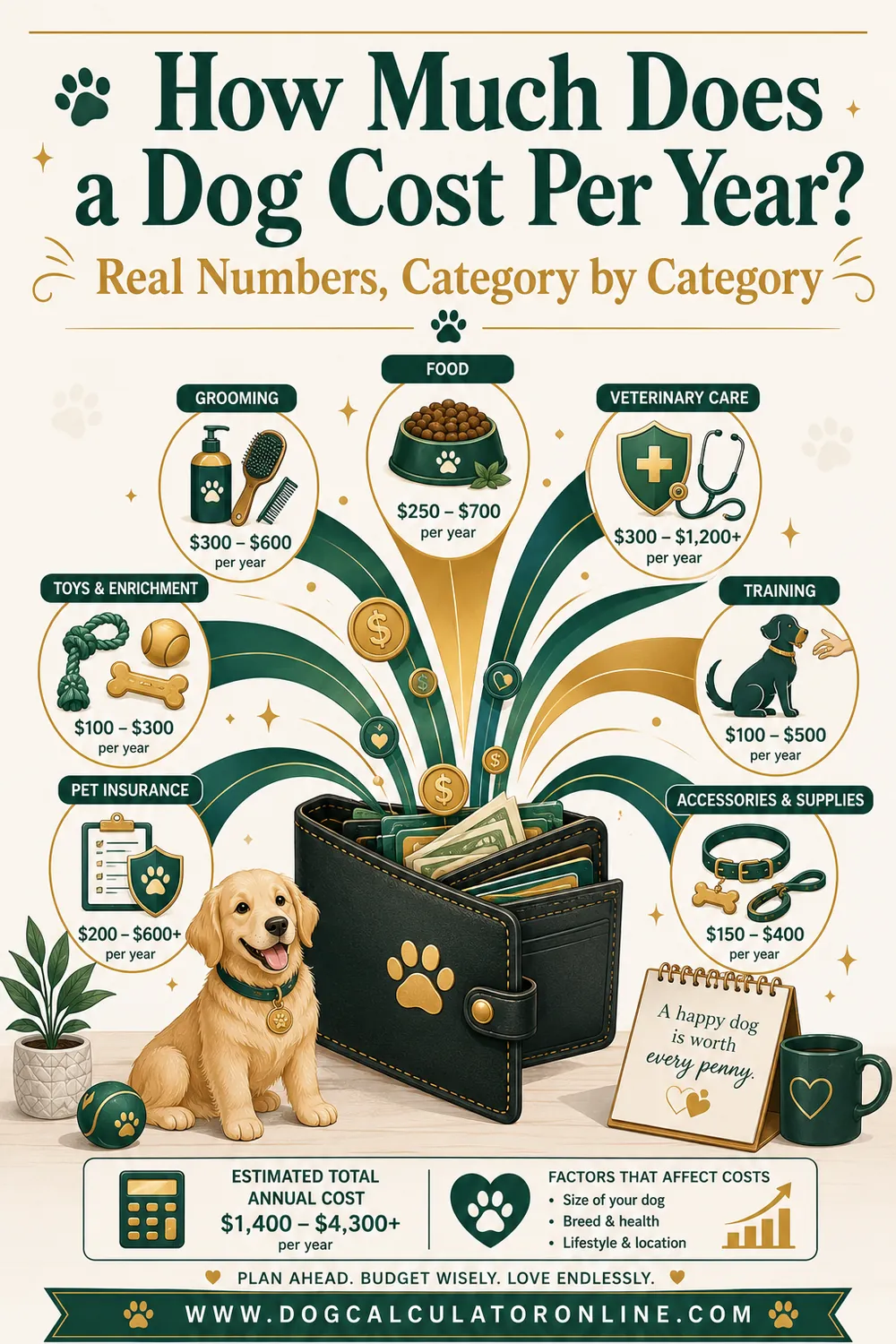
Your first dog's annual figure is the right starting point. If you have not worked it out, the categories are broken down in how much a dog costs per year.
What Doubles, Almost Exactly
These are the honest doublings. Do not talk yourself out of them.
Food doubles. Two dogs of similar size eat twice as much. The only saving is buying a larger bag, which typically cuts 15–25% off the price per pound — real money, but not a halving, and the arithmetic is set out in what it costs to feed a dog.
Preventative medicine doubles. Flea, tick and worming treatments are dosed by weight, per dog, every month. There is no volume discount at the practice counter.
Vaccinations and annual health checks double. Some practices discount a second dog seen in the same appointment, usually by waiving one consultation fee of $50–$80. That is the whole discount.
Grooming doubles, sometimes more. Two doodles at $80–$120 a visit every six to eight weeks is one of the biggest single line items people fail to plan for.
Insurance nearly doubles. Multi-pet discounts exist but are modest, usually 5–10%, so two policies cost about 1.9 times one — the detail is in pet insurance costs for multiple dogs.
Poo bags, treats, chews and toys double, and toys arguably more than double, because two dogs destroy things faster than one dog does.
What Does Not Change At All
Here is where the second dog genuinely is cheaper, and it is worth being specific about it.
Fencing and garden security. If your garden is already secure, it is secure for two. This is often the single largest one-off cost of the first dog, sometimes $500–$3,000.
Household equipment. Stair gates, a trunk liner or barrier, a decent pet-hair vacuum, washable throws, a doorbell routine. Bought once.
Training equipment and knowledge. You already own the long line, the treat pouch and the clicker, and you already know how to use them.
Your time on the walk. Walking two dogs takes almost exactly as long as walking one, provided they walk well together. That is the biggest non-financial saving in the whole exercise.
Some services are priced per visit, not per dog. Many dog walkers charge a modest supplement — often $5–$10 — rather than double, because they are already at your house.
Your existing crate may not carry over, though. Two dogs generally need two crates and two beds, and separate resources from day one matter behaviorally as much as practically — see how to introduce a second dog.
A Side-by-Side Annual Comparison
Figures below are planning ranges for two medium dogs of about 40–50 lb (18–23 kg) in the US, not quotes. Your region moves them substantially.
| Cost each year | One dog | Two dogs | Doubles? |
|---|---|---|---|
| Food | $400–$900 | $700–$1,600 | Nearly |
| Preventatives (flea, tick, worm) | $150–$350 | $300–$700 | Yes |
| Vaccinations and annual check | $150–$300 | $250–$550 | Nearly |
| Insurance | $350–$800 | $650–$1,500 | Nearly |
| Grooming | $0–$700 | $0–$1,400 | Yes |
| Boarding, 2 weeks a year | $500–$1,000 | $950–$2,000 | Yes |
| Toys, treats, replacements | $150–$400 | $250–$650 | Nearly |
| Home setup (one-off, amortised) | $100–$300 | $100–$300 | No |
| Rough annual total | $1,800–$4,750 | $3,200–$8,700 | ≈1.8× |
The multiplier lands near 1.8, not 1.5. People who expect a second dog to be half price are usually thinking of the equipment they will not rebuy, which is the smallest row in the table.
Notice that boarding is the row that hurts most. It is the one cost that can more than double, because two dogs sometimes need two kennel runs.
Your own figure will differ, and the categories matter more than the numbers. Fill in your actual food brand, your actual premium and your actual grooming schedule.
The Risk Nobody Budgets For
This is the part that turns a comfortable budget into a stressful one, and it has nothing to do with routine spending.
Two dogs mean two independent chances of an emergency each year. If a single dog has roughly a one-in-ten chance of needing unplanned treatment in a given year, the chance that at least one of two dogs does is close to one in five — not exactly double, but near enough that planning for double is sensible.
Emergency bills are large and lumpy. A foreign body removal, a cruciate repair, a bloat surgery or a road accident commonly runs $2,000–$7,000, and out-of-hours consultations alone start around $150–$250 before anything is done.
The genuinely bad scenario is two claims in one year. With one dog it is unlikely. With two it is entirely ordinary, and it is the situation that empties a savings account.
This is the strongest argument for insuring both dogs rather than self-insuring. A savings buffer that covers one $4,000 event does not cover two, and the math gets worse as both dogs age together.
Dogs acquired together also age together. Two dogs bought within a year of each other hit their expensive senior years simultaneously, roughly a decade later. Staggering by three or four years spreads that considerably.
Build an emergency fund sized for two, not one. A reasonable target is $3,000–$5,000 accessible, on top of insurance, given the typical figures in average vet costs for a dog.
Boarding, Travel and the Costs That More Than Double
The category most likely to break a two-dog budget is the one that only appears when you go away.
Kennels often charge per dog with a small sharing discount. Two dogs sharing a run might be $45–$70 a night instead of $30–$45 for one, so a two weeks moves from around $500 to around $850.
Some kennels will not house two dogs together at all, particularly if they are unrelated, of different sizes, or not neutered. Then you are paying two full rates.
Home boarders and sitters vary the most. A sitter staying in your house may charge a $10–$20 supplement rather than double, which makes it the best value option for two dogs by a wide margin — the comparison is laid out in the dog boarding cost guide.
Pet-friendly hotels almost always charge per pet, typically $25–$75 per dog per night, and many cap occupancy at two dogs per room.
Flying with two dogs is disproportionately expensive, because most airlines allow one pet per passenger in cabin, so a second dog may need a second traveling human or cargo transport.
Book earlier than you used to. Spaces for two dogs together are scarcer, especially over holidays, and last-minute availability costs a premium.
Where a Second Dog Genuinely Saves You Money
It is not all one direction, and some of the savings are real.
Bulk buying finally makes sense. A 30 lb (13.6 kg) bag that would go stale for one dog is used within its freshness window by two, capturing the 15–25% per-pound saving.
Daycare need often drops. Two dogs that get along keep each other company, and households frequently cut daycare from three days a week to one, saving $1,500–$3,000 a year.
Separation-related problems sometimes ease — though this is genuinely uncertain and often overstated. A second dog is not a treatment for separation anxiety, which is about the absence of you, and adding a dog to fix it can produce two anxious dogs.
Multi-pet insurance discounts are small but free. Ask for them; 5–10% on two policies is $50–$150 a year for one phone call.
Adoption keeps the entry cost low. Fees of $50–$500 usually include neutering, vaccination and a microchip, which is a far cheaper start than a purchase — see what it costs to adopt a dog.
Some shelters discount bonded pairs. If you are set on two, taking an established pair avoids the introduction risk entirely and often costs less than one purchased puppy.
How to Work Out Your Own Number
Ten minutes with real figures beats any national average.
Take your last twelve months of spending on dog one. Bank statements, not memory. Memory understates dog spending by a wide margin.
Split it into recurring and one-off. Food, insurance, preventatives, grooming, boarding and consumables are recurring. Fencing, crate, car equipment and the vacuum are one-off.
Double the recurring column and add nothing for the one-off column. That is your marginal cost, and it is usually uncomfortably close to your current total.
Adjust for size and age. A larger second dog scales food, medication and boarding upward; an older one scales insurance and veterinary costs upward.
Add an emergency line sized for two. Either a second insurance premium or a bigger savings target — realistically both.
Then stress-test it. Ask whether you could absorb $4,000 of unplanned veterinary spending in a year where you also boarded both dogs for a two weeks. If the honest answer is no, wait a year. The dog cost calculator will run both dogs side by side.
FAQ
Is a second dog cheaper than the first?
Slightly, but far less than people expect. A second dog typically adds 70–85% of your current annual spending, because food, insurance, preventatives, grooming and boarding all roughly double while one-off purchases such as fencing, gates and a car crate do not repeat.
How much does a second dog cost per year in the US?
For a medium dog of about 40–50 lb (18–23 kg), plan for roughly $1,100–$2,000 a year on top of your existing costs, covering food, preventatives, vaccinations, insurance, grooming and boarding. Larger, older or high-maintenance breeds sit above that range.
Do pet insurers give a discount for two dogs?
Most do, but it is modest — usually 5–10% off each policy. Two dogs therefore cost about 1.9 times one dog rather than 1.5 times. It is still worth asking for, and worth comparing against insuring each dog with a different provider.
Does a second dog double the chance of a big vet bill?
Close to it. If one dog has around a one-in-ten annual chance of needing unplanned treatment, the chance at least one of two dogs does is roughly one in five. The real budgeting risk is two significant claims landing in the same year.
Is boarding two dogs cheaper than boarding them separately?
Usually a little. Kennels often offer a sharing rate of about 25–35% off the second dog if the pair can share a run, but many refuse to house unrelated dogs together. A house-sitter is normally the cheapest option for two dogs, charging a small supplement rather than double.
Will a second dog cure my dog's separation anxiety?
Probably not, and it is a costly experiment. Separation anxiety is distress at your absence specifically, so a companion dog often does not help and can occasionally make things worse. Treat the anxiety first, and consider a second dog for its own sake.
Deciding With the Real Number in Front of You
The honest summary is that a second dog costs less than the first, but not nearly half — plan on 70–85% of your current annual spending, and closer to 100% if the new dog is bigger or older. Everything recurring doubles; only the household setup does not repeat. The item worth taking seriously is risk rather than routine spending: two dogs mean roughly double the chance of an emergency in any given year, and a savings buffer built for one dog will not stretch. Insure both, board carefully, and stagger their ages if you can. Put your real figures into the dog cost calculator, then read how to introduce a second dog before anyone comes home.