New Puppy First Week: What to Expect
The first week is not a training week — it is a settling week, and treating it as anything else is the single most common mistake. A puppy that arrives at eight weeks has just lost its mother, its littermates, its smells and its entire routine on the same afternoon. For roughly five to seven days it will sleep badly, eat unpredictably, have loose stools, and behave nothing like the dog it will become. Your job is food, sleep, toilet trips and quiet company, in that order. Everything else can wait a two weeks. Start tracking growth from day one with the puppy weight calculator, because week-one weight tells you a lot.

🐾 First-week worry check
Tap what is happening:
Tap an option above. Most week-one worries are settling, not illness.
What the First Week Is Actually Like
Set expectations honestly and the week is manageable. Set them wrong and it feels like a disaster.
Your puppy will sleep 18 to 20 hours a day, in bursts of 30 to 90 minutes. The waking hours are intense and short. Most of the difficult behavior people report in week one — frantic biting, ignoring their name, accidents indoors — happens in the last twenty minutes before a nap that should have started already.
Loose stools are near-universal. New water, new environment, a stressful car journey and often a food change all land at once. Soft stool for three or four days is expected. Blood, black tarry stool, or diarrhea with vomiting and flatness is not.
Appetite is unreliable for 24 to 48 hours. A puppy that ignores its first two meals and then eats normally is settling. A toy-breed puppy that refuses two consecutive meals needs a vet the same day, because low blood sugar develops fast in small puppies.
Nights are hard for three to five nights, then improve sharply. That improvement is the norm, not luck.
Eight weeks is the earliest sensible age to bring a puppy home, and there are real behavioral costs to leaving the litter earlier — bite inhibition and dog-to-dog manners are both learned from littermates between six and eight weeks. The reasoning is in when can puppies leave their mother.
Day by Day: The First Seven Days
| Day | What to expect | Your priority |
|---|---|---|
| Day 1 | Quiet or frantic, little appetite, may not toilet for hours | One room, no visitors, toilet trips every 30–45 min |
| Day 2 | First real night behind you, loose stool likely, more exploring | Fixed feeding times, crate introduced with food |
| Day 3 | Confidence rises, biting starts, sleep still broken | First vet visit if not already done |
| Day 4 | Testing boundaries, first proper play, appetite normalising | Start name response, 2 minutes at a time |
| Day 5 | Routine starting to hold, fewer night wake-ups | First carried outing to see the world |
| Day 6 | Settled enough for one or two calm visitors | Short alone-time practice, 30 seconds to 2 minutes |
| Day 7 | Recognizably your dog; energy noticeably higher | Weigh, review feeding amount, book puppy class |
Day one is deliberately dull. Take the puppy straight to its toilet spot from the car, wait, praise, then bring it into one room. No tour of the house, no relatives, no bath.
The middle of the week is where confidence returns, and with it the behavior people were not expecting: biting, stealing, and testing what happens if they ignore you. That is a good sign, not a bad one.
By day seven the picture is clear enough to set a real routine, which is what the second week is for.
The First Night
Almost every first-week question is really a first-night question.
Put the crate beside your bed. This solves more first-night crying than any other single measure. Puppies are not distressed by the crate; they are distressed by isolation, having never spent a night alone in their lives. A puppy that can hear and smell you will usually settle within twenty minutes.
Expect one or two toilet trips. An eight-week-old can hold on for roughly two to three hours overnight. Set an alarm rather than waiting to be woken — pre-empting is far easier than reacting.
Keep night trips silent and boring. Out, toilet, brief praise, straight back in. No lights, no talking, no play. Three nights of chatting at 3am creates a puppy that wakes at 3am for a two weeks.
"Letting them cry it out" is poor advice for this week. The evidence for it is thin, the distress is real, and it teaches a puppy that calling for help does not work — which is exactly the foundation for later separation problems. The full argument, and what to do if crying persists past a week, is in how to stop a puppy crying at night.
Move the crate gradually if you eventually want the puppy sleeping elsewhere. A foot or two a night, over a week or two, once the nights are settled.
Feeding in Week One
Food is the one thing you should change as little as possible right now.
Keep the breeder's food for at least the first week, even if you dislike it. Changing home and diet on the same day is the most reliable way to produce a week of diarrhea.
Transition over seven to ten days afterwards: 75/25 old-to-new for three days, 50/50 for three days, 25/75 for three days, then all new.
Four meals a day at eight weeks, dropping to three at around four months and two at six months. Spread them out — the first within an hour of waking, the last around three hours before bed.
Feed a measured amount, not free access. Free feeding makes toilet timing unpredictable, and predictable timing is what makes house training fast. How the two schedules interlock is set out in puppy feeding and potty schedule.
Fresh water all day, lifted an hour or two before bedtime in the first weeks — unless the weather is warm or your vet has said otherwise.
Weigh on day one and day seven. A healthy puppy gains steadily; a week with no gain at all, or any weight loss beyond the first 48 hours, is worth a call.
Toilet Training From the First Hour
House training starts the moment you get out of the car, and week one sets the pattern.
Go out every 30 to 60 minutes while awake, and always after waking, after eating, after play, and last thing at night.
Use the same spot every time. The scent does most of the work.
Reward within one second of finishing, outside, while the puppy is still on the spot. A treat given back in the kitchen a minute later teaches nothing at all — the marker has to land almost immediately for the puppy to connect it.
Expect accidents daily for the whole first week. Six to eight a day at eight weeks is normal.
Clean with an enzymatic cleaner, never anything ammonia-based. Ammonia smells like urine and marks the spot as a toilet.
Never punish an accident, including after the fact. A puppy cannot connect a telling-off to something it did two minutes ago. All it learns is that toileting near you is risky, which produces a dog that goes behind the sofa instead of one that asks to go out.
Handling, Biting and Overstimulation
The bitey phase starts around day three, and it alarms people who were not warned.
Biting at eight weeks is normal and necessary. Puppies learn how hard is too hard from littermates, who yelp and stop playing. A puppy taken from the litter early bites harder, because it missed that feedback.
Redirect, then end play. Offer a toy the instant teeth touch skin. If the teeth come back, stand up, walk away and end the session for a minute. Ending the game is the consequence that works.
Never smack, scruff, hold the muzzle or pin a puppy. These do not teach bite inhibition; they teach that hands are threatening, and a hand-shy puppy is much harder to handle at the vet later.
Practice handling in tiny doses. Ten seconds of touching paws, ears and gums, followed by a treat, twice a day. This is what makes nail trims and examinations easy for the next fifteen years.
Watch for the overtired signal. Hard biting, wild running and total deafness usually mean the puppy needed a nap twenty minutes ago. Put it in the crate with a chew and cover it.
Two to three short play sessions a day is plenty. Each one should end while the puppy still wants more.
What Not to Do in Week One
The mistakes are consistent and all of them are avoidable.
Do not invite everyone round. The puppy is not ready to meet fifteen people, and neither are its stress hormones. Two calm visitors by day six is enough.
Do not leave the puppy alone for hours and do not skip alone-time entirely either. Thirty seconds to two minutes behind a door, several times a day, builds the foundation before separation anxiety has a chance to form.
Do not attempt formal obedience. Name response and following you around the garden is the entire curriculum. Sit, down and stay can start in week two.
Do not give the puppy the whole house. A puppy with the run of six rooms will find a quiet corner to toilet in. One or two rooms, gated, until house training is solid.
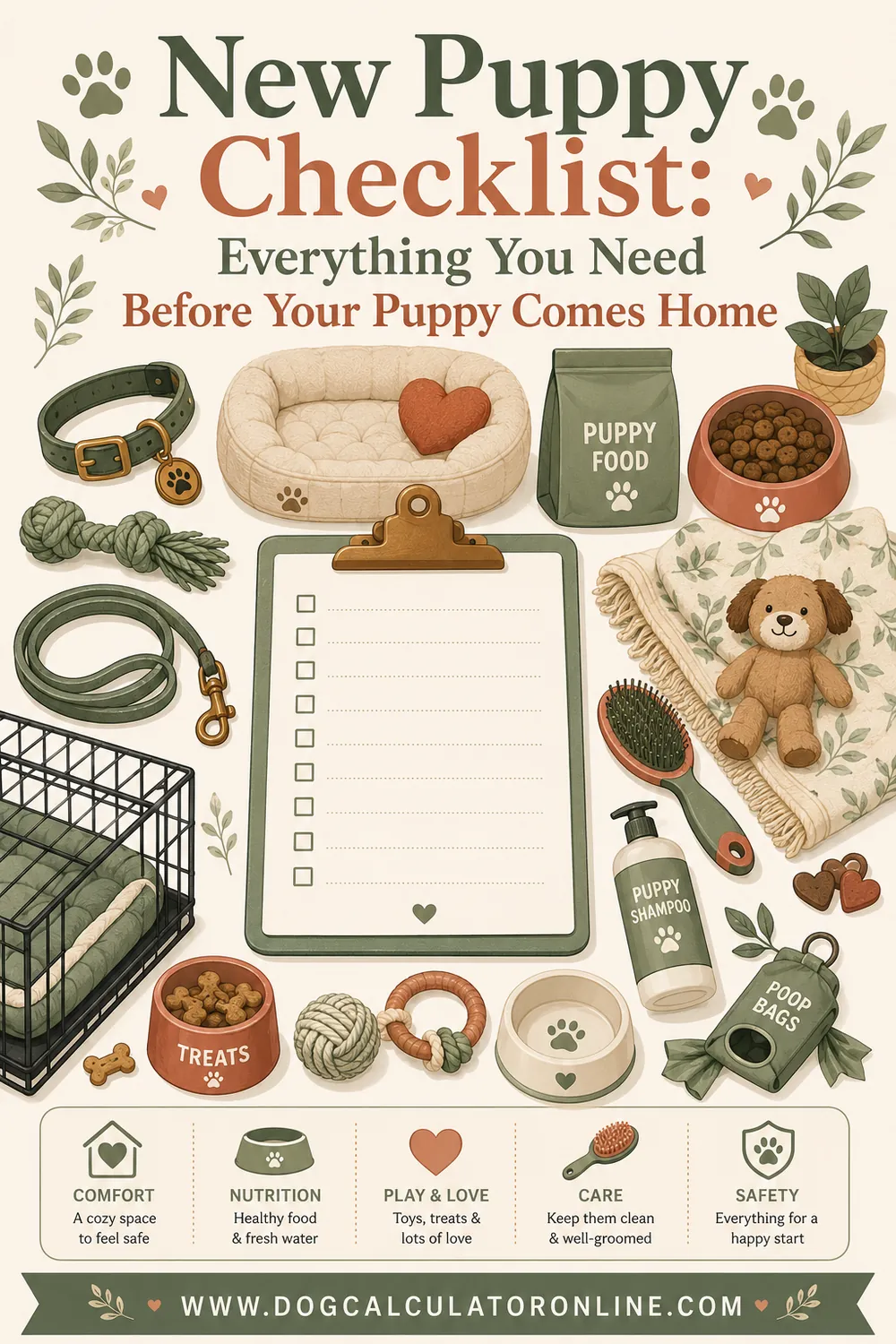
Do not skip puppy-proofing because the puppy seems slow and sleepy. It will not stay slow. The room-by-room list is in puppy-proofing your home checklist, and the supplies you should already have are in new puppy checklist.
Do not bath the puppy unless it is genuinely filthy. It smells of its litter, and that smell is doing useful work this week.
When to Call the Vet in the First Week
Most first-week worries are settling. A few are not, and puppies deteriorate quickly.
Book the routine health check for the first 48 to 72 hours. Many breeder contracts require it, and it is when a heart murmur, hernia or retained testicle gets picked up. What happens at that appointment is set out in puppy first vet visit checklist.
Call the same day for:
- Repeated vomiting, especially with diarrhea
- Blood in the stool, or black tarry stool
- Refusing food for more than 24 hours, or two skipped meals in a toy breed
- Lethargy or wobbliness — a puppy that will not get up is an emergency
- Pale gums, which should be bubblegum pink
- Persistent coughing or labored breathing
- A rectal temperature outside 100°F to 102.5°F (37.8–39.2°C)
Low blood sugar is the specific danger in puppies under 4 lb (1.8 kg). Wobbling, glazed eyes or collapse in a tiny puppy that has not eaten is an emergency, not a wait-and-see.
Parvovirus presents as severe vomiting, bloody diarrhea and rapid collapse in an unvaccinated or partly vaccinated puppy. Phone ahead rather than walking into a waiting room.
FAQ
Is it normal for a new puppy not to eat on the first day?
Yes. Most puppies eat little or nothing for the first 24 hours and are back to normal by day two. Keep offering the breeder's food at fixed times. A toy-breed puppy that skips two meals should see a vet the same day because of hypoglycaemia risk.
Should I ignore my puppy crying on the first night?
No. First-night crying is about sudden isolation, not the crate. Move the crate next to your bed so the puppy can hear and smell you, and take it out for a toilet trip if the crying does not settle within a few minutes.
How often should a new puppy go to the toilet in week one?
Every 30 to 60 minutes while awake, plus immediately after waking, eating and playing, and one or two trips overnight. Six to eight accidents a day is normal at eight weeks and drops steadily over the following two weeks.
When can my new puppy meet other people and dogs?
Calm adults from about day five or six, in small numbers. Other dogs only if they are vaccinated, known to be good with puppies, and met on private ground until your vet clears public spaces. Quality of exposure matters more than quantity.
Why is my new puppy's poo runny?
Stress, a water change, a diet change or all three. Three or four days of soft stool is expected. Blood, black stool, or diarrhea alongside vomiting or lethargy needs a vet the same day rather than a wait.
How long until a new puppy settles in?
Most puppies look recognizably themselves by day seven and are properly settled into a routine by three to four weeks. Sleep improves first, house training next, and confidence with visitors last.
Getting Through Week One in One Piece
Week one is triage, not training. Keep the food the breeder used, feed at fixed times, go out every half hour while the puppy is awake, and reward the instant it finishes rather than back indoors. Put the crate beside your bed for the first nights and set an alarm instead of waiting for crying. Let the puppy sleep 18 to 20 hours, redirect biting onto a toy and end play when it repeats, and hold visitors down to two calm people. Book the health check inside 72 hours, and treat vomiting, bloody stool or a flat, wobbly puppy as same-day problems. Weigh on day one and day seven, then check the numbers against the puppy weight calculator.