How to Budget for a New Puppy
Most people budget for a puppy as a single number, and that is why the plan falls over in month three. A puppy budget has three separate parts that behave completely differently: a one-off setup spend before the puppy arrives, a running cost that starts high and settles, and a buffer that must exist from day one because the vaccination calendar and the chewing phase do not wait for payday. Treat them as one pot and the buffer gets spent on a bed. This guide is about the method — how to sequence the spending, when each bill lands, and which early decisions set your costs for the next decade. Get your own numbers from the free dog cost calculator.

🐾 Where are you in the plan?
Tap a stage:
Tap an option above. Setup, running costs and buffer are three budgets, not one.
Budget in Three Buckets, Not One
Separating them is the whole technique, and it takes ten minutes.
Bucket one is setup: everything bought once. Crate, bed, bowls, harness, pen, gates, grooming kit and the puppy itself. Typically $250–$600 plus the purchase or adoption fee.
Bucket two is running cost: what recurs. Food, parasite prevention, insurance, routine vet care, training. This starts at $150–$300 a month for a puppy and settles to the adult figure in monthly cost of owning a dog.
Bucket three is the buffer: money you hold and do not spend. Emergencies, replacements, and the vet visit that was not on the calendar.
Keep bucket three in a different account. The single most common failure is a buffer that quietly becomes a puppy shopping fund in the first two weeks.
The full itemised price list is a separate job. First-year puppy costs sets out every line with figures; this guide is about how to sequence and hold them.
The Setup Spend, and What Can Wait
Half of the standard shopping list can be deferred until you have met the dog.
| Buy before pickup | Typical cost | Can wait |
|---|---|---|
| Crate sized for adult weight, with divider | $60–$180 | Second bed, car crate |
| Two bowls and a week of the breeder's food | $25–$60 | Automatic feeder |
| Flat collar, ID tag, lead, adjustable harness | $40–$90 | Long line, no-pull harness |
| Puppy pen or stair gate | $50–$120 | Additional gates |
| Enzymatic cleaner and puddle pads | $25–$50 | Grooming table |
| Two or three chew toys, one food puzzle | $25–$60 | Toy collection |
Buy the crate for the adult dog, not the puppy. A divider costs a few dollars and saves buying twice, which is the most common $120 mistake new owners make.
Beds are the wrong thing to spend on early. A puppy that is teething, house-training and growing will ruin at least one; buy cheap now and well later.
Secondhand is fine for hard goods. Crates, pens and gates clean easily and cost half. Buy new for anything a previous dog chewed or soiled.
Expect to spend $250–$600 on setup for a normal puppy, more for a giant breed because everything is bigger.
Ask what the breeder or shelter sends home with the dog. Many provide a few days of food, a blanket carrying familiar scent and a record of worming and vaccinations, which removes two purchases and one vet query.
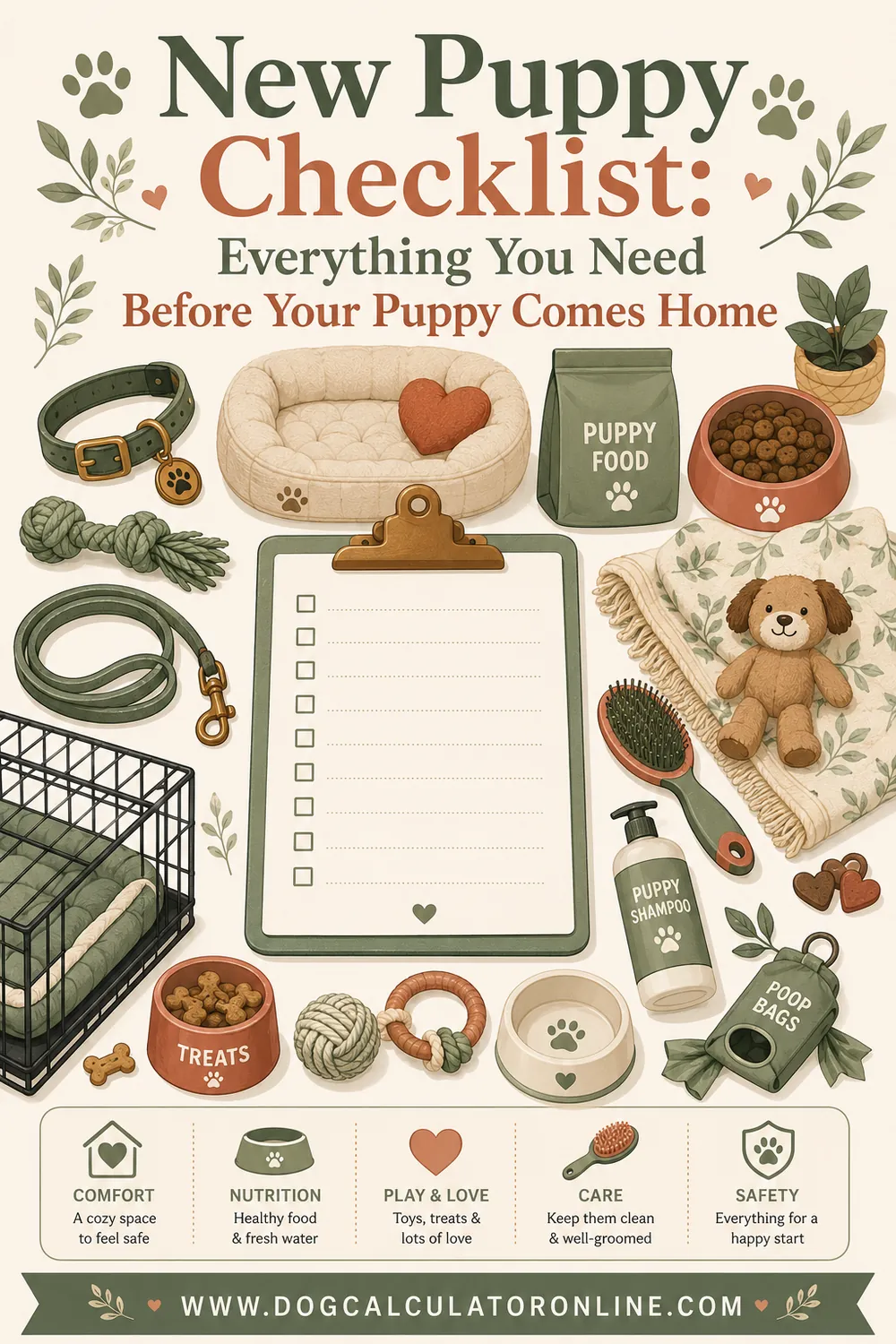
Use a checklist so you buy once. The new puppy checklist covers what is genuinely needed in week one.
Month One Is the Most Expensive Month
The first four weeks compress several bills into one payday.
The registration visit is the first. A new-patient consultation and health check runs $60–$120, and it is worth booking within 48–72 hours of pickup.
Vaccinations are a course, not a single event. A puppy typically needs doses at around 8, 12 and 16 weeks, at $30–$70 each, plus rabies where required.
Parasite treatment starts immediately and repeats. Worming every two weeks until 12 weeks, then monthly, plus flea and tick cover at $15–$30 a month.
Microchipping is $25–$60 and is legally required in many places.
Food changes twice in the first months. Buy small bags while the puppy is growing rapidly rather than a large one that will not be finished before the ration changes.
Book the puppy class in month one, not month three. The socialization window narrows from around 12–16 weeks, so a $120–$250 course booked late is money spent after the most valuable period has passed.
When Each Bill Lands
Knowing the calendar lets you stage the spending instead of absorbing it in one hit.
| Age | What is due | Typical cost |
|---|---|---|
| Week 1 | Registration visit, microchip check, first worming | $80–$180 |
| 8–16 weeks | Vaccination course, puppy class, monthly preventatives | $250–$500 |
| 4–6 months | Teething replacements, intermediate class, growth food | $150–$400 |
| 5–9 months | Neutering or spaying, pre-op checks | $250–$900 |
| 6–12 months | Adult food transition, first adult harness and crate | $80–$250 |
| 12 months | Annual booster, health check, insurance renewal | $200–$450 |
Spaying and neutering is the largest single scheduled bill of year one. Price varies enormously with size, sex and whether a laparoscopic technique is used, and the timing decision matters clinically as well as financially — see best age to spay or neuter a dog.
Ask your practice about a puppy health plan. Monthly plans bundling vaccinations, preventatives and checks typically save 10–20% and convert a lumpy year into a standing order.
Low-cost neutering schemes exist in many areas. Shelters and charitable clinics often run them, and the standard of care is generally high.
Expect the total first year to run two to three times an ordinary year. For most dogs that is $2,000–$4,500 including setup.
The Decisions That Set the Next Decade
Four choices made in the first months determine most of what you will spend by year ten.
Adult size. Food, drug doses, boarding rates and kit all scale with adult weight. A dog that finishes at 70 lb (32 kg) rather than 30 lb (14 kg) costs roughly $800–$1,200 more every year.
Coat type. A clipped coat commits you to a groomer every six to eight weeks at $50–$120, which is $400–$900 a year for the dog's whole life. A short flat coat costs nothing at the groomer.
Insurance, taken now or not at all. Every insurer excludes pre-existing conditions, so the cheapest and most useful moment to buy cover is while the puppy is healthy — is pet insurance worth it for a puppy sets out the arithmetic.
Whether anyone is home during the day. The same dog costs $110 or $450 a month depending on whether it needs daycare or a walker. This is the largest single lever in an adult budget.
Training early rather than remedially. A $150 puppy class is the cheapest behavioral spend available; a behaviorist consultation at 18 months is $300–$700 plus follow-ups.
Building the Buffer From Week One
The buffer is the part of the plan that gets skipped, and the part that decides whether the budget survives.
Start a standing transfer the week the puppy arrives. $50–$80 a month is a realistic target for most households.
Aim for $1,500 by the first birthday. That covers most single emergency consultations with diagnostics, and it is achievable at $60 a month plus a small starting deposit.
Then aim for $3,000 by year three. That level covers the great majority of non-orthopedic emergencies outright.
Puppies find trouble. Swallowed socks, corn cobs, chocolate and grapes are among the commonest emergency presentations in dogs under a year, and each of them is a same-day vet call rather than a wait-and-see.
Keep a written list of what the buffer is for. Emergencies, dentals, unplanned boarding and household damage. Anything not on the list comes out of the running-cost bucket instead.
Do not raid the buffer for the setup list. If the setup spend does not fit, buy secondhand and delay — the buffer is the one bucket that has to be intact.
Where New Owners Overspend
Almost all of it is concentrated in the same handful of lines.
Buying twice. Puppy-sized crates, collars and beds replaced within months. Buy for the adult where the item allows it.
Premium food chosen on marketing rather than on the label. A complete diet appropriate to the growth stage and adult size is what matters; a doubled food bill does not buy a proportionally better dog.
Supplements without a clinical reason. Joint, coat and calming supplements add $20–$60 a month and mostly lack good evidence in healthy puppies. Ask your vet whether a specific one is indicated.
Excess toys. Three or four durable toys rotated beats a basket of twenty, and puppies engage more with rotation than with volume.
Skipping the cheap protective spends. Vaccinations, parasite prevention, a puppy class and early insurance are the four lines where saving reliably costs more later, as the lines set out in the hidden costs of owning a dog show.
A Worked Twelve-Month Plan
One example, for a medium crossbreed puppy from a shelter, in a household with someone home part of the day.
Before pickup: $520. Adoption fee $250, crate with divider $90, harness, lead and tag $55, bowls and first food $45, pen $50, cleaner and pads $30.
Months 1–3: $780. Registration visit and vaccinations $220, monthly preventatives $75, puppy class $180, food $95, replacements and toys $60, insurance at $32 a month $96, buffer transfers $150 held separately.
Months 4–6: $640. Neutering $320, preventatives $75, intermediate class $160, food $85, plus buffer transfers.
Months 7–12: $900. Food $200, preventatives $150, insurance $200, annual booster and check $250, adult harness and crate divider removal $100, plus buffer transfers.
Year-one total: roughly $2,840, plus $600–$750 held in the buffer. That is a realistic figure for a moderately priced puppy budgeted deliberately, and it settles to roughly $1,500–$2,200 a year afterwards.
FAQ
How much should I save before getting a puppy?
Enough for three separate things: the setup spend ($250–$600 plus the purchase or adoption fee), the first three months of running costs (roughly $500–$900), and a starting buffer of at least $500 that you do not touch. For most households that is $1,500–$2,500 available before pickup.
What is the biggest single cost in a puppy's first year?
Usually spaying or neutering at $250–$900, unless you bought from a breeder, in which case the purchase price is larger. Vaccination courses, training classes and setup equipment each typically land in the $150–$500 range but arrive across several months.
Can I budget for a puppy on a low income?
Yes, if you protect four lines: vaccinations, parasite prevention, a puppy class and insurance or a savings buffer. Everything else can be secondhand, delayed or done yourself. Look for shelter adoption fees that include neutering, low-cost clinics, and community-run training classes.
When should I take out pet insurance for a puppy?
Before any symptom is recorded — ideally in the first week. Every insurer excludes pre-existing conditions, and a note in the clinical record from month two can exclude a whole body system for life. Premiums are also at their lowest at this age.
How much a month does a puppy cost after the setup spend?
Typically $150–$300 a month across the first year for a medium dog, covering food, preventatives, insurance, training and a share of the vaccination course. That settles to roughly $110–$200 a month for an adult of the same size once the one-offs are done.
Should I buy everything before the puppy comes home?
No. Buy the crate, bowls, lead, harness, pen and cleaner before pickup, and wait on beds, extra toys, long lines and grooming equipment until you know the dog's size, coat and chewing habits. Roughly half of a standard shopping list can be safely delayed.
Sequence the Spending, Then Protect the Buffer
A puppy budget works when it is three budgets. Set aside the setup spend and buy for the adult dog wherever the item allows it. Map the running costs against the vaccination and neutering calendar so nothing arrives as a surprise. And start the buffer in week one, at $50–$80 a month, aiming at $1,500 by the first birthday and $3,000 by year three. Expect year one to run two to three times an ordinary year — around $2,000–$4,500 for most dogs — and expect the decisions you make in the first months about size, coat, insurance and daytime cover to set your costs for the next decade. Build yours with the free dog cost calculator.