14 Dog Years in Human Years: How Old Is a 14-Year-Old Dog?
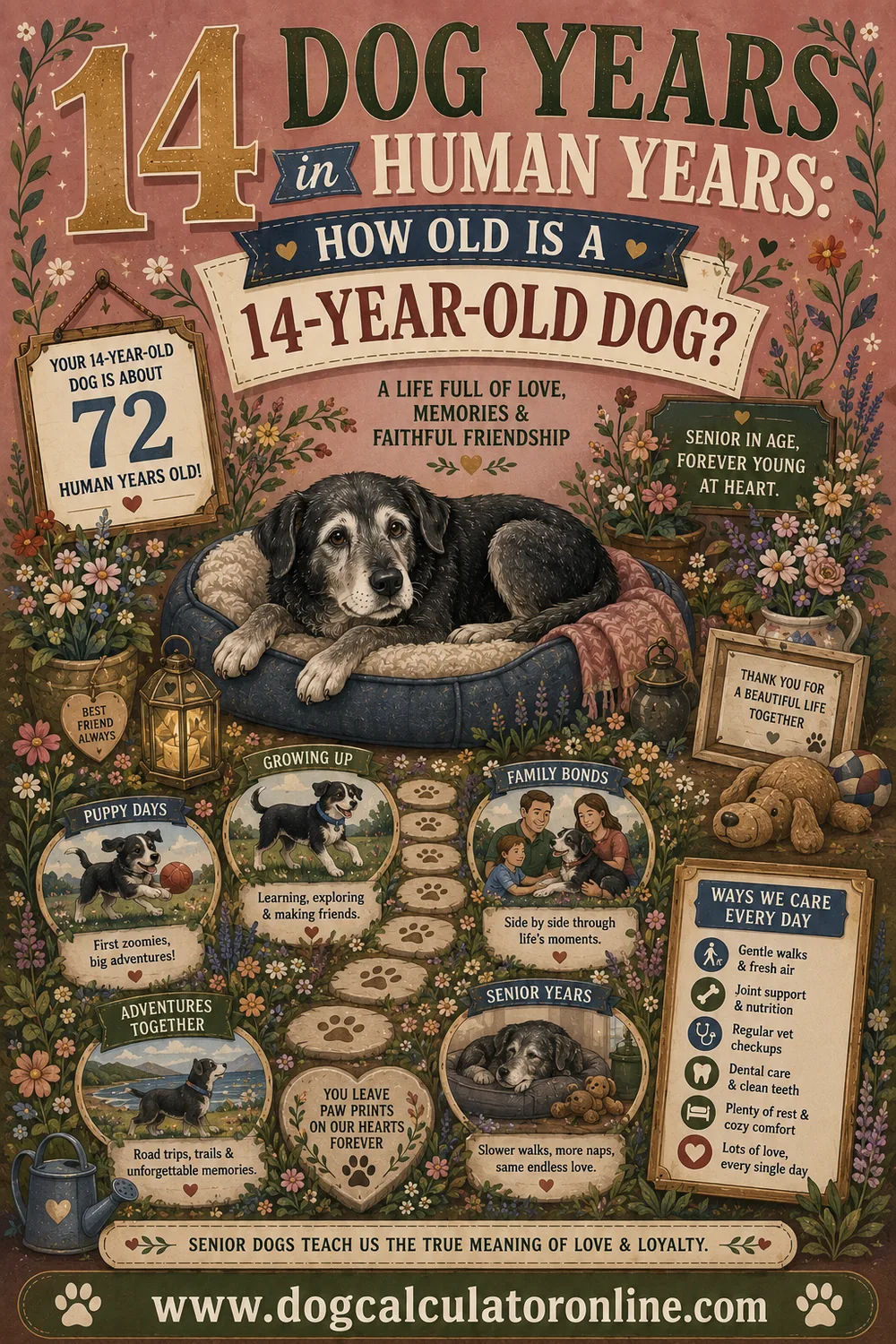
A 14-year-old dog is about 72 to 108 in human years, depending on size: roughly 72 for a small dog, 84 for a medium, 96 for a large, and 108 for a giant breed. Fourteen is a geriatric milestone for any dog — routine for a healthy Chihuahua, near-record territory for a Rottweiler, and virtually unheard of for a Great Dane.
Get your dog's exact figure at the free dog age calculator, which runs the size-adjusted math and the 2019 DNA-study formula together. Here's what 14 really means, and how to care for a dog in the deep senior years.
🐾 Quick check: how old is a 14-year-old dog?
Tap your dog’s size class to see the human-year equivalent at age 14:
Tap a size above to see the answer.
The Short Answer: 14 Dog Years ≈ 72–108 Human Years
The vet-backed size-adjusted method counts about 15 human years for a dog's first year, 9 for the second, then adds 4–7 per year by adult weight. At 14, that's 24 plus twelve size-adjusted years:
| Size class | Adult weight | Math | 14 dog years in human years |
|---|---|---|---|
| Small | Under 20 lb | 24 + (12 × 4) | ≈ 72 |
| Medium | 21–50 lb | 24 + (12 × 5) | ≈ 84 |
| Large | 51–90 lb | 24 + (12 × 6) | ≈ 96 |
| Giant | Over 90 lb | 24 + (12 × 7) | ≈ 108 |
The old 7:1 rule says 98 for everyone — 26 years too old for a small dog. At the geriatric end of life, that error matters: it makes owners of perfectly healthy 14-year-old terriers think their dog is on borrowed time, when the honest equivalent is a spry 72.
Who Reaches 14? A Reality Check by Size
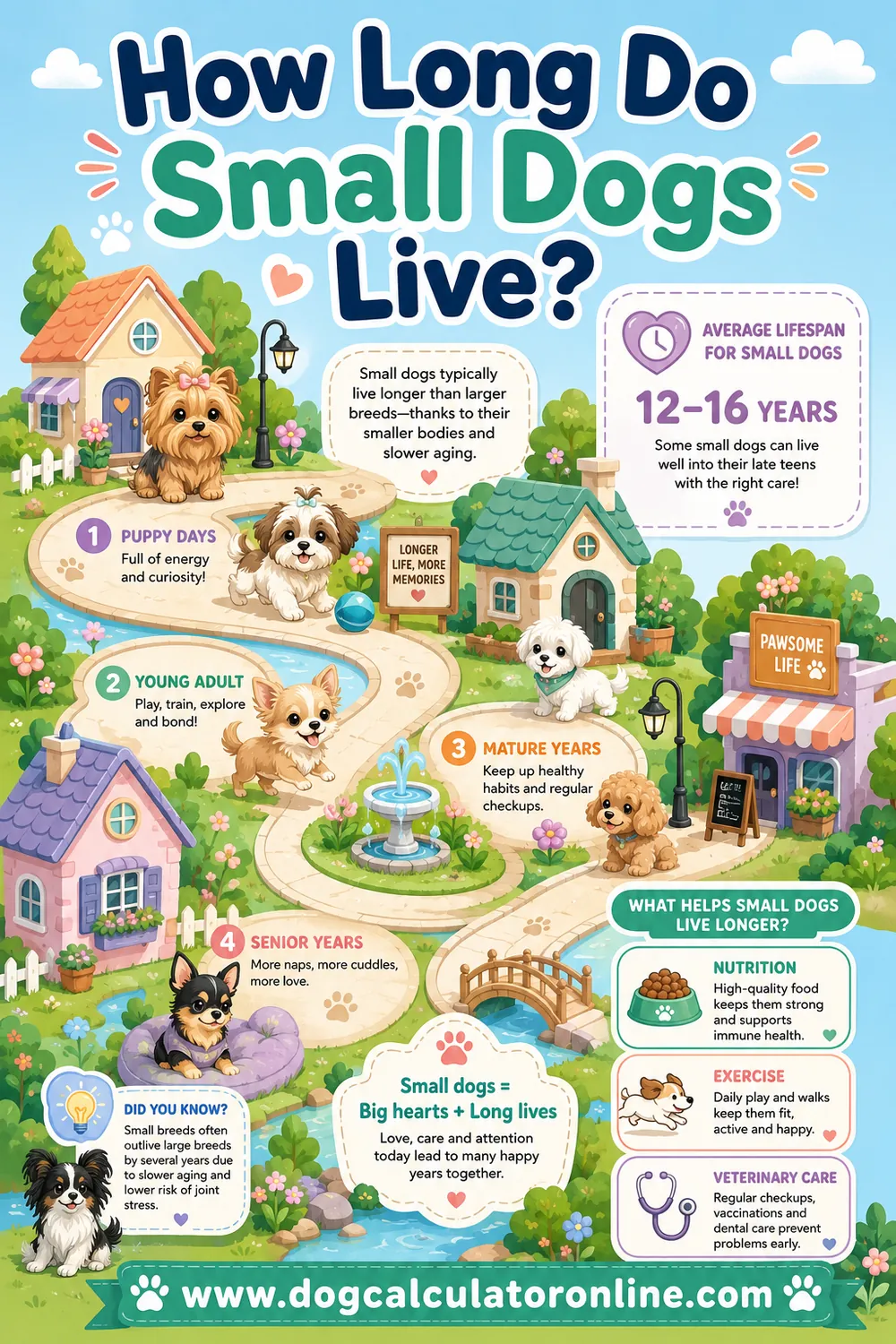
- Small breeds (≈72): Common and often comfortable. Many small dogs — Chihuahuas, Toy Poodles, Shih Tzus, Dachshunds — routinely live 14–16 years. A healthy small 14-year-old may still enjoy a year or three of good life.
- Medium breeds (≈84): An achievement. Fourteen sits at or past the typical 10–14 year range for medium dogs. These are bonus-round years.
- Large breeds (≈96): Rare and remarkable. Typical large-breed lifespans run 8–12 years; a 14-year-old Lab or Shepherd is a genuine outlier, effectively a canine 96-year-old.
- Giant breeds (≈108): Almost unknown. With typical lifespans of 8–10, giants essentially never see 14. One who does has more than doubled some of its peers.
This is why "is 14 old for a dog?" has no single answer. For your dog specifically, plug age and weight into the free dog age calculator and see where they land.
The DNA Study's Number: About 73
The 2019 UC San Diego study derived an epigenetic aging formula from DNA methylation patterns in about a hundred Labrador Retrievers:
Human age = 16 × ln(dog age) + 31
For age 14: 16 × ln(14) + 31 ≈ 73 human years.
Here the two methods tell very different stories. The size-adjusted guideline puts a large 14-year-old at 96; the DNA clock says 73. Why? Because the epigenetic curve is nearly flat by now — from age 10 to age 14 it adds only about 5 human-equivalent years. At the molecular-marks level, the study suggests, very old dogs change slowly.
Which should you believe? For care decisions, neither number outranks your actual dog. The guideline better matches functional reality — a 14-year-old large breed needs 96-year-old-level support, not 73-year-old-level. The DNA figure is best enjoyed as science trivia, with the usual caveats: Labrador-based, population-level, not a prognosis.
Life With a Geriatric Dog
Fourteen-year-olds live small, deep lives. What most owners see:
- The world shrinks pleasantly. Shorter walks, favorite sunny spots, well-worn routes. That's not sad — old dogs genuinely prefer the familiar, and routine keeps them confident.
- Sleep dominates. Sixteen to eighteen hours is common. Watch for quality: a dog who settles easily is resting; one who circles, pants, or repositions constantly may be uncomfortable — tell your vet.
- Senses are well faded. Most 14-year-olds hear and see substantially less. Approach visibly, keep floors clutter-free, and don't move the furniture.
- Cognitive changes are common. Getting "stuck" in corners, staring at walls, confusing day and night, forgetting house training. These are recognized signs of canine cognitive dysfunction — a vet conversation, not a scolding matter.
- Every meal is a vote. Appetite is the clearest daily signal of how a geriatric dog feels. Changes deserve prompt attention, since dental pain, nausea, and organ disease all show up at the bowl first.
Caring for a 14-Year-Old: Comfort Is the Goal
At 72–108 human-equivalent years, the mission statement simplifies: maximize comfort, minimize surprises. With your vet steering the medical side:
- Vet visits every six months — or as often as your vet advises. Geriatric dogs benefit from frequent monitoring; in dog-time, a year between exams is half a decade.
- Bloodwork and urinalysis on schedule. Kidney and liver trends caught early are manageable; caught late, they're crises.
- Treat pain as a solvable problem. Stiffness, slow rising, and stair refusal are arthritis speaking. Modern veterinary options can transform a geriatric dog's daily comfort — but only through your vet, never the home medicine cabinet.
- Engineer the house. Rugs on slick floors, ramps where jumps used to be, night lights for dim eyes, water bowls on every floor. Think grab-bars-for-grandma, dog edition.
- Feed for the individual. Some geriatric dogs need fewer calories; underweight ones need more, and appetite coaxing. This is bespoke territory — your vet's call.
- Keep joy on the menu. Gentle sniff walks, car rides with the window cracked, brushing sessions, simply being near you. Quality of life at 14 is mostly made of small familiar pleasures, generously supplied.
The Whole Journey: How a Dog Reaches 72–108
Seeing the full timeline puts 14 in perspective. Here's the complete size-adjusted path from puppyhood to this birthday:
| Dog's age | Small | Medium | Large | Giant |
|---|---|---|---|---|
| 1 | 15 | 15 | 15 | 15 |
| 2 | 24 | 24 | 24 | 24 |
| 5 | 36 | 39 | 42 | 45 |
| 8 | 48 | 54 | 60 | 66 |
| 11 | 60 | 69 | 78 | 87 |
| 14 | 72 | 84 | 96 | 108 |
Notice how the lines fan out: identical at 2, nine years apart at 5, thirty-six years apart at 14. Every year, a giant breed travels almost twice as much human-equivalent distance as a small one. It's why a 14-year-old Chihuahua and a 14-year-old Shepherd — same calendar, same gray muzzle — are living entirely different chapters.
For in-between ages, pro-rate the current year: a small dog at 14 and a half is 72 + (0.5 × 4) = 74. Or let the free dog age calculator handle years, months, and size class in one go.
What Owners of 14-Year-Olds Say They Learned
Talk to people who've walked a dog into deep old age and the same lessons repeat — worth hearing before you need them:
- "I wish I'd treated the arthritis sooner." The most common regret. Stiffness that crept in at 11 often turns out to have been manageable pain; by 14, mobility preserved early is mobility you still have.
- "The notes helped more than I expected." A one-line daily log — ate, walked, wagged — turned anxious guesswork into clear conversations with the vet, especially on the hard questions.
- "Routine was the kindest gift." Old dogs flourish on predictability. The owners who stopped rearranging life around novelty and leaned into sameness watched their dogs relax.
- "Small joys scaled down, not off." The hike became the block, the block became the yard — and the tail kept wagging. Enjoyment doesn't retire; it just shortens its commute.
- "Every extra season felt earned." Fourteen is past the average for all but the smallest dogs. Owners describe these years less as borrowed time and more as the dividend of a lifetime of care.
Fourteen in Context: The Birthdays on Either Side
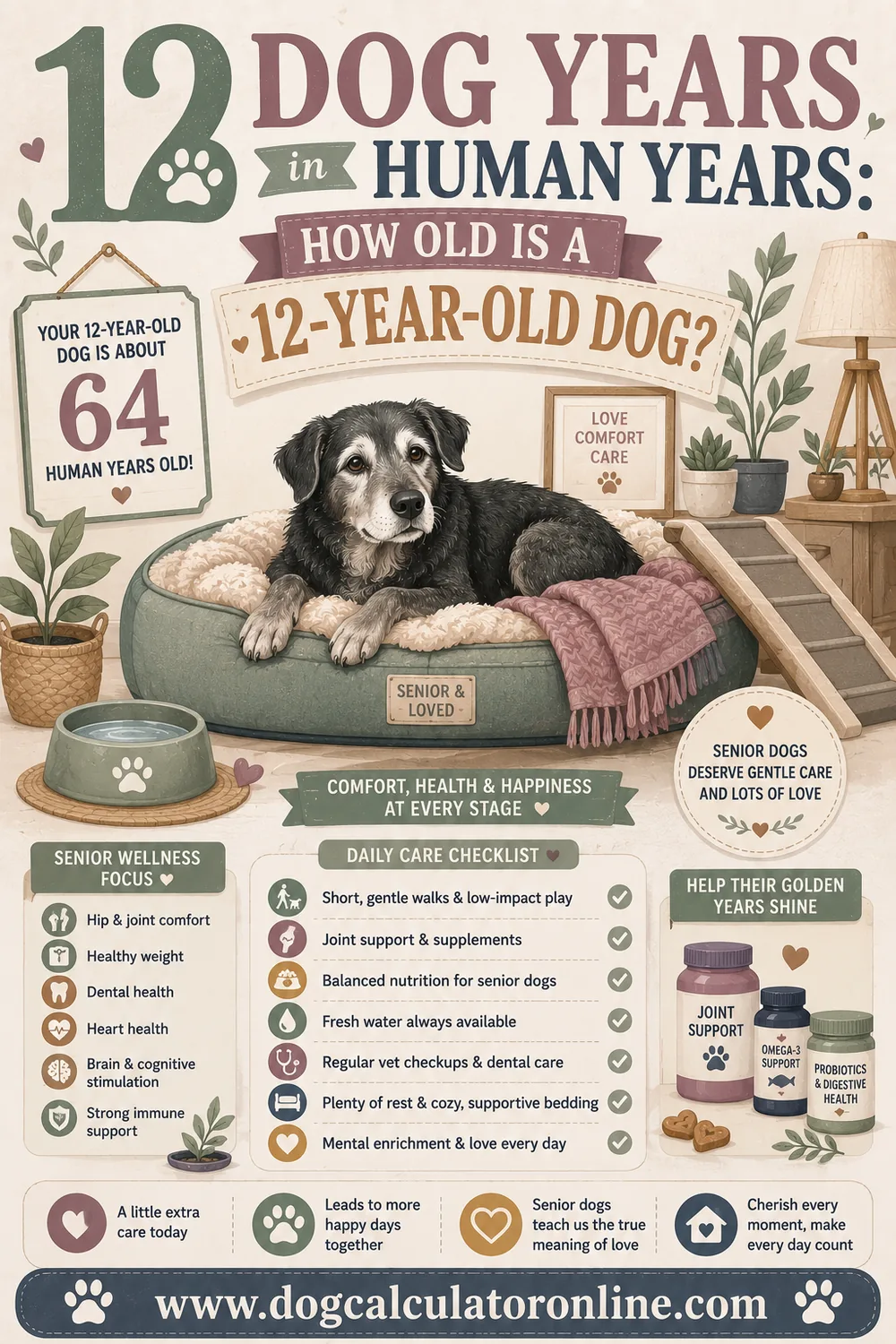
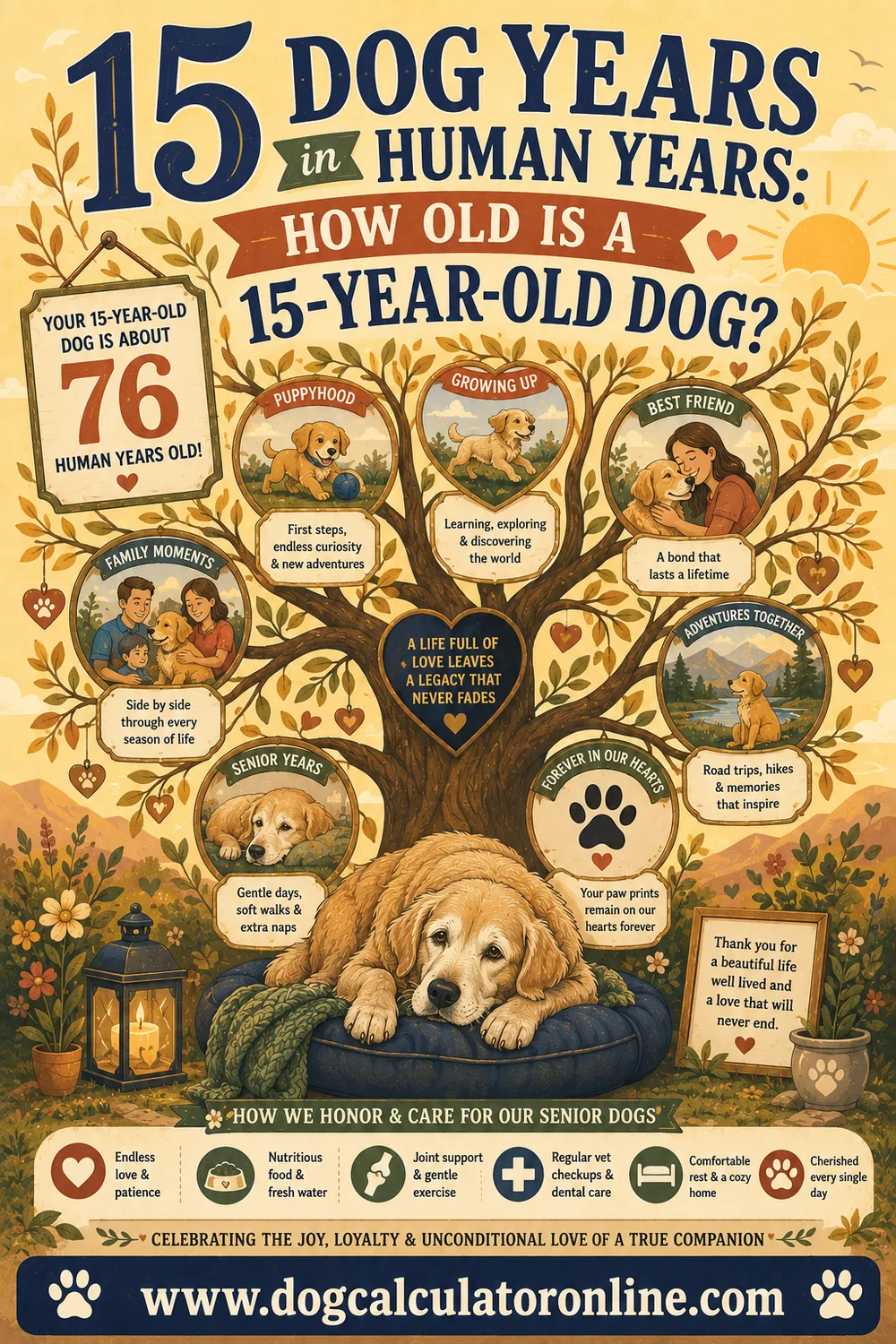
One step back and one step forward frames this milestone. At 12 dog years, a small dog was about 64 — the difference between then and now is roughly a human decade's worth of aging packed into two calendar years. Looking ahead to 15, that same small dog will be about 76, and each subsequent birthday adds another 4 human-equivalent years; a medium dog adds 5.
The practical upshot: at 14, a single year is a big chapter, which is why vets like six-month check-ins and why owners of geriatric dogs learn to think in seasons rather than years. Plans made now — comfort upgrades, monitoring routines — get used immediately and often.
Related Guides
If this helped, these go deeper on the same question:
- 12 Dog Years in Human Years: How Old Is a 12-Year-Old Dog?
- 15 Dog Years in Human Years: How Old Is a 15-Year-Old Dog?
- Senior Dog Care: A Practical Checklist
- How Long Do Small Dogs Live?
And if you just want your own dog's number, the free dog age calculator does it in one tap.
FAQ
How old is a 14-year-old dog in human years?
About 72–108 depending on size: 72 for small dogs, 84 for medium, 96 for large, and 108 for giant breeds, by the vet-backed size-adjusted method.
Is a 14-year-old dog 98 in human years?
That's the old 7:1 myth. The honest answer ranges from 72 for a small dog to 108 for a giant — the flat rule misses small breeds by 26 years at this age.
Is 14 very old for a dog?
For small breeds, 14 is senior but commonly reached. For mediums, it's the far edge of typical lifespan. For large and giant breeds, it's exceptional — the canine equivalent of the late 90s and beyond.
What does the DNA study say for age 14?
About 73 human years. The 2019 UCSD epigenetic curve flattens sharply in later life, so it reads much lower than the size-adjusted guideline for big dogs at this age.
How often should a 14-year-old dog see the vet?
At least twice a year, typically with bloodwork — and more often if your vet recommends it or anything changes. Geriatric health can shift fast; frequent monitoring keeps small issues small.
Can a 14-year-old dog still have good quality of life?
Yes — especially small breeds, many of whom enjoy comfortable, happy years at 14 and beyond. The keys are managed pain, steady routine, lean weight, and an owner who notices things.
The Bottom Line
Fourteen dog years equal about 72–108 human years — a hale 72 for the smallest dogs, a once-in-a-generation 108 for the giants. Whatever the size, a 14-year-old dog has earned geriatric-grade care: frequent vet partnership, an engineered-for-comfort home, and days built around the simple things they love.
See your dog's exact size-adjusted age — plus the DNA-study figure — free at the dog age calculator.