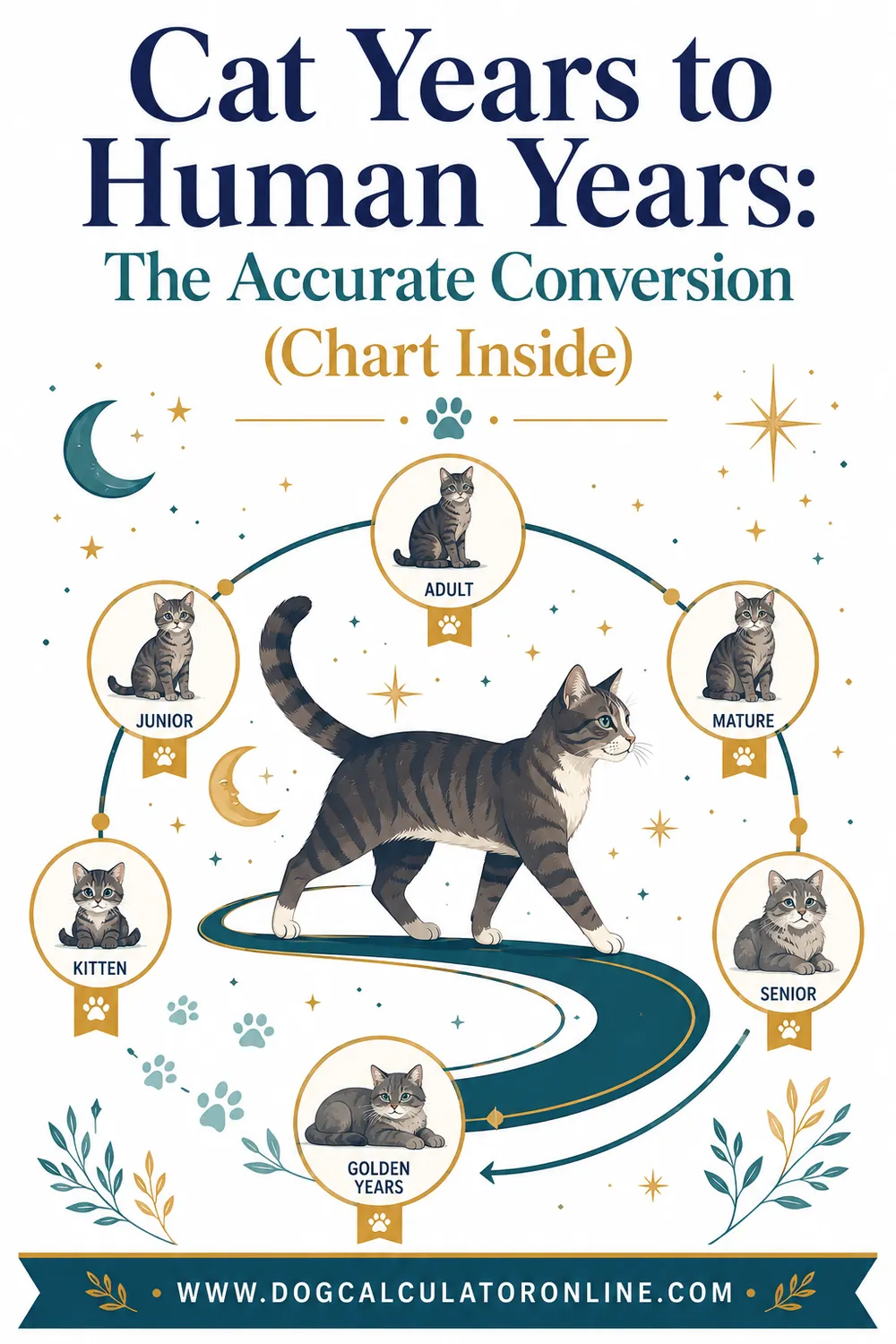
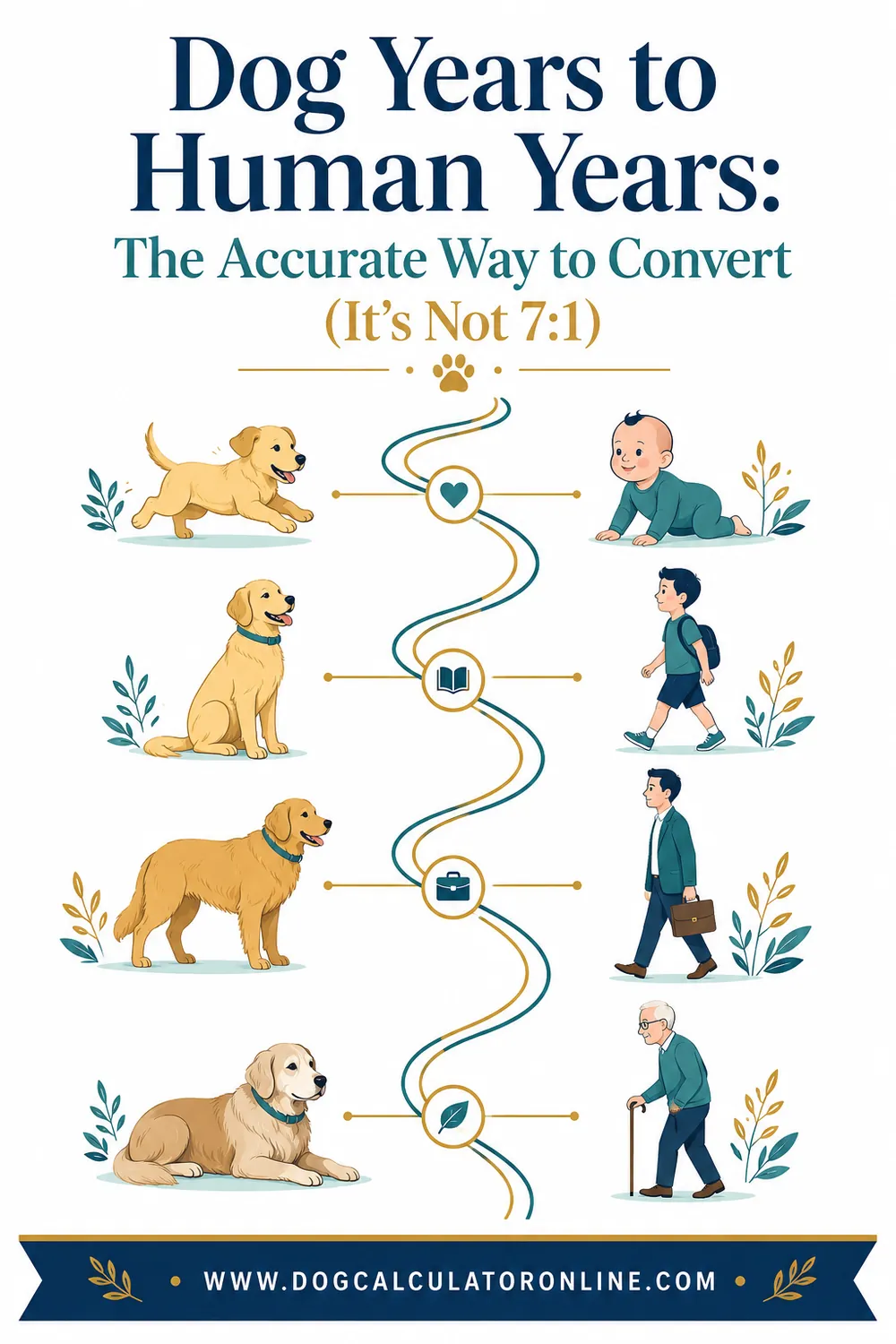
Cat Years vs Dog Years: How They Compare
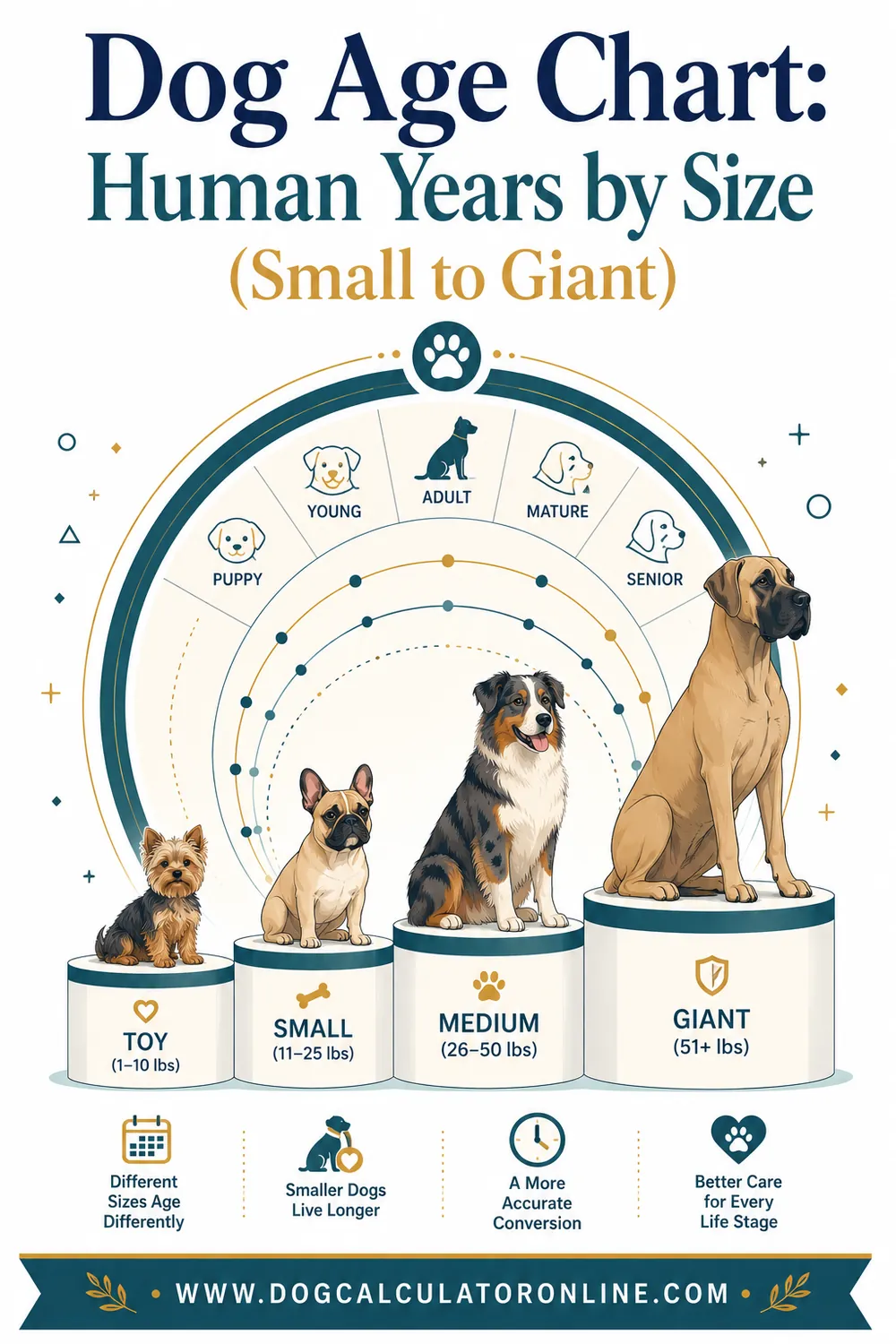
There is one structural difference between the two conversions and everything else follows from it. A cat's age converts with a single formula that works for almost every cat; a dog's needs a size adjustment, because a chihuahua and a great dane of the same calendar age are years apart in human-equivalent terms. Both species front-load their aging in much the same way — roughly 15 human years in the first year and about 24 by the second birthday — and then a cat settles at around four human years annually while a dog runs at four to seven depending on adult weight. Here are both charts, side by side, with the arithmetic behind them. Convert any age with the free dog age calculator.

🐾 Convert an age
Tap an animal and age:
Tap an option above. One formula fits cats; dogs need a size adjustment.
Both Charts, Side by Side
This is the comparison most people are looking for, in one place.
| Calendar age | Cat | Small dog (under 25 lb / 11 kg) | Medium dog (25–60 lb / 11–27 kg) | Large dog (60–100 lb / 27–45 kg) | Giant dog (100 lb+ / 45 kg+) |
|---|---|---|---|---|---|
| 1 | 15 | 15 | 15 | 14 | 12 |
| 2 | 24 | 24 | 24 | 22 | 22 |
| 3 | 28 | 28 | 28 | 31 | 31 |
| 4 | 32 | 32 | 32 | 38 | 38 |
| 5 | 36 | 36 | 36 | 40 | 45 |
| 6 | 40 | 40 | 42 | 45 | 49 |
| 7 | 44 | 44 | 47 | 50 | 56 |
| 8 | 48 | 48 | 51 | 55 | 64 |
| 10 | 56 | 56 | 60 | 66 | 79 |
| 12 | 64 | 64 | 69 | 77 | 93 |
| 14 | 72 | 72 | 78 | 88 | — |
| 16 | 80 | 80 | 87 | 99 | — |
| 20 | 96 | 93 | — | — | — |
Notice how closely the cat and small-dog columns track each other. They diverge by only a year or two across two decades, which is the clearest evidence that body mass rather than species drives most of the difference.
The giant-dog column is the outlier at every row past three. By eight it is 16 human years ahead of the cat column.
These are conventions, not measurements. Different veterinary bodies publish slightly different tables, and no formula fits every individual animal.
The dog age chart gives the dog side in more detail, and cat years to human years does the same for cats.
How the Cat Conversion Works
The cat formula is the simpler of the two because there is almost nothing to adjust for.
Year one equals about 15 human years. A twelve-month-old cat is physically mature, sexually mature and behaviorally adolescent.
Year two adds about nine more, reaching 24. By two a cat is a fully finished young adult.
Every year after that adds about four. Three is 28, five is 36, ten is 56, fifteen is 76.
Breed barely changes it. Maine coons take longer to reach full size and live slightly shorter lives on average, but the conversion is not adjusted for breed in the way the dog conversion is for size.
Indoor and outdoor living changes lifespan, not aging rate. An outdoor cat is not biologically older at five; it is simply less likely to reach fifteen.
How the Dog Conversion Works
The dog side needs one extra input, and getting it wrong is the commonest error people make.
Year one is roughly 15 human years for small and medium dogs, slightly less for large and giant ones. Big dogs take longer to finish growing, so their first year covers less developmental ground.
Year two brings all sizes to roughly 22–24.
From year three the annual increment splits by size: about four human years for a small dog, five for a medium, six for a large and seven for a giant.
Adult weight is the input, not breed name. A 55 lb (25 kg) crossbreed uses the medium column whatever its ancestry, which is why how old is my dog in human years asks for weight.
The size effect compounds. Two extra human years a year does not sound like much until a dog is twelve, at which point the gap between a terrier and a dane is nearly thirty human years.
What the DNA Research Added
A 2019 study gave the dog side its first genuinely biological footing, and it is worth knowing its limits.
The researchers compared methylation patterns — chemical marks on DNA that accumulate predictably with age — in dogs and humans. The resulting formula was human age ≈ 16 × ln(dog age) + 31.
It maps early life much better than any linear rule. It puts a one-year-old dog at about 31 human years, which fits the reality of a sexually mature, fully grown adolescent better than the traditional 15.
Its major limitation is the sample. The work was based on labrador retrievers, so it does not carry the size adjustment that matters most across the whole species.
No equivalent epigenetic clock has been as widely publicised for cats, which is part of why the cat conversion remains a life-stage convention.
Use the size-adjusted table for practical decisions. The logarithmic formula is the better description of early aging; the size-adjusted chart is the better tool for deciding when to start senior screening.
Comparing Your Own Cat and Dog
Three worked examples, since this is usually the real question.
A 12-year-old cat and an 8-year-old labrador. The cat is about 64 human years, the labrador about 55. The older-looking animal is the cat, and the cat is genuinely older.
A 10-year-old cat and a 10-year-old great dane. The cat is about 56, the dane about 79. Same birthday, twenty-three human years apart.
A 6-year-old cat and a 6-year-old jack russell. Both about 40. These two really are the same age in every sense that matters.
The rule of thumb that follows: compare a cat to a small dog and expect a match; compare it to anything over 60 lb (27 kg) and expect the dog to be older.
Whether cats age faster is a separate question from the conversion. Do cats age faster than dogs covers the biology behind the divergence.
Life Stages Do Not Line Up Either
The named stages are more useful than the numbers for deciding on care, and they arrive at different times.
| Stage | Cat | Small dog | Large dog |
|---|---|---|---|
| Growth | 0–1 year | 0–1 year | 0–18 months |
| Young adult | 1–6 years | 1–6 years | 18 months–4 years |
| Mature | 7–10 years | 7–9 years | 5–7 years |
| Senior | 11–14 years | 10–13 years | 6–9 years |
| Geriatric | 15+ years | 14+ years | 10+ years |
The senior label is about screening, not decline. It marks the point at which twice-yearly checks and baseline bloodwork start paying for themselves.
Giant breeds may be flagged senior from five. That can be startling for owners of a dog that still behaves like an adolescent.
Cats hide age-related illness particularly well. Chronic kidney disease and hyperthyroidism are common from eleven and often present only as gradual weight loss or increased thirst.
Lifespan expectations follow the same pattern as the conversions. Dog life expectancy by size sets out the ranges by band.
The Myths Worth Dropping
Three persistent ideas make both conversions less useful than they should be.
"One year equals seven" is wrong for both species. It would make a one-year-old dog a seven-year-old child, when a one-year-old dog can reproduce and has a fully grown skeleton.
"Big dogs age faster because their hearts work harder" is not the accepted explanation. The current evidence points to rapid growth and elevated growth-hormone and IGF-1 signalling in puppyhood, and to earlier onset of cancer in large breeds.
Gray muzzles do not date an animal. Both cats and dogs can gray from three, and premature graying tracks pigment genetics and stress rather than biological age.
Teeth are a better guide than coat color, but only roughly. Wear, tartar and gum recession give a usable estimate in a dog or cat of unknown age, and vets use them alongside eye lens changes.
Neutering does not slow aging, but it does extend average life. The gain comes from avoiding roaming, fighting, accidents and reproductive cancers, and it is largest in animals with outdoor access.
Using the Numbers Well
The conversion is a communication tool. It earns its keep when it changes something you do.
Use it to set the screening clock. When your animal's converted age crosses about 50, that is the point to start annual bloodwork; past about 60, twice-yearly checks.
Use it to interpret behavior. A one-year-old of either species is an adolescent, not a child, which explains a great deal of the behavior owners find baffling at that age.
Do not use it to compare a healthy old animal with an unhealthy young one. Body condition, dental health and mobility tell you more about biological age than any chart.
Weigh your dog before converting. The size band is the single input people guess at, and guessing weight by eye is unreliable by 20% or more.
Call the vet within days, not months, for any sudden change in an older animal — increased thirst, weight loss, reduced appetite, new lethargy or difficulty rising. Six months in a senior large dog is roughly three human years, and that is time you rarely want to spend waiting. Convert both animals in seconds with dog years to human years.
FAQ
Are cat years and dog years the same thing?
No. Both species reach roughly 15 human-equivalent years at one and 24 at two, but after that a cat adds about four human years annually regardless of breed, while a dog adds four to seven depending on adult weight. Dog conversions need a size input; cat conversions do not.
Is my 10-year-old cat older than my 10-year-old dog?
It depends on the dog's size. A ten-year-old cat is about 56 human years, the same as a small dog. A large dog of ten is about 66 and a giant breed about 79, so a cat is younger than both of those and equal to a terrier.
Why do dogs need a size adjustment and cats do not?
Because domestic dogs vary in adult weight by roughly fifty times, while domestic cats vary by about three. With so little variation in body mass, there is almost no size gradient to build into a feline conversion.
What is the most accurate way to convert a dog's age?
Use a size-banded chart based on adult weight. For early life, the 2019 epigenetic formula — 16 × ln(age) + 31 — describes the first two years better, though it was derived from labradors and carries no size adjustment of its own.
Do cats live longer than dogs?
On average, by about two to four years, largely because the average for dogs is dragged down by large breeds. Indoor cats commonly reach 13–17 years and often 20; small dogs reach 14–16; giant breeds average only 7–10 years.
At what converted age should I start senior care?
Around a converted age of 50, which is about eleven for a cat, ten for a small dog, seven for a large one and five for a giant breed. That is the point to start baseline bloodwork and move toward twice-yearly veterinary checks.
Two Charts, One Difference That Matters
Cat years and dog years share a starting shape — about 15 human years in the first year, about 24 by the second birthday — and then part company for one reason: dogs come in fifty-fold size variation and cats do not. That is why one formula covers every cat and why a dog's conversion is meaningless without knowing its adult weight. In practice a cat ages like a small dog, roughly a decade behind a large one by age ten and more than twenty human years behind a giant breed. Weigh the dog, pick the right column, and use the converted age to decide when senior screening starts. Convert both with the free dog age calculator.