Why Do Dogs Age Faster Than Humans?
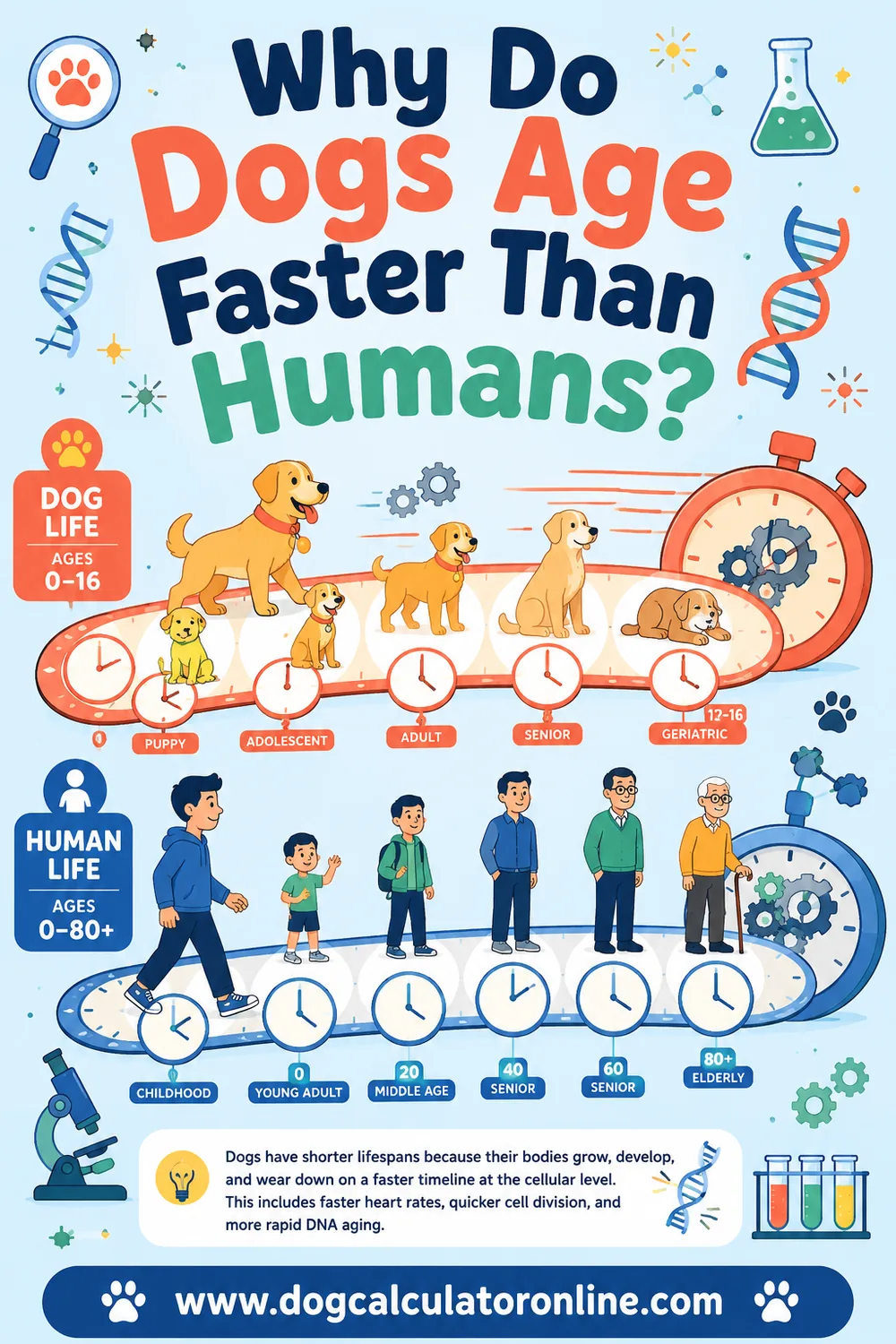
Dogs age faster than humans because they mature far quicker, run faster metabolisms, and are biologically "programmed" for a compressed lifespan. A dog reaches full adulthood in about two years — a milestone humans take around 20 to hit — and a single dog year covers far more biological change than one of ours. It's not that dogs' years are longer; it's that they live them much faster.
Curious how fast that actually is for your dog? Our free dog age calculator converts dog years to human years using the size-adjusted formula vets rely on, so you can see the pace for yourself.
🐾 See how fast dogs age
Tap a dog age to see the human-year equivalent (medium dog):
Tap an age above.
The Big Picture: A Life Lived on Fast-Forward
A dog and a human are built from the same basic biology — cells that divide, tissues that wear, DNA that accumulates changes over time. The difference is speed. Dogs pack the whole arc of a life — birth, childhood, adulthood, old age — into 10 to 16 years instead of 80. Every process that ages a body simply runs faster in a dog.
Several forces drive that pace. Here they are, from the most intuitive to the most surprising.
Reason 1: Dogs Mature Incredibly Fast
The clearest evidence dogs age faster is how early they grow up. A dog can reach sexual maturity by 6–12 months — an age at which a human child is barely walking. By age 2, a dog is a fully mature adult; a human doesn't finish physically and mentally maturing until around 20.
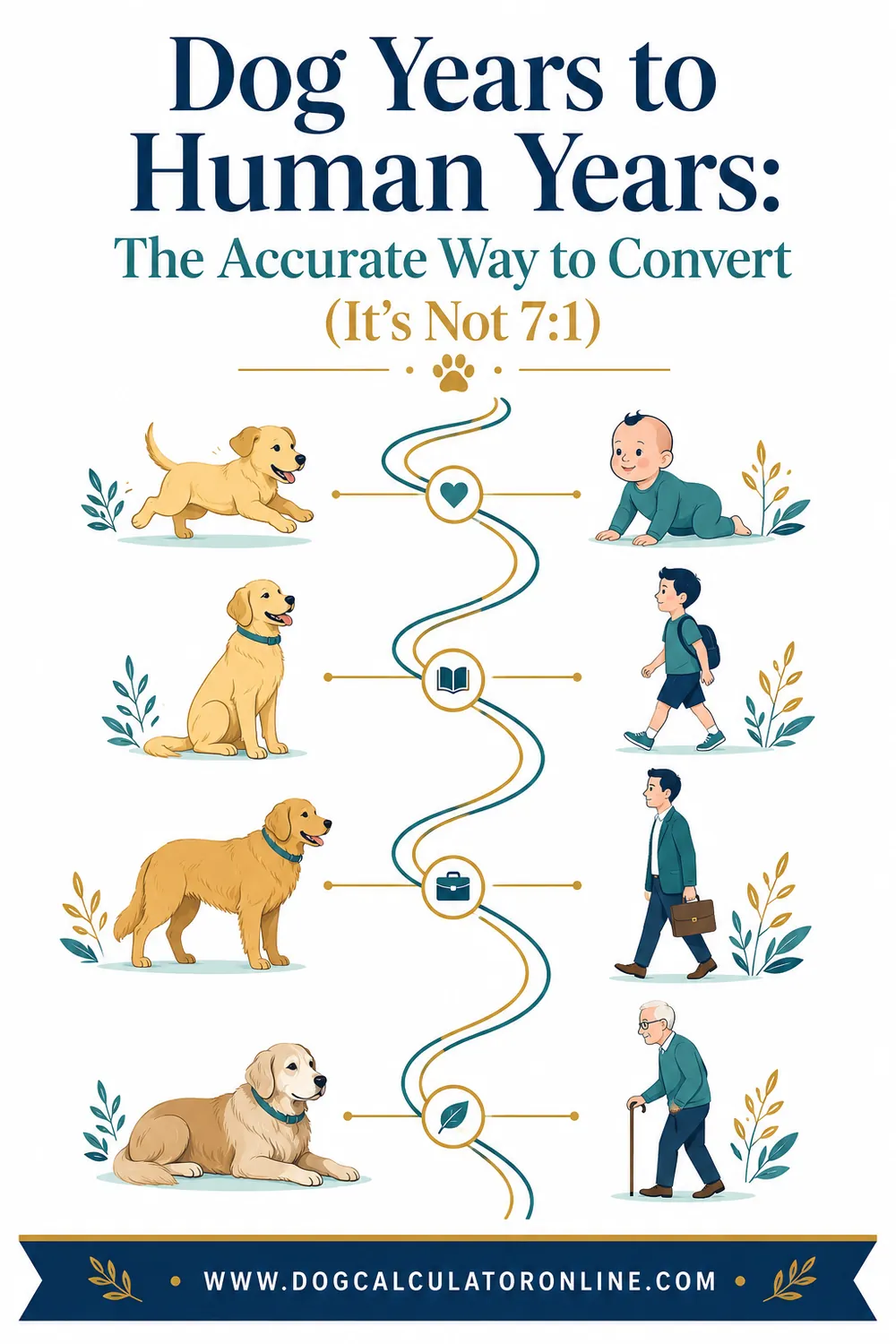
This front-loading is why the old "1 dog year = 7 human years" rule fails so badly. Aging isn't linear. Dogs sprint through early development, which is why the size-adjusted method vets use counts a dog's first year as about 15 human years and the second as 9 more — then slows to 4–7 per year afterward. The steepest aging happens right at the start.
Reason 2: A Faster Metabolism
Smaller, warmer-running bodies tend to burn energy faster, and faster metabolism is broadly associated with faster aging across the animal kingdom. Dogs run hotter and burn through energy quicker than we do, pound for pound.
The leading idea connecting metabolism to aging is cellular wear: the same energy-producing machinery that keeps a body running also generates byproducts (like reactive oxygen species) that gradually damage cells. Run the engine faster and hotter, and — very roughly — the wear accumulates faster. It's one thread in a complex story, but it fits the pattern: small, fast-metabolizing animals often live short, fast lives, while large, slow ones live long.
Which raises an apparent puzzle inside the dog world itself.
Reason 3: The Size Paradox
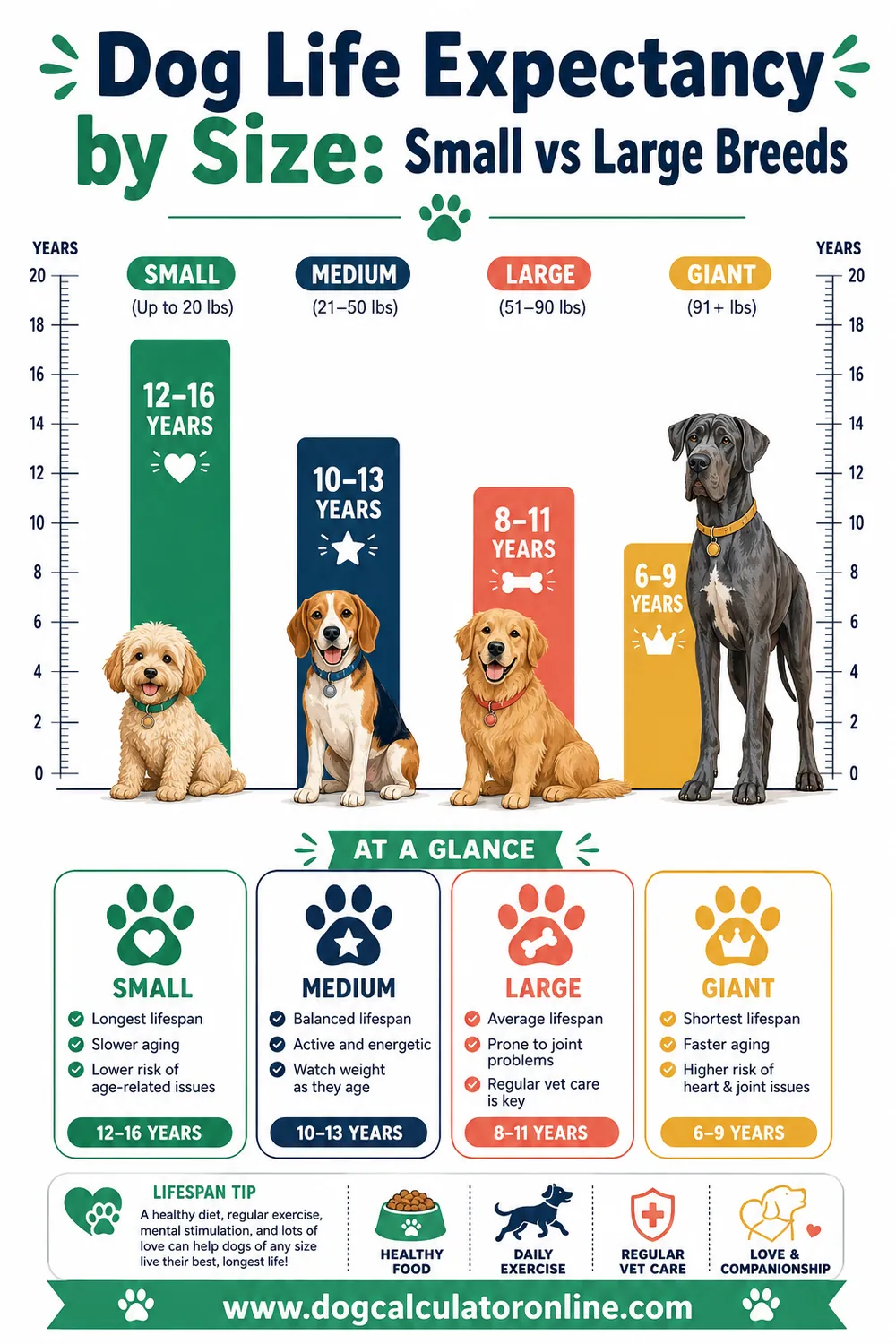
Between species, bigger usually means longer-lived — an elephant outlasts a mouse by decades. But within dogs, it flips: big dogs age faster and die younger than small dogs. A Chihuahua may reach 16; a Great Dane is often a senior by 5 and rarely passes 10.
Why the reversal? The leading explanations:
- Explosive growth. A giant-breed puppy multiplies its birth weight more than a hundredfold in under two years. That torrent of cell division appears to accelerate aging and raise cancer risk.
- Higher IGF-1. Big dogs carry more insulin-like growth factor 1, a hormone that drives size but is linked across species to faster aging.
- Earlier disease onset. Age-related conditions simply arrive earlier on the calendar in big-bodied dogs.
So dogs age faster than humans in general — and among dogs, the bigger ones age faster still. That's exactly why any accurate dog-to-human conversion has to ask your dog's weight, which our free dog age calculator does.
Reason 4: The Evolutionary Logic
Aging speed isn't an accident — it reflects the life a species evolved to live. Biologists frame it around reproduction: animals that mature early, reproduce quickly, and face high natural mortality tend to evolve short, fast lifespans, because there's little evolutionary payoff to bodies built for the very long haul.
Dogs descend from animals that matured fast and reproduced early. Humans took the opposite path — few offspring, enormous parental investment, long lives to raise them. Our biology is tuned for endurance; a dog's is tuned for a quicker turnaround. Neither is "better." They're different strategies, and lifespan follows the strategy.
Reason 5: The DNA Clock
The most modern piece of the puzzle came in 2019, when researchers at the University of California San Diego measured aging directly at the molecular level using DNA methylation — chemical tags on DNA that change predictably as any mammal ages, sometimes called the "epigenetic clock."
Comparing the methylation patterns of Labrador Retrievers to humans, they produced a formula:
Human age = 16 × ln(dog age) + 31
("ln" is the natural logarithm — the calculator handles it for you.)
Two findings stand out:
- Young dogs are molecularly "older" than we assumed. By this clock, a 1-year-old Lab's DNA resembles a 30-something human's — the aging really is that front-loaded.
- The pace then slows sharply. The curve flattens with age, so the gap between a 10- and 14-year-old dog is small in "human" terms.
The DNA clock confirms at the molecular level what the maturity milestones show behaviorally: dog aging is fast early and non-linear — nothing like a flat multiplier.
| Dog age | DNA-clock human age | Size-adjusted (medium dog) |
|---|---|---|
| 1 | ~31 | 15 |
| 2 | ~42 | 24 |
| 5 | ~57 | 39 |
| 10 | ~68 | 64 |
(The two methods answer different questions — the DNA clock measures molecular aging, the size-adjusted method tracks real-life stages — which is why our calculator shows both.)
Does "Aging Faster" Mean Suffering Faster?
No — and it's worth saying plainly. A dog aging quickly isn't a dog in distress; it's a dog living its natural timeline. A 10-year-old dog that's biologically "60-something" isn't unhappy about it any more than a 60-year-old person is. The fast clock is just how dogs are built.
What the fast clock does mean is that your care calendar should run faster too. Middle-age health habits that a person adopts at 45 belong with a dog at 5 (big breeds) or 7 (small breeds). And because six months is a bigger slice of a dog's life than of ours, senior dogs benefit from twice-yearly vet visits rather than annual ones.
How Fast Is "Faster," Really?
It helps to put numbers on it. In a dog's first year, it ages roughly 15 times faster than a human — a 12-month-old dog is developmentally comparable to a human mid-teenager. By the second year the pace eases to about 9-to-1, and in adulthood it settles to roughly 4-to-1 for a small dog and 7-to-1 for a giant.
That's why a single "dogs age X times faster" figure is impossible to pin down — the ratio isn't constant. Early life is a sprint; later life is closer to a fast walk. Averaged crudely across a whole lifespan, a small dog packs about 75–80 human-equivalent years into 15 calendar years, and a giant packs a similar 65–70 into just 8. Either way, dogs compress a full human lifetime into roughly a tenth of the calendar time.
The practical upshot of that front-loaded curve: your dog's most rapid aging is already behind them by their second birthday. After that, the pace is steadier — which is precisely the window where your care habits have the most room to make a difference.
Can You Slow It Down?
You can't change a dog's fundamental clock, but you can influence how well those fast years go — and nudge them toward the top of the range:
- Keep your dog lean. The best-documented longevity lever owners control; a landmark Labrador study found lean-fed dogs lived meaningfully longer.
- Stay ahead of dental disease — a common problem with body-wide effects.
- Exercise daily and appropriately to preserve muscle, heart, and mind.
- Don't skip checkups, especially the senior twice-a-year rhythm.
- Feed a complete, balanced diet in measured portions.
None of it slows the epigenetic clock, but across thousands of dogs, lean and well-cared-for dogs simply get more good years out of the time their biology allots.
Related Guides
If this helped, these go deeper on the same question:
- Dog Years to Human Years: The Accurate Way to Convert (It's Not 7:1)
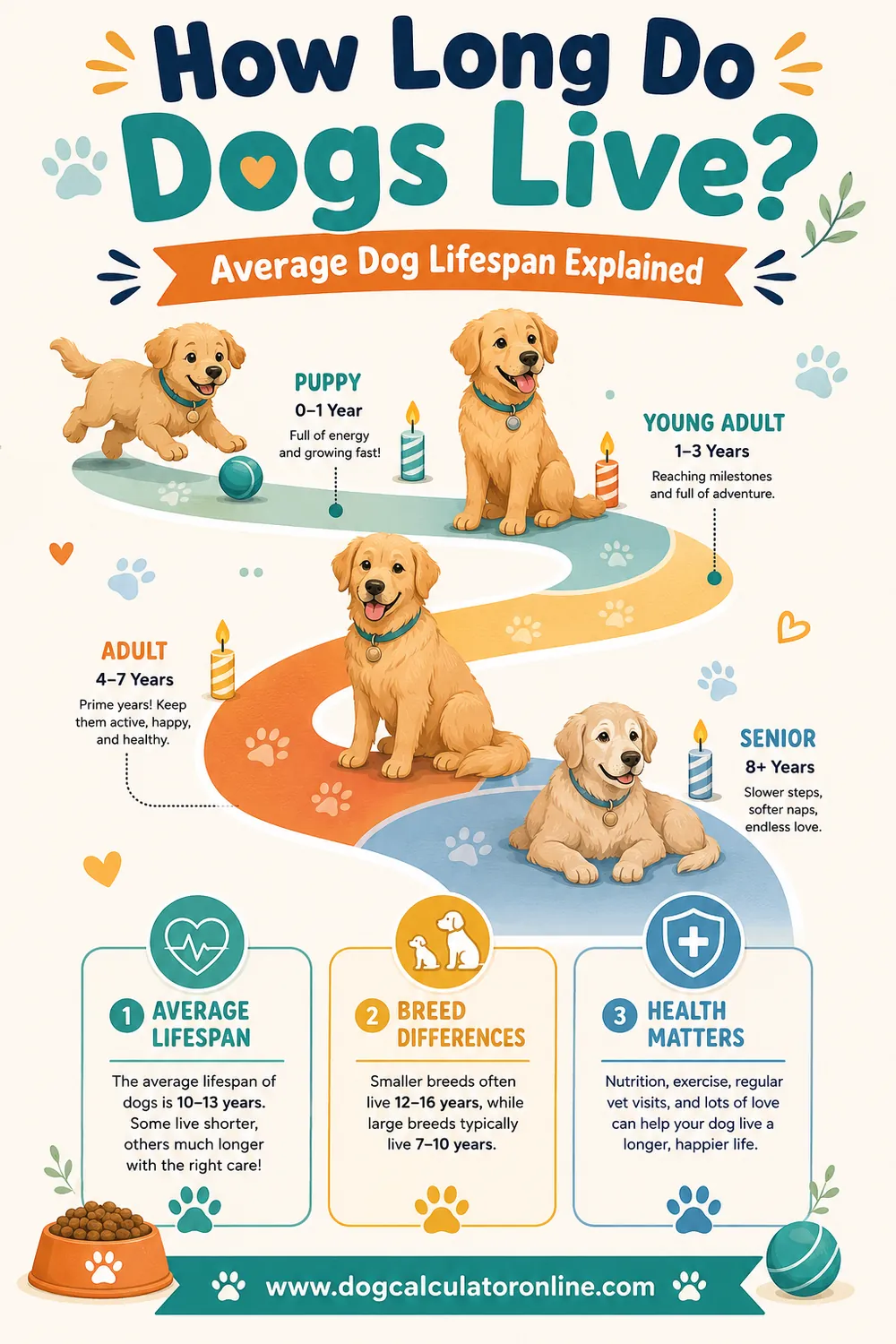
- How Long Do Dogs Live? Average Dog Lifespan Explained
- Dog Life Expectancy by Size: Small vs Large Breeds
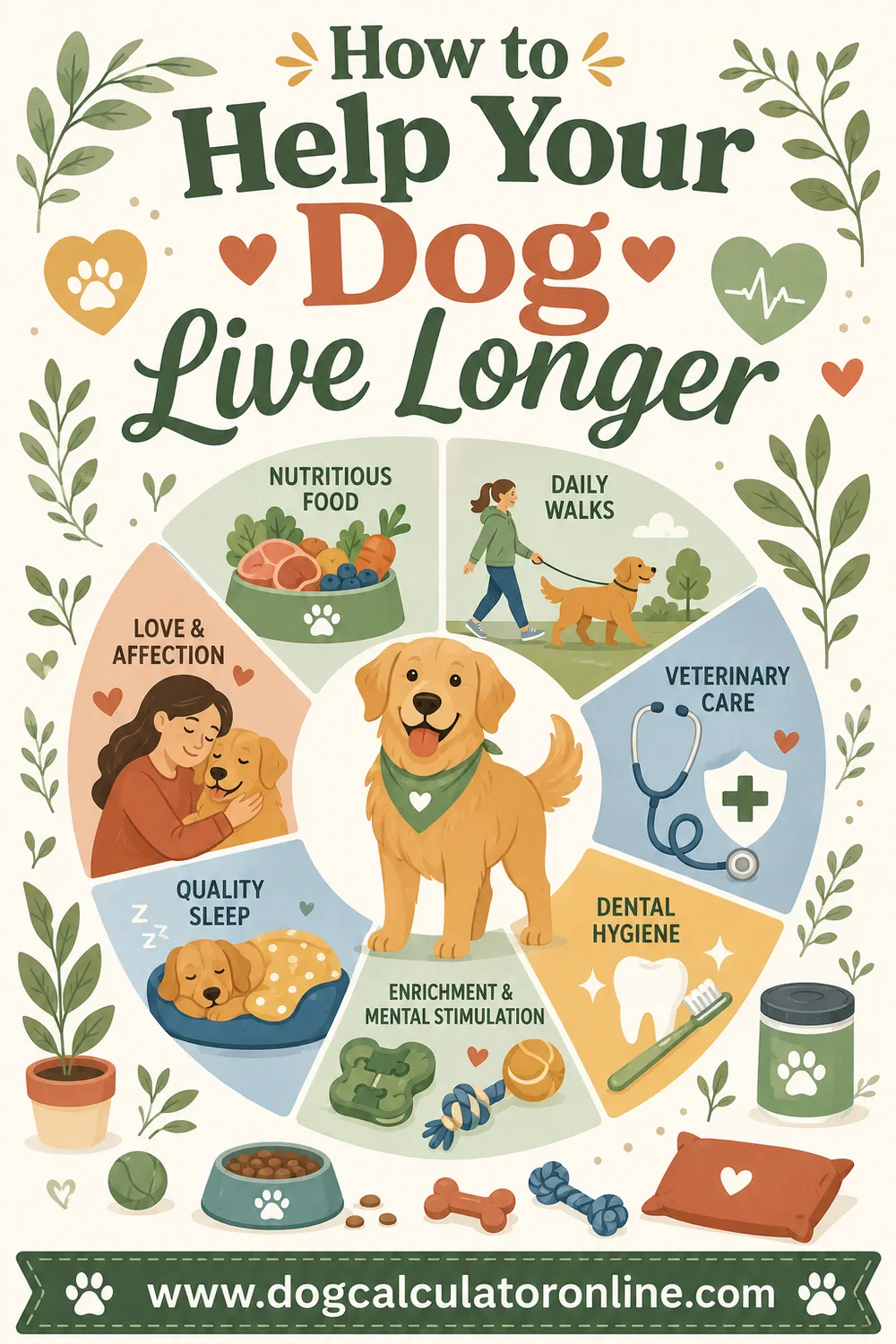
- How to Help Your Dog Live Longer
And if you just want your own dog's number, the free dog age calculator does it in one tap.
FAQ
Why do dogs age faster than humans?
They mature far earlier (adulthood by ~2 years vs ~20 in humans), run faster metabolisms, and evolved for a compressed lifespan. Every aging process runs quicker in a dog.
Is one dog year really seven human years?
No — that's a myth. Aging is non-linear: a dog's first year is worth about 15 human years, the second adds about 9, then 4–7 per year by size. A flat multiplier can't capture that curve.
Do bigger dogs age faster than smaller dogs?
Yes. Within dogs, larger breeds age faster and die younger, likely due to rapid growth and higher IGF-1 levels. That's the opposite of the between-species pattern.
What is the DNA clock for dog aging?
A 2019 UC San Diego study measured DNA methylation to derive human_age = 16 × ln(dog_age) + 31, showing dog aging is fast early then slows. It was based on Labradors, so it best fits similar dogs.
Can I slow my dog's aging?
Not the underlying clock, but you can improve the odds of more healthy years: keep them lean, care for their teeth, exercise daily, feed a balanced diet, and keep up regular vet visits.
How do I convert my dog's age to human years?
Use the size-adjusted method (15 for year one, +9 for year two, then +4 to +7 by size), or let the free dog age calculator do it instantly from age and weight.
The Bottom Line
Dogs age faster than humans because they grow up in a fraction of the time, burn energy faster, and evolved for a short, quick life — with the DNA clock confirming that aging is front-loaded, not linear. Big dogs run the clock faster still. You can't change the pace, but keeping your dog lean, active, and well-checked genuinely stretches the good years.
Want to see how fast your dog's clock is running? Enter age and weight into the free dog age calculator for the size-adjusted human-year answer, plus the DNA-study version, in one tap.