Dog Years Versus People Years: Why the Math Isn't a Simple x7
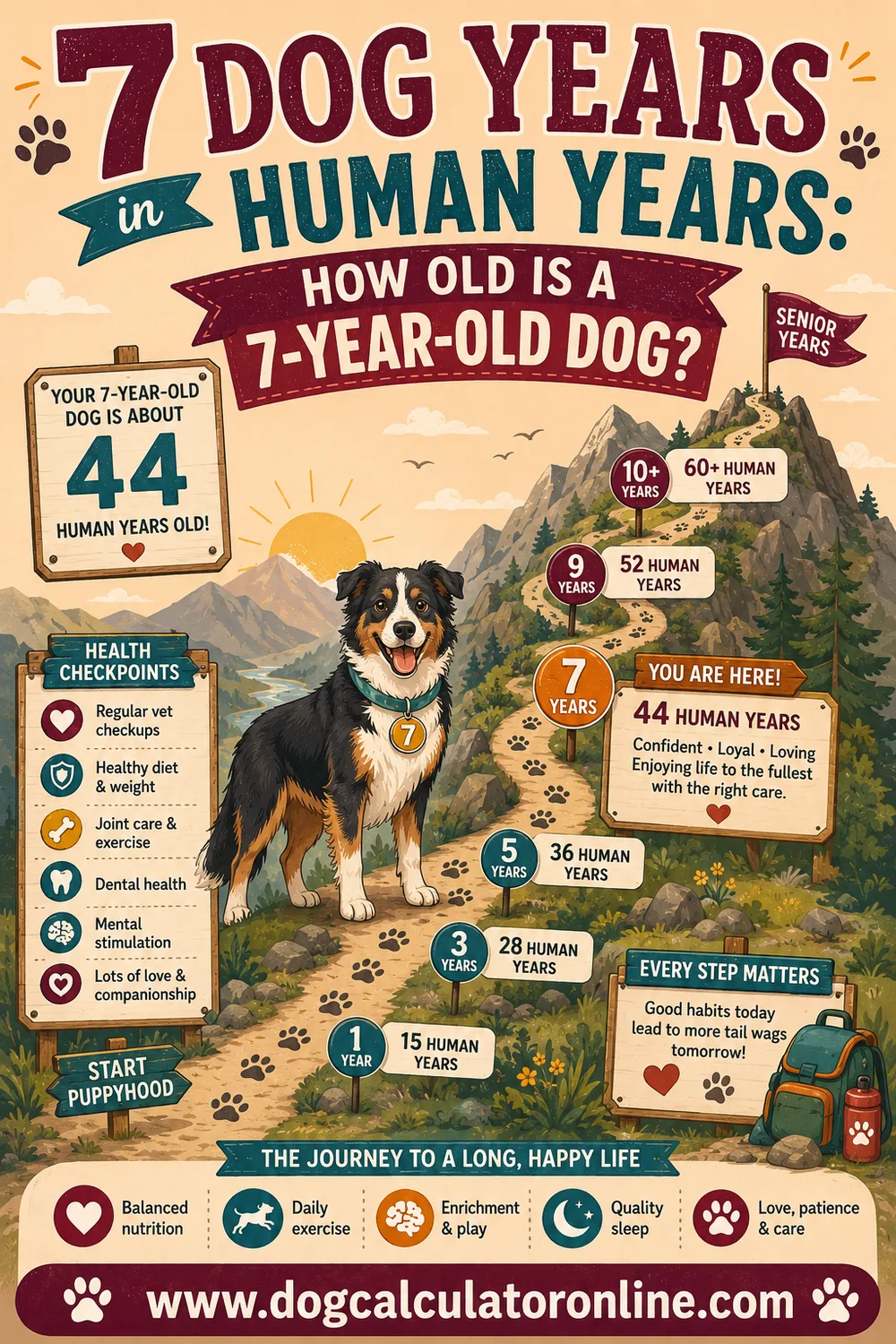
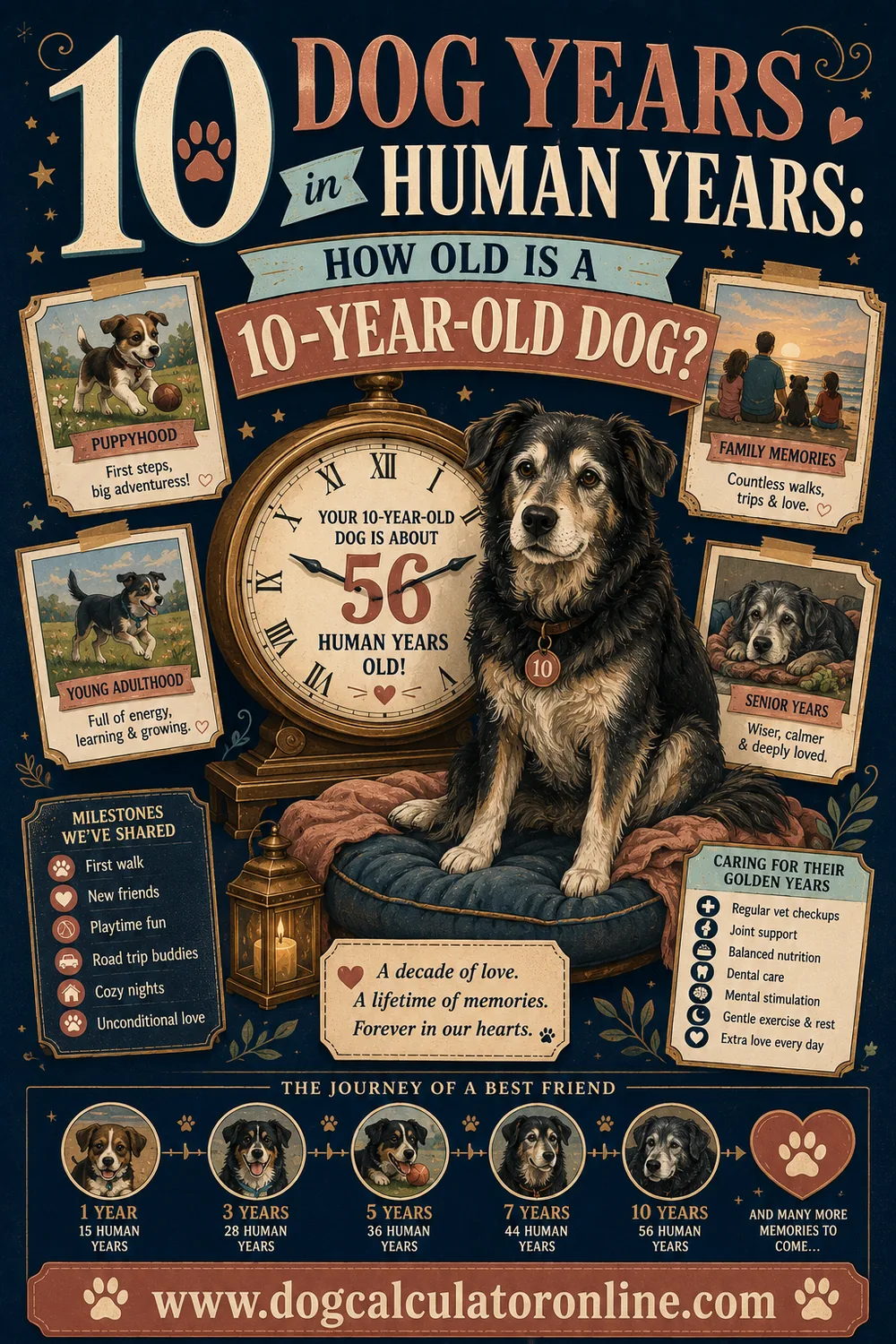
The old "multiply by 7" rule for dog years is a myth — dogs age extremely fast in their first two years, then slow down considerably, and the rate also depends heavily on the dog's size. A 1-year-old dog isn't "7" in human terms; depending on breed size, a 1-year-old dog is closer to 15 in human-equivalent age, since most dogs reach physical and sexual maturity within their first year.
Why the x7 Rule Is Wrong
The multiply-by-7 rule assumes dogs age at a constant, steady rate throughout their whole life, the same way a simple ratio would suggest. Real dog aging doesn't work that way. Dogs mature enormously fast early on to reach adulthood, then age much more gradually — a pattern much closer to how humans themselves age (rapid development in childhood and adolescence, slower change through most of adulthood) than a flat multiplier.
The x7 idea likely originated decades ago as a rough estimate based on comparing average human lifespan (about 70 years) to average dog lifespan (about 10 years) — simple division, not biology. It was never based on an actual study of aging rates.
The Real, Size-Adjusted Formula
Veterinary research has established that a dog's human-equivalent age depends on both its calendar age and its size, since larger dogs age faster in relative terms during adulthood despite maturing at a similar pace to small dogs early on.
General small/medium breed pattern: - Year 1 = about 15 human years - Year 2 = about 24 human years total - Every year after = about 4-5 human years added
General large/giant breed pattern: - Year 1 = about 15 human years (similar to small breeds) - Year 2 = about 24 human years total (similar to small breeds) - Every year after = about 6-9 human years added (faster aging in adulthood than small breeds)
This is genuinely counterintuitive: large dogs mature at roughly the same pace as small dogs early in life, but they age noticeably faster once they're past the growth phase, which is a major reason large and giant breeds have shorter average lifespans than small breeds.
Full Comparison Chart by Size
| Dog's age | Small breed (human years) | Large breed (human years) |
|---|---|---|
| 1 year | 15 | 15 |
| 2 years | 24 | 24 |
| 4 years | 32 | 37 |
| 6 years | 40 | 49 |
| 8 years | 48 | 61 |
| 10 years | 56 | 73 |
| 12 years | 64 | 85 |
| 14 years | 72 | 97 |
For an exact number based on your own dog's specific age and breed size, a dog age calculator applies the size-adjusted formula automatically rather than requiring manual lookup.
Why Size Changes the Aging Rate
The leading theory ties back to cell growth and cancer risk. Larger dogs grow from puppy to full adult size far faster, in absolute terms, than a human ever grows — a Great Dane can go from a few pounds at birth to over 100 pounds within about a year and a half. That rapid, large-scale cell division is thought to be linked to higher rates of cellular damage and cancer risk over a dog's lifetime, which is part of why giant breeds tend to have shorter average lifespans (often 6-10 years) compared to small breeds (often 12-16 years, sometimes longer).
What Each Life Stage Actually Looks Like
Puppy (0-6 months): Rapid growth, teething, high energy, still learning basic social behavior and house training.
Adolescent (6 months-2 years): Reaches full size (small/medium breeds faster than large breeds), sexual maturity, often the most challenging behavior period as energy and independence peak before full mental maturity.
Adult (2-6 years for small breeds, 2-5 years for large breeds): Prime of life, stable weight, established behavior patterns, lowest general health-risk period.
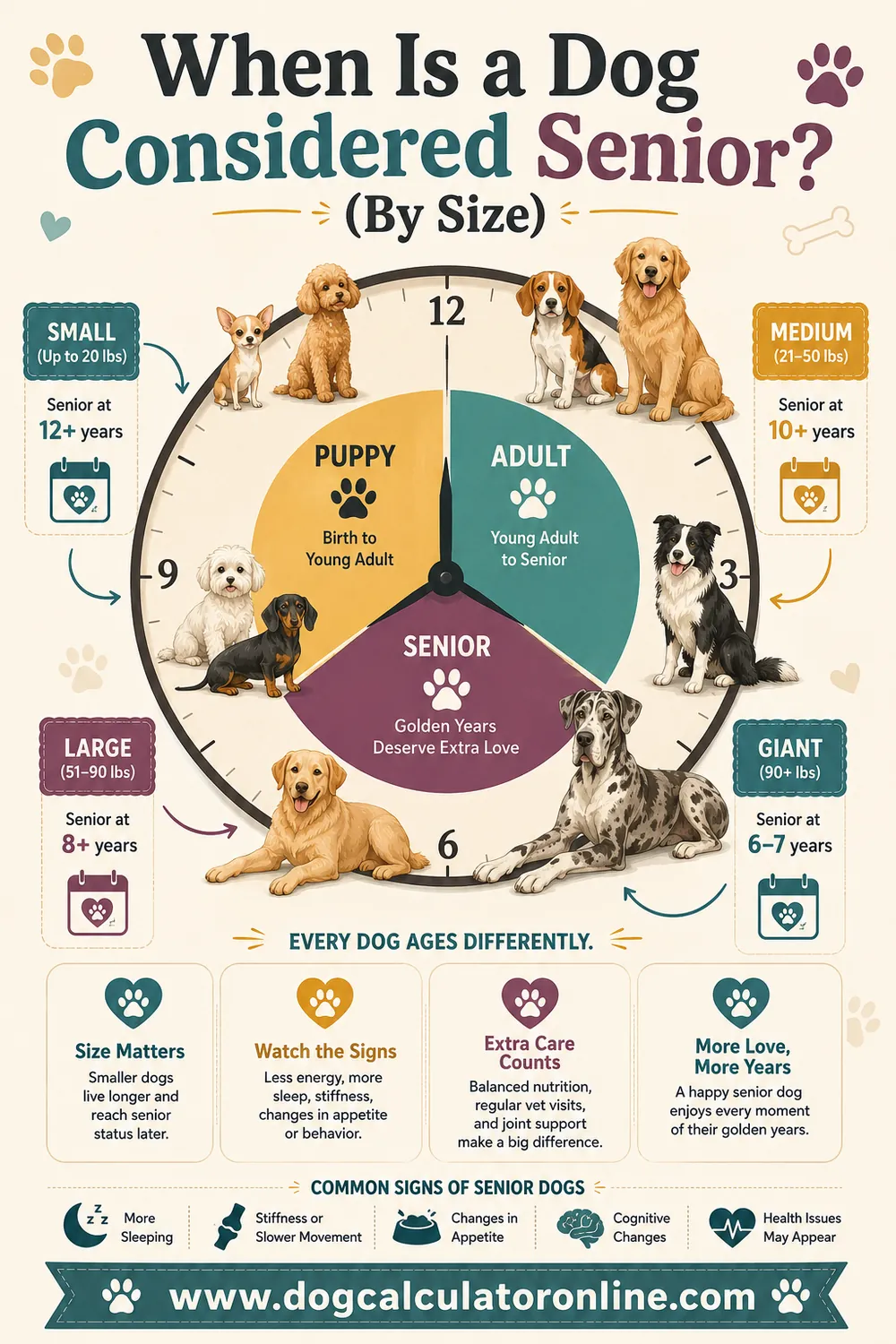
Senior (varies significantly by size — roughly 7+ years for large breeds, 10+ years for small breeds): This is the biggest practical difference size makes — a large breed dog is considered "senior" and benefiting from more frequent vet checkups years earlier in calendar age than a small breed dog.
Why This Actually Matters for Care
Knowing your dog's real human-equivalent age changes what you should watch for and when:
- A 6-year-old Great Dane (roughly 49 in human-equivalent terms) benefits from senior-level vet screening, even though 6 sounds young — for a Chihuahua the same age (roughly 40 in human-equivalent terms), that level of screening isn't typically needed for several more years.
- Joint supplements and weight management matter earlier for large breeds precisely because their "senior" phase, in human-equivalent terms, arrives sooner on the calendar.
- A small breed dog's longer overall lifespan means a slower, more gradual approach to increasing vet care frequency as they age, compared to a large breed.
Watching for Age-Related Changes, Stage by Stage
Knowing your dog's real human-equivalent age is most useful for knowing what's actually normal at each point, rather than worrying every time something changes. A few honest markers worth tracking as your dog moves through each stage:
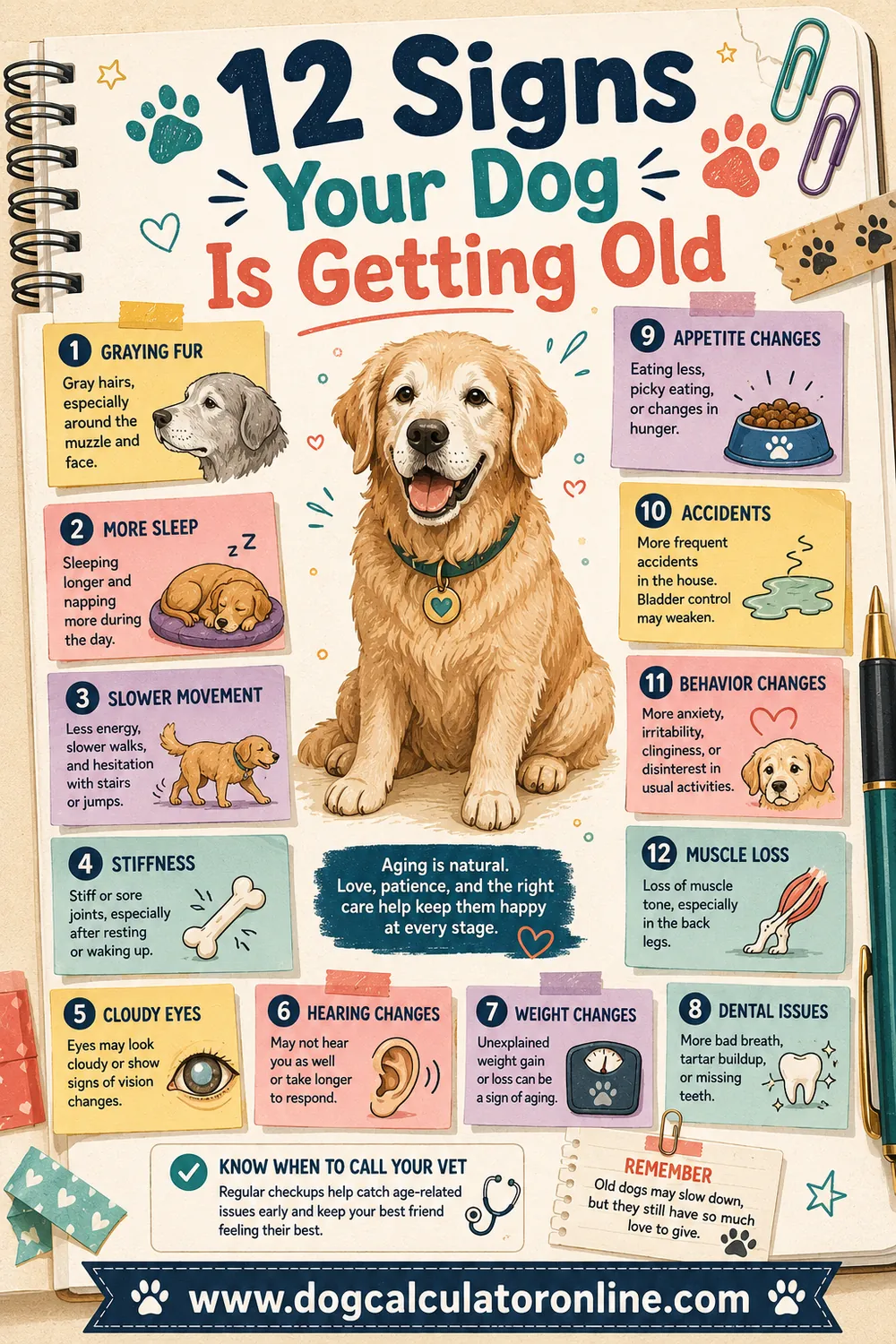
Coat and energy. A slight dulling of coat shine and a gradual drop in spontaneous zoomies is completely normal starting in the mature stage, but a sudden, sharp change over a couple of weeks is worth a vet call rather than being chalked up to "just getting older."
Joint stiffness. Especially in large breeds, mild stiffness after a nap or first thing in the morning often starts appearing earlier than owners expect — sometimes as early as human-equivalent age 45-50 — and catching it early with vet-guided supplements or activity adjustments does far more good than waiting until it's visibly affecting daily movement.
Weight changes. Both gradual weight gain and unexplained weight loss become more clinically meaningful as a dog moves into the mature and senior stages, since they're often early indicators of thyroid, joint, or metabolic changes that respond much better to treatment when caught early through routine bloodwork.
Sleep patterns. More total daily sleep is expected and normal as dogs age, but a dog that's suddenly restless at night or sleeping through normal wake-up cues is worth mentioning at the next vet visit rather than dismissing outright.
Why This Isn't Just Trivia
Understanding your own dog's real human-equivalent age changes what kind of care actually makes sense at each point, rather than applying a one-size-fits-all schedule regardless of breed or age. A 6-year-old Great Dane benefiting from senior-level joint support and twice-yearly vet visits, even though "6" sounds young, makes a lot more sense once you see that she's already around 49 in human-equivalent terms — solidly into the stage where a human doctor would also be recommending more proactive screening. A small breed dog the same calendar age, by contrast, is only about 40 in human terms and can reasonably wait a bit longer before stepping up that level of care. This is exactly why "how old is my dog really" is a genuinely useful question, not just a fun fact for the vet's waiting room.
How Vets Use Human-Equivalent Age in Real Appointments
When a vet examines your dog, the human-equivalent framework quietly shapes a lot of the specific questions they ask and tests they recommend, even if it's never mentioned by name during the visit. A vet examining a 7-year-old Great Dane (already around 55 in human-equivalent terms) is thinking about the same category of age-related screening a physician would consider for a person in their mid-fifties — joint health, cardiac function, early cancer screening given the breed's known risk profile. The same chronological age in a Chihuahua (only about 44 in human terms) warrants a somewhat different conversation, closer to what a vet would discuss with a healthy person in their mid-forties. This is exactly why breed and size are among the first things a good vet factors into any age-related conversation, rather than treating "7 years old" as a single universal category regardless of the dog in front of them.
Comparing Your Dog's Age to Your Own
One of the more genuinely useful applications of understanding real dog-years math is comparing your own dog's human-equivalent age to your own age, or to family members' ages, as a way of building intuition about what stage of life your dog is actually in. If you have a 10-year-old small breed dog (about 56 in human terms) and a parent or grandparent in their mid-fifties, thinking about the kind of care, activity level, and health monitoring that person receives can offer a genuinely useful, relatable mental model for what your dog might reasonably need too — while always remembering dogs and humans are different species with different specific health needs, the general life-stage intuition still transfers surprisingly well.
How to Work Out Dog Years Without a Calculator
The chart above is exact, but the arithmetic is simple enough to do in your head at the vet's office.
The forward version. If you want to know how to work out dog years from a birthday, start at 15 for the first year, add 9 for the second to reach 24, then add 4 to 5 a year for a small or medium dog and 6 to 9 a year for a large or giant one. That is the whole method, and it answers how do you calculate dog years to human age without a chart: 24 + (5 × years over two) for a small dog, 24 + (7 × years over two) for a big one.
A 6-year-old spaniel: 24 + (5 × 4) = about 44. A 6-year-old Great Dane: 24 + (7 × 4) = about 52.
The reverse version. People also ask how do you convert human years to dog years — going the other way, from a human age to a dog's calendar age. Subtract 24, divide by the yearly rate for the size, then add 2. A human-equivalent 60 for a medium dog works out at (60 − 24) ÷ 5 + 2, or roughly 9 calendar years.
Round generously in both directions. These are population averages, and no formula knows your individual dog.
What "Dog Years" Actually Means
The phrase gets used two different ways, which is why the answers online disagree so often.
Used loosely, what does dog years mean is simply "one year of a dog's life" — a dog year is a calendar year that happens to be lived by a dog. Used the way most people intend it, though, a dog year is a translation: the amount of human aging that one year of dog life is roughly equivalent to.
That second sense is what a dog age in people years figure is reporting. It is not a measurement of time. It is a way of saying where your dog sits on the same life curve you are on — puppy, young adult, middle age, senior — using a number you already have intuitions about.
Which is also the answer to the clumsily worded but extremely common question of what is the difference between dog years in human years: the difference is that dog years compared to people years are not a fixed exchange rate. The first dog year buys about fifteen human ones, the second about nine, and each one after that four to nine depending on size. Any single multiplier, including the famous seven, is an average of a curve that is nowhere near flat.
Do Cats Have the Same Thing?
Owners with both animals in the house ask this constantly, usually while trying to work out which pet is "older."
Yes — there is an equivalent conversion for cats, so if you were wondering are there cat years like dog years, the concept transfers cleanly. Cats follow the same shape of curve: a fast first year worth about 15 human years, a second year worth about 9 more, then roughly 4 human years for every calendar year after.
Where the two diverge is size. Are cat years the same as dog years? Not quite, and the reason is that dogs vary enormously in adult weight while cats barely do. A Chihuahua and a mastiff need different formulas; a 9-pound cat and a 14-pound cat do not. That is why cat conversions use one flat rate after year two and dog conversions need a size band.
The practical consequence in a mixed household: a 10-year-old cat lands near 56, and a 10-year-old medium dog lands near 64 — so the dog is usually the "older" animal even when the two arrived as babies in the same week.
Frequently Asked Questions
Is the "1 dog year = 7 human years" rule completely wrong? Yes, functionally — it was never based on real aging research and significantly misrepresents both ends of a dog's life: it underestimates how mature a young dog already is, and overestimates how old a senior dog actually is in real terms.
Do all dog breeds age at the same rate? No — size is the biggest factor. Small and medium breeds tend to age more slowly in adulthood (and live longer overall) than large and giant breeds, even though most breeds reach physical maturity around the same calendar age.
Why do large dogs have shorter lifespans than small dogs? The leading explanation involves the rapid rate of cell growth large breeds go through to reach their much bigger adult size, which is linked to higher long-term cancer risk and faster aging in adulthood, even though large and small puppies mature at a similar early pace.
At what age is a dog considered "senior"? It depends heavily on size — often as early as 6-7 years old for large and giant breeds, but not until 10-12 years old for small breeds, which is why a one-size-fits-all senior age doesn't work well across different dogs.
Do mixed-breed dogs age according to their dominant breed size or an average? Generally, a mixed-breed dog's aging pattern tracks closest to its actual adult body size rather than any specific breed in its ancestry, since size (not breed identity itself) is the primary driver of the aging-rate difference described above.
Is there a dog breed that lives longer than the general small-breed average? Yes — some small breeds, including certain terrier and toy breeds, have documented average lifespans exceeding 16-18 years, among the longest of any dog breeds, though individual health and care play a major role regardless of breed.
Does neutering or spaying affect how fast a dog ages? Some research suggests spaying and neutering may modestly affect lifespan and certain health risk profiles, though the effect is generally much smaller than the size-based aging differences described above, and the decision involves many factors beyond aging rate alone — a conversation worth having directly with your vet.
Do senior dog foods account for the size-based aging difference? Many premium senior dog food lines do offer size-specific formulas, recognizing that a senior large breed and a senior small breed have somewhat different nutritional needs tied to their different aging timelines and common health risks.
Is it possible for a dog to "age backward" in terms of health with good care? Not literally, but excellent nutrition, regular vet care, appropriate exercise, and weight management can meaningfully slow the practical effects of aging and extend a dog's healthy, active years relative to what would happen with less attentive care — the underlying calendar age doesn't change, but quality of life at each stage genuinely can.
Is there ongoing scientific research into more precise dog-aging formulas? Yes — researchers continue studying dog aging at a molecular level (including DNA methylation-based "epigenetic clocks"), which may eventually produce even more precise age-equivalence models than the current size-based charts.
How do dog years work for a mixed-breed dog? Use adult weight rather than breed. The size bands in the chart above are really weight bands, so a 45-pound mixed breed follows the medium-dog curve regardless of what the DNA test says. If your dog sits on a boundary, run both numbers and treat the answer as a range — the point of the figure is to place your dog in a life stage, and a five-year spread rarely changes which stage that is.
How do dogs age in dog years compared with people? Front-loaded, then steady. A dog does roughly two decades of human-equivalent development in its first two calendar years, reaching social and physical maturity while a person the same age is still a toddler. After that the rate settles into a slower climb that continues for the rest of the dog's life, which is why the gap between your age and your dog's widens fast at first and then closes at a predictable pace.