Nighttime Puppy Potty Schedule
Set an alarm and wake the puppy before it wakes you — that one change fixes more broken nights than anything else on this page. A puppy that is carried out at 2am while still half asleep goes back down in four minutes. A puppy that wakes, panics, cries for ten minutes and then gets taken out has learned that crying produces company, and you will be repeating that performance for a two weeks. Night-time house training is almost entirely a timing exercise: know how long your puppy can physically hold on, pre-empt it by twenty minutes, and keep the trip so dull that going back to sleep is the most interesting option. Growth drives bladder capacity, so track it with the puppy weight calculator.
🐾 How many night trips does your puppy need?
Tap an age:
Tap an age above. Pre-empt with an alarm; never reward crying with a trip out.
How Many Night Trips Does a Puppy Actually Need?
Fewer than most owners expect, and the reason is straightforward.
Puppies last longer at night than during the day. They are asleep, still, and not drinking. A ten-week-old that needs the garden every hour in the afternoon can manage three or four hours in the small hours.
The working formula is the puppy's age in months plus one, in hours. Two months gives about three hours; three months about four. That is a maximum under good conditions, not a target.
Two trips at eight weeks, one at twelve, none by sixteen is the usual arc. Individual puppies vary by a few weeks in either direction, and small breeds tend to need one more trip for longer.
Most puppies sleep through by twelve to sixteen weeks. If yours is still needing two trips at four months, something else is usually going on — a late dinner, water at bedtime, an oversized crate or a urinary infection.
Every trip you skip too early costs you a wet crate, and a wet crate costs more than a lost twenty minutes of sleep. Err on the side of one extra trip in the first two weeks. The daytime side of this is covered in how long can a puppy hold its bladder.
The Night Schedule by Age
These times assume a bedtime of 11pm and a start of 6:30am. Shift the whole block to fit your own hours.
| Age | Night trips | Alarm times | Longest stretch | Typical accidents |
|---|---|---|---|---|
| 8 weeks | 2 | 1:30am, 4:00am | 2.5–3 hrs | 1–3 a week |
| 10 weeks | 1–2 | 2:00am, 4:30am | 3–3.5 hrs | 1–2 a week |
| 12 weeks | 1 | 3:00am | 4 hrs | Occasional |
| 14 weeks | 0–1 | 3:30am if needed | 4.5–5 hrs | Rare |
| 16 weeks | 0 | none | 6–7 hrs | Should be none |
| 5 months | 0 | none | 7 hrs | Investigate any |
Last trip out at 11pm sharp, immediately before the crate door shuts, not half an hour before while you finish tidying up.
Move the alarm 15 minutes later every three nights once the puppy is reliably dry at the current time. Fifteen minutes is small enough not to trigger an accident and adds up to an hour a two weeks.
Drop a trip entirely when you find the puppy already asleep and unbothered on three consecutive nights at the same alarm.
If an accident follows a change, go back to the previous timing for four nights before trying again. This is normal and not a failure.
Keep a note on your phone of the time of each trip and whether the puppy went. Four days of data shows the real pattern far better than memory does.
Setting the Alarm Instead of Waiting
The mechanism behind this is worth understanding, because it is the difference between a settled two weeks and a miserable one.
Waking to crying teaches crying. If the sequence is always cry, then trip out, the puppy learns that noise summons a person. Puppies learn this in three or four repetitions.
Waking on your schedule breaks the link. The trip arrives out of nowhere, unrelated to anything the puppy did, so nothing is being reinforced.
Go before the puppy is fully awake if you can. Lift a small puppy straight out, carry it to the spot, and it will often go while still half asleep.
Use a quiet alarm — a vibrating phone or a very low tone. A loud alarm wakes the puppy, and a wide-awake puppy is much harder to put back down.
Two alarms in the first week for an eight-week-old. It sounds brutal and it lasts about ten days.
If the puppy cries between alarms, wait for a gap of a few seconds' quiet before going, so the timing does not line up with the noise. Whether the crying is a toilet need at all is a separate question, covered in how to stop a puppy crying at night.
What a Night Trip Should Look Like
Keeping it boring is not a stylistic preference; it is the whole technique.
Lead on, straight out, same spot every time. The scent prompts the puppy far faster than waiting does.
No lights beyond the minimum, no talking, no eye contact, no play.
Praise quietly and reward within one second of finishing, while the puppy is still on the spot. Late rewards teach nothing — the marker has to land almost immediately for the puppy to connect the treat with what it did.
Straight back into the crate. No cuddle on the sofa, no drink, no snack.
Five minutes maximum. If nothing happens, go back in, wait ten minutes, try once more.
Do not make it a social occasion once, because once is enough. A puppy that gets a fuss at 3am will start requesting one.
Water, Dinner Time and the Last Trip Out
Three levers, and only one of them is genuinely contentious.
Move the last meal to about three hours before bed. Most puppies need to defecate within 10 to 30 minutes of eating, so a 9pm dinner produces a 2am problem. The interlocking schedule is in puppy feeding and potty schedule.
Lifting the water bowl an hour or two before bedtime is standard advice and it does work. It is not universally appropriate: skip it in hot weather, for puppies on dry food that drink little, and for any puppy whose vet has advised free access. Never restrict water during the day.
Offer a small drink at the last trip out, then nothing.
Make the final trip genuinely final. Out at 11pm, straight into the crate at 11:05pm.
A short calm activity before bed — a chew, a sniffy potter in the garden — settles a puppy better than a play session, which wakes it up.
Do not exercise hard in the hour before bed. An overtired, overstimulated puppy sleeps worse, not better, and the sleep totals it needs are in puppy sleep schedule by age.
Where the Crate Goes at Night
The location decides how much sleep everyone gets.
Beside your bed for the first two to four weeks. You hear the shuffling and circling that comes before an accident, you can drop a hand down to reassure, and the puppy is not isolated, which is what most night crying is actually about.
Crate sizing matters at night specifically. A crate large enough to sleep at one end and toilet at the other removes the puppy's natural reluctance to soil its bed, which is the mechanism the whole method relies on. Stand, turn, lie stretched — no more. The setup is covered in how to crate train a puppy.
Absorbent bedding, not plastic. A wet crate that stays wet under the puppy is unpleasant and slows things down.
Have a spare set of bedding ready. Changing a crate at 3am in the dark is much easier when the replacement is already folded next to it.
Move the crate gradually once nights are settled — a couple of feet per night over a week or two if you eventually want the puppy elsewhere.
A pen with a toilet area is the honest alternative for anyone who cannot do night trips: flat dwellers on upper floors, people with mobility problems, and shift workers. It slows outdoor house training a little, and that trade-off is a reasonable one to make.
Stretching the Night Longer
Once the pattern is stable, extending it is a matter of small steps.
Push bedtime later rather than the wake-up earlier at first. Going to bed at midnight instead of 10pm removes two hours from the front of the night.
Fifteen minutes at a time, every three dry nights.
Expect a plateau around four to five hours at ten to twelve weeks. Sitting there for a week is normal.
Watch for the false start. Many puppies manage a full night once, then go back to needing a trip for a week. Do not drop the alarm on the strength of one good night.
Reduce, do not eliminate, the morning rush. The first trip of the day should still be immediate — out of the crate, straight outside, before anything else.
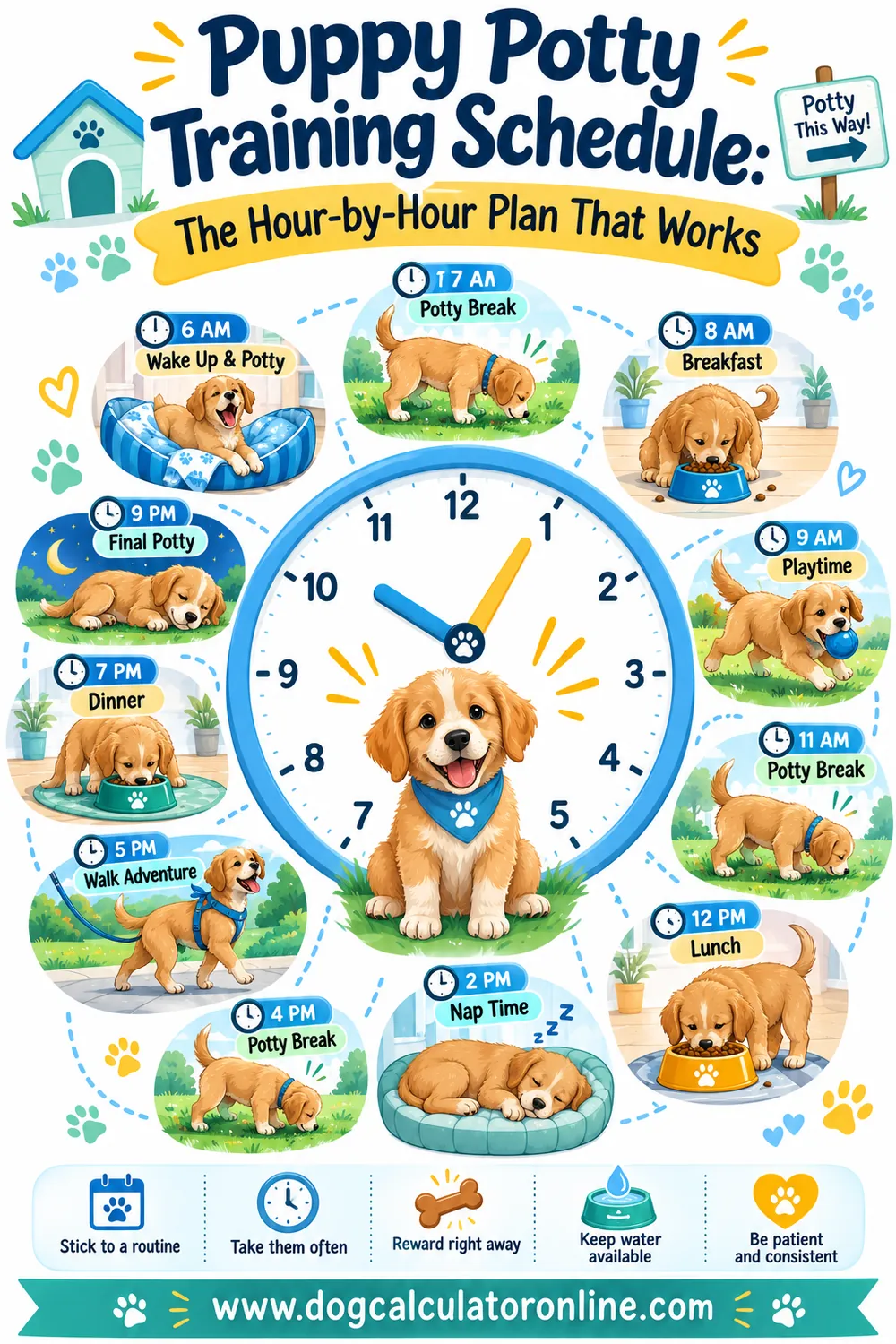
Regression around four to six months is common during adolescence and usually resolves within a two weeks of returning to a stricter schedule. The full daytime plan is in puppy potty training schedule.
When Night Accidents Mean Something Else
Most night accidents are timing. A few are medical, and the pattern tells you which.
Speak to your vet if:
- A previously dry puppy starts wetting at night again
- The puppy strains, or passes small amounts frequently
- There is blood in the urine
- The puppy is drinking noticeably more as well as urinating more
- Urine leaks while the puppy is asleep or lying down, leaving a wet patch
- The puppy seems in pain when passing urine
Urinary tract infections are common in puppies, particularly females, and they respond quickly to treatment. A consultation is cheap compared with three more weeks of pointless training.
Leaking while asleep can indicate an anatomical problem such as an ectopic ureter, which is more common in some breeds and is correctable.
Excessive drinking plus excessive urinating always warrants investigation.
Never punish a night accident. A puppy that physically could not hold on has not done anything wrong, and telling it off after the event teaches only that toileting near you is dangerous. That produces a dog that goes behind the sofa. Clean with an enzymatic cleaner, never anything ammonia-based, and move the alarm earlier.
FAQ
How many times should I take my puppy out at night?
Twice at eight weeks, once or twice at ten weeks, once at twelve, and usually none by sixteen. Base it on age in months plus one, in hours, and set alarms to pre-empt rather than waiting for the puppy to wake you.
Should I wake my puppy up to go to the toilet at night?
Yes, for the first few weeks. Waking the puppy on a schedule prevents accidents and stops it learning that crying brings a person. Carry a small puppy straight out while it is still drowsy and it will usually settle again within minutes.
When will my puppy sleep through the night without a toilet trip?
Most puppies manage a full six to seven hours somewhere between twelve and sixteen weeks. Small breeds often take a couple of weeks longer. Still needing two trips at four months usually points to a late dinner, water at bedtime, or a urinary infection.
Should I take away water at night?
Lifting the bowl an hour or two before bedtime helps and is standard practice, with exceptions: hot weather, puppies that drink very little, and any puppy whose vet has advised otherwise. Water should never be restricted during the day.
Why is my puppy weeing in the crate at night?
Usually the crate is too big, so the puppy can sleep at one end and toilet at the other. Other causes are too long between trips, a late meal or drink, and urinary infection. Clean everything with an enzymatic cleaner, since ammonia-based products smell like urine to a dog.
My puppy cries at night but does not need the toilet. What now?
That is isolation distress rather than a bladder problem, and moving the crate next to your bed solves it far more often than waiting it out. Take the puppy out on the alarm schedule anyway, and keep the trips silent so they stay uninteresting.
Getting Your Nights Back
The night plan is short: last meal three hours before bed, last trip out at bedtime, and one or two alarms placed just inside your puppy's physical limit. Keep the trips silent, dark and five minutes long, reward within a second on the spot, and go straight back into a correctly sized crate beside your bed. Move each alarm fifteen minutes later after three dry nights, and expect a plateau and the occasional false start along the way. Most puppies are sleeping through by twelve to sixteen weeks, and a puppy that goes backwards after being reliably dry is a vet question rather than a training one. Keep an eye on how fast your puppy is growing with the puppy weight calculator.