How to Tell How Old a Dog Is
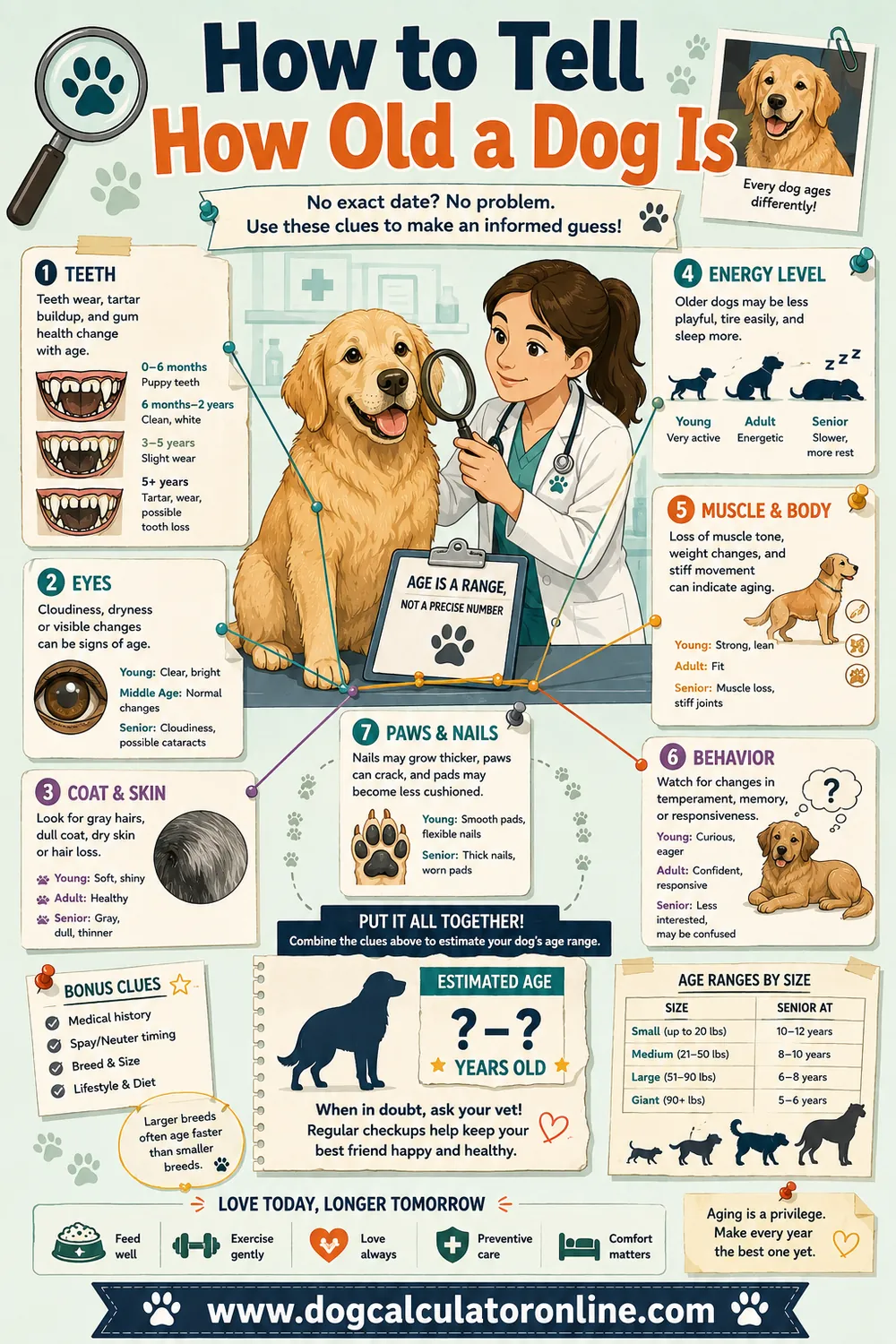
You can estimate a dog's age from five main clues: teeth (the most reliable), eyes, coat and muzzle color, body condition, and behavior. Teeth alone can place a puppy's age within weeks; for adult dogs, the clues combine into a range — usually accurate to within a couple of years. Vets use exactly this method for rescues with unknown birthdays.
Once you have an estimated age, our free dog age calculator converts it to human years using the size-adjusted formula vets rely on — useful for setting up the right care schedule for your new dog.
🐾 Age clue decoder
Tap a clue you can see in your dog:
Tap a clue above for the age range it suggests.
Why Dog Age Estimation Works
No single feature gives a dog's age away, but dogs age on fairly predictable physical schedules — especially their teeth, which erupt, whiten, wear, and stain in a known sequence. Shelter vets estimate age routinely, and while nobody can pin an adult dog's birthday to the month, a good exam usually lands within a year or two.
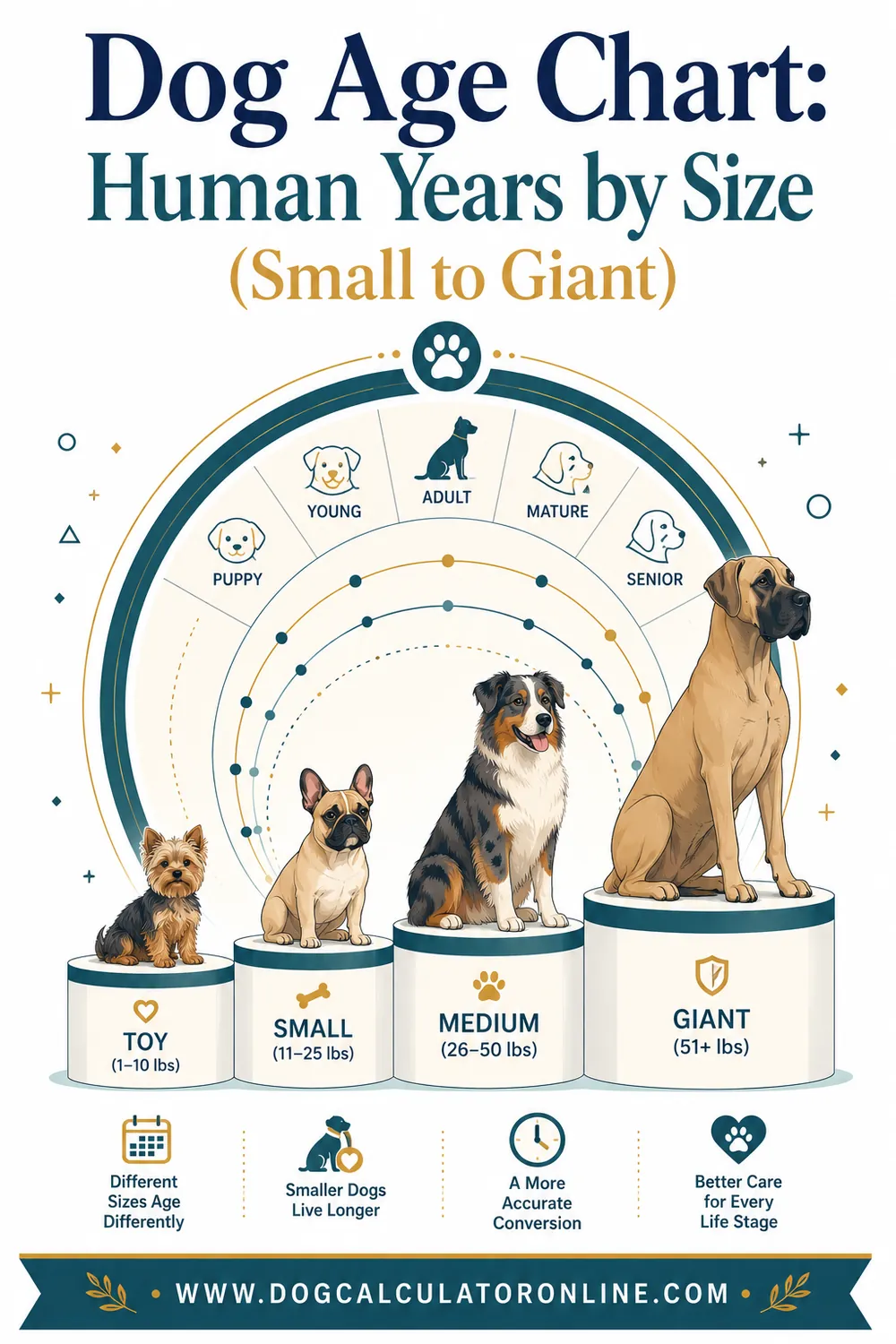
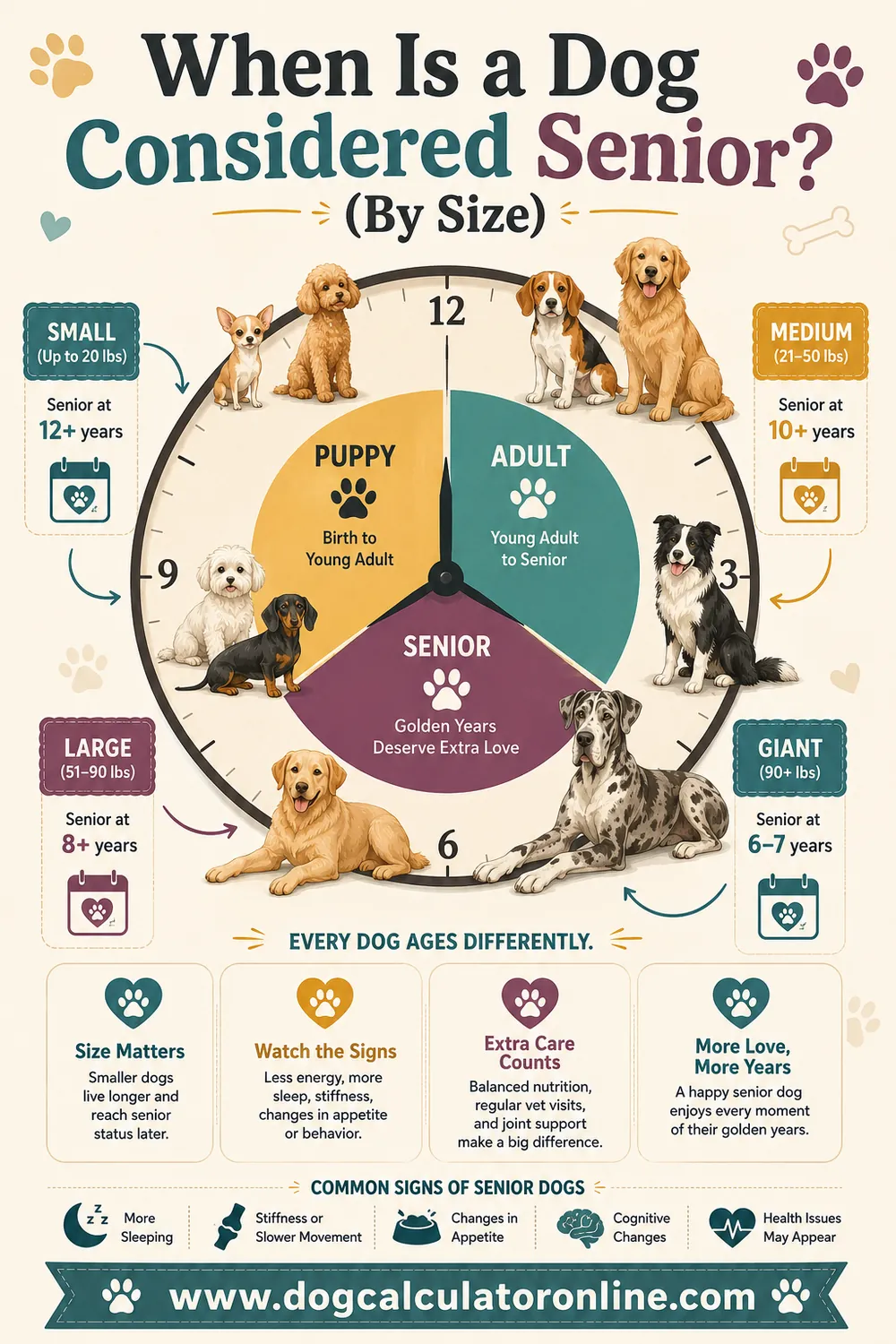
One rule before the clues: size changes the interpretation. Small dogs live 12–16 years and show old-age signs late; giant breeds live 7–10 and show them early. A gray-muzzled Chihuahua is probably 10+; a gray-muzzled Great Dane might be 6.
Clue #1: Teeth (The Gold Standard)
Teeth are the closest thing to a birth certificate a dog carries.
Puppies: accurate to within weeks
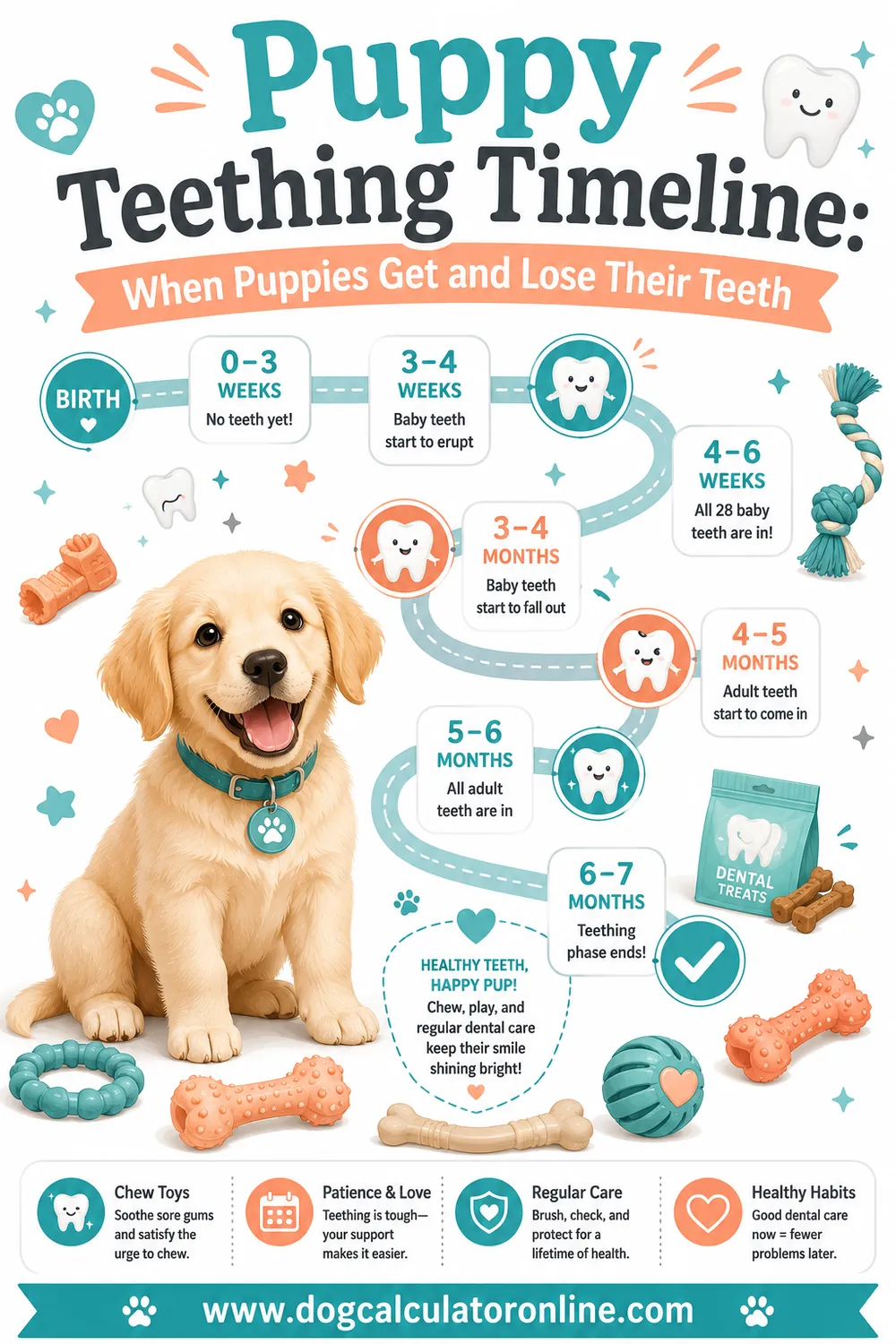
Puppy teeth follow a tight schedule, which is why vets can age a puppy so precisely:
| What you see | Approximate age |
|---|---|
| No teeth yet | Under 3 weeks |
| Baby (deciduous) teeth erupting | 3–6 weeks |
| Full set of 28 needle-sharp baby teeth | ~8 weeks |
| Baby teeth falling out, adult incisors arriving | 3.5–5 months |
| Adult canines and premolars coming in | 4–6 months |
| Full set of 42 adult teeth | ~6–7 months |
If a puppy still has any baby teeth, they're almost certainly under 6 months. This is also how shelters can confidently call a dog a "5-month-old puppy."
Adults: wear and tartar tell a rougher story
After the adult set is complete, vets read wear and staining:
| Teeth look like... | Rough age range |
|---|---|
| Gleaming white, no wear | 7 months–1.5 years |
| Slight dullness, maybe early tartar on back teeth | 1.5–3 years |
| Visible tartar, mild wear on incisor tips | 3–5 years |
| Obvious tartar, worn incisors, some gum recession | 5–10 years |
| Heavy tartar, well-worn or missing teeth, dental disease | 10+ years |
Big caveat: dental care and chewing habits skew this badly. A dog whose owner brushed daily can have 3-year-old teeth at age 8; an aggressive rock-chewer can have 10-year-old teeth at 4. That's why teeth set the starting estimate and the other clues adjust it.
How to check the teeth at home (safely)
You don't need to pry a dog's mouth open — most of the information is on the outside surfaces:
- Pick a calm moment and a dog you know tolerates handling. A brand-new rescue on day one may not — wait, or leave it to the vet.
- Lift the lip at the side with your thumb, like flipping a page. This exposes the canines and back teeth where tartar shows first.
- Then lift the front lip to see the incisors — the small front teeth whose flattened or worn tips hint at years of use.
- Look, don't poke. You're checking color (white vs. yellowed vs. brown), tartar buildup along the gumline, wear on the tips, and any missing or broken teeth.
Ten seconds is plenty. If the dog stiffens, pulls away, or growls, stop — no age estimate is worth a bite, and your vet will see the same teeth at the first checkup anyway.
Clue #2: Eyes
Around age 6–8, most dogs develop lenticular sclerosis — a bluish, hazy tint deep in the lens caused by normal age-related hardening. It barely affects vision, and its arrival is consistent enough that vets treat it as a solid "this dog is at least middle-aged" marker.
Distinguish it from cataracts — whiter, more opaque, vision-impairing, and possible at various ages (not just old age). You can't reliably tell the two apart at home; a vet can with a quick look. Bright, completely clear eyes suggest a dog under 6; a definite blue haze suggests 7+.
Clue #3: Coat and Muzzle Color
Gray hair around the muzzle and eyes typically starts in middle age — around 5–7 for many dogs — and spreads with the years. A mostly-gray face usually means a senior.
But graying is the least reliable clue on this list:
- Some dogs carry genes for premature graying and salt-and-pepper at 2 or 3.
- Stressful histories are associated with early muzzle graying — relevant for rescues.
- Light-coated dogs hide gray; you may need to look closely in good light.
Coat texture helps a little too: senior coats often turn duller, thinner, or coarser, and old dogs may develop calluses on their elbows from years of lying down.
Clue #4: Body Shape and Muscle
Bodies tell age the way they do in humans:
- Puppies and adolescents: loose, lanky, oversized paws, still "growing into themselves."
- Young adults (1–3): peak muscle tone, tight waist, effortless movement.
- Middle age (3–7): solid and filled out; often a bit of weight creep.
- Seniors: gradual muscle loss over the spine and hindquarters (you may feel the spine more), a swaying or stiffer gait, and sometimes a pot-bellied look as muscle tone declines.
Muscle loss along the back and rear legs is one of the more dependable senior markers, since it's hard for good grooming to hide.
Clue #5: Behavior and Energy
The least precise clue, but useful for breaking ties:
- Under 2: bursts of zoomies, chewing enthusiasm, short attention span, play-first worldview.
- 2–5: energetic but regulated; settles when nothing's happening.
- 5–8: chooses comfort more often; still game for anything, recovers slower.
- 8+: longer sleep, deliberate movements, slower mornings, selective hearing that may be real hearing loss.
Behavior misleads easily — some Border Collies act 2 at age 10, and some Bulldogs act 8 at age 3. Weigh it lightly.
Bonus Clues Vets Also Use
Beyond the big five, a few smaller tells help a vet fine-tune the range:
- Paw pads. Puppy pads are soft and smooth; years of pavement gradually make pads thicker and more calloused.
- Whiskers. Like the muzzle, whiskers can turn gray or white with age — easiest to spot on dark-coated dogs.
- Hearing response. Age-related hearing loss usually starts with high-pitched sounds. A dog who ignores a squeaky toy but startles at a clap may be older than they look.
- Elbow calluses. Thick, hairless patches on the elbows accumulate from years of lying on hard surfaces — rare on young dogs.
- Exam-table findings. During a hands-on exam, a vet also feels for joint thickening and checks overall condition — the kind of evidence you can't gather from across the room.
None of these stands alone, but each one can nudge an estimate a year or two in one direction.
The Five Clues at a Glance, by Life Stage
Here's the whole system in one table — find the column that matches most of what you see:
| Life stage | Teeth | Eyes | Coat | Body & behavior |
|---|---|---|---|---|
| Puppy (<7 mo) | Baby teeth or mixed set | Bright, clear | Soft puppy fluff | Lanky, big paws, zoomies |
| Adolescent (7 mo–2 yr) | Gleaming white adult set | Clear | Glossy adult coat | Leggy, high energy, short attention |
| Young adult (2–4) | Slight dulling, early tartar | Clear | Glossy, no gray | Peak muscle, energetic but settles |
| Middle-aged (4–7) | Visible tartar, mild wear | Clear, or earliest haze | First gray flecks possible | Solid build, chooses comfort more |
| Senior (7–10) | Obvious tartar, worn incisors | Bluish haze common | Graying muzzle | Early muscle loss, slower mornings |
| Geriatric (10+) | Heavy tartar, worn/missing teeth | Pronounced haze | Widely gray face, thinner coat | Visible muscle loss, stiff gait, long sleep |
Remember the size rule when reading it: a giant breed moves through these columns years faster than a toy breed, so shift your interpretation accordingly.
Putting It Together: A Worked Example
Say you adopt a 45-pound mixed-breed with: white teeth showing early tartar on the molars, completely clear eyes, no gray, athletic muscle tone, and moderate-high energy.
- Teeth say 1.5–3 years
- Clear eyes say under 6
- No gray says likely under 5–6
- Body and behavior say young adult
Verdict: roughly 2–3 years old. Call it 2.5, and you now have a working birthday. Feed her age and weight into the free dog age calculator and you'll see she's about 26–27 in human years — a young adult whose care plan is straightforward: annual checkups, lean diet, lots of exercise.
For a borderline-senior estimate, the stakes are higher — a dog guessed at 7 rather than 5 should be getting twice-yearly senior screening — so when clues conflict, let your vet arbitrate.
Common Mistakes When Guessing a Dog's Age
A few predictable errors trip up first-time estimators. Knowing them keeps your guess honest:
- Trusting one clue. Teeth stained by a rock-chewing habit, or a young dog with premature gray, will fool you if you read a single feature. Always stack at least three clues.
- Ignoring size. The same gray muzzle means "10+" on a Chihuahua and maybe "6" on a Great Dane. Interpret every clue through the dog's size class.
- Confusing sclerosis with cataracts. The normal age haze and vision-robbing cataracts look similar but mean different things. When eyes matter to your estimate, get a vet's read.
- Reading energy as age. Some breeds stay hyper into old age and others are couch potatoes from puppyhood. Behavior is a tiebreaker, not a foundation.
- Overprecision. Nobody can name an adult rescue's birth month from an exam. A range ("about 3–5 years") is the honest and useful output — pick the middle as a working birthday.
When your estimate lands near a care threshold — is this dog 5 or 7? — err toward the older guess. Starting senior screening a year early costs little; starting it a year late can cost a missed early diagnosis.
What About DNA Age Tests?
Some commercial dog DNA panels now include a "biological age" estimate based on methylation — the same epigenetic signal behind the 2019 UC San Diego study that produced the human_age = 16 × ln(dog_age) + 31 formula. The science is real and improving, but consumer biological-age estimates are still young; treat them as an interesting second opinion rather than a birth record. The physical exam remains the standard, and it's free at your next vet visit.
Turning an Estimate Into a Working Birthday
Once you and your vet settle on a range, make it official — a concrete birthday is more useful than a fuzzy range:
- Pick the middle of the range (estimate "3–5 years" becomes "4 years old").
- Assign a date. Many adopters use the adoption day itself — the "gotcha day" — as the birthday, which has the bonus of being a real anniversary worth celebrating.
- Put it in the vet record. Vaccine schedules, senior-screening timing, and medication decisions all key off recorded age, so make sure the clinic logs your agreed estimate.
- Revisit it once or twice. Age estimates get sharper with more data. If your "4-year-old" still looks and moves exactly the same three years later, or ages visibly faster than expected, your vet can adjust the working age — it's an estimate, not a contract.
The estimate's real job is triggering the right care at the right time: a dog logged as 6 gets senior bloodwork years before a dog logged as 3, and for a borderline case that difference can matter a lot.
Related Guides
If this helped, these go deeper on the same question:
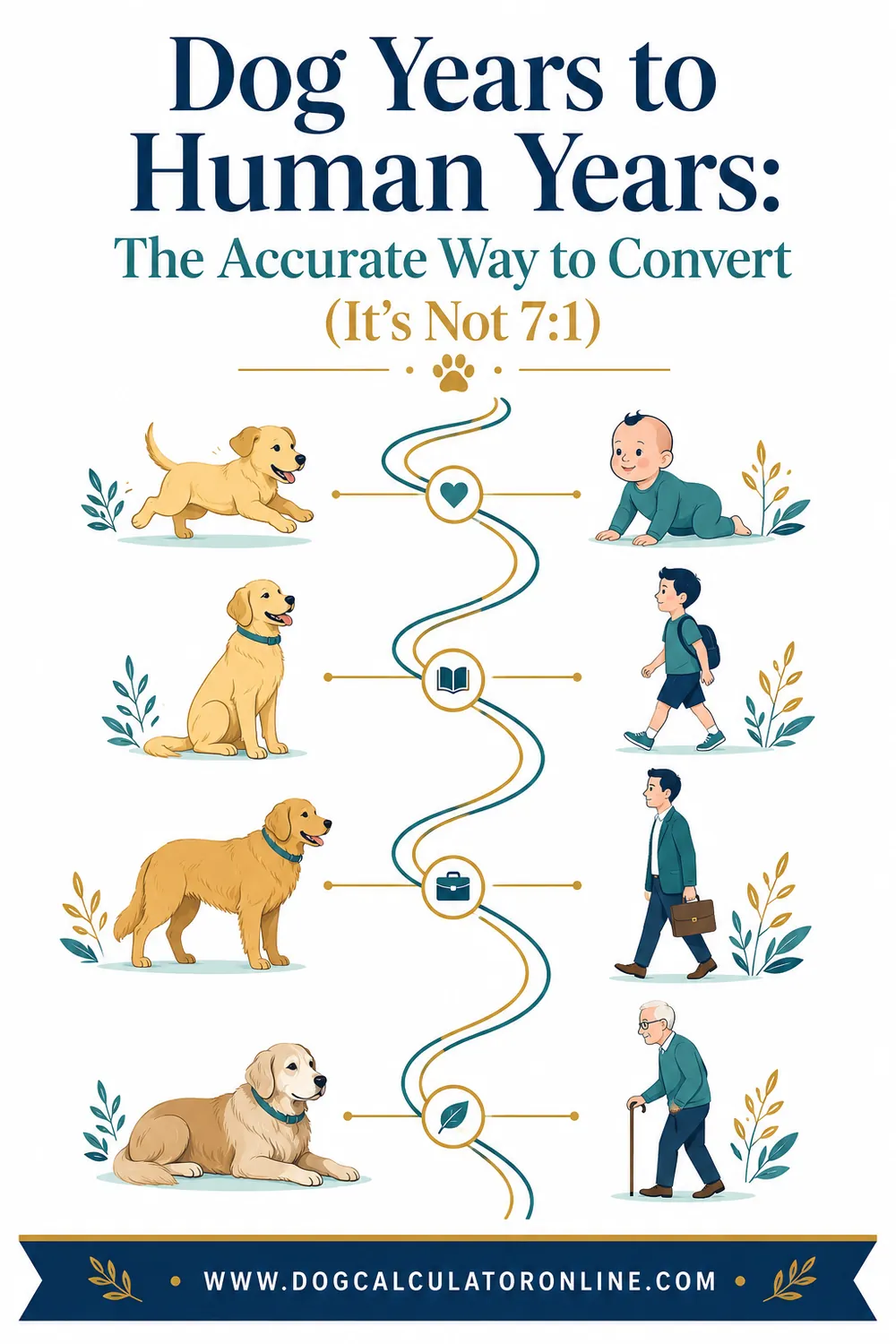
- Dog Years to Human Years: The Accurate Way to Convert (It's Not 7:1)
- Dog Age Chart: Human Years by Size (Small to Giant)
- When Is a Dog Considered Senior? (By Size)
- Puppy Teething Timeline: When Puppies Get and Lose Their Teeth
And if you just want your own dog’s number, the free dog age calculator does it in one tap.
FAQ
How do vets tell how old a dog is?
Primarily by teeth — eruption schedule for puppies, wear and tartar for adults — combined with eye changes, coat graying, muscle tone, and overall condition. Estimates for adults are usually accurate to within a year or two.
How accurate is aging a dog by its teeth?
For puppies, extremely — within weeks, since baby and adult teeth erupt on a tight schedule. For adults it's a range, because dental care and chewing habits change how teeth wear.
At what age do dogs' eyes get cloudy?
The normal bluish haze (lenticular sclerosis) typically appears around 6–8 years. True cataracts look whiter and affect vision — a vet can tell the difference quickly.
Do gray muzzles mean a dog is old?
Usually middle-aged or older (5–7+), but not always — genetics and stress can gray a young dog. Never rely on gray alone.
Can a DNA test tell my dog's age?
Some tests estimate biological age from DNA methylation — promising science, but current consumer versions are best treated as a rough second opinion, not a birthday.
Once I estimate my dog's age, how do I convert it to human years?
Use the size-adjusted method: year one ≈ 15 human years, year two adds 9, then +4 to +7 per year by size class. The free dog age calculator does it instantly.
Why did the shelter's age estimate change after my vet visit?
Completely normal. Shelter staff estimate quickly, often for stressed dogs in loud rooms; your vet gets a calm, hands-on look at teeth, eyes, and joints. When the two disagree, go with your vet's number — and expect even that to be a range, not a birthday.
Is it harder to age a small dog or a big dog?
Small dogs are trickier at the older end — they show gray and slow down so late that a 9-year-old and a 12-year-old Chihuahua can look nearly identical. Big dogs compress their aging into fewer years, so each clue tends to separate the ages more clearly.
The Bottom Line
Teeth first, then eyes, coat, muscle, and behavior — stack the clues and you can place most dogs within a year or two of their true age, and puppies within weeks. Get your vet's read at the first checkup, pick a working birthday, and build the care schedule around it.
Then make the number useful: enter your dog's estimated age and weight into the free dog age calculator to see their human-year equivalent — it tells you at a glance whether you've adopted a 30-year-old or a 60-year-old.