Most Expensive Dog Breeds to Own
The dogs that cost the most to buy and the dogs that cost the most to own are largely different animals. A $6,000 puppy you pay for once is a smaller financial event than a $600 puppy that needs airway surgery at two, a cesarean at four and daily medication from six. Running cost is driven by four things: adult body mass, exaggerated conformation, breed-specific disease risk and coat maintenance — and the insurance market prices all four openly, which makes premium loading the most honest ranking available. Here are the breeds that genuinely cost the most across a life, and why. Put real numbers on your own dog with the free dog cost calculator.

🐾 Where does the money actually go?
Tap a cost driver:
Tap an option above. Conformation and body mass predict the bill better than pedigree price.
Expensive to Buy Versus Expensive to Own
These two lists barely overlap, and confusing them is how people end up under-budgeted.
Rare breeds command high purchase prices without high running costs. A Tibetan mastiff or a Norwegian lundehund may cost several thousand dollars as a puppy, then live an unremarkable, moderately priced life.
Common breeds with popular exaggerated features are the genuinely expensive ones. French bulldogs and pugs are widely available at modest prices and sit near the top of every claims table.
Purchase price is typically 3–5% of the lifetime total. Even a $5,000 puppy premium is around $380 a year over thirteen years.
Health testing raises the purchase price and lowers the running cost. Hip and elbow scoring, eye testing and cardiac certification are the reason a well-bred puppy costs more, and they measurably reduce the odds of a five-figure bill.
The reliable ranking is by claims, not by price. Which is why the insurance section below is the most useful part of this guide.
The Traits That Make a Dog Expensive
Four features predict high running cost across every breed, and they compound.
Exaggerated conformation. A shortened muzzle, a lengthened back, excessive skin folds, very heavy bone or extremely large eyes each carries a specific and predictable surgical bill.
Large body mass. Food, parasite preventatives, anaesthesia and every per-kilogram drug dose scale with weight, as does boarding. The scaling arithmetic is in cost of owning a dog by size.
A narrow gene pool with a signature disease. Cavaliers and mitral valve disease, dobermanns and dilated cardiomyopathy, boxers and cancer: where a breed carries a high-prevalence condition, the cost is close to an expectation rather than a risk.
A coat that requires professional maintenance. Poodles, bichons, old english sheepdogs and heavily coated spitz breeds cost $400–$1,300 a year at the groomer for their entire lives.
Short lifespan does not make a breed cheap. Giant breeds spend their final, most expensive years earlier, and the last eighteen months of a giant breed's life is often the priciest period of any dog's.
The Breeds With the Highest Running Costs
Ranked by likely lifetime spend, not puppy price. All figures are planning ranges for an ordinary year with insurance included.
| Breed | Adult weight | Typical lifespan | Main cost drivers | Ordinary year |
|---|---|---|---|---|
| English Bulldog | 45–55 lb (20–25 kg) | 8–10 years | Airway, skin, eyes, cesarean, arthritis | $3,500–$6,500 |
| French Bulldog | 20–28 lb (9–13 kg) | 10–12 years | Airway, spinal, skin, eyes, cesarean | $3,000–$5,500 |
| Great Dane | 110–175 lb (50–79 kg) | 7–10 years | Food volume, bloat, cardiac, drug doses | $3,000–$5,500 |
| Bernese Mountain Dog | 70–115 lb (32–52 kg) | 7–9 years | Cancer, joints, grooming, size | $2,800–$5,000 |
| Cavalier King Charles Spaniel | 13–18 lb (6–8 kg) | 9–13 years | Mitral valve disease, syringomyelia, eyes | $2,500–$4,500 |
| Dachshund | 11–32 lb (5–15 kg) | 12–15 years | Intervertebral disc disease, dental | $2,200–$4,500 |
| Newfoundland / Mastiff | 120–200 lb (54–91 kg) | 8–10 years | Food, joints, cardiac, anaesthetic | $3,200–$6,000 |
| Standard Poodle | 45–70 lb (20–32 kg) | 11–14 years | Grooming every 6 weeks, bloat, Addison's | $2,500–$4,500 |
| German Shepherd | 50–90 lb (23–41 kg) | 9–13 years | Hips, elbows, spinal, gastrointestinal | $2,200–$4,200 |
| Chow Chow / Shar Pei | 40–70 lb (18–32 kg) | 9–12 years | Skin, eyes (entropion), fever syndromes | $2,400–$4,500 |
Read these as tendencies across a population. Plenty of individual bulldogs and danes live cheaply; the point is that the odds are materially different, and budgets should be set on odds.
The list is dominated by shape, not by rarity. Eight of the ten are common breeds; none is on a list of the priciest puppies.
Small does not protect you. Cavaliers and dachshunds are small dogs near the top of the table because their signature conditions are chronic, expensive and common.
Two of the same breed can differ enormously. A bulldog from health-screened lines with open nostrils and a lean body condition may cost half what a heavily exaggerated one costs, which is an argument for scrutinising the individual dog rather than the breed name.
Lifespan cuts both ways. A dachshund's 12–15 years multiplies a moderate annual figure into a large lifetime one; see dog life expectancy by size for the pattern.
Flat Faces: The Most Predictable Big Bills
Brachycephalic breeds are the clearest example of cost written into anatomy.
Brachycephalic obstructive airway syndrome surgery runs $2,000–$5,500, and a substantial minority of affected dogs need revision or additional procedures.
The related conditions arrive together, not separately. Corneal ulceration ($400–$2,500 depending on grafting), skin fold dermatitis (recurring, $200–$600 a course), narrowed nostrils, dental crowding and heat intolerance all cluster in the same dogs.
Anaesthesia carries higher risk and higher cost. Many practices require extended monitoring and recovery for flat-faced dogs, which raises the price of every procedure including routine dentals.
Breeding is a cost too. A high proportion of bulldog and french bulldog litters are delivered by cesarean at $1,500–$4,000, which is a reason not to plan on breeding as a way to offset expense.
Insurers know all of this. Premiums for these breeds run well above average from the first year — see pet insurance cost for french bulldogs for the figures.
Giant Breeds: Short Lives, Large Doses
Everything about a giant dog is priced at the top of the list.
Food alone is $900–$1,800 a year, and giant-breed formulations carry a premium over standard ranges.
Every drug dose is a multiple. A daily arthritis medication that costs $30 a month for a spaniel costs $120–$180 a month for a great dane, for the same number of years.
Gastric dilatation-volvulus is a genuine budget line. Emergency surgery for bloat runs $3,000–$8,000; prophylactic gastropexy at the time of neutering costs $400–$1,000 and is worth discussing with your vet for deep-chested breeds.
Orthopedic disease is more common and more expensive to treat. Implants, anaesthetic time and rehabilitation all scale with the patient.
Boarding, transport and equipment sit at the top of every price list. Kennels, groomers and airlines all band by size, and pet insurance cost for large breed dogs shows how the premium follows.
Long Backs, Bad Knees and Weak Hearts
Three specific conditions account for a large share of the biggest bills owners face.
Intervertebral disc disease is the most expensive common condition in dogs. Surgical management runs $4,000–$10,000, dachshunds are affected at roughly ten times the rate of normally proportioned dogs, and recurrence is common.
Cruciate ligament rupture costs $3,000–$6,000 per knee. Around half of affected dogs rupture the second side within a couple of years, so the realistic figure is often double.
Mitral valve disease in cavaliers begins early. A majority show a murmur by five and many need lifelong medication, repeat echocardiography and cardiology follow-up, commonly $1,200–$2,500 a year for years.
Chronic beats acute in total spend. A single $5,000 operation is dramatic; $1,500 a year for eight years is $12,000 and gets far less attention when people choose a breed.
Call the vet promptly with these breeds. Sudden reluctance to jump or use stairs in a long-backed dog, a new cough or fainting episode in a cavalier, or a swollen tense abdomen with unproductive retching in a deep-chested dog are all same-day emergencies, and delay makes both the outcome and the bill worse.
What the Insurance Market Says
Premiums are the closest thing to an objective ranking, because insurers pay when they get it wrong.
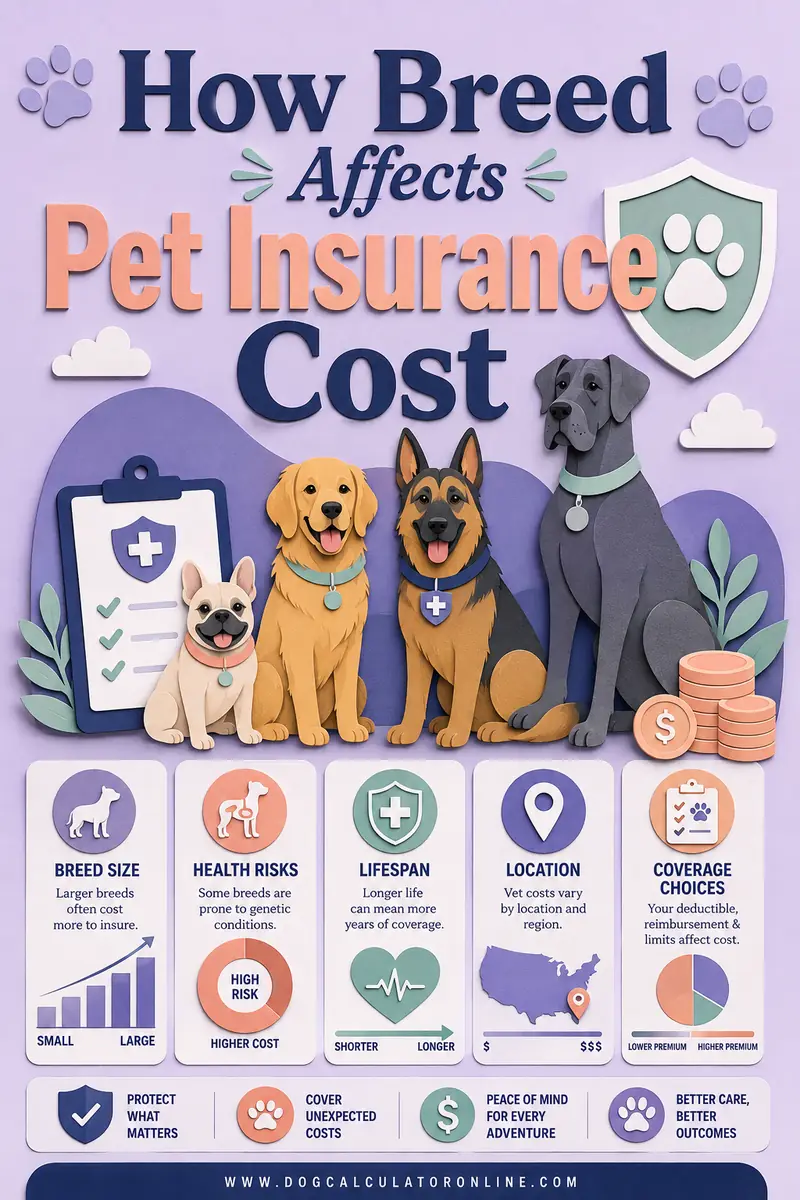
Breed loading is large and public. For a three-year-old dog in the same ZIP code, an accident-and-illness premium can run from $28 a month for a medium crossbreed to $95–$140 for a bulldog or a great dane.
Loading is a claims forecast, not a judgement. It reflects the average size and frequency of claims for that breed, which is exactly the information a prospective owner wants.
Get quotes before you choose the breed, not after. Two minutes on a comparison site produces a better cost forecast than any article — pet insurance cost by breed explains how the loading is built.
Premiums rise steeply with age on top of breed loading. A high-risk breed at ten can cost three to four times its premium at two, which is when many owners lapse cover and lose it permanently.
Exclusions bite hardest here. Once a bulldog has been treated for airway disease or a dachshund for a disc episode, that condition is excluded from any new policy, so switching insurer stops being an option.
Owning an Expensive Breed Well
Choosing one of these dogs is a legitimate decision; going into it unbudgeted is not.
Insure from day one, at the highest annual limit you can afford. For breeds with chronic signature conditions, a low annual limit runs out mid-treatment.
Buy from health-tested parents and ask to see the certificates. Hip and elbow scores, cardiac certification, eye testing and DNA panels genuinely shift the odds.
Keep the dog lean, and be strict about it. Weight control is the single most effective intervention for joint disease, airway function and lifespan, and it costs nothing.
Hold a bigger buffer than average. $3,000–$5,000 rather than $1,500 is a realistic emergency fund for a high-risk breed.
Find a practice experienced with the breed before you need one. Familiarity with brachycephalic anaesthesia, giant-breed dosing or spinal cases changes outcomes, and asking during a routine visit is far easier than searching in an emergency.
Compare honestly before you commit. If the running cost is out of reach, cheapest dog breeds to own sets out what a lower-cost dog looks like — the difference over a lifetime is commonly $15,000–$25,000.
FAQ
What is the most expensive dog breed to own?
By lifetime running cost, English and French bulldogs and the giant breeds — great danes, mastiffs, newfoundlands and bernese mountain dogs — sit at the top, commonly $3,000–$6,500 a year. Bulldogs combine surgical conformation problems with high insurance loading; giants combine large doses with short, expensive lives.
Why are French bulldogs so expensive to keep?
Because airway, spinal, skin and eye conditions are all common in the same dog, and each has its own bill. Airway surgery alone runs $2,000–$5,500. Insurance premiums reflect this from the first policy year, and pre-existing exclusions make switching insurer difficult later.
Are expensive puppies expensive to own?
Not reliably. Rare breeds command high prices without high claims rates, while several of the costliest breeds to run are cheap to buy. What raises running cost is exaggerated conformation, large body mass, a signature breed disease and a coat needing professional grooming.
Does insurance make a high-risk breed affordable?
It converts unpredictable bills into a predictable premium, which is genuinely valuable. It does not lower the total, because insurers load premiums for high-claiming breeds. Expect to pay more every month as well as more at the vet, and expect exclusions once a condition is diagnosed.
Which is more expensive, a giant breed or a flat-faced one?
Per year they are comparable. Giant breeds cost more in food, drug doses and boarding; flat-faced breeds cost more in surgery, ophthalmology and dermatology. Over a lifetime, flat-faced breeds often edge ahead because they live longer with chronic problems.
Can I reduce the cost of an expensive breed?
Yes, meaningfully. Buy from health-tested lines, insure on day one at a high annual limit, keep the dog lean, brush the teeth, and treat early signs promptly rather than waiting. Those five habits can save several thousand dollars across a life without compromising care.
Budget for the Shape, Not the Price Tag
The dogs that cost the most to own are not the ones with the highest puppy prices. They are the flat-faced, the giant, the long-backed and the heart-diseased, plus anything needing a groomer every six weeks — and their costs are predictable enough that insurers publish them as premium loading. Expect $3,000–$6,500 a year for a bulldog or a giant breed against $1,000–$1,800 for a medium short-coated crossbreed. That is a $15,000–$25,000 difference across a life, and it is a decision worth making with the numbers in front of you. Run yours through the free dog cost calculator.