How Long Does a Dog Stay in Heat?
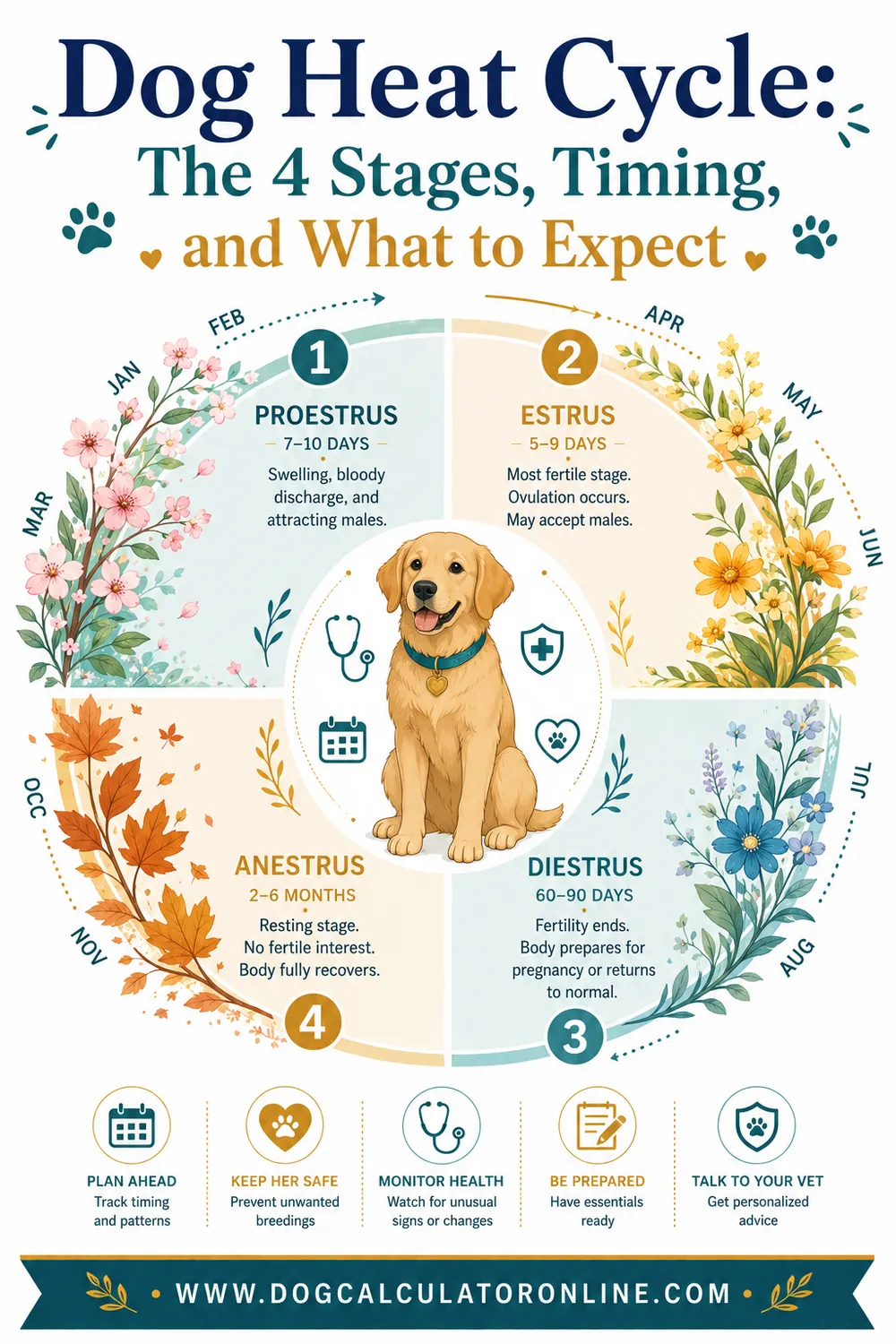
A dog's heat typically lasts 2 to 4 weeks, with about 18–21 days being a common average — counted from the first signs of swelling and bleeding to the point her body returns to normal and males lose interest. Within that window, the first stretch (proestrus, often around 7–10 days) brings bleeding but no receptivity, and the second stretch (estrus, often around 5–10 days) is when she's actually fertile. Every dog runs her own clock, though: perfectly normal heats range from well under two weeks to nearly a month, and a female's pattern often only becomes predictable after her first few cycles.
If there's any chance of a mating during that fertile window — planned or otherwise — dates start mattering fast. The free dog pregnancy calculator turns a known or suspected mating date into a due-date window and week-by-week milestones in seconds. Below: the full stage-by-stage timeline, how to tell where in the cycle your dog is, what varies by breed and age, what's normal versus what's a vet call, and practical care for the weeks in between.

📅 Heat cycle stage check
Tap a stage to see what happens and how long it usually lasts:
Tap a stage above. Averages, not promises — each dog sets her own timeline.
The Short Answer, With the Ranges That Matter
"In heat" usually means the outwardly visible part of the cycle — proestrus plus estrus — and that's the 2-to-4-week span. Here's the honest range picture:
| Phase | Common average | Normal range | What defines it |
|---|---|---|---|
| Proestrus | ~7–10 days | ~3–17 days | Swelling, bleeding, males interested, she refuses |
| Estrus (fertile) | ~5–10 days | ~3–21 days | Lighter discharge, she's receptive, can conceive |
| Total "in heat" | ~18–21 days | ~2–4 weeks | First swelling/bleeding to back-to-normal |
| Diestrus | ~2 months | — | Post-heat hormone phase, no receptivity |
| Anestrus | ~4+ months | — | Quiet reset until the next cycle |
Two takeaways worth pinning. First, bleeding does not equal the whole heat: many dogs bleed mostly in the first phase, so a female whose discharge has lightened or nearly stopped may be at her most fertile, not finished. (More on that trap in our how long does a dog bleed in heat guide.) Second, the total cycle — heat plus diestrus plus anestrus — is why most dogs come into heat roughly every six months; the between-heat phases fill the calendar. Frequency has its own wrinkles by breed and age, covered in how often do dogs go into heat.
Stage by Stage: What You'll Actually See
Proestrus — the opening act (~7–10 days)
This is the stage most owners notice first: the vulva swells, a bloody discharge appears, and she may lick more, urinate more often, and act clingy or unsettled. Male dogs begin paying serious attention; she says no — sometimes emphatically. Discharge amount varies hugely between dogs (fastidious self-groomers can make a heat look "light" when it isn't), which is one reason day counts beat discharge-watching for tracking. If you're not sure a heat has started at all, our signs your dog is going into heat rundown lists the early tells.
Estrus — the fertile window (~5–10 days)
The discharge typically lightens in color and volume, the swelling softens, and her behavior flips: tail flagging (swinging the tail aside when touched near the rear), backing up to males, and active interest. This is when pregnancy can happen, and it's when escape attempts, backyard visitors, and "she was only out for a minute" stories do their damage — intact males detect a female in heat from remarkable distances, and both sexes become determined escape artists. Supervision, secure fencing, and leashed-only outings are the whole game for these days.
If a mating occurs — intended or not — write the date down immediately. Canine pregnancy runs about 63 days from ovulation, and the dog pregnancy calculator converts a mating date into a due-date window plus week-by-week milestones. And if the mating was unwanted, call your vet promptly to talk through options rather than waiting to see.
Diestrus — the invisible aftermath (~2 months)
Outward heat ends: discharge stops, swelling recedes, males lose interest. Hormonally, though, her body runs a progesterone phase that looks pregnancy-like whether or not she conceived. This is why some dogs show false pregnancy signs weeks after a heat — nesting, mothering toys, appetite shifts, even milk production. Mild cases commonly pass on their own; persistent or distressing signs are a vet conversation, not a home project.
Anestrus — the reset (~4 or more months)
The quiet stretch with no reproductive activity while the system resets. Nothing to manage — this is simply why heats arrive roughly twice a year rather than continuously. The full four-phase physiology gets deeper treatment in our dog heat cycle guide.
What Changes the Timeline: Breed, Size, and Age
Size and breed shift the rhythm more than the length. An individual heat lasts about the same 2–4 weeks across sizes, but frequency differs: small breeds may cycle up to three times a year, most dogs run about every six months, and giant breeds may cycle only once a year — all normal patterns.
First heats start at different ages. Small breeds often have a first heat around 6–9 months; large and giant breeds commonly start later, sometimes not until 18–24 months. A first heat is also allowed to be weird: "silent" heats (minimal visible signs), split heats (a stall and restart), and irregular spacing are common in young dogs, and cycles usually settle into a personal pattern over the first couple of years.
Older dogs don't stop. Dogs have no menopause — intact females cycle for life, though heats may space out and signs may soften with age. Any bleeding pattern in a senior female that doesn't fit her known cycle deserves a vet check rather than a "probably just heat" shrug, since other conditions can mimic one.
Tracking beats guessing. Note the first day of swelling/bleeding, the day discharge lightens, the day males lose interest, and the total length. After two or three cycles you'll have her numbers — invaluable for planning supervision windows, boarding, grooming appointments, and any conversation with your vet or a breeder.
Common Myths and Mix-Ups
Heat cycles collect folklore, and some of it causes real problems. The frequent offenders:
"The bleeding stopped, so the heat is over." The most consequential one. Lighter discharge often marks the start of the fertile window, not the end of the heat. Unplanned litters are regularly conceived in the week after owners relaxed. Count days and watch behavior — receptivity, flagging, male interest — and keep supervision going until all signs have been gone for several days.
"She can't get pregnant on her first heat." She can. A first heat means a fertile dog, however young — and pregnancy that early is physically demanding, which is exactly why containment on a first heat matters as much as on any other.
"Dogs need one litter (or one heat) before spaying." No veterinary evidence supports either claim as a general benefit. Spay timing is a genuine, individualized discussion — age, breed, and size all factor in, and recommendations have evolved, particularly for large breeds — but "she should be a mom once" is sentiment, not medicine. Have the timing conversation with your vet.
"A dog in heat will act pregnant afterward only if she mated." False pregnancy after a heat happens with or without mating — the post-heat hormone phase runs the same either way. Nesting, toy-mothering, and appetite changes a few weeks after heat don't prove a successful escape happened, though if there's any real doubt, your vet can check.
"Male dogs only react if they're nearby." Intact males detect a female in heat across impressive distances and will travel, dig, and climb. The visiting-dog problem is about your fence and gate, not your immediate neighbors' dogs alone.
"Spayed dogs still have silent heats." A complete spay removes the ovaries, and cycles stop. Heat-like signs in a spayed female — swelling, discharge, male attention — are worth a vet visit, both to rule out medical issues and to check for retained ovarian tissue, an uncommon surgical leftover that can keep hormones cycling.
Normal vs. Call-the-Vet
Normal during a heat: moderate bloody discharge that lightens over time, vulva swelling, extra licking, clingy or restless behavior, appetite dips, more frequent urination, and dramatic interest from every intact male in the ZIP code.
Worth a vet call:
- Bleeding beyond ~4 weeks, or heats arriving much more often than her pattern
- Foul-smelling, green, or pus-like discharge — at any point, but especially in the weeks after a heat, when pyometra (a serious, potentially life-threatening womb infection of intact females) classically appears. Lethargy, heavy drinking, vomiting, or a swollen belly in the month or two after heat is an urgent-vet situation, not a wait-and-see.
- Signs of illness during heat — fever-like lethargy, refusing food outright, pain.
- No first heat by around 2 years old, or heats that simply stop in a young dog.
- A suspected unwanted mating — options are time-sensitive; call promptly.
None of this is cause for background dread — most heats pass uneventfully — but the post-heat infection window is the one every owner of an intact female should genuinely know about.
Living With It: Practical Care for 2–4 Weeks
- Containment first. Leash-only outings (even in fenced yards during estrus for the determined), no dog parks, no off-leash trails, and a hard look at gate latches and fence lines. Assume she wants out and every intact male wants in.
- Mess management. Washable blankets over favorite spots, and washable dog diapers or heat pants for indoor bleeding — most dogs accept them quickly. Change often; hygiene matters.
- Comfort and patience. Some dogs sail through; some are visibly out of sorts — clingy, restless, off their food. Quiet routines, gentle exercise on leash, and slack for odd behavior all help. Never give any human or leftover medication for discomfort; if she seems genuinely unwell, that's the vet call again.
- Calendar the aftermath. Set a reminder for the next expected heat (roughly six months out, or her personal interval), and keep half an eye on her for the post-heat weeks given the pyometra window above.
- The long-term question. If you don't intend to breed her, spaying ends the cycle entirely and removes the pyometra risk — and the timing of that surgery relative to age, breed, size, and heats is a genuinely individualized decision. That one belongs with your vet, not a website.
FAQ
How long does a female dog stay in heat?
Typically 2–4 weeks, with 18–21 days a common average — from the first swelling and bleeding until behavior and discharge return to normal. Both shorter and longer can be normal for an individual dog; her own pattern emerges over a few cycles.
How do I know when my dog's heat is finished?
The practical markers: discharge has stopped, the vulva has returned to normal size, she stops flagging or accepting males, and males lose interest in her. When all of those hold for a few days, the heat is done — but keep supervision going until you're sure, since the fertile window can outlast the obvious bleeding.
How long is a dog fertile during heat?
The fertile window falls during estrus — often somewhere around days 9–14 of the overall heat, lasting roughly 5–10 days — but timing varies enough between dogs that no calendar rule is reliable for either achieving or preventing pregnancy. Breeders use veterinary progesterone testing for real precision; for prevention, treat the entire heat as risky.
Do dogs bleed the whole time they're in heat?
Usually not. Bleeding is heaviest in proestrus and typically lightens or stops as she enters the fertile phase — which misleads many owners into relaxing exactly when pregnancy risk peaks. Count days and watch behavior, not just discharge.
How often do dogs go into heat?
About every six months for most dogs, but small breeds can cycle up to three times a year and giant breeds sometimes just once. Young dogs are often irregular for the first couple of years, and intact females keep cycling for life — there's no canine menopause.
At what age do dogs have their first heat?
Commonly between 6 and 15 months — small breeds earlier (often 6–9 months), large and giant breeds later, sometimes not until 18–24 months. First cycles are frequently irregular, light, or "silent," so an unremarkable first heat is normal. No heat at all by around two years old is worth mentioning to your vet.
Can I walk my dog while she's in heat?
Yes — on leash, every time, ideally at quieter times and places. Skip dog parks and off-leash areas entirely: she can attract intact males from a long way off, and both her motivation and theirs to reach each other are stronger than most fences and recalls.
Know Her Timeline, Plan Around It
The answer to "how long?" is 2–4 weeks on the calendar — but the useful version is stage-by-stage: a week-ish of visible bleeding, then the lighter-discharge fertile window where supervision matters most, then a quiet hormonal tail that deserves one watchful month. Track a couple of cycles and you'll know her numbers, not the internet's averages. And if a mating happens inside that window, get ahead of the next 63 days: the free dog pregnancy calculator turns the date into a due-date window and week-by-week plan in seconds.