How Often Do Dogs Go Into Heat?
Most intact female dogs go into heat about every six months — roughly twice a year — but that average hides a lot of normal variation. Small breeds often cycle more frequently, sometimes three times a year, while large and giant breeds may cycle only once a year. Age matters too: young dogs are frequently irregular for their first couple of cycles, and intact females keep cycling for life because dogs have no menopause. The six-month figure is a starting point, not a rule your dog agreed to.
If there's any chance a mating happens during one of those cycles, dates start mattering right away. The free dog pregnancy calculator turns a known or suspected mating date into a due-date window and week-by-week milestones in seconds. Below: how frequency changes by size and age, why the whole cycle takes about six months, how to track your own dog's rhythm, and when an off-schedule heat is worth a vet call.

📅 How often by size
Tap your dog's size to see the typical heat frequency:
Tap a size above. These are typical ranges — each dog sets her own clock.
The Short Answer, and Why "Six Months" Is Only an Average
For a typical adult dog, heat comes around twice a year, spaced about six months apart. That single number gets quoted everywhere because it fits the largest slice of dogs — medium-sized adults in a settled cycle. But two things pull individual dogs off it constantly: body size and age. A Chihuahua and a Great Dane simply do not run on the same reproductive calendar, and neither runs on the calendar she'll eventually keep until she's had a few cycles under her belt.
It helps to separate two questions people blur together. "How long does she stay in heat?" is about the visible bleeding-and-receptivity window — usually 2 to 4 weeks, covered in how long does a dog stay in heat. "How often does she go into heat?" is about the gap between those windows — usually about six months. This article is about the gap.
Why the Cycle Takes About Six Months
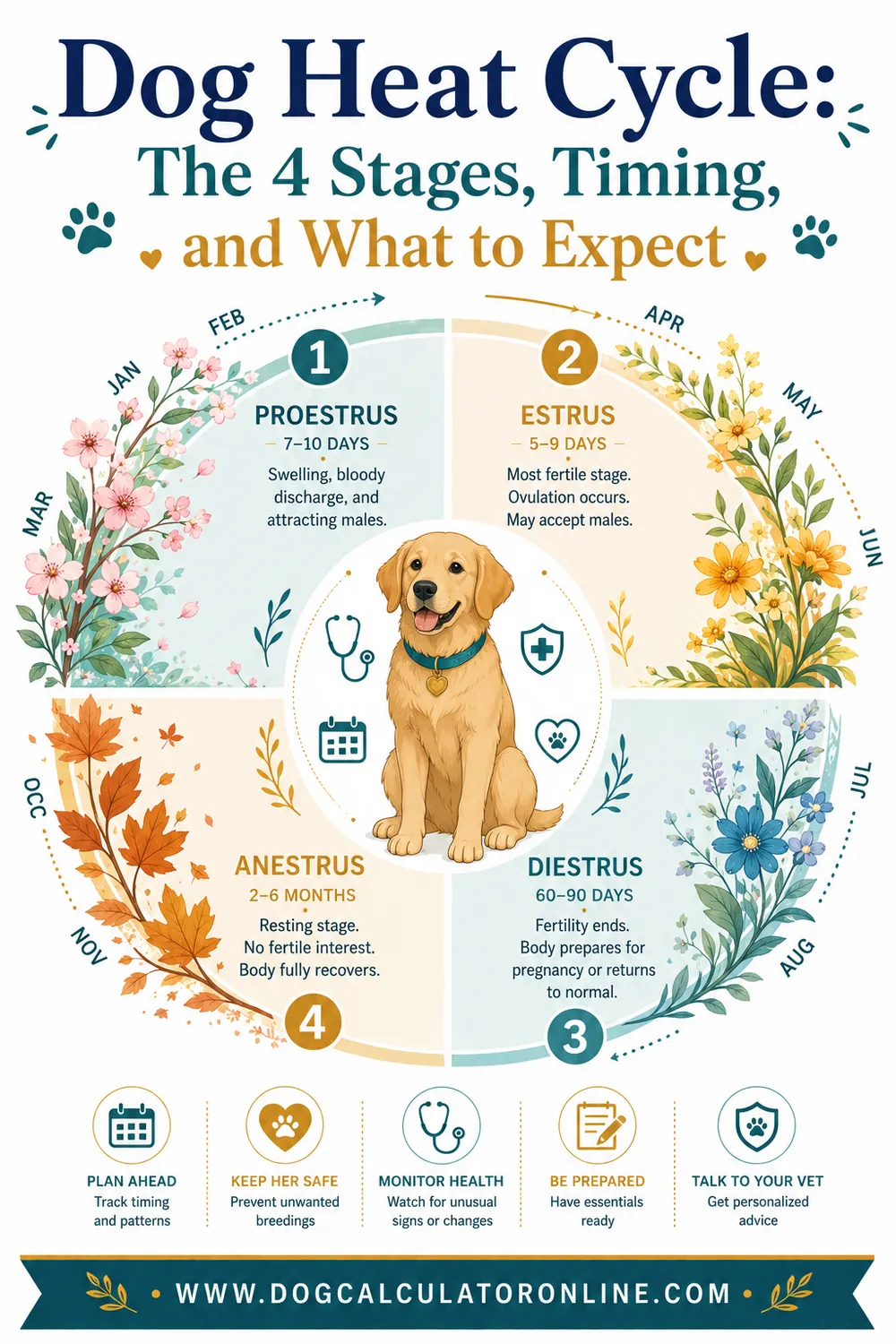
The roughly-six-month spacing isn't arbitrary. A full canine reproductive cycle has four phases, and the visible heat is only the front end of it:
| Phase | Rough length | What's happening |
|---|---|---|
| Proestrus | ~7–10 days | Swelling and bleeding begin; not yet fertile |
| Estrus | ~5–10 days | The fertile window; she's receptive |
| Diestrus | ~2 months | Post-heat hormone phase, pregnant or not |
| Anestrus | ~4+ months | Quiet reproductive rest before the next cycle |
Add those up and you land near six months. The visible heat is only the first three or four weeks; the long, invisible diestrus and anestrus phases fill out the rest of the calendar. That's why a dog can seem "done" with heat for months and then start again right on schedule — her body was working through the quiet phases the whole time. The four-phase physiology is broken down further in our dog heat cycle guide.
Frequency by Size: Small Cycles Faster, Giants Slower
Size is the single biggest driver of how often a dog cycles. As a general pattern:
- Small breeds (think Chihuahuas, Dachshunds, small terriers) tend to cycle more often — every four to six months for some, occasionally three times a year.
- Medium breeds mostly hold the classic six-month, twice-a-year rhythm.
- Large breeds often stretch to every six to twelve months.
- Giant breeds (Great Danes, Mastiffs, some of the big working breeds) may cycle just once a year.
None of these is "better" or "healthier" — they're breed-typical patterns. A giant-breed owner shouldn't worry that once-a-year means something is wrong, and a small-breed owner shouldn't assume three heats a year is a problem. What matters is whether your dog is consistent with her pattern once it's established.
Frequency by Age: Irregular Young, Steady Adult, Lifelong Senior
Puppies and young dogs are allowed to be unpredictable. A first heat can arrive anywhere from about 6 months to 2 years depending on size (more in what age do dogs go into heat), and the first two or three cycles are often irregular. You might see:
- Silent heats — a real cycle with minimal visible signs, easy to miss entirely.
- Split heats — signs start, stall, then restart weeks later.
- Uneven spacing — a gap of four months, then eight, before things settle.
This is normal maturation, not malfunction. Most dogs settle into a personal, fairly predictable interval by around age two.
Adult dogs are the steady middle. Once mature, a healthy intact female usually keeps a consistent gap — hers might be five months or seven, but it tends to repeat. That consistency is exactly what makes tracking worthwhile.
Senior dogs keep going. There is no canine menopause. Intact females cycle for the rest of their lives, though heats may space out further and signs may soften with age. What's not normal in a senior is a sudden change — heats much closer together, much heavier, or discharge that doesn't fit her pattern. Any of those deserves a vet check rather than a "she's just getting older" shrug, because several conditions can mimic or disrupt a cycle.
How to Track Your Dog's Own Rhythm
Averages are for strangers' dogs. For yours, a simple log beats any chart. Each heat, note:
- The first day you see swelling or bleeding (day one of the cycle).
- The day discharge lightens and she becomes receptive (the fertile window opening).
- The day everything returns to normal and males lose interest (heat over).
- The gap until the next heat begins.
After two or three cycles you'll have her real interval, her real heat length, and a rough forecast for the next one. That's genuinely useful for planning: booking boarding or grooming outside her heat, arranging extra supervision during the fertile window, avoiding dog-park trips at the wrong time, and giving your vet accurate history if a question ever comes up. A phone calendar with a recurring reminder set to her interval does the job.
What "Regular" Actually Means for Your Dog
It's tempting to measure your dog against the six-month average and worry when she doesn't match it. But "regular" is defined by her pattern, not the population average. A dog who reliably cycles every five months is regular. So is one who cycles every seven. What matters is consistency once she's mature — not whether she hits the textbook number.
That's why the single most useful thing you can do is establish her baseline. Two or three tracked cycles tell you her normal interval, her normal heat length, and her normal intensity. From then on, you're comparing her to herself, which is far more meaningful than any chart. A change from her own baseline — cycles suddenly much closer together, or heats that stop in a young dog — is the real signal worth acting on, and it's one you can only spot if you know what her normal looks like.
Signs a New Heat Is Starting
Knowing roughly when to expect the next one helps, but the dog tells you too. Early signs a fresh cycle is beginning include a swelling vulva, spots of bloody discharge, more frequent urination, increased licking, and clingy or restless behavior — plus sudden, intense interest from any intact male nearby. Our signs your dog is going into heat guide covers the early tells in detail. The moment you spot them, that's day one for your log — and the start of the supervision window.
Can You Change How Often a Dog Cycles?
Not safely at home, and it's the wrong goal anyway. The cycle's frequency is set by her hormones, size, and genetics. Diet tweaks, exercise changes, and over-the-counter products won't reliably shift it, and attempting to manipulate a heat cycle with any medication is strictly a veterinary decision — never a home experiment.
The one intervention that changes frequency to zero is spaying, which removes the ovaries and ends cycling entirely. Whether and when to spay is a genuinely individualized decision — age, breed, size, and health all factor in, and recommendations have evolved, especially for large breeds. That timing conversation belongs with your vet, not a website. What spaying is not is a casual way to "regulate" a cycle you find inconvenient; it's a permanent surgical decision with its own considerations.
When Off-Schedule Heat Is a Vet Call
Most frequency variation is normal. These patterns, though, are worth a veterinary conversation:
- No first heat by around two years old in a dog that hasn't been spayed.
- Heats suddenly much closer together than her established pattern.
- Heats that stop in a young or middle-aged intact dog after having been regular.
- Very heavy or very prolonged bleeding, or bleeding that lasts well beyond four weeks.
- Foul-smelling, green, or pus-like discharge at any point — especially in the weeks after a heat, when pyometra (a serious womb infection of intact females) classically appears. Paired with lethargy, heavy drinking, vomiting, or a swollen belly, that's an urgent vet situation, not wait-and-see.
- Heat-like signs in a spayed dog — worth a visit to rule out retained ovarian tissue or other issues (see do spayed dogs go into heat).
None of this is cause for constant worry — the vast majority of cycles come and go without incident. But the post-heat infection window is the one thing every owner of an intact female should genuinely know about.
FAQ
How often do dogs go into heat in a year?
Most dogs go into heat about twice a year, roughly every six months. Small breeds may cycle up to three times a year, while giant breeds sometimes cycle only once. Young dogs are often irregular until their pattern settles around age two.
Do dogs go into heat every month?
No. A common misread comes from confusing the multi-week heat with a monthly human cycle. Dogs typically cycle only about every six months, not monthly. If your dog seems to bleed far more often than every few months, that's a reason to see your vet.
How often do small dogs go into heat?
Small breeds tend to cycle more frequently than larger dogs — often every four to six months, and occasionally three times a year. That's a normal breed-typical pattern, not a problem, as long as it's consistent for her.
At what age do heat cycles slow down?
They don't fully stop, since dogs have no menopause, but cycles often space out and signs soften as a dog ages. A sudden change in an older dog — heats closer together, heavier, or with unusual discharge — is worth a vet check rather than chalking it up to age.
How can I predict my dog's next heat?
Track the first day of each heat and count the gap to the next one. After two or three cycles you'll know her personal interval, which is far more accurate than the six-month average. A recurring calendar reminder set to her interval keeps you ahead of it.
Does spaying stop heat cycles completely?
Yes. A complete spay removes the ovaries, so cycling ends. If a spayed dog shows heat-like signs, see your vet — it can indicate retained ovarian tissue or another issue worth ruling out.
Know Her Interval, Plan Around It
"How often?" is about every six months for the average dog — but the useful answer is her interval, which you only get by tracking a couple of cycles. Small dogs run faster, giants slower, and young dogs wander until they settle. Log the first day of each heat, watch for the early signs, and keep an eye on the post-heat weeks. And if a mating ever happens during a cycle, get ahead of the next 63 days: the free dog pregnancy calculator turns the date into a due-date window and week-by-week plan in seconds.