House-Training a Puppy in an Apartment
Time the walk from your puppy's crate to the nearest patch of grass. If it is more than about 90 seconds, carry the puppy — because an eight-week-old cannot hold on through a corridor, a lift and a lobby once it has decided to go. That single measurement shapes every decision that follows. Apartment house training is not harder than house training with a garden; it is just less forgiving of delay, and it forces a choice most owners with gardens never have to make: whether to teach an indoor toilet at all. Both answers are defensible, and this page sets out what each one costs. Track your puppy's growth and bladder development with the puppy weight calculator.
🐾 Which apartment setup fits you?
Tap your situation:
Tap an option above. Whatever you choose, use one surface consistently.
The Apartment Problem, Measured
Do the arithmetic once and the plan writes itself.
A young puppy gives roughly zero warning. Circling and sniffing is often five to fifteen seconds before it happens, not five minutes.
Count your actual journey. Crate to front door, door to lift, lift wait, lift ride, lobby, front entrance, curb, grass. On a sixth floor that is realistically three to four minutes each way.
Multiply by the trip count. A ten-week-old needs the toilet every 45 to 60 minutes while awake — call it twelve trips a day. At seven minutes per round trip, that is 84 minutes of corridor time daily, before walks.
Carrying collapses the time. Carrying an eight-week-old removes the sniffing, dawdling and mid-corridor accidents, and it neatly solves the pre-vaccination problem too, since the puppy's feet never touch shared ground.
Carrying stops working around 15 to 20 lb (7–9 kg), which is roughly 12 to 16 weeks for a medium breed. By then the puppy can usually hold on long enough to walk it.
Pick a spot within sight of the door and use only that spot. Consistency of location does more work than any other single factor.
Pads, Grass Trays or Straight Outside?
The three options and their real costs.
| Option | Best for | Cost | Transition later |
|---|---|---|---|
| Straight outside only | Ground and low floors, someone home | 0 | None — fastest overall |
| Real-grass tray | High floors, balconies, working owners | $25–40/month | Easy — surface already matches |
| Puppy pads | Emergencies, illness, temporary use | $20–30/month | Hard — 2–4 extra weeks |
| Artificial grass patch | Balconies, reusable | $40–90 once | Moderate — needs daily rinsing |
| Litter box with sod | Small breeds under 20 lb (9 kg) | $30–50/month | Easy |
Real grass beats pads for one reason: substrate. Puppies learn to associate a surface with toileting, and a puppy trained on grass indoors already prefers grass outdoors. A pad-trained puppy has learned that a soft absorbent thing is the toilet, which is why pad-trained dogs go on bathmats, rugs and towels for months afterwards.
Pads are not useless. They are the right answer for a puppy that cannot yet go outside, an owner with limited mobility, a dog recovering from surgery, or a genuinely unavoidable ten-hour day.
Do not run both systems half-heartedly. A puppy taken outside sometimes and left with pads sometimes learns that everything is negotiable, and takes weeks longer.
Never put a pad next to the water bowl or bed. Puppies avoid toileting near where they eat and sleep, and putting the two together produces confusion rather than convenience.
Skip the pad-scent attractant sprays. They work well enough that dogs seek out anything smelling similar, which becomes a problem when you want the habit gone.
The Lift and Corridor Routine
Shared spaces need their own small training plan.
Carry the puppy through shared corridors for the first weeks. It is faster, avoids accidents on communal carpet, and keeps the puppy off ground used by unvaccinated dogs.
Introduce the lift deliberately, not in an emergency at 2am. Two or three sessions of stepping in, giving a treat, and stepping straight back out — no journey at all — prevents a lift phobia that is genuinely difficult to fix later.
Lifts are the classic fear trigger because the floor moves and there is no exit. A puppy that panics once often panics for months.
Have a bag and wipes in your pocket every single time. A missed pick-up in a shared lobby is the fastest way to lose your neighbors' goodwill.
Use the stairs for a small puppy if the lift is slow, but carry it — stairs are hard on developing joints and a fall on concrete steps is serious.
Set up a "go bag" by the door: lead, treats in a pot, bags, a small towel. At 3am you need to be outside in twenty seconds, not hunting for a poo bag.
Setting Up a Balcony or Indoor Toilet Area
If you need an indoor option, build it properly rather than improvising.
Choose the place before the puppy arrives and never move it. A balcony corner, a bathroom, or a utility area — the same spot for months.
Use a contained tray with a raised lip. Loose pads slide, get chewed and get dragged around; a tray or a purpose-made frame keeps the boundary clear.
Real turf trays need changing weekly in warm weather and every two weeks otherwise. Artificial patches need rinsing daily and a full disinfectant clean weekly, or the smell becomes the neighbors' problem.
Balconies need a check first. Gaps in railings, a drainage route that does not run into the flat below, shade in summer, and a barrier so the puppy cannot squeeze through. Puppies fit through gaps of a few inches.
Do not use a balcony as the only toileting area long term. Dogs need to be outside for reasons beyond emptying a bladder, and a dog that never toilets on a walk becomes awkward to travel with.
Keep water and bed at the opposite end of the space from the toilet area.
Timing the Trips When Outside Is Four Minutes Away
Timing is the whole method, and apartment timing has to run slightly early.
Go out on the clock, not on the signals. By the time you see circling in a flat, you are already too late. Set a repeating timer.
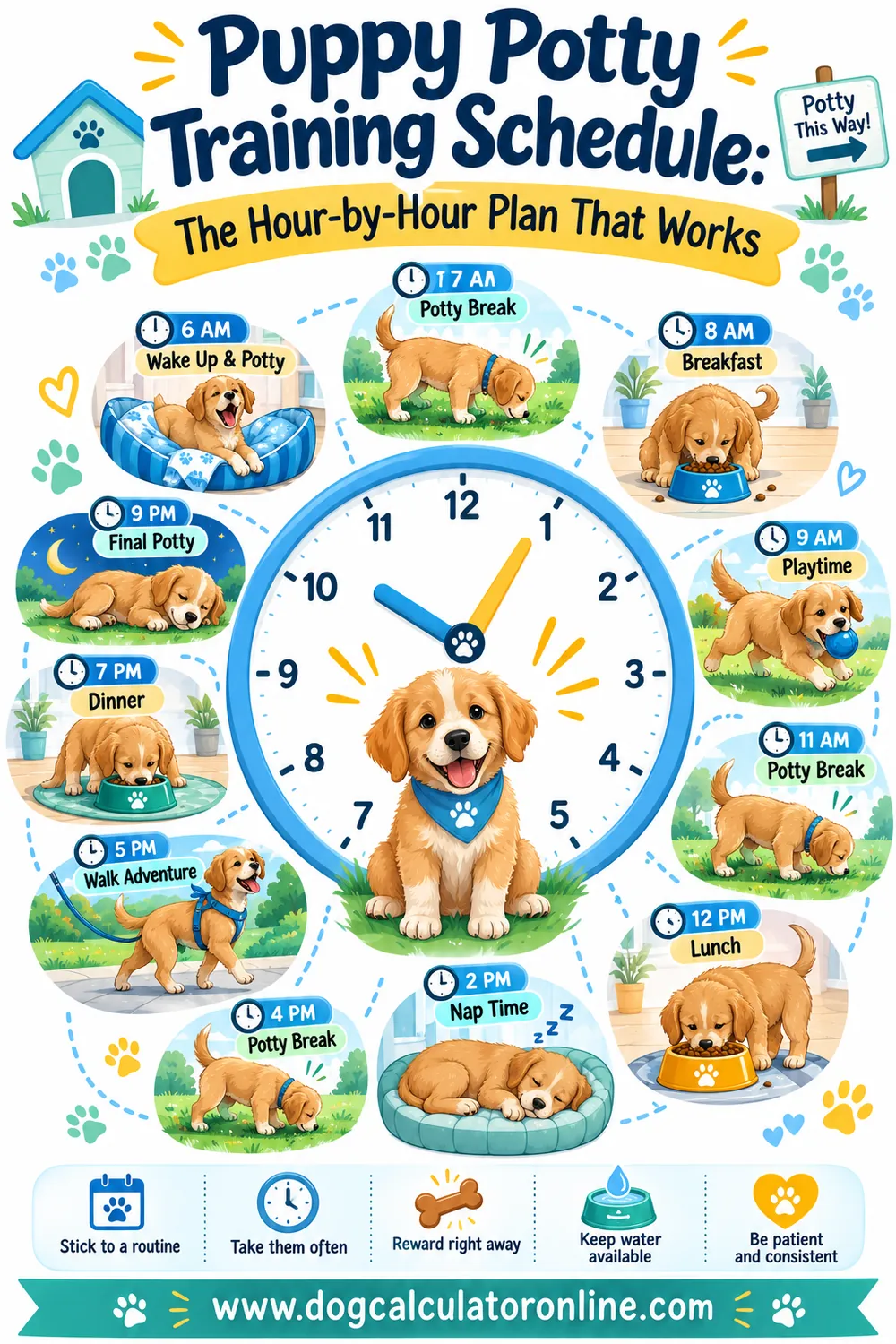
Every 45 to 60 minutes while awake for an eight to ten-week-old, plus after every meal, every nap and every play session.
Meals are the most predictable trigger. Most puppies need to defecate 10 to 30 minutes after eating, so plan the trip for fifteen minutes after the bowl goes down.
The first trip of the day is immediate — out of the crate, into your arms, straight down. Do not stop to put shoes on properly.
Have a fallback for the moments you miss. A tray by the front door catches the trip you did not make in time and keeps the accident somewhere cleanable.
Overnight, plan for one or two trips, and use a tray at 2am if a lift journey is genuinely impractical. The overnight plan by age is in nighttime puppy potty schedule.
Reward Timing and Cleaning Up
Two details decide how fast this goes.
Reward within one second of the puppy finishing, outside, on the spot. A treat handed over back in the flat teaches nothing at all — the puppy connects the food to walking through the door, not to what it did four minutes earlier.
Carry treats in your pocket at all times for the first three weeks. Going back inside to fetch one destroys the timing.
Stay boring until they have been. Praise and play come after, never before, or the trip becomes about going out rather than about toileting.
Clean accidents with an enzymatic cleaner only. Ammonia-based products smell like urine to a dog and mark the spot as a toilet. In a flat, where the same twenty square feet gets used repeatedly, this matters more than in a house.
Never punish an accident, including after the fact. Puppies cannot connect a telling-off to something they did minutes ago; what they learn is to toilet where you cannot see, which in a flat means behind the sofa.
Restrict the space. A puppy with the run of an open-plan flat will find a corner. Gate it into one area until house training is reliable — the general schedule is in puppy potty training schedule.
Weaning Off the Indoor Toilet
The transition is the price of the indoor option, and it is manageable.
Start when the puppy can hold on for two hours or more, which is usually around twelve weeks, and once vaccinations allow public ground. Timings for that are in when can puppies go outside.
Move the tray toward the front door by a foot or two every couple of days.
Then move it outside the front door, then to the toileting spot outdoors, keeping the same tray and the same surface.
Take a used piece of turf or pad to the outdoor spot so the scent is already there. Scent does most of the work.
Reduce the indoor option gradually — remove it during the day first, then at night, then entirely.
Expect two to four weeks for the transition, and longer for pad-trained puppies. Overall house-training timelines are in how long does it take to potty train a puppy.
Apartment Mistakes That Cost Weeks
Each of these is common and each is avoidable.
Waiting for the puppy to ask. Young puppies do not ask. Use a timer.
Running pads and outdoors simultaneously without a plan. Pick a primary system.
Leaving pads down permanently once the puppy is going outside. The habit persists exactly as long as the option does.
Punishing accidents in a small space. The puppy has nowhere to escape to, and the fallout — hiding to toilet, anxiety around you — is worse in a flat than in a house.
Skipping mental exercise. Flats are quiet and small, and a bored puppy chews and barks. Twenty minutes of scatter feeding and nose work does more than an extra walk; there are options in indoor exercise ideas for dogs.
Ignoring the neighbors. A five-minute conversation early, plus never leaving a puppy crying for an hour, prevents most complaints.
Assuming a small breed needs less. Small dogs have smaller bladders and need more frequent trips, not fewer, as covered in how long can a puppy hold its bladder.
FAQ
Can you house-train a puppy in an apartment without a yard?
Yes, and the timeline is much the same as with a garden. The differences are that you must go on a timer rather than waiting for signals, carry a young puppy through corridors and lifts, and decide in advance whether you are using an indoor toilet area at all.
Are puppy pads a good idea in a flat?
They are a reasonable fallback and a poor default. Pads teach that a soft absorbent surface is a toilet, which is why pad-trained dogs later target bathmats and rugs. A real-grass tray teaches the same convenience with a surface that matches outdoors, so the transition is far easier.
How do I stop my puppy weeing in the lift?
Carry the puppy until it can hold on for two hours or more, and always go out immediately after waking, eating and playing rather than waiting. Introduce the lift separately with treats and no journey, so it does not become frightening as well as inconvenient.
Should I take my puppy outside before it is fully vaccinated?
Carrying is the usual compromise: the puppy sees, hears and smells the world without its feet touching ground that unknown dogs have used. Ask your vet about local parvovirus risk, because the balance between infection and missing the socialization window is genuinely area-specific.
How long does apartment house training take?
Most puppies are broadly reliable at four to six months, the same as with a garden. Add two to four weeks if you are weaning off an indoor toilet area, and a little longer again if pads rather than grass were used.
What is the best flooring for a puppy in a flat?
Hard floors with washable runners beat carpet by a wide margin, because urine soaks into carpet underlay and the scent keeps drawing the puppy back. Where there is carpet, restrict the puppy to the hard-floor areas until house training is solid.
Making a Flat Work for a Puppy
Apartment house training comes down to three decisions taken early: measure the journey outside and carry the puppy if it takes more than about 90 seconds, choose one primary toileting surface and stick to it, and run trips on a timer rather than waiting for a signal that will not come in time. If you need an indoor option, use real grass rather than pads and put it somewhere permanent, then move it toward and then through the front door once the puppy can hold on for a couple of hours. Reward within a second, outside, on the spot; clean with enzymatic cleaner; never punish. Keep an eye on growth with the puppy weight calculator, since bladder capacity follows size.