16 Dog Years in Human Years: How Old Is a 16-Year-Old Dog?
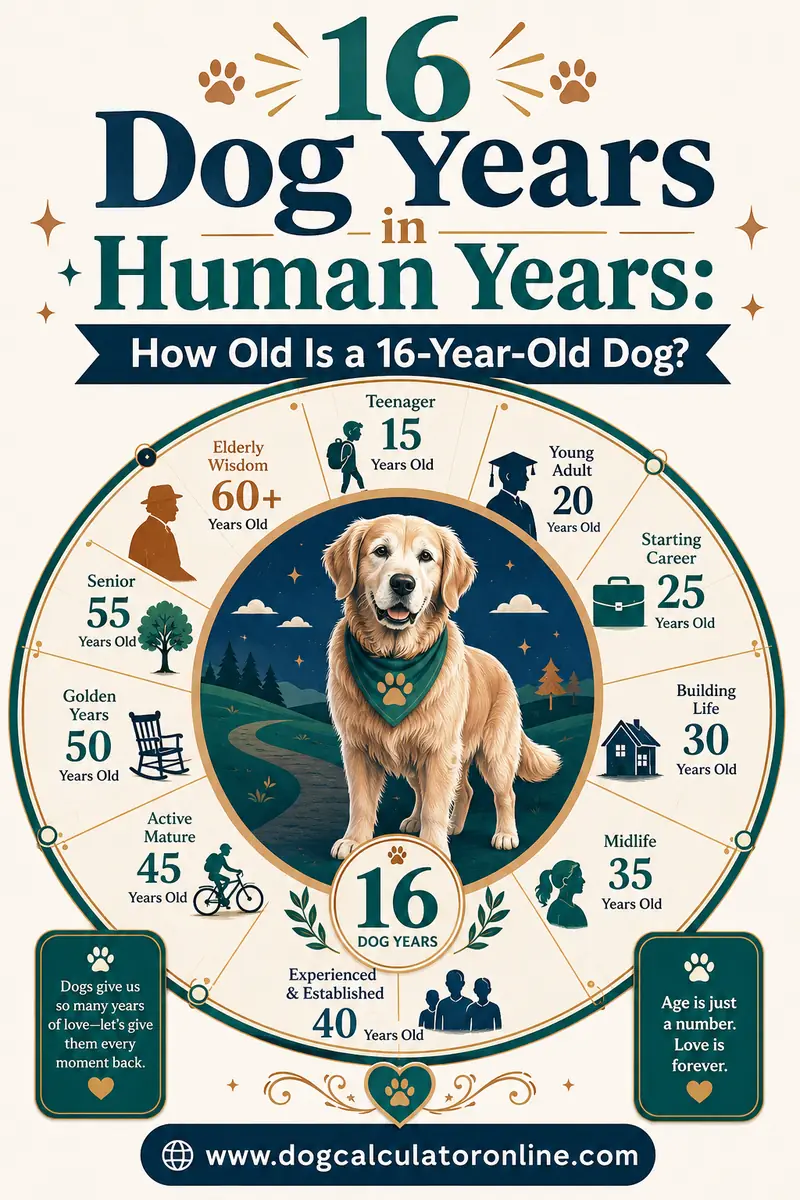
A 16-year-old dog is about 80 to 122 in human years, depending on size: roughly 80 for a small dog, 94 for a medium, 108 for a large, and 122 for a giant breed. Sixteen is super-senior status — an octogenarian if your dog is small, and beyond all records if your dog is giant.
For your dog's precise figure, the free dog age calculator applies the correct size adjustment and shows the 2019 DNA-study number alongside. Here's what 16 means, who gets there, and how they do it.
🐾 Quick check: how old is a 16-year-old dog?
Tap your dog’s size class to see the human-year equivalent at age 16:
Tap a size above to see the answer.
The Short Answer: 16 Dog Years ≈ 80–122 Human Years
The size-adjusted method endorsed by veterinary organizations assigns roughly 15 human years to year one, 9 to year two, then 4–7 per year by adult weight. A 16-year-old is 24 plus fourteen size-adjusted years:
| Size class | Adult weight | Math | 16 dog years in human years |
|---|---|---|---|
| Small | Under 20 lb | 24 + (14 × 4) | ≈ 80 |
| Medium | 21–50 lb | 24 + (14 × 5) | ≈ 94 |
| Large | 51–90 lb | 24 + (14 × 6) | ≈ 108 |
| Giant | Over 90 lb | 24 + (14 × 7) | ≈ 122 |
The 7:1 myth calls a 16-year-old dog 112 across the board — 32 years too old for a small breed. At this altitude the size-adjusted view matters emotionally as much as practically: an "80-year-old" small dog is an elder enjoying a long retirement, not a medical miracle running on fumes.
Who Actually Reaches 16?
Sixteen is a small dog's crown. The breeds most often logged at 16-plus are the little ones: Chihuahuas, Toy and Miniature Poodles, Maltese, Shih Tzus, Dachshunds, Yorkshire Terriers, and small terrier mixes. Among medium breeds, long-lived outliers like Beagles and Australian Cattle Dogs occasionally get here — the breed of Bluey, the famous record-holder credited with 29 years.
Large breeds at 16 are extraordinary rarities; giants, effectively unrecorded. This is the size-lifespan paradox at full stretch: across species, bigger animals live longer, but within dogs the rule flips. Leading explanations point to the breakneck growth of big breeds — enormous cell-division workloads early in life — and higher levels of the growth factor IGF-1, associated with faster aging across many species.
Mixed-breed ancestry, small size, lean body weight, and good dental and veterinary care are the recurring themes in dogs who reach the mid-to-late teens.
The DNA Study's Answer: About 75
The 2019 UC San Diego study derived its formula from DNA methylation patterns in about a hundred Labrador Retrievers:
Human age = 16 × ln(dog age) + 31
For age 16: 16 × ln(16) + 31 ≈ 75 human years.
By now the contrast with the guideline is dramatic — the size-adjusted method says 80–122; the DNA clock says 75. The epigenetic curve did most of its work early (reading 31 at age one!) and has been creeping ever since, adding roughly one human-equivalent year per dog year in the teens.
Neither number is "wrong." The DNA formula tracks a specific molecular marker; the guideline tracks functional life stage. For a 16-year-old, the guideline clearly matches reality better — these are geriatric dogs needing geriatric care. Take the DNA figure as a fascinating hint that late-life aging may be slower at the molecular level than it looks from the outside. The free dog age calculator reports both.
What Owners of 16-Year-Olds Know
Life with a super-senior has its own texture:
- The schedule is sacred. Meals, naps, and the short evening walk happen on rails. A 16-year-old runs on routine the way a puppy runs on kibble.
- Sleep is the main event. Seventeen-plus hours a day is common. The waking hours concentrate into a few reliably good moments — breakfast, the yard patrol, leaning on your shin.
- Communication has evolved. With hearing and vision mostly retired, you and your dog have probably developed a private language of touch, approach angles, and floor vibrations.
- Cognitive quirks are routine. Standing in corners, barking at nothing, midnight confusion. Common at this age, manageable with vet support, and no obstacle to contentment.
- Every quarter counts. In human-equivalent terms, a 16-year-old small dog ages about a year every three months. Health can change quickly; attentive owners and frequent vet contact keep changes from becoming emergencies.
Caring for a Super-Senior
The 16-year-old care plan is geriatric medicine plus hospitality. With your vet directing specifics:
- Vet exams every six months minimum — many vets prefer quarterly contact for dogs this old, with regular bloodwork and urinalysis tracking organs that have worked hard for a decade and a half.
- Treat comfort as a medical priority. Arthritis is a given at 16. Managed pain is the difference between a dog who still enjoys the yard and one who stops trying. Vet-guided options only — never human medications.
- Full home accessibility. Ramps everywhere jumps used to be, rugs on every slick surface, night lights, water bowls in every room your dog uses, and a bed with low sides and orthopedic support.
- Calorie-dense, appetite-friendly feeding if needed. Many very old dogs lose muscle and interest in food. Warmed meals, softer textures, and vet-recommended formulas help keep weight on.
- Short, frequent joys. Five-minute sniff strolls beat one long walk. Sun patches, gentle brushing, car rides, company. Design the day around what still delights.
- A quality-of-life journal. One line a day — appetite, mobility, mood. It keeps the picture honest and makes every vet conversation better.
What Science Is Learning From the Oldest Dogs
Super-senior dogs aren't just heartwarming — they're scientifically valuable. Dogs share our homes, our air, and many of our age-related diseases, yet live compressed lives that let researchers watch a full aging arc in a decade and a half. That's why large research efforts now enroll tens of thousands of companion dogs, tracking genetics, diet, environment, and lifespan — with special interest in the exceptional agers, the canine equivalents of human centenarians.
The questions being asked of 16-year-olds like yours: What do their genomes share? Did lifetime body condition, activity, or household environment tip the scales? Why do some individuals of short-lived breeds dramatically outlast their peers? Early themes echo what veterinarians already observe — lean weight, small size, and lifelong activity keep appearing — but the genetic side may eventually explain outliers like Bluey, the 29-year-old Australian Cattle Dog whose record still stands.
The practical takeaway for owners is quietly hopeful: aging in dogs is an active research frontier, and the fundamentals it keeps validating are ones any owner can apply from puppyhood onward.
The Full Route to 16: A Lifetime in One Table
Here's the entire size-adjusted journey, birth to super-senior — worth a look just to appreciate the distance a 16-year-old has covered:
| Dog's age | Small | Medium | Large | Giant |
|---|---|---|---|---|
| 1 | 15 | 15 | 15 | 15 |
| 4 | 32 | 34 | 36 | 38 |
| 8 | 48 | 54 | 60 | 66 |
| 12 | 64 | 74 | 84 | 94 |
| 16 | 80 | 94 | 108 | 122 |
A small dog at 16 has aged the human equivalent of eight decades; a giant, had it somehow arrived here, twelve. For ages between birthdays, pro-rate the yearly step (a small dog at 16.5 is 80 + 2 = 82) — or let the free dog age calculator handle the fractions, the size class, and the DNA-study comparison in one tap.
The Watch List: What Vets Monitor Most at 16
Super-senior care is largely about watching the right things. These are the areas veterinarians keep the closest eye on in dogs this age — and the home signals worth reporting rather than shrugging off:
- Kidneys and thirst. Drinking noticeably more, bigger urine volumes, or new nighttime accidents can reflect kidney or hormonal changes that routine labs are designed to catch. Track the water bowl loosely; trends matter.
- Heart and breathing. A new cough, breathing that looks labored at rest, or tiring on the shortest strolls deserves a prompt visit. Many heart conditions in old dogs are manageable when found early.
- Lumps and bumps. Most growths on old dogs are benign fatty lumps — but only a vet can say which are which. The habit that serves super-seniors best: a gentle weekly once-over with your hands during cuddle time, and a note about anything new or growing.
- The mouth. Sixteen-year-old teeth have chewed a lot. Bad breath, drooling, dropping food, or chewing on one side all point to dental discomfort that quietly erodes appetite.
- Weight and muscle. Gradual muscle loss along the spine and hindquarters is common but worth quantifying. Many owners do a weekly at-home weigh-in (hold the dog, subtract yourself) for small seniors — cheap, easy, and one of the most useful data points you can bring to the clinic.
- Behavior shifts. Hiding, new clinginess, irritability when touched, or reluctance to be handled are how old dogs report discomfort. Behavior is a vital sign at this age.
None of this list is cause for anxiety — it's a looking guide. The owners whose 16-year-olds do best aren't the ones who worry most; they're the ones who notice early and dial the vet instead of the search bar.
Seventeen, Eighteen, and Beyond: What Comes After 16
Plenty of small dogs who reach 16 keep going, so it's worth knowing what the road ahead converts to. Continuing the size-adjusted math for the sizes that realistically get there:
| Dog's age | Small (≈4/yr) | Medium (≈5/yr) |
|---|---|---|
| 16 | 80 | 94 |
| 17 | 84 | 99 |
| 18 | 88 | 104 |
| 19 | 92 | 109 |
| 20 | 96 | 114 |
A 20-year-old Chihuahua — rare but far from mythical — is pushing the human equivalent of 96. What the late teens typically look like in practice: the world contracts to home and yard, sleep expands past 18 hours, and care becomes genuinely full-service — help standing up, scheduled potty trips, meals hand-delivered to the bed. Owners who've been through it describe it as demanding and strangely precious in equal measure.
The encouraging pattern vets report: dogs who arrive at 16 in decent shape — lean, mobile, eating well — often make the late teens at the same steady pace. Decline in the very old is not always a cliff; for well-supported small dogs it's frequently a long, gentle slope with plenty of good mornings on it.
Loving a Very Old Dog: The Owner's Side of 16
There's a part of super-senior life the conversion charts don't cover: what it asks of you. A few things that help the humans in the house:
- Recalibrate what "a good day" means. At 80–122 human-equivalent years, a good day is eating with interest, a comfortable potty trip, and some tail action at dinner. Measuring against age 8 sets everyone up to feel like something's wrong when nothing is.
- Share the observations, not just the chores. If the household splits dog duties, keep a shared note — who saw the appetite dip, when the limp appeared. Scattered observations across family members are how early signs get missed.
- Prepare the kids honestly. Children often notice the slowing before adults name it. Age-appropriate honesty — "she's very old, so we take extra care of her" — beats surprise later, and old dogs are wonderful teachers of gentleness.
- Ask your vet about quality-of-life check-ins. Most vets are glad to talk through how to assess good days versus hard ones long before any difficult decision is near. Having the framework early removes fear from the conversation.
- Take the photos now. And the videos, especially of the small rituals — the breakfast dance, the particular sigh at bedtime. Every owner of a former 16-year-old says the same thing: you can't have too many.
Sixteen years in, the relationship is the oldest and most fluent one many of us have. The last stretch is where all that fluency pays off — you know this dog, and that knowledge is exactly what great geriatric care is made of.
Related Guides
If this helped, these go deeper on the same question:
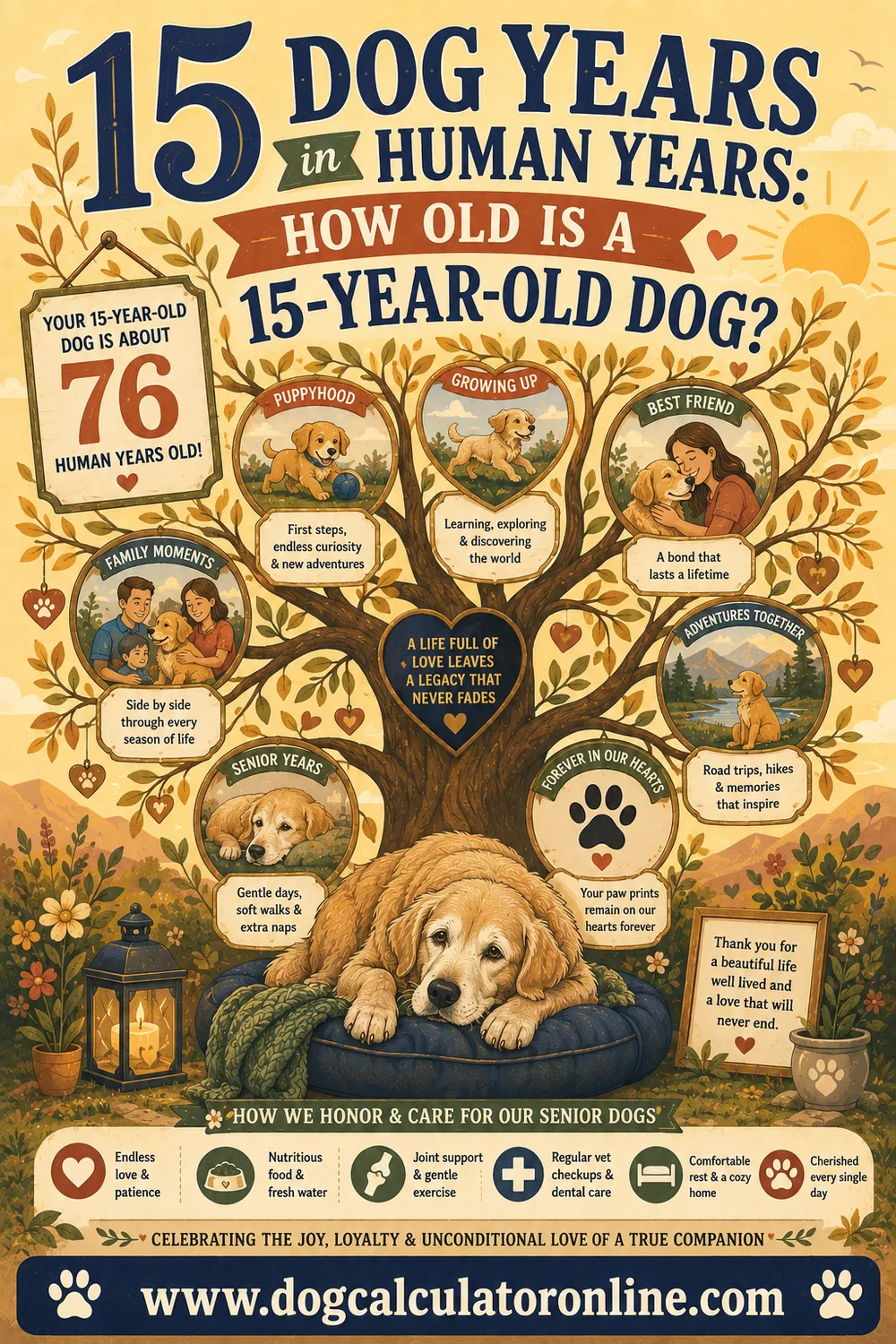
- 15 Dog Years in Human Years: How Old Is a 15-Year-Old Dog?
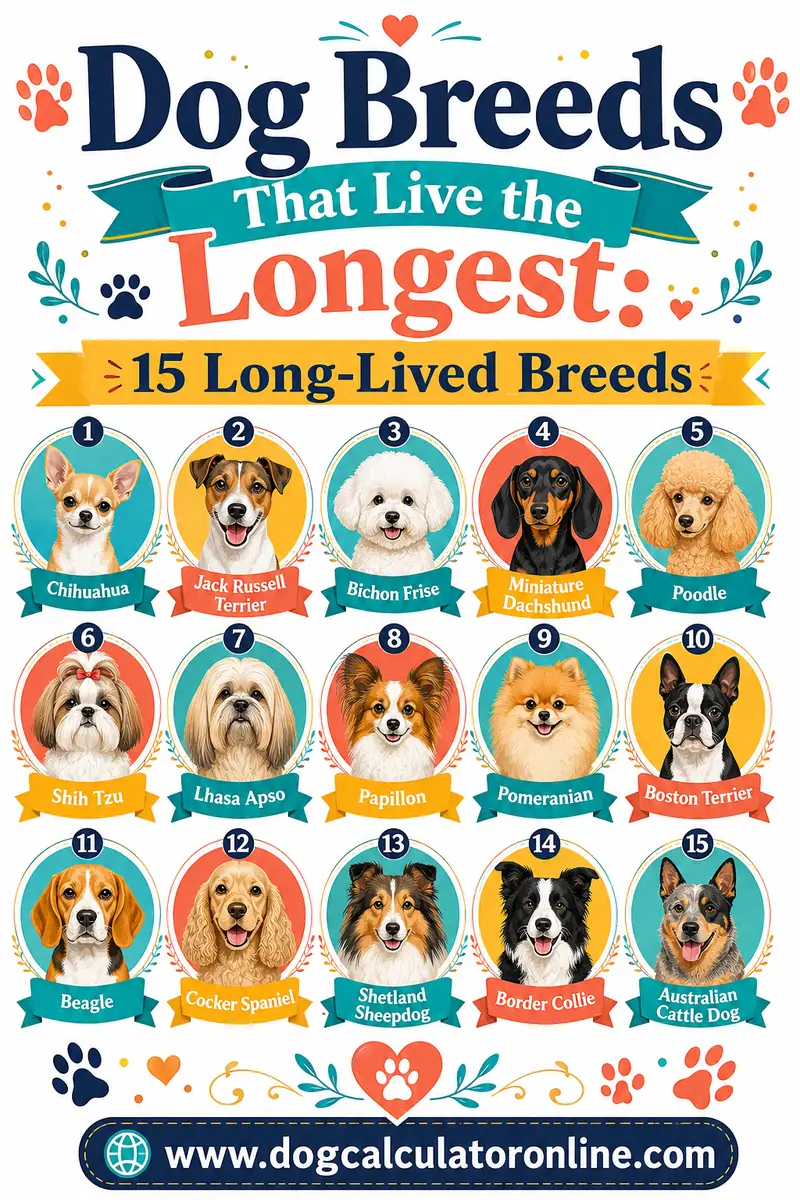
- Dog Breeds That Live the Longest: 15 Long-Lived Breeds
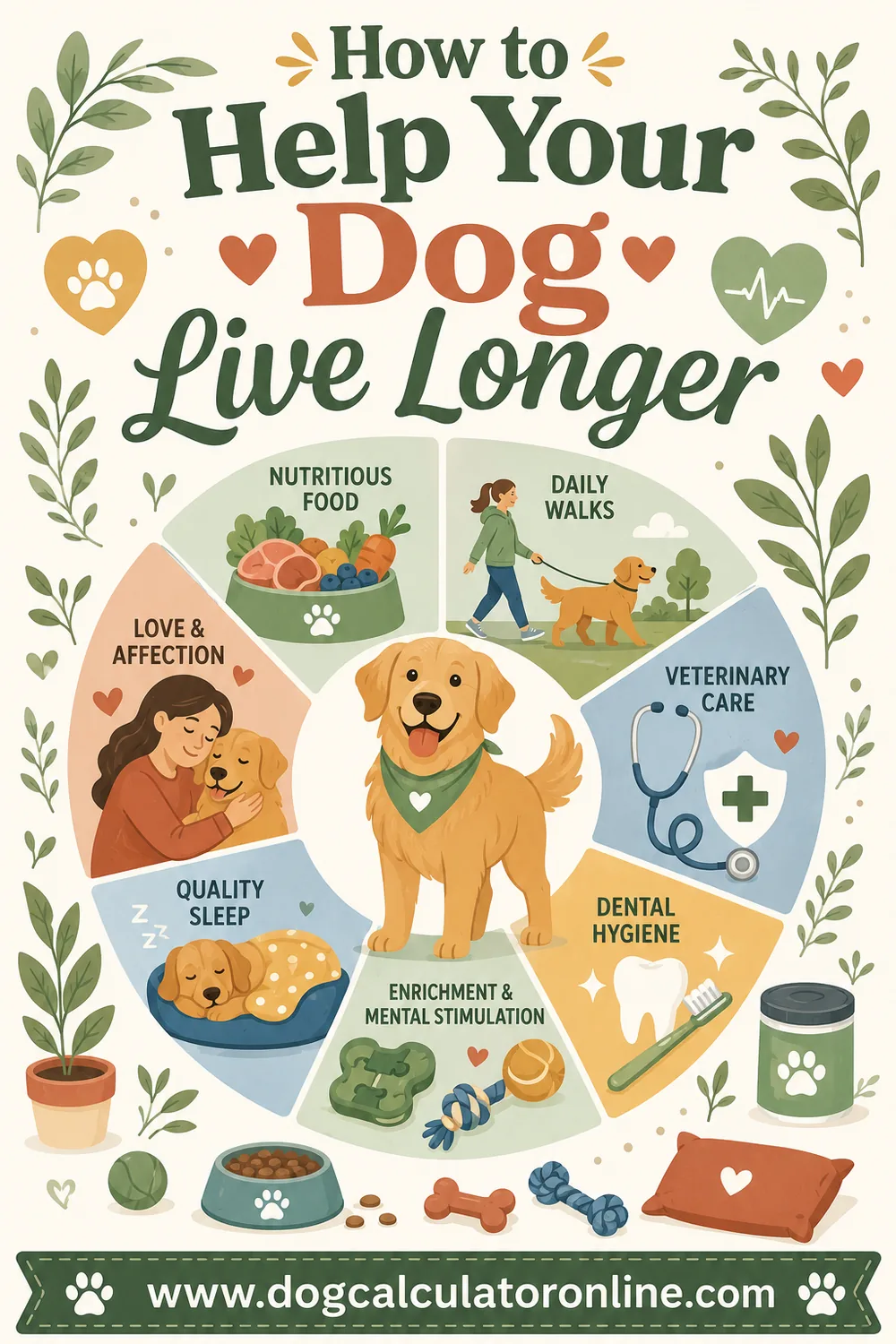
- How to Help Your Dog Live Longer
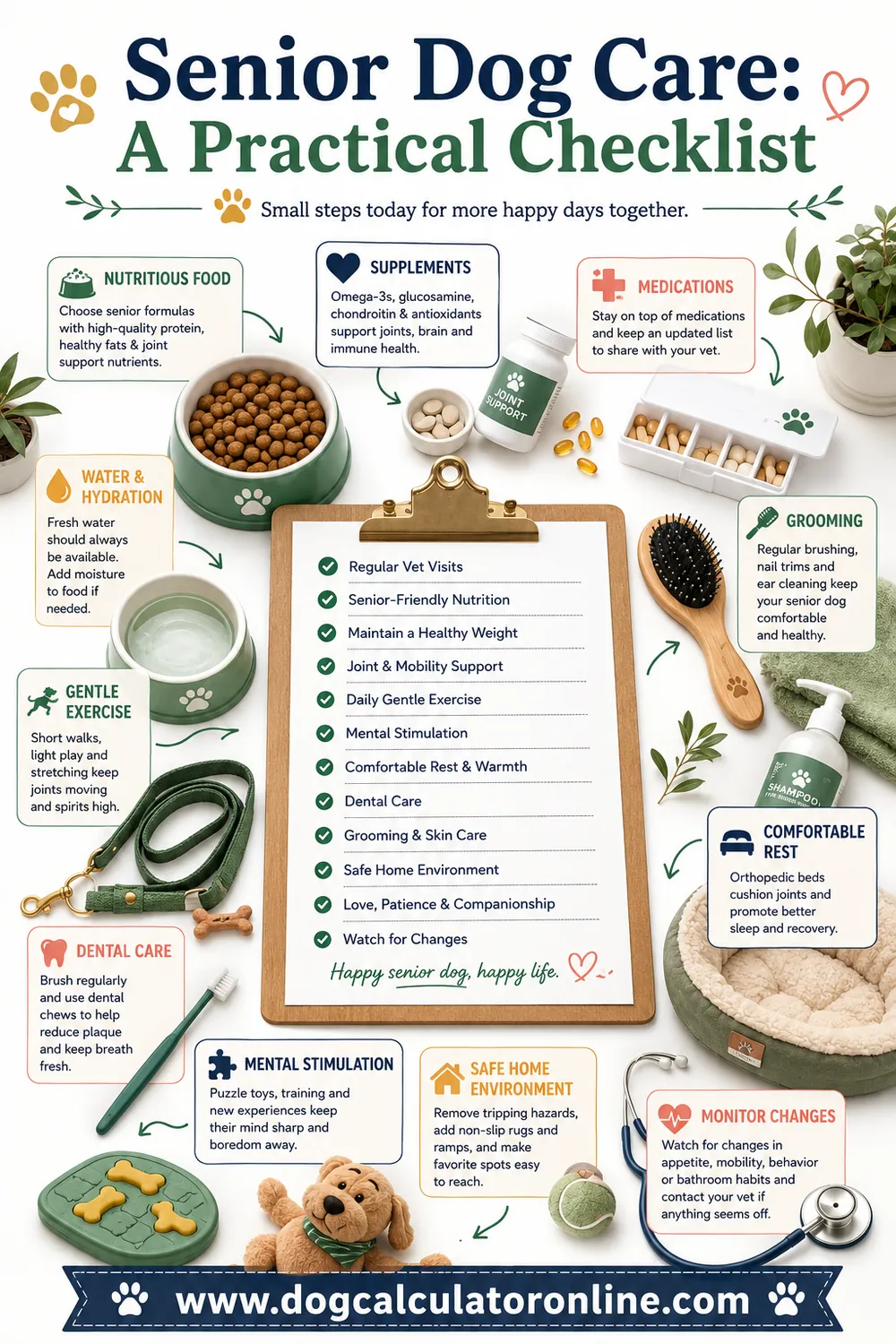
- Senior Dog Care: A Practical Checklist
And if you just want your own dog’s number, the free dog age calculator does it in one tap.
FAQ
How old is a 16-year-old dog in human years?
About 80–122 depending on size: 80 for small dogs, 94 for medium, 108 for large, and 122 for giant breeds, per the vet-backed size-adjusted method.
Is a 16-year-old dog 112 in human years?
That's the old 7:1 myth. A small 16-year-old is about 80 — a big difference. Only large breeds land anywhere near the myth's number at this age.
How rare is it for a dog to live to 16?
Small breeds reach 16 fairly regularly. It's rare for mediums, exceptional for large breeds, and essentially unrecorded for giants. The verified longevity record is an Australian Cattle Dog credited with 29 years.
What does the DNA study say for age 16?
About 75 human years — now well below the size-adjusted guideline. The 2019 UCSD epigenetic curve flattens in late life, adding roughly a year per year in the teens.
What helps dogs live to 16?
The recurring factors: small size, lean body weight throughout life, good dental care, regular veterinary monitoring, and daily exercise. Genetics deals the hand; care plays it.
How often should a 16-year-old dog see the vet?
At least every six months, and many vets recommend more frequent contact at this age. In human-equivalent time, a year between visits is like four or five years — too long for a super-senior.
How can I tell if my 16-year-old dog is in pain?
Old dogs rarely cry out. Instead watch for slow rising, reluctance on stairs, licking at joints, panting at rest, restlessness at night, irritability when touched, or pulling back from activities they used to enjoy. Any of these is worth describing to your vet — much late-life "slowing down" turns out to be treatable discomfort, and only your vet should decide how to treat it.
The Bottom Line
Sixteen dog years equal about 80–122 human years — a dignified 80 for the small dogs who dominate this age bracket, and uncharted territory for anything bigger. A 16-year-old dog is a masterpiece of genetics and good care; the job now is comfort, routine, and celebrating the streak.
See exactly where your dog stands — size-adjusted, with the DNA-study number too — free at the dog age calculator.