How to Train an Adult Rescue Dog
The difference between training a puppy and training an adult rescue is not age. It is that with a puppy you are writing on a blank page, and with a rescue you are working on top of years of learning you cannot read. He may have been beautifully house-trained in a flat and never taught to toilet on grass. He may have learned that a hand coming toward his collar means something unpleasant. He may know six cues in a language you do not speak. So you assume nothing, you start at the bottom of every skill, and you let him show you what he already has. Sort his food out first — the dog food calculator tells you his daily amount, and training treats come out of that total.
🐾 Where do you need to start?
Tap the problem you are facing:
Tap an option above. Assume nothing and you will rarely go wrong.
Assume He Knows Nothing, and Let Him Prove You Wrong
This sounds pessimistic. It is actually the kindest starting point.
Paperwork is often optimistic. "Housetrained, good with children, knows basic commands" is frequently a foster carer's honest impression from a different house with a different routine. It is not a guarantee and it is not a lie; it is one data point.
Test gently rather than assume. Say "sit" once in a quiet room with a treat in view. If nothing happens, he does not know it in that context, and you teach it. If he sits, brilliant, you have found something to build on.
A dog can know a cue and still not perform it. Stress suppresses trained behavior. A dog who cannot sit in week one may sit instantly in week four with no training in between.
He may know cues in another language or with different hand signals. Overseas rescues especially. Watch what he offers when he wants something; that is usually a trained behavior looking for its old cue.
Starting at the bottom costs you almost nothing. Reteaching sit to a dog who already knows it takes about four minutes. Assuming he knows it and being wrong in a parking lot costs a great deal more.
Do not start formal training in week one. Let him decompress first. The pattern of that first month is set out in the guide to the first 30 days with a rescue dog.
What He May Have Learned About Hands
This is the part that separates rescue training from puppy training.
Watch what happens when you reach. A dog who ducks, freezes, licks his lips, turns his head away or shows the whites of his eyes when a hand comes toward him is telling you something about his history. Believe him.
Stop reaching over his head. Approach from the side and below, at chest height, with your palm flat. Over-the-top reaching is threatening to most dogs and terrifying to some.
Pair collar contact with food, every time. Touch the collar, feed immediately. Twenty repetitions a day for a two weeks. You are building an association that will one day let you grab him safely in an emergency.
Never take anything out of his mouth by hand. Trade for something better, or scatter treats away from the item and pick it up when he leaves. Hands that remove things become hands worth guarding against.
Let all handling be escapable. Groom, examine and stroke in short bursts and let him walk away. A dog who knows he can leave rarely needs to escalate to stop you.
If he growls, that is information, not insubordination. A growl is a warning that saves you a bite. Punishing it removes the warning without changing the feeling underneath, which is how dogs end up biting "without warning". Back off, and get help for anything that is escalating.
House-Training an Adult From Scratch
Do not skip this because he is four years old.
Assume he has never been house-trained, whatever you have been told. Kennelled dogs in particular often learn to toilet where they sleep because they had no choice, which is exactly the instinct house-training relies on.
Run a puppy schedule. Outside first thing, last thing, after every meal, after every nap, after every play session, and every two hours in between for the first week.
Reward within three seconds of him finishing, outdoors, with something excellent. Not when he comes back in — that rewards coming back in. Go out with him, wait, pay him on the spot.
Go out with him even in the rain. If you open the door and let him out alone you cannot reward the right thing, and you do not actually know whether he went.
Never punish an accident, and never the old nonsense about rubbing his nose in it. Dogs do not link a telling-off to something they did twenty minutes ago; all they learn is that you are unpredictable, and some learn to toilet out of sight instead.
Clean with an enzyme cleaner. Ordinary detergents leave the scent marker, and anything containing ammonia smells like urine and actively invites a repeat.
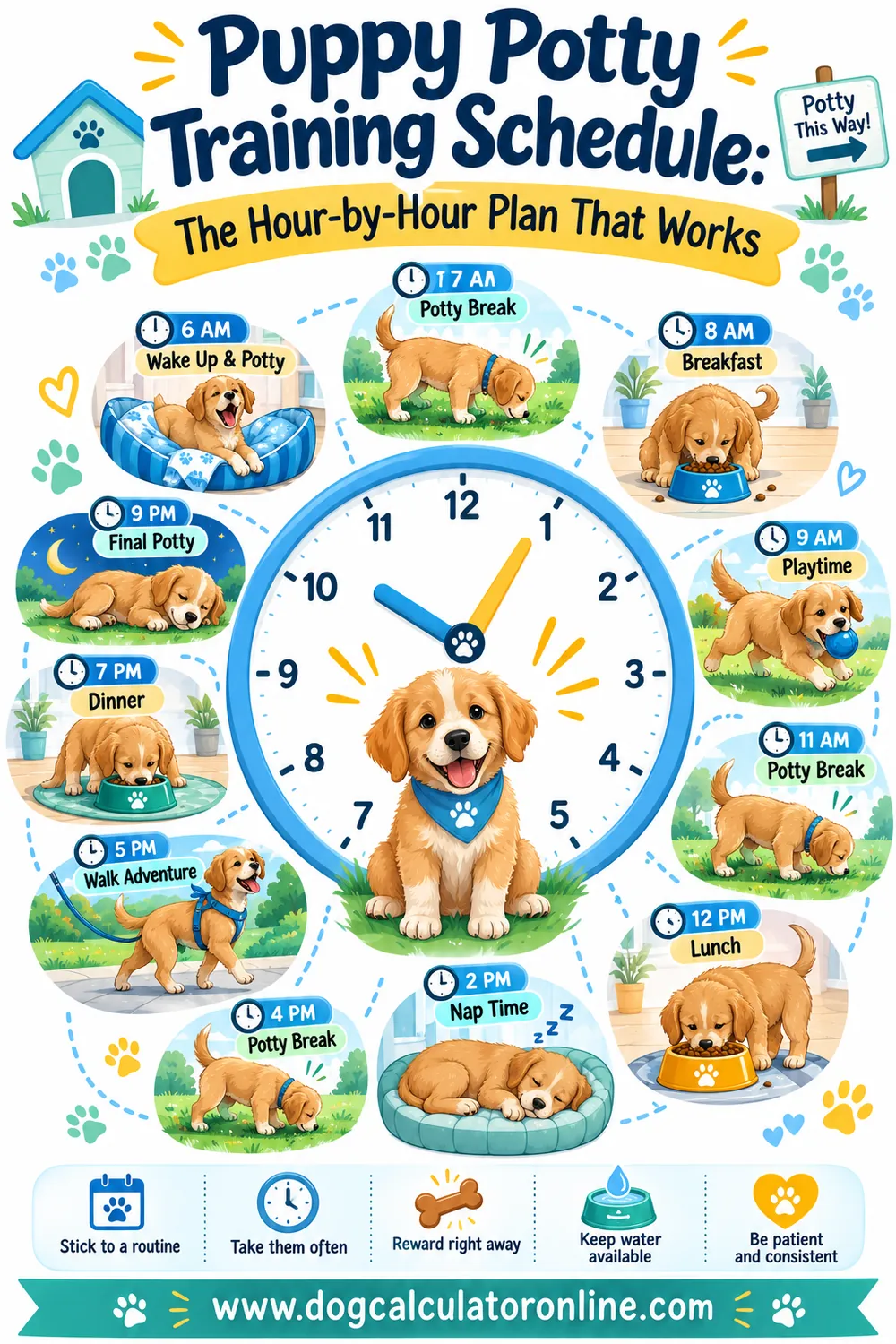
The full schedule works the same for adults as for puppies and is set out in the potty training schedule; just expect faster progress because his bladder is adult-sized.
Building a Marker and Finding a Reward He Cares About
Two small pieces of mechanics that make everything else work.
Pick a marker word and use it consistently. "Yes" said brightly, or a clicker if you like them. The marker means "that exact thing, food is coming". It buys you precision, because you can mark the split second he does the right thing.
Charge it first. Say "yes", give a treat. Thirty times over two days, no behavior required. Now the word means something.
Find out what he actually likes. Put five things on the floor — kibble, cheese, chicken, sausage, a squeaky toy — and see what he goes for. Rank them. Use the boring ones at home and the best ones outdoors.
Some rescues will not take food at first. That is stress, not fussiness. Work in a quiet room, use something smelly, and if he still will not eat anywhere, go slower and give him more time rather than pushing.
Keep sessions absurdly short. Two minutes, three times a day. Long sessions produce a tired, frustrated dog and a tired, frustrated owner.
Take training food off his dinner. A rescue putting on weight in month one is very common. Check the daily treat allowance and subtract as you go.
The First Six Skills, in Order
A sensible sequence for the first month, once he has decompressed.
| Order | Skill | Why it comes here | Typical time to a first response |
|---|---|---|---|
| 1 | His name | Everything else needs his attention first | 1-3 days |
| 2 | Hand touch (nose to palm) | Builds a friendly meaning for hands and moves him without pulling | 2-4 days |
| 3 | Sit | Easy win, gives him something to do instead of jumping | 1-5 days |
| 4 | Settle on a mat | Turns "do nothing" into a trained, payable behavior | 1-2 weeks |
| 5 | Loose leash walking | Needs the marker and the rewards working first | 2-8 weeks |
| 6 | Recall on a long line | The most valuable and the slowest to make reliable | 1-6 months |
Do not add the next skill until the one before is easy in the house. Then take it outside and expect to start again, because dogs generalise badly.
Where Adults Learn Faster Than Puppies, and Where They Do Not
Rescue owners are often surprised by both halves of this.
Adults have far better concentration. A 10-week-old puppy has roughly 30 seconds of focus. A three-year-old dog can work for several minutes, which means real progress in real sessions.
Adult bladders make house-training quicker. An adult can physically hold on for hours; a puppy cannot. Once he understands where to go, adults usually crack it in one to three weeks.
Adults are calmer about the world, having already met most of it. You are rarely doing socialization from zero.
But established habits are slower to shift. A dog who has pulled on a leash for four years has thousands of successful repetitions behind him. That is the one genuine advantage a puppy has.
And fear is harder to undo than to prevent. A specific fear learned years ago can be reduced but may never disappear entirely. Managing it well is a legitimate outcome, not a defeat.
Age is almost never the barrier people imagine. Old dogs learn new things perfectly well; they simply need slightly shorter sessions and a bit of consideration for stiff joints.
Undoing Habits That Already Work
The mechanism here is the same for every stubborn habit.
A behavior continues because it pays. Counter-surfing pays in sandwiches. Bolting through the door pays in freedom. Jumping up pays in attention, even if the attention is you shouting.
So stop the payment first, then teach the replacement. Clear the counters completely for a month. Put a baby gate at the front door. Turn your back and fold your arms when he jumps, then pay him generously the second all four feet are down.
Expect an extinction burst. When a behavior stops paying, most dogs try harder for a few days before giving up. That spike is a sign it is working, not a sign it has failed.
Never let it pay intermittently. A habit rewarded once in ten tries is more durable than one rewarded every time. One stolen sandwich funds another month of counter-surfing.
Leash pulling deserves its own project, because equipment does half the work. The method for an adult with an established habit is in the guide to stopping an adult dog pulling on the leash.
Recall is the other big one, and it is worth building properly from the first week rather than improvising. The step-by-step version is in the guide to teaching a reliable recall.
Equipment, Crates and What Backfires
Kit will not train your dog, but the wrong kit will undo you.
A harness he cannot back out of, plus a collar with an ID tag. Clip a double-ended lead to both. Escaped rescue dogs in the first month are distressingly common and a slipped collar is usually why.
A 30 ft (9 m) long line for open spaces. Attach it to the harness, never to a flat collar, and wear gloves. This is the single most useful piece of equipment you will buy.
A front-clip harness if he pulls hard. It changes the physics so pulling stops working, which gives you the space to train.
Crates need introducing, not imposing. Some rescues love a crate; some have been shut in one for a very long time and panic. Feed him in it with the door open, never shut him in as punishment, and drop it entirely if he shows real distress. The gradual approach is in the crate training schedule.
Avoid choke chains, prong collars and shock collars, particularly with a dog whose history you do not know. Beyond the welfare argument, they risk attaching pain to whatever he happens to be looking at, and with an anxious rescue that is very often another dog or a stranger.
Skip retractable leashes for the first few months. They teach that constant tension is normal, which is the opposite of what you are trying to build.
When Training Is Not the Answer
Some things need a vet or a behaviorist, not another week of practice.
Get a vet check before you blame behavior. Pain, thyroid problems, poor eyesight, ear infections and dental disease all produce behavior that looks like stubbornness or grumpiness. A dog who suddenly snaps when touched needs examining, not correcting.
Call your vet the same day for a dog who is repeatedly unproductively retching with a swollen, tight abdomen, for collapse, for labored breathing, or for any sudden severe change in behavior. Do not train through a medical problem.
Get qualified behavior help early for guarding that is escalating, any bite that breaks skin, fear that is worsening week on week, or genuine panic when left alone. Ask for accredited, force-free credentials and ask what happens when the dog gets something wrong.
Ring the rescue too. Many have behavior support included, and most would far rather hear from you in week two than in month three.
Be honest about what management can do. Plenty of excellent lives are built on a dog who will never enjoy other dogs and simply walks somewhere quiet. That is a legitimate plan, not a failure of training.
FAQ
How long does it take to train an adult rescue dog?
Most adult rescues learn basic cues such as name, sit and hand touch within one to two weeks of starting. House-training usually takes one to three weeks once you run a full schedule, and a reliable recall takes one to six months. Established habits like leash pulling take longest.
Can you house-train an adult rescue dog?
Yes, and it is usually faster than house-training a puppy because an adult bladder can hold on for hours. Assume he has never been trained, take him out every two hours plus after meals and naps, and reward within three seconds of him finishing outdoors.
Why does my rescue dog flinch when I reach for him?
Most often because a hand reaching toward him has previously predicted something unpleasant, though it can also be poor eyesight or pain. Stop reaching over his head, approach from the side at chest height, and pair every collar touch with a treat.
Is it harder to train an adult dog than a puppy?
In some ways it is easier. Adults concentrate for longer, have adult bladders and have already met most of the world. What is harder is undoing habits with years of successful repetition behind them, and reducing fears that were learned long before you met him.
Should I use a crate with a rescue dog?
Only if he likes it. Introduce it with the door open and food inside, and never shut him in as punishment. Some rescue dogs settle beautifully in a crate; others have been confined for long periods and panic, in which case use a pen or a quiet room instead.
What treats work best for training a rescue dog?
Whatever he will actually work for, tested by offering several options and seeing what he chooses. Use plain kibble indoors and something high value such as chicken, cheese or sausage outdoors. Subtract the training food from his daily ration to avoid weight gain.
The Dog You Meet in Month Three
Training an adult rescue is mostly an exercise in patience and humility. You are not correcting a dog who should know better; you are teaching one who was never told, or who was told something else entirely. Assume nothing, start every skill at the bottom, keep sessions to two minutes, protect his ability to walk away, and let equipment do the heavy lifting while the training catches up. Owners are almost always startled by how much changes between week three and month three. Keep the first 30 days calm, build recall properly, and use the dog food calculator so the treats do not quietly become dinner.