How to Choose a Pet Insurance Plan
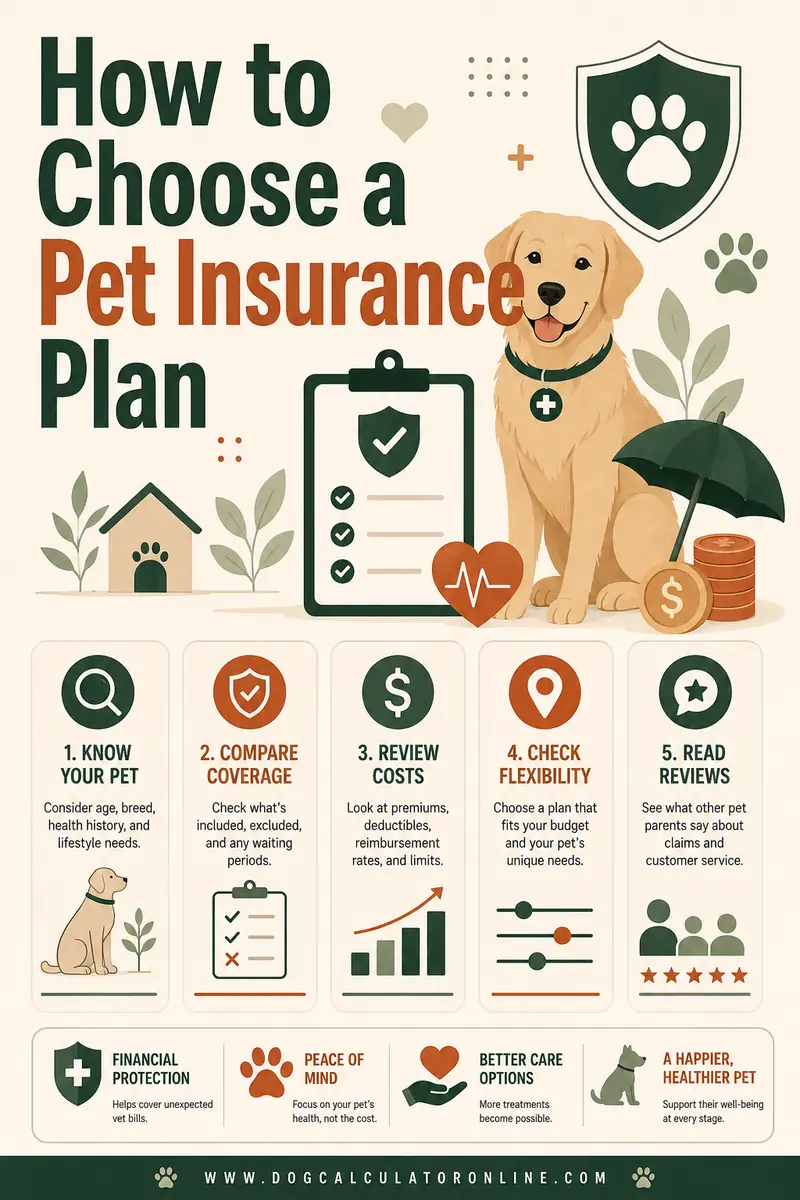
Choosing a pet insurance plan comes down to five settings you can compare across any policy from any company: the deductible, the reimbursement rate, the annual limit, the exclusions page, and the waiting periods. Get those five right for your dog and your budget, and the brand name on the policy matters far less than the marketing suggests. This guide teaches you how to read each lever, how they interact, and how to compare two quotes on equal footing — no rankings, no recommendations, just the framework. Before you shop, it also helps to know what your dog costs you overall; the free dog cost calculator puts a number on food, vet care, and everything else in about a minute.
What Actually Matters in a Pet Insurance Plan?
Strip away the mascots and the testimonials and every accident-and-illness policy is the same machine with five adjustable parts. Two of them — deductible and reimbursement rate — decide how much of each vet bill lands on you. One — the annual limit — decides where the insurer stops paying entirely. The last two — exclusions and waiting periods — decide which bills count as claims in the first place.
Here's the whole framework in one table:
| Lever | What it controls | Typical options | Rule of thumb |
|---|---|---|---|
| Deductible | What you pay before reimbursement begins | $100–$1,000, usually annual | Higher = cheaper premium, more out of pocket per year |
| Reimbursement rate | The insurer's share of covered costs | 70%, 80%, 90% | Higher = better claim payouts, pricier premium |
| Annual limit | Maximum payout per policy year | $2,500 to unlimited | Low caps fail exactly when you need them most |
| Exclusions | What never counts as a claim | Varies by policy | The fine print matters more than the brochure |
| Waiting periods | Delay before coverage activates | 2–15 days; up to 6 months orthopedic | Shorter is better; ask about orthopedic waivers |
The order matters too. Most shoppers start by comparing monthly premiums, which is backwards — the premium is the output of these five settings, not a feature in itself. Two plans priced at $45 a month can behave completely differently when a $6,000 bill arrives. Learn the levers first, and the premium comparison becomes meaningful instead of misleading.
How Do You Choose the Right Deductible?
The deductible is the amount you pay out of your own pocket before the insurer starts reimbursing anything. Most dog policies use an annual deductible: you meet it once per policy year, and every covered expense after that gets reimbursed at your chosen rate. A smaller number of policies use a per-incident deductible, which resets for each new condition — friendlier if your dog has one expensive ongoing problem, harsher if a bad year brings three unrelated ones.
The practical question isn't "what's the lowest deductible I can get?" It's "what number could I absorb without stress in a bad month?" If a surprise $500 wouldn't wreck your budget, a $500 deductible usually buys a noticeably lower premium than a $250 one — and over a few claim-free years, that premium gap adds up to real money you kept.
A worked example makes the trade visible. Say your dog needs a $3,000 surgery on an 80% reimbursement plan:
- $250 deductible: you pay $250, the insurer reimburses 80% of the remaining $2,750 = $2,200. Your total: $800.
- $500 deductible: you pay $500, the insurer reimburses 80% of $2,500 = $2,000. Your total: $1,000.
- $1,000 deductible: you pay $1,000, the insurer reimburses 80% of $2,000 = $1,600. Your total: $1,400.
The $250 plan saved you $600 on this claim compared with the $1,000 plan — but it might cost you $10–$20 more every single month. If claims are rare, the high-deductible plan wins over time; if your breed is claim-prone, the low deductible earns its keep. There's a full breakdown of annual versus per-incident structures in our deductible explainer.
One honest caution: deductibles interact with age. A deductible that feels comfortable for a young dog can sting when premiums rise later, so many owners raise the deductible at renewal to keep the monthly cost sane. That's a legitimate strategy — far better than canceling and losing your coverage history.
What Reimbursement Rate Should You Pick?
After the deductible is met, the reimbursement rate is the percentage of each covered bill the insurer pays back. The standard menu is 70%, 80%, or 90%, and the difference sounds small until you run it against a big number. On a $8,000 emergency after the deductible:
- 70% plan → insurer pays $5,600, you pay $2,400
- 80% plan → insurer pays $6,400, you pay $1,600
- 90% plan → insurer pays $7,200, you pay $800
That's a $1,600 swing between the top and bottom tiers on a single bad day. The 90% tier costs more per month, but it's the setting that most changes how a catastrophe feels — which is, after all, the point of insurance.
A sensible way to decide: pair the reimbursement rate against your deductible rather than choosing each in isolation. A 90% rate with a higher deductible protects you from the huge bills while keeping premiums reasonable — you absorb the predictable small stuff and the insurer absorbs the disaster. A 70% rate with a low deductible does the opposite: it softens routine claims but leaves you holding 30% of a five-figure emergency, which can still be thousands of dollars. If the whole reason you're buying insurance is catastrophe protection, weight your money toward the reimbursement rate. The math on all three tiers, including how insurers calculate "covered costs" before applying the percentage, is in our reimbursement guide.
Watch for one quiet variation: most insurers reimburse a percentage of your actual vet bill, but some reimburse based on a benefit schedule — a preset table of what they think each condition should cost. Actual-bill reimbursement is more predictable and generally more generous in high-cost areas. If a quote looks suspiciously cheap, check which model it uses.
How Much Annual Coverage Do You Need?
The annual limit is the ceiling on what the plan pays out in a policy year. Once you hit it, every additional dollar is yours, regardless of deductible or reimbursement rate. Tiers commonly run from about $2,500 up to unlimited, and this is the lever where cheap plans hide their weakness.
Think about what the limit is for. Routine bad luck — an ear infection, a torn dewclaw, a digestive episode — rarely threatens a $5,000 cap. The limit matters in the scenarios that generate the scary numbers: an ACL tear followed by complications ($4,000–$7,000), cancer treatment ($5,000–$15,000+ across a year), or an intensive-care stay after a toxin ingestion. Those are exactly the events people buy insurance for, and a low cap quietly abandons you partway through them.
The honest guidance looks like this:
- $5,000 caps handle most single emergencies but can be exhausted by one major surgery plus follow-up care in the same year.
- $10,000 caps cover the large majority of realistic worst years for most dogs.
- Unlimited plans cost more monthly but remove the tail risk entirely — worth a serious look for large breeds, brachycephalic (flat-faced) breeds, and breeds with known cancer or orthopedic histories.
Price the jump before assuming it's expensive: the difference between a $5,000 cap and unlimited is often smaller per month than people expect, especially for young dogs. And check whether the plan also carries per-incident or lifetime caps stacked underneath the annual one — layered caps are a red flag worth asking about directly. The full picture of how limits work, including how they reset and interact with multi-year conditions, is in the annual limit explainer.
How Do You Read the Exclusions Page?
Every policy excludes some things, and the exclusions page — not the marketing page — is where a plan's real personality lives. Ten minutes here saves you from the classic insurance heartbreak: discovering after the fact that the thing you assumed was covered never was.
Some exclusions are universal. Pre-existing conditions — anything diagnosed or showing symptoms before enrollment or during a waiting period — are excluded by essentially every insurer. Routine and preventive care (vaccines, checkups, spay/neuter) sit outside accident-and-illness coverage unless you add a wellness plan. Cosmetic procedures, breeding costs, and experimental treatments are near-universal exclusions too.
Beyond those, plans genuinely differ, and this is where comparison pays off. Items worth checking line by line:
- Exam fees. Some plans reimburse the vet's consultation fee attached to a covered claim; others quietly don't, which shaves $50–$150 off every payout.
- Hereditary and congenital conditions. Most reputable modern policies cover them, but confirm it in writing — this is critical for purebreds with known breed risks.
- Dental illness. Accident-related dental is broadly covered; disease-related dental (extractions, periodontal treatment) varies enormously — some plans include it, some cap it, some exclude it. Our guide to dental coverage unpacks the variations.
- Bilateral conditions. If your dog tore the left ACL before enrollment, many plans will treat a future right-side tear as pre-existing. This clause alone can decide whether a plan is right for your dog.
- Prescription food and supplements. Sometimes covered when prescribed for a covered condition, often not.
- Behavioral treatment. Increasingly covered, still far from standard.
For a full tour of what falls outside coverage — including the exclusions that surprise owners most often — see what pet insurance doesn't cover. The comparison habit to build: don't ask "is this plan good?" Ask "which of these specific things does this plan exclude that the other one covers, and how likely is my dog to need them?"
What About Waiting Periods?
Waiting periods are the delay between buying a policy and the coverage actually switching on. They exist to stop people from buying insurance in the parking lot of the emergency clinic, and they follow a fairly standard pattern: a few days (often 2–5) for accidents, around 14 days for illnesses, and in some policies up to 6 months for orthopedic conditions like cruciate ligament tears and hip dysplasia.
Two practical implications for choosing a plan. First, anything that shows symptoms during a waiting period counts as pre-existing under that policy — permanently. That's the strongest argument for enrolling during a healthy, boring stretch of your dog's life rather than after a worrying vet visit. Second, orthopedic waiting periods vary more between insurers than almost any other term, and some companies will waive or shorten the orthopedic wait if your vet performs an exam certifying healthy joints. For large breeds — where cruciate injuries are among the most common five-figure claims — that waiver can be the single most valuable feature on the plan. The timing details, including how waits apply at renewal versus enrollment, are in the waiting period explainer.
When comparing quotes, put the waiting periods side by side rather than assuming they match. A plan that's $3 cheaper per month but carries a six-month unwaivable orthopedic exclusion is not cheaper for a Labrador.
How Do You Compare Two Quotes Fairly?
Premiums only compare cleanly when the settings match. So the first move is mechanical: set both quotes to the same deductible, same reimbursement rate, and same annual limit, then look at the price gap. If one insurer's quote tool won't let you match settings exactly, get as close as possible and note the difference.
Then stress-test both plans against the same imaginary bad year. Here's the kind of worksheet that exposes the difference between two plans that both cost about $45 a month:
| Scenario: $7,000 ACL surgery year | Plan A ($500 ded., 90%, unlimited) | Plan B ($250 ded., 70%, $5,000 cap) |
|---|---|---|
| You pay the deductible | $500 | $250 |
| Insurer's share of the rest | 90% of $6,500 = $5,850 | 70% of $6,750 = $4,725 |
| Annual cap applied | No cap hit | Payout stays under cap: $4,725 |
| Exam fees covered? | Check the policy | Check the policy |
| Your total cost | $1,150 | $2,275 |
Same monthly price, roughly double the out-of-pocket difference in the year that matters. Run the same exercise with a $15,000 cancer year and Plan B's cap starts doing real damage. This is the honest way to shop: pick two or three realistic disaster scenarios for your dog's breed and size, and compute what each plan leaves you holding.
Finally, factor in the trajectory, not just the day-one price. Ask each insurer how premiums have typically changed with age, whether your settings can be adjusted at renewal, and whether claims affect your individual price. You're not buying one year of coverage — you're choosing a policy your dog may grow old inside.
What Questions Should You Ask Before You Buy?
Run every finalist plan through this checklist. Any insurer's support team should answer all of these in plain language — and hesitation on any of them is information too.
- Is the deductible annual or per-incident?
- Do you reimburse from my actual vet bill, or from a benefit schedule?
- Are exam and consultation fees included in covered claims?
- Are hereditary and congenital conditions covered for my breed, with no breed-specific exclusions?
- What exactly are the waiting periods, and can the orthopedic wait be waived with a vet exam?
- How do you define and review pre-existing conditions — and are curable past conditions ever eligible again after a symptom-free window?
- Is there an annual limit, and are there per-incident or lifetime caps beneath it?
- Is dental illness covered, or only dental accidents?
- Can I change my deductible, reimbursement rate, or limit at renewal without triggering new waiting periods?
- What's the claim process — direct vet pay or reimbursement, and what's the typical turnaround?
Ten questions, maybe twenty minutes of reading and one email. That's the entire skill of choosing a pet insurance plan — not finding a magic brand, but making any brand show you its five levers in daylight.
Frequently Asked Questions
What is the best deductible for pet insurance?
There's no universal best — the right deductible is the largest amount you could comfortably pay out of pocket in a bad month. Choosing $500 instead of $250 typically lowers the monthly premium meaningfully, and over claim-free years that savings compounds. Owners of claim-prone breeds may prefer lower deductibles; owners buying pure catastrophe protection usually do better with higher ones.
Is 90% reimbursement worth the extra cost?
It's the setting that most changes how a large emergency feels: on a $10,000 bill, 90% versus 70% reimbursement is a $2,000 difference in your share. If your main reason for buying insurance is protection from big bills, prioritizing the reimbursement rate — even alongside a higher deductible — is usually money well aimed.
Should I choose an unlimited annual limit?
Unlimited coverage removes the risk of a cap running out mid-crisis, and the monthly upcharge over a $10,000 cap is often modest for young dogs. It deserves strongest consideration for large breeds, flat-faced breeds, and breeds with known cancer or orthopedic risks, where realistic worst-case years can exceed $10,000. For a small, generally healthy mixed breed, a $10,000 cap covers most realistic scenarios.
Is accident-only insurance a good way to save money?
Accident-only plans cost less but skip illness coverage entirely — no allergies, infections, cancer, or chronic disease. Since illness claims dominate veterinary spending as dogs age, accident-only coverage protects against a shrinking share of your real risk over time. It can suit tight budgets as a stopgap, but treat it as partial protection, not a cheaper version of the full thing.
How many pet insurance quotes should I compare?
Two or three quotes with matched settings is usually enough to see the market. The key is matching the deductible, reimbursement rate, and annual limit across quotes before comparing prices, then reading each exclusions page for the differences that matter to your breed. Comparing five plans on mismatched settings teaches you less than comparing two on matched ones.
Can I change my pet insurance plan settings later?
Most insurers let you adjust deductible, reimbursement rate, or annual limit at renewal, and many owners raise deductibles over time to offset age-driven premium increases. Be careful with changes that increase coverage — some insurers apply fresh waiting periods or new pre-existing reviews to upgrades. Ask before you switch anything, and get the answer in writing.
The Bottom Line
Choosing a pet insurance plan isn't about finding the one good company — it's about forcing every candidate to show you the same five levers: deductible, reimbursement rate, annual limit, exclusions, and waiting periods. Match the settings, stress-test the quotes against your breed's realistic worst year, and read the exclusions page before you read a single review. Do that, and you'll choose confidently from any lineup. To see how a premium fits into your dog's total yearly budget — food, vet care, gear, and all — run the numbers with the free dog cost calculator.