How to Measure Your Dog for a Crate
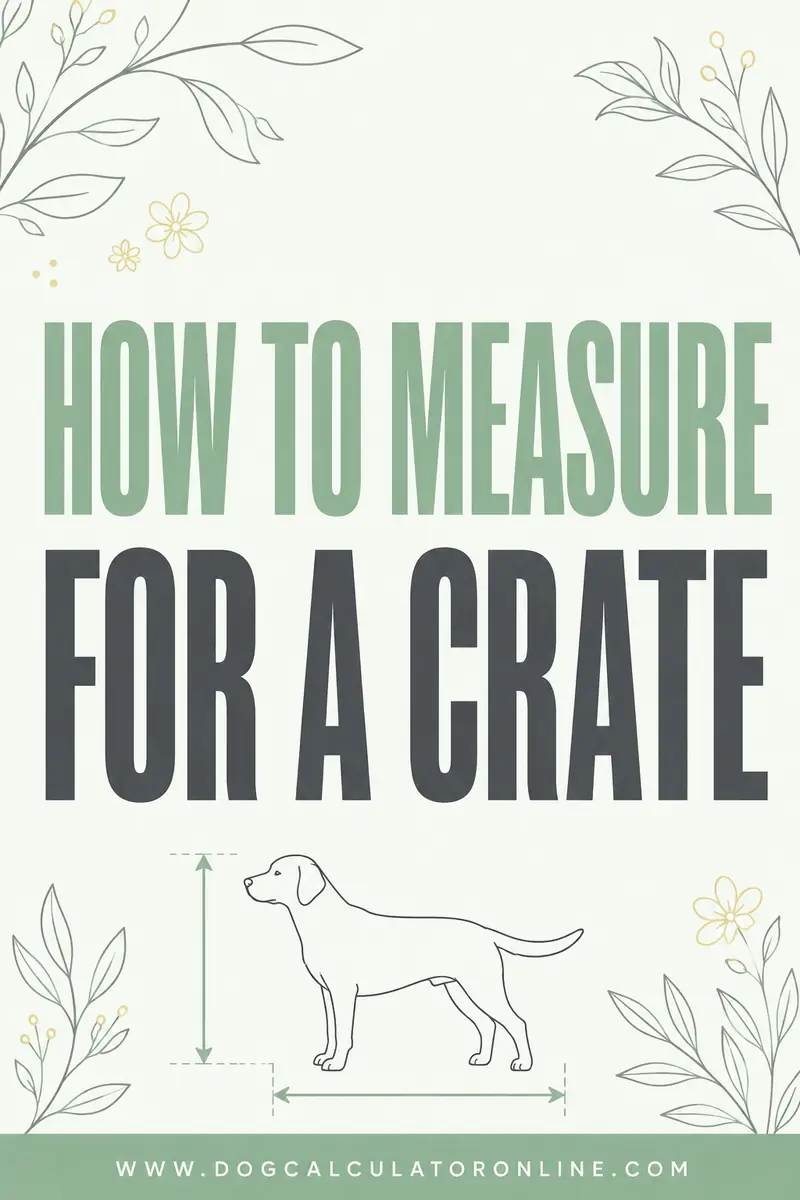
Measuring a dog for a crate takes two measurements and about two minutes: length from the tip of the nose to the base of the tail, and height from the floor to the top of the head while the dog is sitting. Add 2 to 4 inches to each, and that is the minimum interior size the crate needs to be. The mistakes people make are measuring to the tip of the tail instead of its base, measuring a lying-down dog, and buying to the crate's advertised size rather than its interior size. This page walks through the method properly. Once you have the numbers, the free crate size calculator turns them straight into a crate size.
📏 The two measurements you need
Tap each step to see exactly how to take it:
Tap a step above. Two measurements, plus the add-on, gives you the crate size.
What You Need Before You Start
Very little, and improvising works fine.
A soft tape measure is ideal — the kind used for sewing. A rigid builder's tape works but is harder to hold against a moving dog.
A piece of string and a ruler does the job just as well. Run the string along the dog, mark it with your thumb, then lay it flat against a ruler.
A second person, if your dog does not stand still. One holds and reassures, the other measures. This is far easier than trying to do both.
A few treats, because the whole thing works better if the dog thinks it is a game. Measure before a meal rather than after.
A flat, non-slip surface. A dog standing on carpet sinks slightly and stands differently than one on a hard floor, and the height measurement shifts by an inch or so as a result.
One thing you don't need: the dog's weight. Weight matters for food, medication and general health, but crate sizing is driven by the dog's dimensions. A stocky Bulldog and a leggy Whippet can weigh the same and need very different crates. If you want the weight anyway, the method is in how to weigh your dog at home.
How Do You Measure the Length?
This is the measurement people most often get wrong, and always in the same way.
Get the dog standing square — four feet on the ground, weight evenly distributed, head in a normal forward position. Not stretching, not sitting, not lying down.
Measure from the tip of the nose to the base of the tail. The base is where the tail joins the body, not the end of the tail.
Why not the tail tip? Because dogs curl their tails around themselves when they lie down. Measuring to the tip adds anywhere from three inches on a Corgi to a foot on a Golden Retriever, and buying to that number gets you a crate substantially larger than the dog needs — which is a real problem for a puppy, because the extra space becomes a toilet area.
Add 2 to 4 inches. Two inches gives a snug fit that suits toilet training and dogs who like enclosure. Four inches gives room to stretch out fully, which suits settled adults.
Worked example. A Beagle measuring 24 inches nose to tail base needs an interior length of 26 to 28 inches, which puts it in a 30-inch crate once you account for the interior being smaller than the advertised size.
If the dog won't stand still, measure them lying stretched out on their side and take the same two points — nose to tail base. It's slightly less accurate but close enough, and much easier with a wriggly puppy.
How Do You Measure the Height?
Here the mistake is measuring the wrong posture.
Sit the dog. Height is measured with the dog sitting, not standing. A sitting dog's head is higher than a standing dog's head, and a dog that cannot sit up straight in its crate will not use it.
Measure from the floor to the highest point of the head. For most breeds that is the crown of the skull.
For upright-eared breeds — German Shepherds, Corgis, French Bulldogs, Huskies — measure to the ear tips instead. Ears that press against the crate roof are a daily irritation, and it is the single most common reason a correctly-measured crate still gets refused.
Add 2 to 4 inches, same as length.
Worked example. A German Shepherd sitting 30 inches to the ear tips needs 32 to 34 inches of interior height, which means a 42-inch crate — those are usually around 30 inches tall inside, so this is exactly where people go wrong by buying on length alone.
The test that matters more than the tape: in the crate, the dog should be able to stand without ducking, sit without the head touching, turn around fully, and lie stretched on its side. If it can do all four, the crate fits. If not, it does not, whatever the numbers said.
Do You Need to Measure Width?
For a home crate, usually not. For a travel crate, yes.
Home crates come in standard widths tied to their length — a 36-inch crate is around 23 inches wide, a 42-inch around 28. Manufacturers have matched these to dog proportions, and a dog whose length and height fit will almost always fit the width.
Travel and airline crates are different. Airlines specify that the dog must be able to stand, turn and lie down, and they measure width across the shoulders. Measure at the widest point of the dog's body, usually the shoulders or hips, and add a few inches. The airline-specific detail is in travel crate size for dogs.
Broad-chested breeds are the exception at home too. Bulldogs, Staffies, Pugs and similar are wide relative to their length. If your dog is noticeably barrel-shaped, measure the width and check it against the crate's interior figure rather than assuming.
Exterior vs Interior: The Trap in Every Crate Listing
This catches almost everyone once.
Crates are advertised by exterior dimensions. A "36-inch crate" is 36 inches on the outside. The usable interior is smaller — commonly by an inch to two inches in length and rather more in height, because the tray sits inside the base and raises the floor.
Plastic crates lose more. Molded shells have thick curved walls, so the interior is meaningfully smaller than the outside suggests, and the shape narrows towards the top.
What to do about it. Find the interior dimensions in the product specification rather than relying on the headline number. If the listing does not give them, assume you lose about two inches in each direction and size up accordingly.
Which is why it's better to round up. If your dog measures out between two crate sizes, take the larger one — unless you are toilet training a puppy, in which case take the larger crate and fit a divider. That gets you both things at once.
What Size Crate Do the Measurements Point To?
A rough conversion once you have your two numbers plus the add-on.
| Interior length needed | Crate size | Typical suits |
|---|---|---|
| Up to 20 in | 24 in | Chihuahua, Yorkshire Terrier, Pomeranian |
| 20–26 in | 30 in | Beagle, French Bulldog, Miniature Schnauzer |
| 26–32 in | 36 in | Border Collie, Cocker Spaniel, Bulldog |
| 32–38 in | 42 in | Labrador, German Shepherd, Boxer |
| 38–44 in | 48 in | Rottweiler, Doberman, large Retriever |
| Over 44 in | 54 in | Great Dane, Mastiff, Newfoundland |
Treat this as a starting point, not an answer. Breeds vary widely within themselves, and the height measurement overrides the length one — a tall dog of modest length needs the bigger crate. There are breed-by-breed starting figures in the dog crate size chart by breed, but your own tape beats any chart.
Height is the tie-breaker. If length says 36 and height says 42, buy 42. A dog that fits lengthways but cannot sit up is in a crate that is too small.
Measuring a Puppy: Measure the Adult, Not the Puppy
The one case where you deliberately ignore the numbers in front of you.
Buy for the adult size, then divide the space. A crate bought to fit an eight-week-old Labrador will be outgrown within about six weeks, and then again, and again. Buying at projected adult size with a divider is one purchase instead of three.
Estimate adult size from the breed, from the parents if you know them, or from a growth projection. For crate purposes you need a rough adult length and sitting height, not a precise weight.
Then use the divider to keep the usable space at roughly the puppy's current measurements plus a couple of inches, and move it back every few weeks. The reason this matters is toilet training: a puppy will not soil where it sleeps, but give it a space twice its size and it will simply use one end as a bedroom and the other as a bathroom.
A rough guide for mixed breeds: at four months most puppies are around two-thirds of their adult height, though they fill out in width for months afterwards. The full sizing method is in what size crate for a puppy.
Common Measuring Mistakes
Measuring to the tail tip. Adds several unnecessary inches and produces an oversized crate.
Measuring a standing dog for height. Always sit the dog. A standing measurement produces a crate the dog cannot sit up in.
Forgetting the ears. Upright-eared breeds need the measurement taken to the ear tips.
Measuring on thick carpet. Use a hard floor; carpet compresses and skews the height reading.
Buying to the advertised size. Check the interior dimensions.
Rounding down to save space or money. A crate an inch too small does not get used, which wastes the whole purchase. Rounding up costs a few pounds and some floor area.
Measuring once. Take each measurement twice, on different days if the dog is difficult. Two consistent readings are worth far more than one rushed one.
Assuming breed charts are enough. They are a useful cross-check and a poor substitute. Two Labradors can differ by four inches in length.
What to Do Once You Have the Numbers
Write them down — length, height, and the add-on you chose. You will want them again when buying a bed, a harness or a travel crate.
Check them against the crate's interior specification, not the headline size.
Decide the type separately. Size and type are two different decisions, and the type determines how the crate behaves at home — the comparison is in types of dog crates explained.
Then do the four-point test once the crate arrives: stand without ducking, sit without touching, turn fully around, lie stretched on the side. All four, or it is the wrong size.
And remember the crate only works if the training does. A correctly sized crate that the dog was never taught to like is just furniture — the process is in how to crate train a puppy.
FAQ
How do I measure my dog for a crate?
Two measurements: length from the nose tip to the base of the tail with the dog standing, and height from the floor to the top of the head with the dog sitting. Add 2 to 4 inches to each to get the minimum interior crate size.
Do I measure my dog's length to the tail tip?
No — measure to the base of the tail, where it joins the body. Dogs curl their tails when lying down, so measuring to the tip produces a crate several inches larger than needed.
Should my dog be sitting or standing when I measure height?
Sitting. A sitting dog's head is higher than a standing dog's, and the crate needs enough height for the dog to sit up straight without its head or ears touching the roof.
How much extra space should a dog crate have?
Two to four inches beyond the dog's measurements. Two inches suits toilet training and dogs who prefer enclosure; four inches gives a settled adult room to stretch out fully.
Why is my crate smaller inside than the size on the box?
Crates are advertised by exterior dimensions. The interior is typically an inch or two smaller in length and noticeably shorter in height, because the tray raises the floor. Always check the interior specification.
Do I need to measure my dog's width for a crate?
Rarely for home crates, which come in standard widths matched to their length. Measure width across the shoulders for travel or airline crates, and for broad-chested breeds like Bulldogs and Staffies.
Two Measurements, One Correct Crate
Measuring a dog for a crate is genuinely quick: nose to tail base with the dog standing, floor to head with the dog sitting, plus 2 to 4 inches on each. Take both twice, measure to the ear tips on upright-eared breeds, and check the crate's interior dimensions rather than the number on the box. If the dog can stand, sit, turn and stretch out, you have it right. Put your two numbers into the free crate size calculator and it will give you the crate size in seconds.