How to Potty Train a Puppy
Most house-training failure is a math problem, not a training problem. A puppy can hold its bladder for roughly one hour per month of age, plus one — three hours at two months, four at three months, five at four. Ask for longer than that and you will get accidents no matter how good your technique is, and no amount of correction changes the plumbing. Get the intervals right and the rest of the method is straightforward: supervise, go out often, reward the instant it happens outside, and never tell a puppy off for something you did not see. Sizing a crate correctly makes it far easier — the crate size calculator does that part.
🐾 How long can your puppy hold on?
Tap your puppy's age:
Tap an option above. The rule is age in months plus one, in hours.
The Rule That Explains Most House-Training Failure
Before any technique, the physical limit.
| Age | Daytime hold | Overnight | Trips per day |
|---|---|---|---|
| 8 weeks | 2–3 hrs | 3–4 hrs | 10–12 |
| 10 weeks | 3 hrs | 4–5 hrs | 9–10 |
| 3 months | 4 hrs | 5–6 hrs | 7–8 |
| 4 months | 5 hrs | 6–7 hrs | 6–7 |
| 5 months | 5–6 hrs | 7 hrs | 5–6 |
| 6 months | 5–6 hrs | 7–8 hrs | 5–6 |
| 9 months+ | 6–8 hrs | 8 hrs | 4–5 |
Overnight is longer than daytime, and that is not cheating. A sleeping puppy produces less urine — metabolism slows, the kidneys concentrate — which is why a three-month-old that needs the garden every four hours in the afternoon can manage six overnight. Owners who assume the daytime number applies at night get up far more often than they need to.
Treat the numbers as ceilings. A puppy that can hold on for four hours should still be going out every two while you are training. You are building a habit, not testing capacity.
Small breeds sit at the short end. A 5 lb (2.3 kg) toy puppy has a physically smaller bladder than a 20 lb (9 kg) retriever of the same age. Age-by-age detail is in how long can a puppy hold its bladder.
The Method, Step by Step
Six things, done consistently for a few weeks. None of them are complicated.
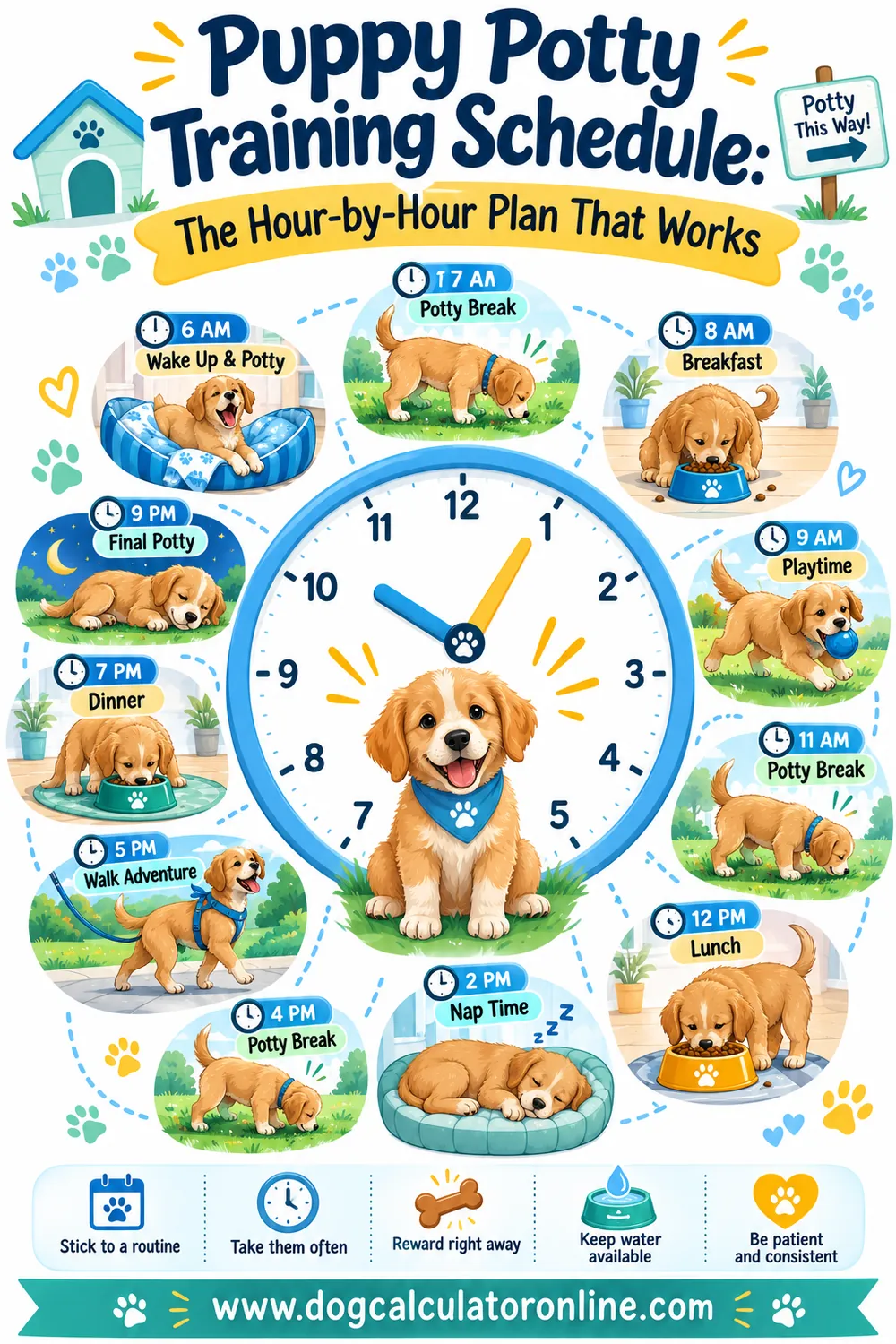
Take the puppy out on a fixed trigger list, not just a timer: first thing in the morning, after every meal, after every nap, after every play session, after a long drink, before bed, and every two hours in between at eight to twelve weeks.
Go to the same spot every time. Scent is doing most of the work. Walk there on a leash even in your own garden, so the puppy learns the route rather than wandering.
Stand still and be boring. Do not play, do not chat, do not walk about. Give the puppy two or three minutes of nothing to do but sniff.
Reward within two seconds of finishing. Not when the puppy comes back to you, not at the back door — right there, immediately, with something genuinely good. A delay of even ten seconds and the puppy connects the food to walking toward you instead.
Add a cue once it is reliable. Say a quiet word as the puppy starts going, and after a few dozen repetitions you can use it to prompt. Useful in the rain and in strange places.
Supervise or confine, never neither. An unwatched puppy loose in the house is an accident waiting to happen. A house line, a closed door, a pen or a crate covers the gaps.
If nothing happens after three minutes, go back inside, keep the puppy on a leash or in the crate for ten minutes, and try again. Free roaming after a failed trip is how accidents happen.
Why Punishment After the Fact Makes It Worse
This is the single most damaging piece of folk advice in dog ownership, and it is worth being blunt about it.
A puppy cannot connect a telling-off to something it did minutes ago. Association learning in dogs works over a window of a second or two. Ten minutes later, the puppy has no way of linking your anger to the puddle, even if you are pointing at it.
What it actually learns is that you are dangerous near mess. So it stops going in front of you — and starts going behind the sofa, under the bed, or in the spare room. The problem does not go away, it goes underground, and it becomes much harder to fix because you can no longer catch it happening.
The guilty look is not guilt. The lowered head, flattened ears and averted eyes are appeasement signals, produced in response to your body language. Studies that manipulated whether dogs had actually misbehaved found the look tracked the owner's demeanour, not the dog's behavior.
Rubbing a puppy's nose in it teaches nothing except that hands near the face are unpleasant. Nor does a rolled newspaper, a raised voice, or dragging the puppy to the spot.
If you catch the puppy mid-act, interrupt gently — a soft noise, not a shout — scoop it up, get it outside, and reward if it finishes there. Startling a puppy badly enough can teach it never to toilet in your presence at all, including outdoors, which is a genuinely difficult problem to undo.
After the fact, say nothing. Clean it up in silence and adjust the schedule. That is the whole response.
How Should You Clean Up an Accident?
With an enzymatic cleaner, and this matters far more than it sounds.
Ordinary household cleaners do not remove the scent markers. They remove what you can smell; the dog still smells the spot perfectly well, and a scented toilet spot is an invitation to use it again. This is the most common reason a puppy keeps going back to the same patch of carpet.
Ammonia-based cleaners are actively counterproductive. Urine breaks down into ammonia compounds, so an ammonia cleaner makes the spot smell more like a toilet, not less. Bleach has a similar problem for some dogs.
Enzymatic cleaners break down the organic compounds rather than masking them. Soak the area properly rather than dabbing, leave it for as long as the label says — often ten to fifteen minutes — and let it dry naturally rather than blotting it dry.
Blot first, do not scrub. Scrubbing pushes urine deeper into carpet backing and underlay, where cleaner cannot reach it.
Hard floors need the same treatment, particularly the joins between boards and the edges of skirting, which is where liquid runs.
If a puppy keeps returning to one spot, assume the previous clean-up failed. Re-treat it, and block access for a two weeks while the habit fades.
Where Does the Crate Fit In?
It is the single most useful tool, and the sizing is the part people get wrong.
Dogs avoid soiling where they sleep, which is what makes a crate work. That instinct only holds if the crate is the right size — big enough to stand, turn round and lie stretched out, and no bigger. A crate with spare room becomes a bedroom at one end and a toilet at the other, and the whole mechanism fails.
Use a divider in a crate bought for adult size. Most wire crates come with one. Move it out as the puppy grows rather than buying three crates.
The crate is for sleep and short waits, not for long absences. Never use it for longer than the puppy's bladder allows.
Never use it as punishment. A crate has to be a good place, or the puppy will hold on rather than settle, and you lose both the sleeping and the toileting benefit. The introduction process is in how to crate train a puppy.
A soiled crate means the gap was too long, the crate is too big, or something medical is going on. It is not defiance, and a puppy that has once soiled its bed loses some of the instinct that makes the whole approach work.
For longer absences use a pen, with a bed at one end and a toilet tray or pads at the other. That protects the crate's clean-den status. This is also the sensible set-up when there is no garden — see house training a puppy in an apartment.
What About Puppy Pads?
Useful in some homes, a genuine handicap in others. It depends on your situation, and the honest answer is not one-size-fits-all.
Pads teach a puppy that toileting indoors is acceptable, then ask it to unlearn that. For a house with a garden, most sneakers consider this an unnecessary extra step that adds two or three weeks.
They make real sense in a flat, in a high-rise, for an owner with limited mobility, for a toy breed in bad weather, or for a puppy that is not yet vaccinated and cannot be put on shared ground.
If you use them, use them deliberately. One fixed location, never moved around the house, and move it a foot closer to the door every few days once the puppy is reliable.
Do not put a pad in the crate. That defeats the clean-den instinct entirely.
Grass patches transfer better than paper. A real or artificial turf tray teaches the surface preference you eventually want, so the switch to outdoors is smaller.
Expect a transition period. Moving from pads to outdoors typically costs a two weeks of accidents while the surface preference shifts, which is the cost you are trading against the convenience.
What Do You Do at Night?
Less than most people think, and boringly.
One trip at eight to twelve weeks is normal, sometimes two in the first two weeks. Most puppies sleep through by twelve to sixteen weeks.
Set an alarm rather than waiting for crying. Getting up before the puppy wakes and complains prevents both the accident and the lesson that noise summons a human.
Keep it silent. Out, same spot, wait, quiet praise, straight back in. No lights on, no talking, no play, no treats beyond a small one at the spot.
Push the alarm later by fifteen minutes every few nights, rather than dropping it in one go.
Last water an hour or two before bed is reasonable in cool weather. Do not restrict water in hot weather, for a puppy on medication, or against veterinary advice.
Crate beside your bed for the first few weeks. It resolves most night crying without any training, and you can move it gradually later. The full night plan is in the nighttime puppy potty schedule.
Why Has My Puppy Suddenly Regressed?
Regression is normal and almost always has a findable cause.
A growth spurt or a change in routine. New house, new baby, a week of visitors, a return to the office — any of these can knock a two weeks off progress. Go back to the interval that worked and rebuild.
Too much freedom, too soon. The commonest cause by far. A puppy that has been clean for a week gets the run of the house, and it turns out the reliability was supervision rather than learning. Reintroduce confinement for a two weeks.
Adolescent marking, usually six to twelve months and more common in entire males. Small amounts, on vertical surfaces, often after a new dog has visited. This is a different behavior from house training failure and needs supervision and interruption rather than restarting the process.
Feeding changes. More food, a richer food, or meals moved later all change the timing. Aligning meals with toilet trips is set out in the puppy feeding and potty schedule.
Something medical. Urinary tract infections are common in young dogs, and a puppy that was clean and suddenly is not deserves a vet visit rather than more training. Call the vet the same day for straining, blood in the urine, frequent tiny amounts, drinking noticeably more, or any accident in a dog that has been reliable for months.
Excitement and submissive urination are not house-training failures at all. A puppy that leaks when greeted or told off needs calmer greetings and no telling off; most grow out of it by a year.
FAQ
How long does it take to potty train a puppy?
Four to six months to reliable for most puppies, with the bulk of progress in the first four to eight weeks. Small breeds often take longer because their bladders are physically smaller. Expect occasional accidents up to about a year — the detail is in how long does it take to potty train a puppy.
How often should I take my puppy out?
Every two hours at eight to ten weeks, every three at twelve weeks, plus after every meal, nap, drink and play session, and last thing at night. That works out at ten to twelve trips a day at first, falling to five or six by six months.
Should I punish my puppy for accidents?
No. A puppy cannot connect a telling-off to something it did even a minute or two earlier, so it learns to hide rather than to hold on — which turns a visible problem into a hidden one. Clean up in silence with an enzymatic cleaner and shorten the interval instead.
Why does my puppy pee right after coming inside?
Usually because the trip outside was too short or too interesting. Give a full three minutes of standing still and being boring, and reward within two seconds of the puppy finishing rather than when it comes back. If it still happens, keep the puppy on a leash indoors for ten minutes after each trip.
Do puppy pads slow down house training?
In a house with a garden, usually yes — they add a step, because the puppy must first learn that indoors is acceptable and then unlearn it. In a flat, for a toy breed, or before vaccinations are complete, they are the practical choice. A turf tray transfers to grass more easily than paper.
Can you potty train a puppy in a week?
No. Some puppies have very few accidents in their first week, which owners read as success, but bladder control is physical maturation and it cannot be trained faster. What a week can achieve is a solid routine and a clear signal — reliability follows over months.
Getting Through the House-Training Weeks
House training rewards patience and a stopwatch far more than cleverness. Set the interval by the puppy's age rather than by your convenience, take it to the same spot each time, pay it within two seconds, and confine or supervise for everything in between. Say nothing at all about accidents you did not witness, and clean them properly with an enzymatic product so the spot stops advertising itself. Most puppies are largely reliable by five or six months, and a regression at eight months usually means something has changed rather than that the training failed. A ready-made timetable is on the puppy potty training schedule, and the crate size calculator will size the crate that makes it all easier.